
Fribourg Takes Off
Thanks to the support of the FSAM and the AéCS, GAM Fribourg was able to overcome various objections and thus prevent a flight ban in the municipality of Misery-Courtion. The objections raised by both the municipal authorities and the neighboring golf club were rejected in court. The judge upheld the vast majority of the arguments presented by GAM Fribourg.
The story begins in an almost mundane way: “Once upon a time, in the Canton of Fribourg, there was a group of passionate modelers…” However, while the beginning resembled a fairy tale, the dream was soon shattered.
In fact, the story began a long time ago. The Fribourg Model Club (GMRF) spent many years searching for a location to set up its model airfield. But each time, an obstacle forced the GMRF to abandon its project.
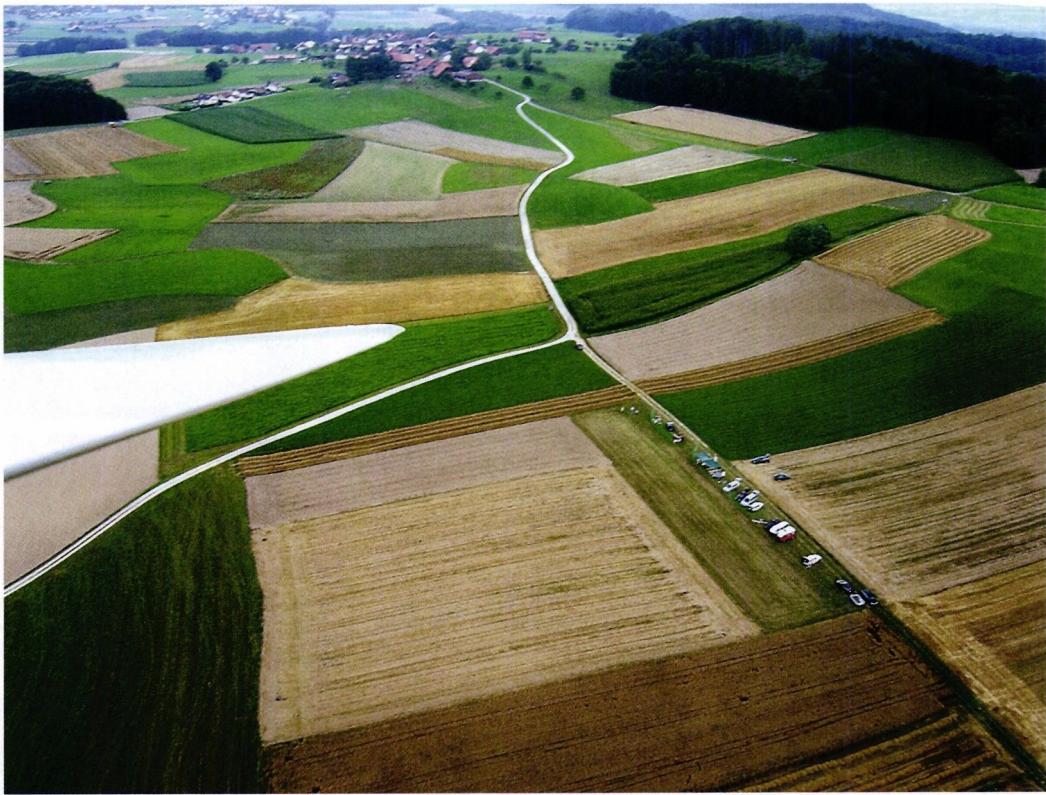
Then, finally, things began to take shape. In the spring of 2003, Thomas Werren, President of the GMRF, negotiated a lease for two plots of land with two landowners. The site was ideally located in the heart of farmland, between three villages. Not a single tree, power line, or road nearby. The nearest house is about 300 meters away. Once the lease agreements were signed with the landowners, work began: the ground had to be leveled, rolled with a steamroller, and then seeded. At the same time, we’re taking care of the administrative procedures: we’ve filed an application with the district prefecture to obtain permission to make a few improvements: a wind vane, a garden shed to store the lawn mower, a safety net, and, of course, tables, benches, and most importantly, a grill! The paperwork is completed, and the file makes its way through the various offices and departments of the Canton of Fribourg. A noise assessment is conducted by the Environmental Service, which comes to measure the noise levels of the 3
the noisiest aircraft in the GMRF, first on the ground and then in flight. Verdict: no problems; the noise levels are well within Swiss standards.
The request has sparked a flurry of objections from neighbors—some closer, some farther away—including a golf club and the neighboring municipality. On April 29, 2004, the Deputy Prefect’s decision was handed down: permission to build a model airplane runway was granted, but under certain conditions. Specifically, the shelter must be modest in size; the tables, benches, and grill are permanently off the table, and the net is also denied. Or more precisely, the GMRF is allowed to set up a net, particularly during events, but must then take it down.
Regardless, the GMRF is enthusiastic. Unfortunately, this joy will be short-lived. Indeed, the golf club, the neighboring municipality, and a few private individuals have filed an appeal against the prefectural authorization. Things are taking a turn for the worse,
which means the case will be heard by the Administrative Court of the Canton of Fribourg. Both the municipality and the golf club have retained the services of attorneys.
The GMRF decided to contact the FSAM. Thomas Werren and the GMRF’s vice president, Jean Thévenaz, exchanged several phone calls and emails, primarily with Yves Burkhardt, president of the FSAM, and Adrian Eggenberger, head of infrastructure. Adrian Eggenberger reports the matter to Allianz-Suisse, the legal protection insurer for the AéCS. Allianz-Suisse agrees to appoint a lawyer to defend the interests of the GMRF and, through them, those of the FSAM and the AéCS as a whole. Initially, Maître Roland Müller—a lawyer and, at the time, Central President of the AéCS—was retained. However, for geographical and linguistic reasons, the Administrative Court of the Canton of Fribourg asked the GMRF to select a lawyer from the region, noting that the case would be heard in French. A lawyer from Fribourg therefore took up the cause:
Christophe Tornare. He is no stranger to the world of aviation, as he is himself a member of the AéCS and a helicopter pilot.
Then comes the back-and-forth exchange of legal documents, arguments, and so on. The GMRF’s opponents challenge the expert assessment prepared by the cantonal environmental office and submit a report from an expert they commissioned unilaterally. The cantonal administrative court then orders a new noise assessment. This time, an independent Fribourg-based firm is commissioned to conduct new noise measurements on the ground using the same aircraft and then with a model in flight. Unsurprisingly, the results are similar to those obtained by the environmental office. Regarding the calculation of noise by extrapolation—that is, averaged over a one-year period— the results are also comparable to those of the cantonal office, but the firm in question also performs a calculation based on German standards, which were developed specifically to address noise caused by model aircraft. The calculated noise levels
are also in compliance with German standards, with the exception of Sunday afternoons, when a slight exceedance is observed.
After conducting a thorough analysis of the technical aspects, the judge summons the parties to a hearing aimed at reaching a compromise. The GMRF, represented by part of the committee and a few club members, is accompanied by Yves Burkhardt, who participates in his capacity as President of the FSAM and Vice President of the AéCS. This meeting is preceded by a flight demonstration on the field so that the judge and the parties can observe the model aircraft in flight and gain a concrete understanding of the situation. The various parties then present their arguments in an effort to reach the most favorable amicable settlement possible. Ultimately, the GMRF agrees to a series of concessions so that a draft agreement can be drawn up. The parties are given time to consider the proposal before confirming their agreement. Essentially, the GMRF agrees to
flying after 7:00 p.m. and on three out of every four Sundays.
When the deadline expired, the court informed the GMRF that the golf club had rejected the draft agreement! The judge therefore had no choice but to rule on the matter himself.
Finally, in an extremely detailed and very well-reasoned judgment dated April 27, 2006, the Administrative Court of the Canton of Fribourg found that, while the Swiss standards contained in the Noise Protection Ordinance had indeed been met, but that this standard did not specifically address the type of noise at issue in this case, and that the noise nuisance suffered by the neighborhood could be examined directly under Article 15 of the Environmental Protection Act. To support its assessment, the court may rely on various factors and considerations; the German standard may therefore be examined for comparison. In conclusion, the court ruled that the noise pollution emitted by the GMRF was very low, such that the flight schedules
were granted within broader limits than those discussed at the hearing attended by all parties. However, the authorization to establish and operate the model airplane runway was subject to a number of restrictions, particularly regarding where pilots must stand on the runway to fly, the maximum noise level that model airplanes flying on this runway must not exceed, the flight zone, etc. Of course, the GMRF will strictly comply with these mandatory restrictions.
As a result, the GMRF is extremely satisfied with the ruling that was handed down. It now has its own airfield and can operate it under very favorable conditions. The
GMRF will naturally be committed to maintaining cordial and friendly relations with its neighbors. Indeed, nothing beats a good relationship where everyone respects one another.
Finally, the GMRF would like to take this opportunity to express its sincere thanks and gratitude to the FSAM—and especially to Yves Burkhardt and Adrian Eggenberger—as well as to the FSAM committee and the AéCS. Indeed, without this invaluable support, the GMRF would not have been able to have its interests represented by an attorney and likely would not have succeeded in winning its case. To all, the GMRF wishes “nice flights and happy landings.”
Jean Thévenaz
With the support of the SMV and AeCS, GAM Fribourg successfully defended itself against an objection and a related flight ban in the municipality of Wallenried. Both the relevant municipal authorities and a neighboring golf club were defeated in legal proceedings. The judge upheld the vast majority of GAM Fribourg’s claims.


News from HEBU

F3A EUROPEAN CHAMPIONSHIPS IN ST-MACAIRE, FRANCE
 Matthias Bosshard

What's New at Leomotion.com

YOU KNOW WHAT I MEAN? 125 YEARS OF THE SWISS AERO CLUB
 Emil Giezendanner

52. 2026 ALPS CUP
Emil Giezendanner
PRIDE AND GOOD IDEAS
 Markus Nussbaumer

HORIZON HOBBY/LEMACO NEWS: MICRO OV-10 BRONCO 645 MM BY E-FLITE

EURO CONTEST GLIDER ACRO TOUR AUSTRIA 2026

BY YOUTH, FOR YOUTH
 Lorena Betschen

TEAM MANAGER "THIS" BOSSHARD
Rodito Nussbaumer
SMALL, MODEL-LIKE SAILBOATS
Res Dauwalder
TRY-OUT DAY AT MFV WETTINGEN
Urs Keller
34th HAHNENMOOS ALPINE MODEL AIRPLANE CAMP
Res Dauwalder
CORSAIR F4U – A WARBIRD WITH A MEMORABLE LOOK
Jürgen Rosenberger, Jürgen Prinz
SUMMER FUN 2026 AT MG USTER
Martin Wunderli
WELCOME, NEW MEMBER!
Andrea Bolliger
FREE FLIGHT IN THE MIDDLE OF SUMMER
Urs Muntwyler
THE PC-21 STORY
Emil Giezendanner
TWIN TOWN PARTNERSHIP
Wolfgang Voeller
ATOM, THE NEW DOUBLE-DECKER FROM CPLR
Matthias Bosshard
COUPE DES ALPES – OBSERVE AND LEARN
Rodito Nussbaumer
INSIGHTS INTO THE HISTORY OF SEAPLANES

NEWS FROM HEBU
 Julia Bucher

FROM 0 TO 100
Markus Nussbaumer
MEMORIES
Wolfgang Völler
NOS REGION – A HUB FOR ELECTRIC AVIATION
Emil Giezendanner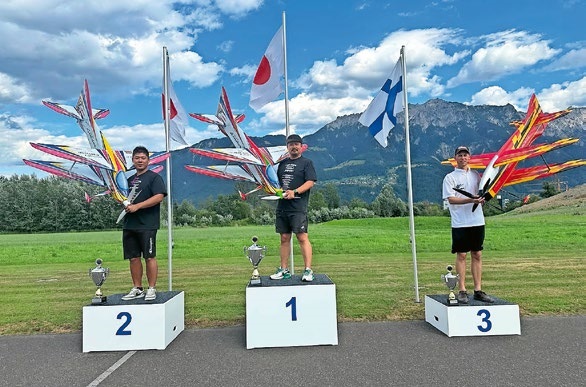
A SPECTACULAR F3A WORLD CUP IN THE PRINCIPALITY OF LIECHTENSTEIN
Emil Giezendanner
DO YOU KNOW WHAT I MEAN IN THE LAND OF SMILES?
Emil Giezendanner