
BLADE Nano CP X will soon be one year old
Horizon Hobby's smallest and lightest flybarless helicopter has been on the market for nearly a year. The developers have impressively achieved their goal of building the world's smallest and lightest 3D helicopter.
The BLADE Nano CP X is a small and lightweight 3D helicopter designed for carefree fun even indoors. However, having a sufficiently large apartment is an advantage, since this little guy is very agile. With a total weight of just 29 grams and a main rotor diameter of 197 millimeters, the BLADE Nano CP X is a true tiny model compared to many other indoor helicopters—and, above all,
others, it was the only flybarless 3D helicopter of this size when it was released. The model is available in two configurations:
1. The affordable BNF version with two batteries and a charger. Ideal for model pilots who already own a Spektrum transmitter: this version with the DSMX-DX6i computer-controlled transmitter is highly recommended, as it allows for convenient programming of standard parameters such as dual-rate and Expo.
2. The slightly more expensive RTF version of the new BLADE Nano CP X, which includes a Spektrum DSMX DX4e transmitter and the appropriate batteries.
Well-protected, the BLADE Nano CP X sits ready for takeoff in its small, handy Styrofoam
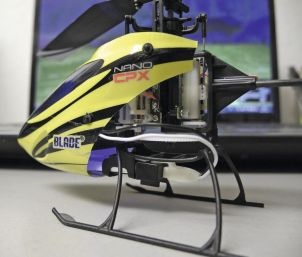
box. The build quality of the entire helicopter is good, but on the unit tested, the swashplate linkage has a bit of play; when descending slightly—that is, at about 0 degrees pitch—the little helicopter shakes alarmingly but always recovers—thanks in part to the flawlessly functioning flybarless system. The standard Blade design: A lightweight plastic frame houses the three linear servo units that control the swashplate. Below this, the landing gear is inserted into the main frame, and at the front of the frame, the main circuit board—which houses all electronic components such as the receiver, the AS3X flybarless system, and the ESC—is secured to the frame with two screws. A small
high-performance brushed motor drives the CFRP rotor shaft—and thus the main rotor—via a single-stage gearbox. The tail boom consists of a small CFRP tube through which the power cable to the tail motor runs. In addition to the yellow canopy, a set in a blue design is also available. As usual, the included German-language manual is very detailed and ideally prepares beginners and those switching from fixed-pitch helicopters for the BLADE Nano CP X. It’s definitely worth taking a look at the documentation, and you’ll find it helpful right from the binding process. Additionally, when using Spektrum computer transmitters such as the DX6i, DX8, or DX18, Horizon Hobby provides a detailed list of the ideal settings. →
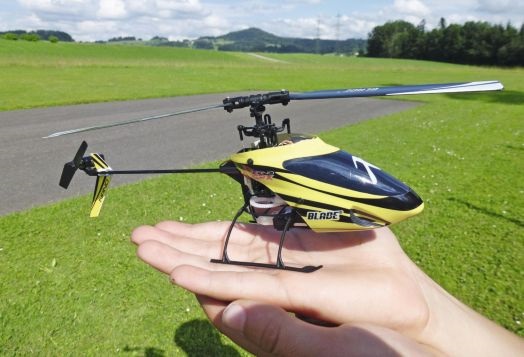
So anyone who follows the instructions will quickly get the hang of the new BLADE Nano CP X. The tail remains stable even during rapid load changes
and keeps the helicopter on course. The entire model flies well even when inverted, but even outdoors in moderate winds, it requires an experienced 3D pilot. Its performance is comparable to that of a
| Technical Specifications: | |
| • Stabilization | AS3X |
| • Main rotor diameter | 197 mm |
| • Tail rotor diameter | 40 mm |
| • Length | 197 mm |
| • Servos | 3 × 2.1-gram liner servos |
| • Weight | 29 grams |
| Included in the package: | |
| • Battery | 2× 1S 150 mAh LiPo |
| • LiPo charger | |
| • Remote control | Spectrum DX4e DSMX (RTF version) |
Of course, it’s no match for the BLADE 130X. For standard aerobatic maneuvers, the RPM is sufficient for a dynamic flying style—though experts might have hoped for a bit more power in reserve. Due to the relatively low RPM, your home furnishings will be the ones to suffer in the event of a crash. Despite all the electronic aids, the BLADE Nano CP X is and remains a true 3D helicopter—and, especially when getting started, it’s absolutely essential to complete your first turning exercises outdoors before attempting aerobatics indoors. Better safe than sorry! The large walls of spare parts at retailers are evidence of pilots’ different approaches.
The BLADE Nano CP X is a small technical marvel and the logical next step in the BLADE Micro series. Despite its delicate construction, it appears to be very robust; in any case, it hasn’t always landed on its skids and still works perfectly. A brushless version of the BLADE Nano would be desirable.
The manufacturer lists flight time as four minutes as a realistic average, though it varies significantly depending on flying style. If you’re looking for something a bit larger, the BLADE 130X with its fixed-drive tail rotor is always worth considering. ■


News from HEBU

TEAM MANAGER "THIS" BOSSHARD
 Rodito Nussbaumer

YOU KNOW WHAT I MEAN? 125 YEARS OF THE SWISS AERO CLUB
 Emil Giezendanner

F3A EUROPEAN CHAMPIONSHIPS IN ST-MACAIRE, FRANCE
 Matthias Bosshard

SUMMER FUN 2026 AT MG USTER
Martin Wunderli
TRY-OUT DAY AT MFV WETTINGEN
Urs Keller
52. 2026 ALPS CUP
Emil Giezendanner
BY YOUTH, FOR YOUTH
Lorena Betschen
ATOM, THE NEW DOUBLE-DECKER FROM CPLR
Matthias Bosshard
CORSAIR F4U – A WARBIRD WITH A MEMORABLE LOOK
Jürgen Rosenberger, Jürgen Prinz
SMALL, MODEL-LIKE SAILBOATS
Res Dauwalder
What's New at Leomotion.com

TWIN TOWN PARTNERSHIP
Wolfgang Voeller
EURO CONTEST GLIDER ACRO TOUR AUSTRIA 2026

INSIGHTS INTO THE HISTORY OF SEAPLANES

34th HAHNENMOOS ALPINE MODEL AIRPLANE CAMP
Res Dauwalder
WELCOME, NEW MEMBER!
Andrea Bolliger
HORIZON HOBBY/LEMACO NEWS: MICRO OV-10 BRONCO 645 MM BY E-FLITE

FREE FLIGHT IN THE MIDDLE OF SUMMER
Urs Muntwyler
COUPE DES ALPES – OBSERVE AND LEARN
Rodito Nussbaumer
PRIDE AND GOOD IDEAS
 Markus Nussbaumer

THE PC-21 STORY
Emil Giezendanner
NEWS FROM HEBU
 Julia Bucher

FROM 0 TO 100
Markus Nussbaumer
MEMORIES
Wolfgang Völler
NOS REGION – A HUB FOR ELECTRIC AVIATION
Emil Giezendanner
Have you almost forgotten about aircraft that take off and land vertically?
Emil Giezendanner
DO YOU KNOW WHAT I MEAN IN THE LAND OF SMILES?
Emil Giezendanner