
SAWO—a forward-looking project?
SAWO is the abbreviation for Sauter Wolfgang, who has been designing model engines for over 15 years.
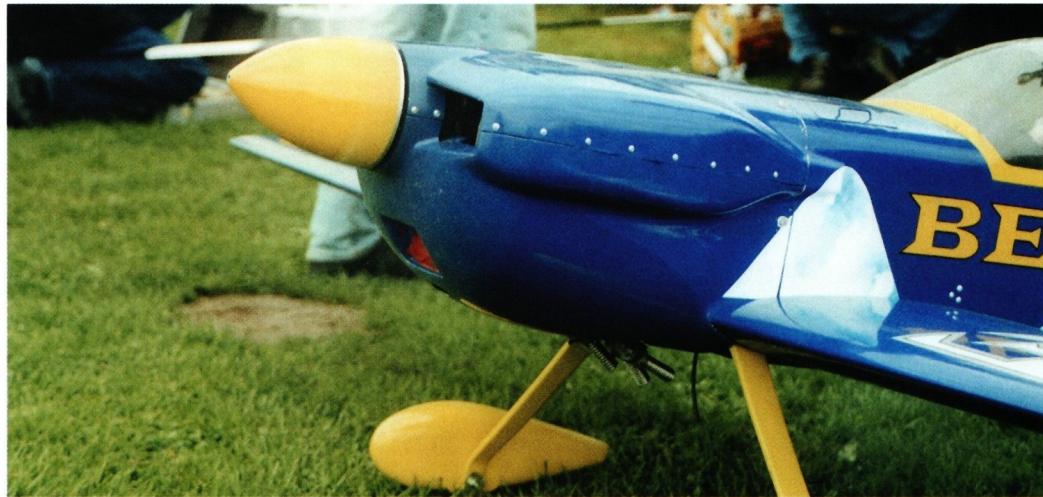
When I was recently at a model aircraft event in Bad Waldsee, Germany, I noticed a blue ICE-BEER cap. It was flown by the well-known top pilot Bernd Albinger. His smooth flying style didn’t really surprise me, since Bernd enjoys showcasing a wide variety of flying styles. But it wasn’t just the flying style—the entire model was remarkably smooth. After the landing, I immediately went over to the model with my camera, eager to find out how something like that was possible. He demonstrated the very effective smoke system one last time, and then shut off the engine—which had you wondering all along why it hadn’t died out long ago. An idle speed of 500 to 600 rpm is so low that you’re tempted to count the revolutions. Kneel down and take a look underneath. But all you see are four short pieces of corrugated hose sticking out.
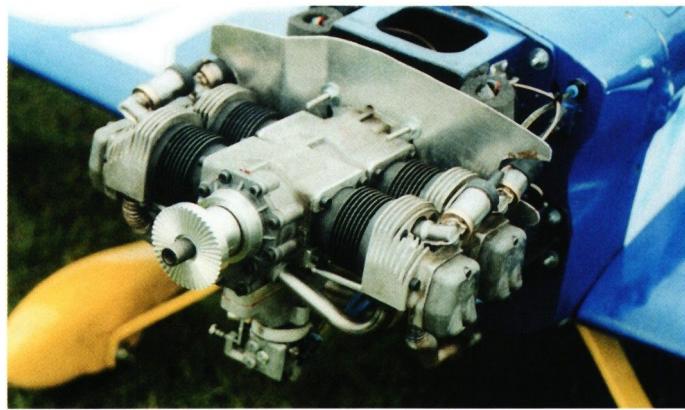
Now Bernd Albinger joins us and reveals the secret. He removes the hood, and a four-cylinder boxer engine powered by gasoline comes into view.
A SAWO four-cylinder with a displacement of 136 cm³. After an interesting conversation, we agreed to visit Wolfgang Sauter in Biberach following the air show. In Sauter’s living room, over coffee and cake, we discussed for the first time the goal of this engine and the long road to achieving it.
The engine is to be as true to the original as possible in both sound and appearance, must fit under the hoods of the corresponding aircraft, and, in this case, must be a four-cylinder boxer engine and a gasoline engine with mixture lubrication. In Bernd Albinger, they found a test pilot and technical advisor who, after winning so many trophies as a display pilot, wanted to take on a new challenge and is also a tireless aviator.
The prototype alone was put through its paces in 2003 during over 70 hours of rigorous testing. For these test flights, Bernd still had a DELRO-Cap with a 2.5-meter wingspan in his collection, which he modified for this purpose. Originally, the model—weighing 11 to 12 kg—was intended to be powered by an 80-cm³ boxer engine. Now, however, it weighs 14 kg, which is due in part to various modifications to the model and in part to the additional weight of the engine. The SAWO weighs 4,050 g. Adding the ignition system and fuel pump brings the total to 4.5 kg. The fuel pump is powered by the ignition battery. In practice, this results in a weight disadvantage of 800 g to 1 kg compared to previous power units, which also require a complex exhaust system—something the SAWO actually does not need. The 34 cm³ displacement per cylinder in 4-stroke operation can be easily dampened using a 20 cm-long flexible hose. This has the advantage that no exhaust system fills the entire fuselage inside the model, and it also incurs no additional costs. On the test bench, the power output was measured at 2.6 kW / 3.5 PS. At first glance, this may seem like very little. However, this power drives a Menz S 28 × 14 at 4,500 rpm and a 26 × 16 at 4,800 rpm. Some 100-cm³ 2-stroke engines would struggle with that. The steeper pitch compensates for the lower RPM to achieve a comparable airspeed, and the larger diameter increases efficiency, similar to that of a gearbox. As a result, the engine responds powerfully and smoothly to the throttle across the entire RPM range. Another welcome side effect is that, at these RPMs, the wooden propeller remains well below critical noise levels, so even without CFRP props, you have one of the quietest yet still powerful combustion engines on the field. The new performance figures for the slightly modified engine are now available. The changes have resulted in a welcome increase in performance. The engine now spins the Menz 28 × 14 propeller at an impressive 4,650 rpm. Things will get interesting for model aviation once various designers begin refining 4-stroke technology on a broader scale. Then perhaps a wide selection of such quiet, powerful, and reliable engines will soon be available on the market.
| Displacement: | 145 cm³ (now with a longer stroke than the prototype) |
| Weight: | 4,050 g (4,500 with ignition and pump) |
| Mounting width: | 260 mm |
| Power: | 3.4 kW / 4.5 PS |
| Fuel: | Gasoline with 5% oil |
| Recommended propeller: | 28 × 14 |
| Price: | €3,000 |

EURO CONTEST GLIDER ACRO TOUR AUSTRIA 2026

THE PC-21 STORY
 Emil Giezendanner

TWIN TOWN PARTNERSHIP
 Wolfgang Voeller

SUMMER FUN 2026 AT MG USTER
Martin Wunderli
CORSAIR F4U – A WARBIRD WITH A MEMORABLE LOOK
Jürgen Rosenberger, Jürgen Prinz
52. 2026 ALPS CUP
Emil Giezendanner
YOU KNOW WHAT I MEAN? 125 YEARS OF THE SWISS AERO CLUB
Emil Giezendanner
News from HEBU

TEAM MANAGER "THIS" BOSSHARD
Rodito Nussbaumer
ATOM, THE NEW DOUBLE-DECKER FROM CPLR
 Matthias Bosshard

F3A EUROPEAN CHAMPIONSHIPS IN ST-MACAIRE, FRANCE
Matthias Bosshard
INSIGHTS INTO THE HISTORY OF SEAPLANES

WELCOME, NEW MEMBER!
Andrea Bolliger
What's New at Leomotion.com

PRIDE AND GOOD IDEAS
 Markus Nussbaumer

SMALL, MODEL-LIKE SAILBOATS
Res Dauwalder
FREE FLIGHT IN THE MIDDLE OF SUMMER
Urs Muntwyler
BY YOUTH, FOR YOUTH
Lorena Betschen
HORIZON HOBBY/LEMACO NEWS: MICRO OV-10 BRONCO 645 MM BY E-FLITE

COUPE DES ALPES – OBSERVE AND LEARN
Rodito Nussbaumer
34th HAHNENMOOS ALPINE MODEL AIRPLANE CAMP
Res Dauwalder
TRY-OUT DAY AT MFV WETTINGEN
 Urs Keller

NEWS FROM HEBU
 Julia Bucher

NOS REGION – A HUB FOR ELECTRIC AVIATION
Emil Giezendanner
MEMORIES
 Wolfgang Völler

70 YEARS OF THE NIDWALDEN MODEL AIRPLANE CLUB
Martin Barmettler
A SPECTACULAR F3A WORLD CUP IN THE PRINCIPALITY OF LIECHTENSTEIN
Emil Giezendanner
FROM 0 TO 100
Markus Nussbaumer