
THE EXOT – SIROKO BY L-MODEL
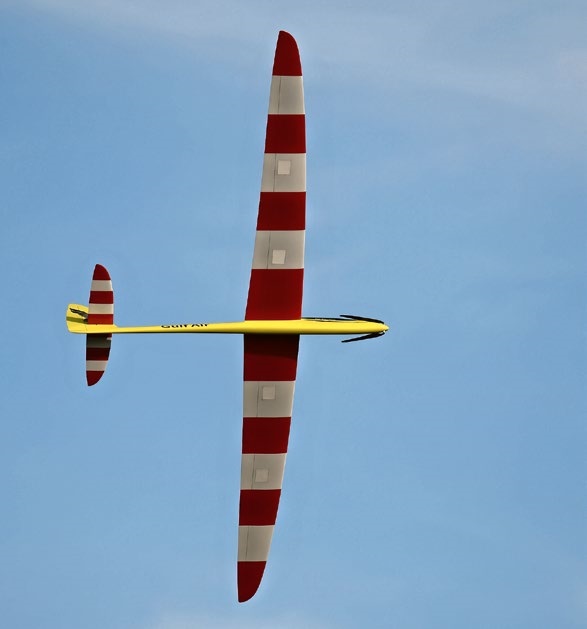
It’s completely different from anything else currently flying in the popular 3-meter class. The tall fuselage shape—it’s round only at the front, otherwise oval, with straight fuselage sidewalls—and the unique wing geometry set it apart from the crowd in a refreshing way. And the tall fuselage takes on a guiding role, especially during roll maneuvers!
Miroslav Laurencik is an artist—a fiberglass artist, to be precise. Because what’s being flown in from South Bohemia to Western Europe is currently unmatched in quality—and at a rather affordable price. The fuselage impresses with a seam as fine as a scalpel’s cut, and the wings and horizontal stabilizer are every bit as impressive. A high-gloss, flawless surface is paired with a virtually invisible leading-edge seam. Was it sanded and polished by the manufacturer? It can hardly be anything else.
All the fuselage panels are in place—CNC-machined from high-quality plywood coated with fiberglass on both sides. A feast for the eyes—and highly functional to boot. That doesn’t leave our valued customers with much left to do. Especially since I treated myself to our in-house L-Model construction service when installing the engine bulkhead. Why? Well, the front of the fuselage isn’t quite round and needs to be pressed into shape—without the necessary templates, it would be a suicide mission. And what Miroslav delivered there is simply perfect; it couldn’t be any better. Our photo shows how the spinner fits the fuselage. Oh, and
If you don't feel confident enough to tackle the rest of the renovation (we'll get to that in a moment) or simply don't want to, L-Model offers a full construction service. But the author is a native of Swabia. So, save money and do it yourself.
With a model that’s already so far along in assembly, our work is limited to installing the engine and systems. Since the motor bulkhead is already in place, the fuselage assembly is completed quite quickly, especially since the removable servo board features precisely cut-out openings for the required rudder actuators (KST servos). Screw them in, connect the linkages—done. The manufacturer’s thoughtfulness is evident in the marking for the neutral position of the pendulum elevator! Great—that saves us the hassle of calibrating this parameter.
| Wingspan: | approx. 2750 mm |
| Length: | 1,443 mm |
| Profile: | TP 66/66s |
| Motor: | Leomotion L 3031-3250, 6.7:1 |
| ESC: | Phoenix Edge Lite 100 BEC |
| Propeller: | GM 18 × 13 inches |
| Battery: | 4s/3700 mAh |
| Manufacturer/Distributor: | L-Model.eu |
| Order: | www.l-model.cz/info@l-model.eu |
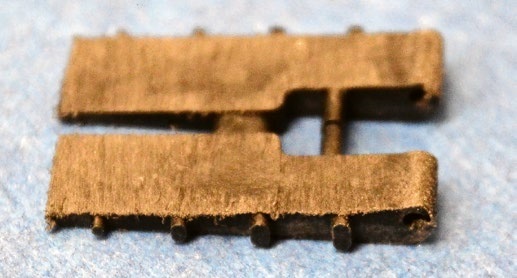
This high-quality, GRP-coated mounting board is delivered to customers fully embedded in resin.
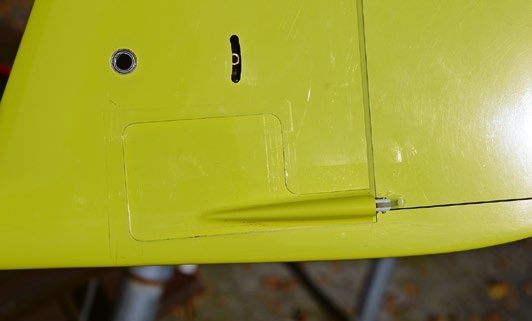
Hidden beneath this cleverly designed cover is a GRP deflection lever, pre-mounted at the factory. Note the ball bearing on the front tailplane connector.
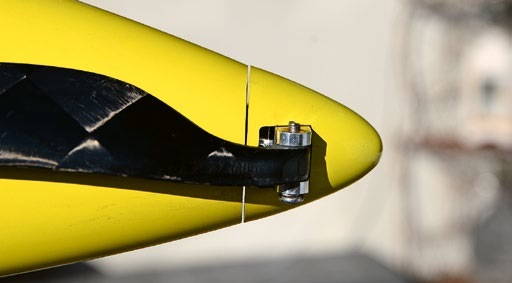
Now that's what you call a perfect fit!
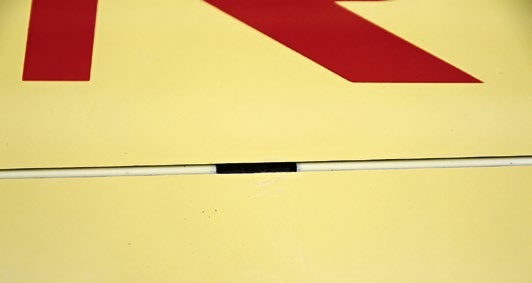
This cutout must be made in the sealing lip so that the component in question can be embedded in the resin parallel to and flush with the rudder edge.
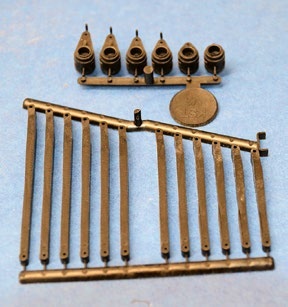
Servo arms and pushrods from RC-Rahmen.de. We need the third (for the aileron) and fourth servo arms (flap) and the third and fourth pushrods. As seen from the right. They determine the servo position in the bay.
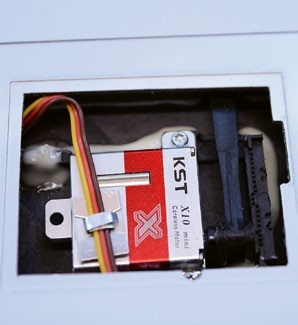
Complete installation of a wing servo. The frame is neatly glued to the upper shell, and the cables are secured to prevent them from shifting around.
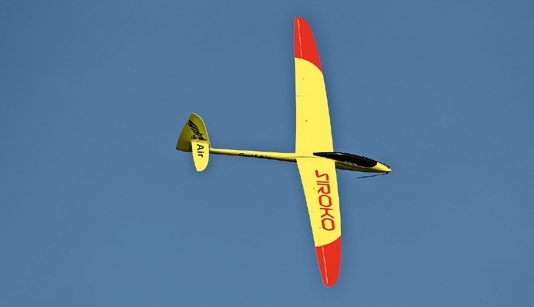
The Leomotion gear-driven motor takes a hefty bite out of the Ampère battery—nearly 80 A sends a clear message, as do the 5,700 propeller revolutions with the 18 x 13 GM CFRP propeller. With that, it’s off toward the moon at cruise missile speed. True to the motto: Anything but vertical is a lazy compromise. Out of the climb, into the joy of gliding. Two trim clicks to low, and it flies straight ahead. Ah, despite the markings, I didn’t hit the neutral position precisely enough. But since my test model is already coming in slowly, that doesn’t bother me—especially since the center-of-gravity check produces a very long, smooth flare arc into the sky. That’s a good sign; there’s very little pressure to apply during inverted flight or during rolls. And roll maneuvers are a proven specialty of the Siroko—that high fuselage and the enormous agility around the longitudinal axis are what make it so much fun. But it’s also a core strength for sharp turning maneuvers, which is certainly no drawback, especially in alpine terrain. Fully ballasted—up to 600 grams is possible (included with the kit)—it becomes a whirlwind, guaranteeing seemingly endless thrust. So it’s a good thing that the butterfly position of the ailerons works so well that landings in the tightest of spaces are possible.
Quality meets value! And all this with a reasonable delivery time of just over half a year. So if you’re interested, be sure to fill out the order form quickly—special requests are welcome—and check your bank balance. By the time the beautiful Siroko from South Bohemia arrives somewhere in Western Europe, 1,700 francs will have changed hands. In return, you’ll get a perfectly crafted and flight-ready utility model in the 3-meter class that’s sure to become addictive.
This brings us to the installation of the four wing servos. And this is a major undertaking, as the servo frames with their counter bearings—including the LDS linkages—must be positioned neatly and without tension. This is only possible if everything is first loosely positioned in the right spot and, as the first step, the wedge that holds the linkage is glued into the respective control surface. A fiddly undertaking! Custom-cut foam wedges help a lot, since the linkage wedge is thinner than the control surface flap and must therefore be secured in place until our fast-curing resin dries. Only now is the servo frame tacked into place—with the ailerons in the neutral position—and these bonded areas are given sufficient time to cure. A test run shows whether everything runs smoothly and functions without a hitch. The final, complete bonding of the servo frames and the wedge into the rudder flap using thickened Uhu Plus 300, along with adjusting the rudder settings according to the spec sheet, completes our work. Or so we thought. Since the fuselage, unlike the wings, stands out for its solid color, Andy’s Folienwelt was able to design and plot a decal set—thanks for that. To top it all off, a 4S LiPo with 3700 mAh and (importantly, because it’s heavy) 45C brings the center of gravity to just the right spot.

News from HEBU

TEAM MANAGER "THIS" BOSSHARD
 Rodito Nussbaumer

YOU KNOW WHAT I MEAN? 125 YEARS OF THE SWISS AERO CLUB
 Emil Giezendanner

HORIZON HOBBY/LEMACO NEWS: MICRO OV-10 BRONCO 645 MM BY E-FLITE

PRIDE AND GOOD IDEAS
 Markus Nussbaumer

34th HAHNENMOOS ALPINE MODEL AIRPLANE CAMP
Res Dauwalder
TRY-OUT DAY AT MFV WETTINGEN
Urs Keller
F3A EUROPEAN CHAMPIONSHIPS IN ST-MACAIRE, FRANCE
 Matthias Bosshard

52. 2026 ALPS CUP
Emil Giezendanner
ATOM, THE NEW DOUBLE-DECKER FROM CPLR
Matthias Bosshard
SUMMER FUN 2026 AT MG USTER
Martin Wunderli
What's New at Leomotion.com

THE PC-21 STORY
Emil Giezendanner
COUPE DES ALPES – OBSERVE AND LEARN
Rodito Nussbaumer
TWIN TOWN PARTNERSHIP
Wolfgang Voeller
EURO CONTEST GLIDER ACRO TOUR AUSTRIA 2026

BY YOUTH, FOR YOUTH
Lorena Betschen
CORSAIR F4U – A WARBIRD WITH A MEMORABLE LOOK
Jürgen Rosenberger, Jürgen Prinz
SMALL, MODEL-LIKE SAILBOATS
Res Dauwalder
WELCOME, NEW MEMBER!
Andrea Bolliger
FREE FLIGHT IN THE MIDDLE OF SUMMER
Urs Muntwyler
INSIGHTS INTO THE HISTORY OF SEAPLANES

NEWS FROM HEBU
 Julia Bucher

FROM 0 TO 100
Markus Nussbaumer
MEMORIES
Wolfgang Völler
NOS REGION – A HUB FOR ELECTRIC AVIATION
Emil Giezendanner
DO YOU KNOW WHAT I MEAN IN THE LAND OF SMILES?
Emil Giezendanner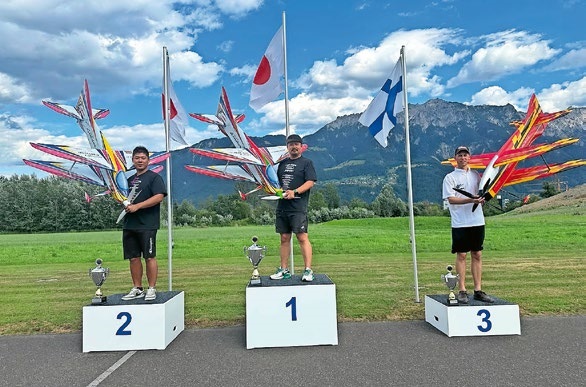
A SPECTACULAR F3A WORLD CUP IN THE PRINCIPALITY OF LIECHTENSTEIN
Emil Giezendanner