
... and every flight is a special experience
by Rolf Rubin
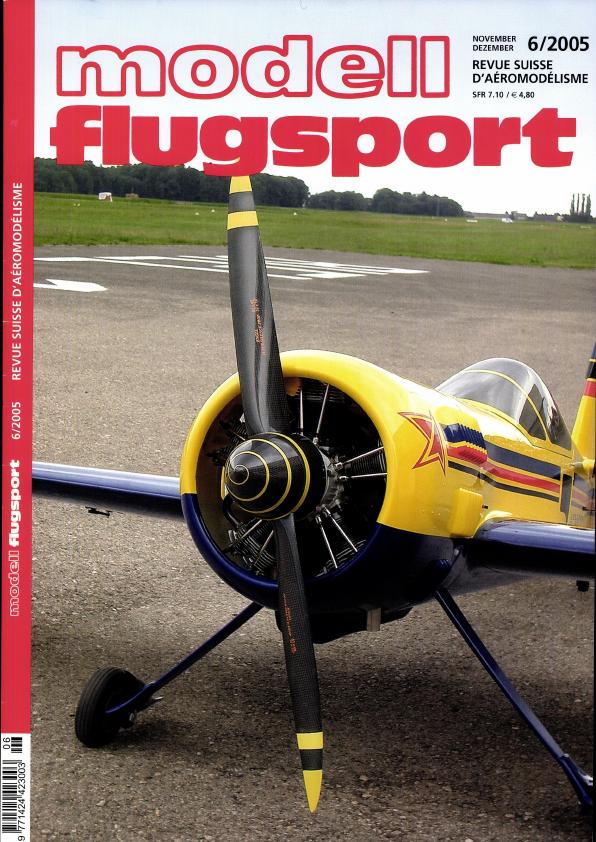
When I first saw the five-cylinder Moki radial engine with a displacement of 215 ccm at the trade show in Sinsheim in March 2001, I couldn’t stop thinking about the Airworld booth. I had to keep going back to look at it and, of course, give it a good once-over. When the engine was then flown in an SU31 during the afternoon air show, I couldn’t shake the shiver that ran down my spine—and it lingered for a long time, even months later.
And so, as was bound to happen, the (medically unexplained) problem could only be solved by obtaining such a part, which I did two years later (2003). I had also envisioned a Sukhoi as a model to build, but the all-fiberglass kit from Airworld didn’t quite convince me, and besides, I prefer Styrofoam/balsa wings. I finally found what I was looking for at Zoder. Zoder offers an SU-31 with a 2.6-meter wingspan (fiberglass sandwich fuselage, Styrofoam/balsa wings). A quick phone call with Mr. Zoder confirmed that the engine would fit perfectly under the cowling, so I placed my order right away. The kit arrived in July 2003. I really liked the kit; the fiberglass parts are neatly laminated, the resin was applied in just the right amount, and the Styrofoam-balsa sandwich parts are perfectly integrated into the fuselage. The wings and tail are also covered with high-quality balsa wood. The only downside is that the cooling air louvers aren’t laminated directly onto the cowl. Instead, there are six cutouts, and the kit includes six injection-molded ABS parts that need to be cut out, milled, sanded to fit, and glued into the cowl. Bonding ABS to fiberglass isn’t entirely straightforward. I checked with R&G and, following their recommendation, was able to purchase a professional-grade acrylic-based construction adhesive (PLEXUS MA310). I then used this adhesive right away to bond the canopy to the fiberglass frame, and it worked perfectly. Due to a lack of time caused by work commitments and other model-aircraft activities, there was a delay in construction; I had actually intended to have the aircraft finished last year. However, since I cannot compromise on precision in the execution, the entire construction period (including the experiments and troubleshooting with the radial engine on the test stand) spanned two years.
After some initial promising test runs on the test bench—which our engine specialist Roland Küenzli had made available to me—cracks formed in the original cast-aluminum engine mount. Everyone present, and especially me as the person in charge, can count ourselves lucky that the engine didn’t fly off! The engine suddenly began to shake violently when I opened the throttle, so I shut it down immediately. Roland then turned and milled a high-quality aluminum engine mount for me. Afterward, vibration issues occurred in the spinner at engine speeds between 2,800 and 3,200 RPM. The cause turned out to be (for use with the Moki propeller) a spinner plate that was slightly too weak (a Mezlik carbon spinner with a very lightweight, perforated aluminum plate). This plate resonated within the aforementioned RPM range. So I placed another order with Roland Küenzli, who turned and milled a new spinner plate for me. The engine now ran flawlessly on the test bench and was ready for installation.

I also modified the rear landing gear and made it a bit more true to the original than the one that came with the kit by using a straight carbon plate. Now I could move on to installing the control system. Of course, this immediately raises the question: where to put the control system when there’s a 5.5 kg motor installed right at the front? Naturally, everything has to go as far back as possible. Using Zoder’s center of gravity specifications, I secured the components to the fuselage with tape until the center of gravity was correct. I didn’t want to have to install any additional trim weights. Now the elevator servos are mounted directly in the horizontal stabilizer, the rudder servos and the two receiver batteries are installed in the rear section of the fuselage.
On August 6, I successfully test-flew the model at the Kappelen airfield. The flight dynamics, combined with the sound of the radial engine, are absolutely realistic.
And during that first flight, I felt exactly the same shiver run down my spine as I did back then in Sinsheim—only now it doesn’t seem to be a chronic issue anymore. What I had to realize was that the engine, in its original condition, cannot be optimally tuned for aerobatic flight. The front-mounted air pump, which generates pressure pulses fed to the diaphragm carburetor, is underpowered and becomes contaminated with gear grease during operation, which clogs the pressure line. I tried various fine-tuning adjustments. I also discussed this with Dieter Reisert (boss) and Thomas Gleissner (test pilot) from Airworld, who told me that the Moki would run well for aerobatics even in its original condition—it’s just a matter of adjustment. I also drilled a vent hole in the pump cylinder (as suggested by Reisert and Gleissner), which—at least in my case—did nothing except cause grease to leak out. The engine simply could not be properly adjusted for aerobatic flight. In a vertical climb, it ran lean; in a vertical dive, it ran rich; and from time to time, it ran irregularly and experienced brief misfires during some maneuvers. Twice, I also had the engine cut out after turns. Thankfully, there was plenty of space in Kappelen for off-field landings. When I tried to enrich the mixture on the ground (by opening the H-jet needle $$ more), the full-throttle range was already erratic on the ground—it wasn’t getting enough fuel. After discussing my problems with Urs Kupferschmied—who, as many of you surely know, operates the Moki in his Dromader tow plane—he suggested that I install an electric fuel pump from Bernd Albinger, which I did. Albinger developed and optimized this pump specifically for the Moki. The pump delivers a constant pressure of 0.4 bar. I removed the original pump from the Moki and sealed the hole in the housing with an aluminum cover. I also sealed the compressed air inlet on the carburetor according to Bernd Albinger’s instructions. Now the engine could be tuned properly, and it runs flawlessly in all flight attitudes.

2 Futaba FP-R 149 DP receivers, 8 Hitec HS 5945 MG servos, 1 Futaba S9202 servo (throttle servo), 3 Sanyo RC-4/5SC 1600 mAh batteries (2 for the receivers, 1 for the ignition).
I’ve equipped the aircraft with two complete receiver systems—one for the left side of the model and the other for the right side. Since I love simplicity and enjoy working with tried-and-true standard components, I deliberately chose not to use an additional power supply board. Instead, I power each of the two receivers with a separate battery (4 cells, 1600 mAh). From the battery, I run two power cables—each with a switch—to the receiver, where I connect them to two outer slots to better distribute the power across the receiver board. This also ensures that a switch failure is accounted for—in other words, I have a total of four switches. I had to place the rudder servos (two linked servos) and the receiver batteries in the rear section of the fuselage to achieve the center of gravity without ballast. The center of gravity range specified by Zoder (170–190 mm) has proven effective. I went exactly to the middle—that is, 180 mm—and the aircraft was easy to fly in and flies very neutrally. I used two servos per aileron, one servo per elevator, and two servos for the rudder; these are all controlled by a single receiver! The receiver antennas are routed spirally toward the rear inside the fuselage through Bowden cable tubes.

Fuselage spray-painted yellow and blue with 2K paint; the rest was glued with Orastick; wings strung with Orastick.
To decide on the color scheme, I spent some time browsing the internet until I came across the original SU31 by the Spanish master; I then painted and applied decals to my model more or less based on that example. By the end of July, I had finished the paint job, put it together, and “hurray”—the center of gravity was spot on! Now the suspense grew even more. Just how heavy is the model?? My goal was to definitely stay under 17 kg, because that was the weight of the Airworld SU31—exactly the same size—that I’d seen flying, and I really had tried to save weight—except for the motor. With the help of my wife Susi and son Marc, I placed the model on our precise electronic bathroom scale, and lo and behold: 15 kg! Another highlight. As already mentioned, the weight without fuel is 15 kg. Of course, the 5.5 kg of the radial engine with its ignition battery accounts for a significant portion of that. But with the engine’s 25 kg of static thrust, you still have plenty of power, of course, and the wing loading is acceptable given the SU31’s large wingspan. In any case, I get immense joy from this aircraft, and every flight is a special experience.

EURO CONTEST GLIDER ACRO TOUR AUSTRIA 2026

THE PC-21 STORY
 Emil Giezendanner

TWIN TOWN PARTNERSHIP
 Wolfgang Voeller

SUMMER FUN 2026 AT MG USTER
Martin Wunderli
CORSAIR F4U – A WARBIRD WITH A MEMORABLE LOOK
Jürgen Rosenberger, Jürgen Prinz
52. 2026 ALPS CUP
Emil Giezendanner
YOU KNOW WHAT I MEAN? 125 YEARS OF THE SWISS AERO CLUB
Emil Giezendanner
News from HEBU

TEAM MANAGER "THIS" BOSSHARD
Rodito Nussbaumer
ATOM, THE NEW DOUBLE-DECKER FROM CPLR
 Matthias Bosshard

F3A EUROPEAN CHAMPIONSHIPS IN ST-MACAIRE, FRANCE
Matthias Bosshard
INSIGHTS INTO THE HISTORY OF SEAPLANES

WELCOME, NEW MEMBER!
Andrea Bolliger
What's New at Leomotion.com

PRIDE AND GOOD IDEAS
 Markus Nussbaumer

SMALL, MODEL-LIKE SAILBOATS
Res Dauwalder
FREE FLIGHT IN THE MIDDLE OF SUMMER
Urs Muntwyler
BY YOUTH, FOR YOUTH
Lorena Betschen
HORIZON HOBBY/LEMACO NEWS: MICRO OV-10 BRONCO 645 MM BY E-FLITE

COUPE DES ALPES – OBSERVE AND LEARN
Rodito Nussbaumer
34th HAHNENMOOS ALPINE MODEL AIRPLANE CAMP
Res Dauwalder
TRY-OUT DAY AT MFV WETTINGEN
 Urs Keller

NEWS FROM HEBU
 Julia Bucher

NOS REGION – A HUB FOR ELECTRIC AVIATION
Emil Giezendanner
MEMORIES
 Wolfgang Völler

70 YEARS OF THE NIDWALDEN MODEL AIRPLANE CLUB
Martin Barmettler
A SPECTACULAR F3A WORLD CUP IN THE PRINCIPALITY OF LIECHTENSTEIN
Emil Giezendanner
FROM 0 TO 100
Markus Nussbaumer