
2019 F1A/B/C Free Flight World Championships, Lost Hills (USA)
The United States was awarded the contract to host the 2019 World Championships in the F1A/B/C classes. The venue, Lost Hills in California, is quite an experience for us Europeans. The site measures approximately 4 by 5 km. There are no obstacles, just steppe-like grass—but plenty of dust.
The Swiss team had decided to compete in the World Cup ahead of the World Championships. The goal was to familiarize themselves with the terrain and conditions—a decision that later proved to be the right one.
The championship kicked off with the F1A class. Representing Switzerland were Dominik Andrist, Christian Andrist, and Lauri Malila. The start went perfectly; all three achieved the required flight time (four minutes) on their first flight. The second round was also set at four minutes of flight time. Lauri and Christian achieved this. Dominik’s model was set too slowly and was stuttering slightly, so he didn’t make the time. Lauri and Christian flew the full time through the sixth round. The sixth round proved to be Lauri’s undoing. Despite a good start and an initial gentle climb, it wasn’t enough to reach the three-minute mark. That left Christian. He advanced to the first flyoff along with 31 other pilots. The flyoff time was set at six minutes. Twenty pilots qualified for the second flyoff, including Christian. The flight time was increased to eight minutes. Once the flight time was announced, most pilots raised their gliders and set out in search of good air. Christian also raised his glider. He searched for good air for a long time. Two minutes before the end of the flight time, he launched his glider with a perfect takeoff. Team members watched anxiously to see if it would climb. The air didn’t seem to be very good; the glider slowly began to sink. The wind carried it away from the launch site. At an altitude of about 35 meters, it stabilized. Now the model flew one circle after another at the same altitude. Time was running out, and when it became clear that the eight minutes had been reached, there was great joy among the Swiss team. The third flyoff was scheduled for the next morning. Ten minutes were on the clock. Besides Christian, there were two other pilots who could compete in this flyoff. In this pure gliding competition, Christian’s starting altitude was too low. But winning the bronze medal is a magnificent achievement. It’s worth noting that he used his thermal glider in the first two flyoffs. These gliders capture even the smallest thermals and are therefore superior to the newer airfoil designs in these air conditions. The downside is that these models have a lower starting altitude. This means the pilot must maneuver the model into good air.
The next day, it was the rubber-powered models’ turn. The team consisted of the Andrist family. Christian demonstrated his skill in this category as well. Along with forty other pilots, he advanced to the first flyoff. Dominik had trouble from the start getting his glider to an altitude high enough to achieve the required flight time. For the oldest competitor, the fifth round was decisive. As he stood at the launch line with the rubber wound up, it snapped. Despite the efforts of the entire team, they couldn’t get it out of the fuselage. He had to switch to his spare model. This one wasn’t optimally tuned for the thermals. As a result, he didn’t make it to the flyoff either. Christian wasn’t lucky with his launch spot this time. The good air dissipated at the other end of the launch line. His time reflected that.
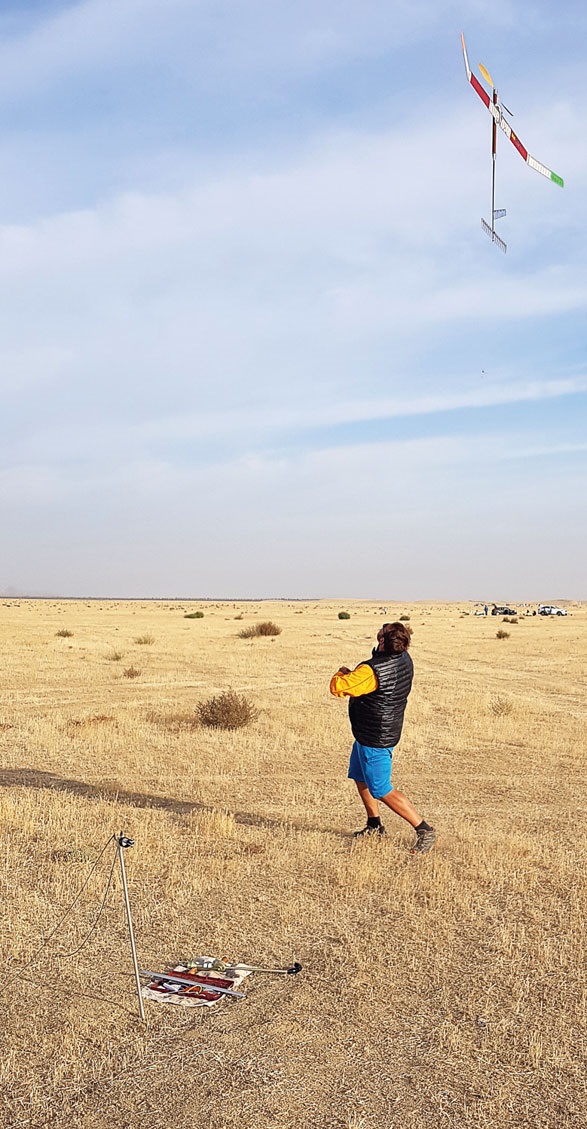
Now it was the F1C class’s turn. This is the most spectacular free-flight class. The models climb to over 150 meters with a motor runtime of 4 seconds. The motors spin at approximately 30,000 revolutions per minute. To make the models climb even faster, the wings are cut in half and stacked on top of each other. Thanks to the symmetrical airfoil, the model now achieves a higher speed, and the initial altitude is correspondingly better. Peter Maurer, our only F1C pilot, had trouble with the climb and didn’t reach the maximum time on every run. F1C model (folder) before launch: The wings are folded. After the motor runs for a set time, the wings are released via a timer and unfold to their full span. The World Championship was superbly organized by the Americans. There were no complaints, and the organization was praised by all. For us, Christian’s medal win was the highlight.


News from HEBU

TEAM MANAGER "THIS" BOSSHARD
 Rodito Nussbaumer

YOU KNOW WHAT I MEAN? 125 YEARS OF THE SWISS AERO CLUB
 Emil Giezendanner

PRIDE AND GOOD IDEAS
 Markus Nussbaumer

ATOM, THE NEW DOUBLE-DECKER FROM CPLR
 Matthias Bosshard

SUMMER FUN 2026 AT MG USTER
Martin Wunderli
F3A EUROPEAN CHAMPIONSHIPS IN ST-MACAIRE, FRANCE
Matthias Bosshard
52. 2026 ALPS CUP
Emil Giezendanner
HORIZON HOBBY/LEMACO NEWS: MICRO OV-10 BRONCO 645 MM BY E-FLITE

TWIN TOWN PARTNERSHIP
Wolfgang Voeller
CORSAIR F4U – A WARBIRD WITH A MEMORABLE LOOK
Jürgen Rosenberger, Jürgen Prinz
TRY-OUT DAY AT MFV WETTINGEN
Urs Keller
WELCOME, NEW MEMBER!
Andrea Bolliger
COUPE DES ALPES – OBSERVE AND LEARN
Rodito Nussbaumer
EURO CONTEST GLIDER ACRO TOUR AUSTRIA 2026

BY YOUTH, FOR YOUTH
Lorena Betschen
INSIGHTS INTO THE HISTORY OF SEAPLANES

34th HAHNENMOOS ALPINE MODEL AIRPLANE CAMP
Res Dauwalder
SMALL, MODEL-LIKE SAILBOATS
Res Dauwalder
What's New at Leomotion.com

FREE FLIGHT IN THE MIDDLE OF SUMMER
Urs Muntwyler
THE PC-21 STORY
Emil Giezendanner
NEWS FROM HEBU
 Julia Bucher

FROM 0 TO 100
Markus Nussbaumer
MEMORIES
Wolfgang Völler
NOS REGION – A HUB FOR ELECTRIC AVIATION
Emil Giezendanner
Have you almost forgotten about aircraft that take off and land vertically?
Emil Giezendanner
DO YOU KNOW WHAT I MEAN IN THE LAND OF SMILES?
Emil Giezendanner