
Lostorf Free Flight Competition
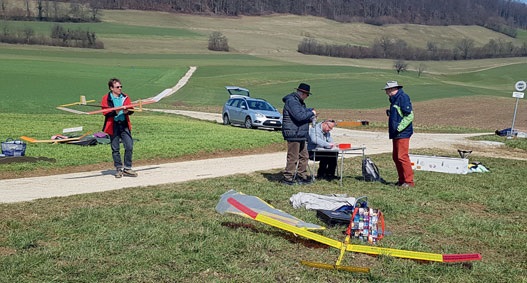
On March 25, amid beautiful weather, the MV Dintikon organized and held the traditional Lostorf Regional Championship ZS-F1E (magnetic-powered glider) and Friendship Competition, as well as the 57th Free Flight Competition for Beginners. The Lostorf Free-Flight Competition was originally launched by the MV Olten, largely on the initiative of the late Werner Kölliker. Many senior members still fondly recall these early “first steps” in model flying.
The MV Dintikon was founded in 1958, making it 60 years old, and has 45 members. In search of a suitable slope for hosting F1E competitions, the MV Dintikon received permission from the MV Olten to hold the F1E competition in Lostorf concurrently with the beginners’ competition. At the request of MV Olten, MV Dintikon has taken over the organization of this beginners’ competition in addition to the F1E competition starting in 2010, ensuring that this long-standing tradition continues.
On average, about 25 students and about ten senior pilots participate in the beginners’ competition. About eight pilots participate in the F1E (magnetic-powered glider) regional championship—which has now been held for the eighth time. The students come from schools in the cantons of Aargau and Solothurn. The F1E pilots are association members from the Central Switzerland (ZEN) region.
F1E is a particularly interesting FAI category. After a hand launch, the model must fly for a time specified by the competition director (e.g.,
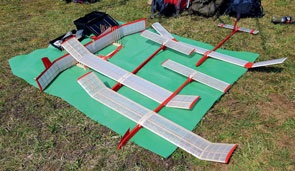
(three minutes). After that, the glider is brought down from the sky using the thermal brake (raising the elevator) so that it doesn’t get lost. Three minutes may seem short—but in poor conditions, they feel agonizingly long.
The models have a built-in magnetic compass. These come in both mechanical and electronic versions. The magnetic compass is used to set a specific course and ensures that the model stays on that course during flight.
With an electronic magnetic compass, you also have the option of initiating a course correction after a programmable time, so that the model, for example, flies back to the launch site.
These models are truly high-tech machines. Despite being “loaded” with all this technical equipment (magnet, timer, control systems), the models have a wing loading of about 10 g/dm². This calls for exceptionally sophisticated construction methods for model builders with the appropriate expertise. By comparison, an RC glider is considered very lightweight if it comes even slightly below the 20 g/dm² mark. Almost exclusively the elaborately built and expensive all-CFRP models in the F3J/F5J class achieve such low wing loading figures. To be fair, it must also be noted that these models must withstand entirely different stresses (police car towing, hard landings, etc.).
In the beginners’ category, eight rounds were flown. In the juniors’ category, Elias Schubert (Reinach) won, followed by Heven Tesfay (Reinach) in second place and Silas Bossi (Muhen) in third place.
In the senior category, Hans Schoder (470 sec.) won, followed by Wolfgang Burgstaller (342 sec.) in second place and Matthäus Vetter (295 sec.) in third place.
In the F1E Regional Championship, five rounds were flown. The winner was Urs Müller of MV Dintikon (633 sec./417.03%), followed by Walter Spatny of ABB (411 sec./400.61%) in second place and Maurice Bodmer of ABB (503 sec./334.83%) in third place.
The complete rankings are available on the SMV website.
Congratulations to the winners!
I would like to take this opportunity to extend my sincere thanks to the organizers and MV Dintikon for organizing and professionally executing this interesting sporting event.
Urs Keller


News from HEBU

HORIZON HOBBY/LEMACO NEWS: MICRO OV-10 BRONCO 645 MM BY E-FLITE

PRIDE AND GOOD IDEAS
 Markus Nussbaumer

TEAM MANAGER "THIS" BOSSHARD
 Rodito Nussbaumer

YOU KNOW WHAT I MEAN? 125 YEARS OF THE SWISS AERO CLUB
 Emil Giezendanner

F3A EUROPEAN CHAMPIONSHIPS IN ST-MACAIRE, FRANCE
 Matthias Bosshard

ATOM, THE NEW DOUBLE-DECKER FROM CPLR
Matthias Bosshard
SUMMER FUN 2026 AT MG USTER
Martin Wunderli
What's New at Leomotion.com

52. 2026 ALPS CUP
Emil Giezendanner
TWIN TOWN PARTNERSHIP
Wolfgang Voeller
34th HAHNENMOOS ALPINE MODEL AIRPLANE CAMP
Res Dauwalder
CORSAIR F4U – A WARBIRD WITH A MEMORABLE LOOK
Jürgen Rosenberger, Jürgen Prinz
SMALL, MODEL-LIKE SAILBOATS
Res Dauwalder
TRY-OUT DAY AT MFV WETTINGEN
Urs Keller
WELCOME, NEW MEMBER!
Andrea Bolliger
FREE FLIGHT IN THE MIDDLE OF SUMMER
Urs Muntwyler
COUPE DES ALPES – OBSERVE AND LEARN
Rodito Nussbaumer
EURO CONTEST GLIDER ACRO TOUR AUSTRIA 2026

BY YOUTH, FOR YOUTH
Lorena Betschen
INSIGHTS INTO THE HISTORY OF SEAPLANES

THE PC-21 STORY
Emil Giezendanner
NEWS FROM HEBU
 Julia Bucher

FROM 0 TO 100
Markus Nussbaumer
MEMORIES
Wolfgang Völler
NOS REGION – A HUB FOR ELECTRIC AVIATION
Emil Giezendanner
DO YOU KNOW WHAT I MEAN IN THE LAND OF SMILES?
Emil Giezendanner
Have you almost forgotten about aircraft that take off and land vertically?
Emil Giezendanner