
5th Model Glider Meet at the historic Tschuggen/Arosa airfield.
Relive the history of model aviation in Arosa. It is gratifying to note that even in the new century and millennium, the original form of model aviation remains perfectly preserved. At the historic Tschuggen airfield, nestled amid magnificent Alpine scenery, these vintage models truly come into their own, evoking many memories and legends from the years 1937 to 1948. The weather: one man’s luck, another’s misfortune. The Dübendorf Air Festival, held a week earlier, enjoyed the most beautiful weather, but the prolonged spell of fine weather did not last until the Arosa gathering. Once again, the Tschuggenhütte was transformed into a meeting place and model aircraft museum. Many thanks to the new, understanding manager, Mr. Balbinot. In addition to the usual traditional dishes and Alpine specialties, he now had to contend with an extensive array of historic plywood “delicacies.”
The willingness of the attendees to make the arduous journey to Arosa even in bad weather is commendable. Many of the attendees were present at all five meetings. The term “enthusiasts” is no empty phrase here. At this gathering, four former participants in the Arosa competitions from 1937 to 1948 were once again present. Josef Meier, the designer of the Jelmoli 3, was also there again. It seems to be like with salmon and eels—they return to their place of origin. By our standards, this is the birthplace of Swiss model aviation. The appearance of Karl Graf, born in 1921, was quite impressive. He brought along an interesting photo collection from the 1938 Arosa competition. He also had a piece of original vertical stabilizer fabric with the registration number and the Arosa launch mark No. 83. Karl had used this to compete in the 1938 Arosa competition. The sprightly veteran walked from the train station up to the Tschuggen, just as he had back then. In the past, participants would arrive by train from Chur to Arosa and march in an official procession through the entire village of Arosa and then up to the Tschuggen. Other participants also brought historical photos and previously unknown Swiss plans. So even with bad weather and into the evening, there was never a dull moment. This model aviation from that era still deserves great attention and respect today. Looking at the models on display, one can say with a clear conscience that everyone present put in a great deal of effort and honored our historical heritage with great care. Many thanks to everyone who helped keep our ideals alive. The consistency of the
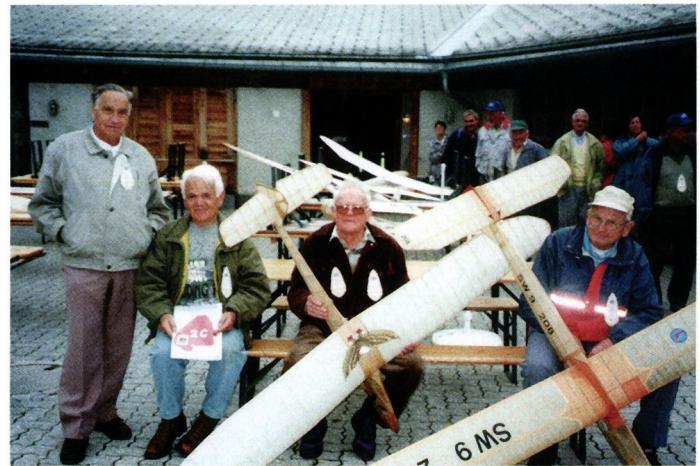
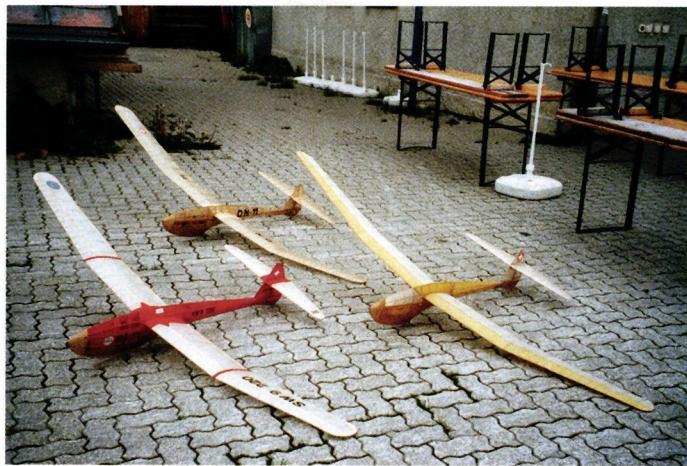
The models on display are an excellent match for the original plywood models from back then. Unfortunately, the large number of elegant Pilot-4 models from the first few gatherings has dwindled considerably. On the other hand, new participants have joined the event with new models. Once again this year, several “old novelties” were on display for everyone to admire.
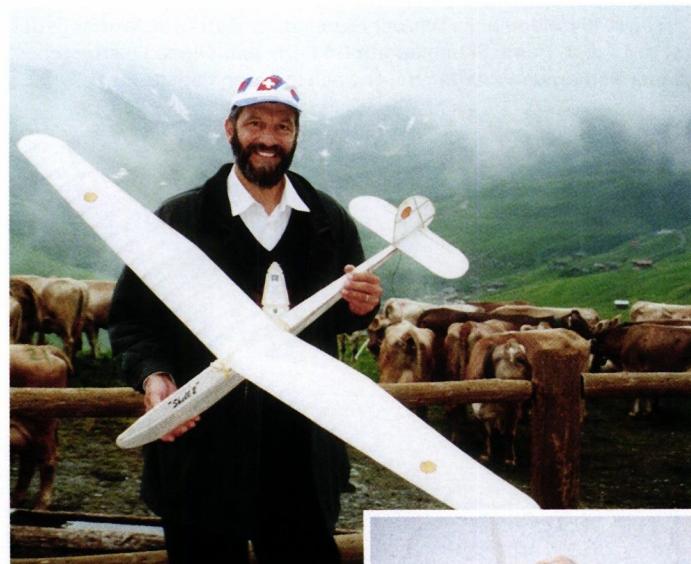
Everyone now understands that plywood models are made from plywood and pine strips. The covering materials—whether silk or paper—are also applied correctly. Iron-on transfer sheets look out of place on antique plywood models; fortunately, this modern material was nowhere to be seen at the last Arosa meetings. The predominant standard covering back then was white. But there were also colored versions in some cases. Today, however, care should be taken to ensure that no “colorful paper parrots” are used. The replica models should have a historically authentic appearance. By the way: Coverings with bulges and creases were not uncommon back then. Our models today are actually built almost too neatly. The registration number used today is often applied as the registration mark, which is absolutely correct. In some cases, models fly with the original registration numbers from that era. It would also be conceivable for a G-41 to appear with the markings of Traugott Haslach’s world-record-breaking model. The club decals or AMD decals on these models are a matter of taste but have nothing to do with original specifications. The Shell, Esso, FCW, and other stick-on logos common at the time are more valuable. And the Swiss crosses, usually round in shape, were standard then and remain so today. Even the decals commonly used back then are still available today. I can help source them upon request. A beautifully designed model name looks nice and is informative. The year of design or construction, as well as the designer’s name, can also enhance the model’s appearance when applied skillfully. The golden Arosa Snow Star, which was presented to all participants by Arosa Tourism along with a welcome letter, is
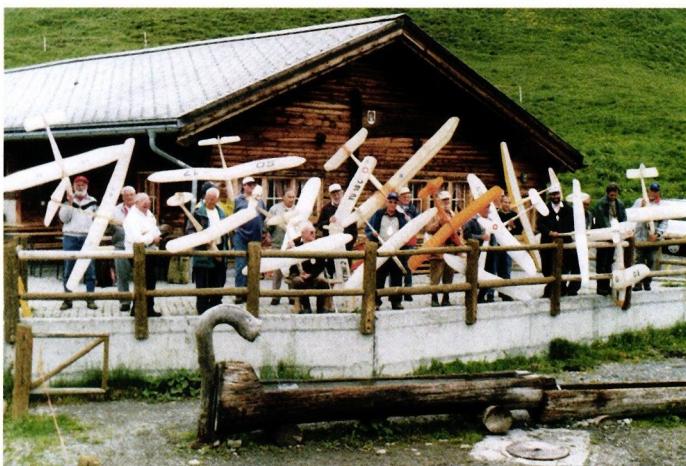
You can find it on the nose of Kurt Lutz’s Jelmoli 3. A brilliant idea—attractive and discreet. Otherwise, it’s important to keep the original look of those models in mind. Incidentally, the Zurich team had a group emblem on their vertical stabilizers. For example, it was also on Emil Glünkin’s Aroser 36, clearly visible in old photos. Details like these are in demand. There’s still a lot to do—let’s get to it.
These vintage plywood glider models are not consumer goods. Anyone involved in this knows that models made with the correct materials and to exact specifications are an absolute must. Since this is a Swiss endeavor, only Swiss designs are permitted. To ensure that our proud relics of the past continue to circle above the Tschuggen, the moti-
6th National Vintage Glider Model Gathering
June 30–July 1, 2001, at Tschuggen/Arosa
Information – Documents – Registration
Alfred Genther, Gumpisbüelstr. 35, 8600 Dübendorf, Tel. 01/821 04 34
| Models | Model Year | Designer | Participants |
| Adler | 1942 | Robert Mathys | Walter Federer |
| Adler | 1942 | Robert Mathys | Walter Wolf |
| Beginner Glider Model | ? | Viktor Kobler | Bruno Ferrari |
| Bussard 4/EK | 1945 | Hans Zeller | Hansruedi Zeller |
| EK AF BN-2 Adölfli | 1940 | Adolf Federer | Walter Federer |
| EK WF BN-1 Sturmvogel | 1940 | Walter Federer | Walter Federer |
| Esso | 1941 | Arnold Degen | Erich Rohrer |
| Esso | 1941 | Arnold Degen | Hans Schmid |
| Esso | 1941 | Arnold Degen | Karl Schwarz |
| ET-2 | 1942 | Theodor Willi | Walter Haller |
| FCW 2 | 1943 | Ernst Hausammann | Alfred Genther |
| Flamingo | 1943 | Willy Tauss | Alfred Genther |
| G-41 | 1941 | Emil Glünkin | Rudolf Schenker |
| Hai | 1943 | Willy Tauss | Alfred Genther |
| Hai | 1943 | Willy Tauss | Fred Huber |
| Jelmoli 3 | 1943 | Josef Meier | Hans Grünenwald |
| Jelmoli 3 | 1943 | Josef Meier | Kurt Lutz |
| Jelmoli 3 | 1943 | Josef Meier | Rudolf Schenker |
| Kormoran | 1939 | Horst Baer | Christian Tanner |
| Milan | 1940 | Horst Baer | Hans Grünenwald |
| Panther | 1945 | Willy Tauss | Alfred Genther |
| Pelican | 1941 | Willy Tauss | Johannes Caglic |
| Pelikan | 1941 | Willy Tauss | Alfred Genther |
| Pilot 4 | 1940 | Arnold Degen | Walter Steudler |
| Pilot 4 | 1940 | Arnold Degen | Kurt Wettstein |
| Pilot 5 | 1944 | Arnold Degen | Alfred Genther |
| Penguin | 1941 | Hans Marti | Alfred Genther |
| Pro Aero 1 | 1941 | Arnold Degen | Alfred Genther |
| Pro Aero 1 | 1941 | Arnold Degen | Walter Haller |
| Radio Student Model | 1936 | Werner Schramme | Walter Haller |
| Rhönadler | 1942 | Heini Kamber | Walter Haller |
| Rhönadler | 1942 | Heini Kamber | Ruedi Schenker |
| Rhönadler | 1942 | Heini Kamber | Karl Schwarz |
| Shell 2 | 1938 | Arnold Degen | Walter Federer |
| Sheli 2 | 1938 | Arnold Degen | Hansruedi Zeller |
| Stini 1 | 1948 | Paul Schmitter | Gody Bachmann |
| Stini 2 | 1948 | Paul Schmitter | Gody Bachmann |
Without Hans Keller, the Arosa Antique Glider Model Gatherings would be almost unthinkable. As early as the 1970s, Hans went to great lengths to collect Swiss construction plans from the plywood model airplane era. From today’s perspective, this collection is extremely valuable, as virtually all of the plans known at the time have been preserved. Thanks to his foresight,
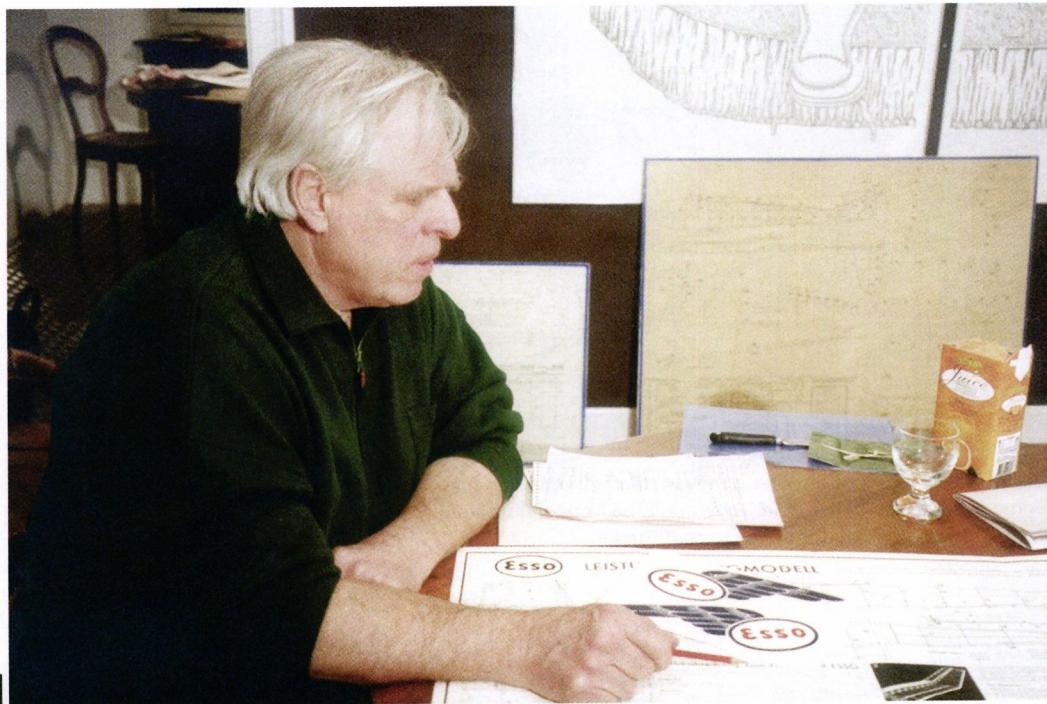
Thanks to his efforts, such models can be recreated today. In addition to his extensive collection of plans, Hans also sought out personal contact with the designers of these models. Hans knew how to recount the stories of these encounters in a very vivid and lifelike way, with great enthusiasm. Many of these designers have passed away, and now, sadly, Hans has also left us forever. We have lost yet another living witness to our model aviation history. He did so much for us and for the sport of model aviation. As a teacher, he led model airplane construction courses at school. It goes without saying that his courses focused not on modern balsa models, but on his beloved plywood constructions.
Hans Keller passed away in mid-January 2001 at the age of 65 after a long illness. Traditional values ran like a common thread through his life. With his down-to-earth attitude, he impressed many model aviators and served as an inspiring role model of the highest caliber to his students. Once again, it becomes clear to us that everything is temporary and fleeting.
By building vintage model airplanes, we honor all the comrades who are no longer with us. It is a pursuit with a deeper meaning. In this spirit, we wish to honor our legacy.
Alfred Genther

EURO CONTEST GLIDER ACRO TOUR AUSTRIA 2026

THE PC-21 STORY
 Emil Giezendanner

CORSAIR F4U – A WARBIRD WITH A MEMORABLE LOOK
 Jürgen Rosenberger, Jürgen Prinz

TWIN TOWN PARTNERSHIP
Wolfgang Voeller
SUMMER FUN 2026 AT MG USTER
Martin Wunderli
YOU KNOW WHAT I MEAN? 125 YEARS OF THE SWISS AERO CLUB
Emil Giezendanner
52. 2026 ALPS CUP
Emil Giezendanner
News from HEBU

ATOM, THE NEW DOUBLE-DECKER FROM CPLR
 Matthias Bosshard

TEAM MANAGER "THIS" BOSSHARD
Rodito Nussbaumer
F3A EUROPEAN CHAMPIONSHIPS IN ST-MACAIRE, FRANCE
Matthias Bosshard
INSIGHTS INTO THE HISTORY OF SEAPLANES

WELCOME, NEW MEMBER!
Andrea Bolliger
FREE FLIGHT IN THE MIDDLE OF SUMMER
Urs Muntwyler
PRIDE AND GOOD IDEAS
 Markus Nussbaumer

What's New at Leomotion.com

SMALL, MODEL-LIKE SAILBOATS
Res Dauwalder
BY YOUTH, FOR YOUTH
Lorena Betschen
HORIZON HOBBY/LEMACO NEWS: MICRO OV-10 BRONCO 645 MM BY E-FLITE

34th HAHNENMOOS ALPINE MODEL AIRPLANE CAMP
Res Dauwalder
COUPE DES ALPES – OBSERVE AND LEARN
Rodito Nussbaumer
TRY-OUT DAY AT MFV WETTINGEN
 Urs Keller

NEWS FROM HEBU
 Julia Bucher

NOS REGION – A HUB FOR ELECTRIC AVIATION
Emil Giezendanner
MEMORIES
 Wolfgang Völler

70 YEARS OF THE NIDWALDEN MODEL AIRPLANE CLUB
Martin Barmettler
A SPECTACULAR F3A WORLD CUP IN THE PRINCIPALITY OF LIECHTENSTEIN
Emil Giezendanner
FROM 0 TO 100
Markus Nussbaumer