
Everything at a Glance
PROEMO software for easily calculating electrically powered model airplanes
What had developed in the last third of the 20th century under the term “electric flight” was ultimately the success story of creative resource management in the face of scarcity. It’s well known that around 2003, LiPo batteries changed everything. Combined with a new generation of motors (brushless) developed just a few years earlier, electric propulsion systems suddenly had the potential to break out of their previous niche, which had been “cared for” by electric propulsion enthusiasts. This was a good thing, because in many places, environmental concerns have made the use of internal combustion engines increasingly difficult. The former volunteer army has grown into a vast army of electric vehicle users. This group has a great need for information, because while electric drives are no longer weaker, they are still entirely different.
Whereas in the past a few extra cubic centimeters would give just about any lead-weighted model wings, “engine tuning” for electric drives now drags a long trail of retrofitting efforts in its wake. Therefore, it makes sense—and is finally possible—to take a holistic view of the powertrain and the model as a whole. This not only prevents wasteful investments but also spares you many a disappointment down the road.
So the question is no longer, “Which motor should I buy?”—but rather, “What characteristics must the drive system and model have overall to achieve the desired result?” This is, however, a rather complex subject, and even seasoned electric model enthusiasts must admit that they, too, had to go through a lot of ups and downs before the whole thing really clicked.
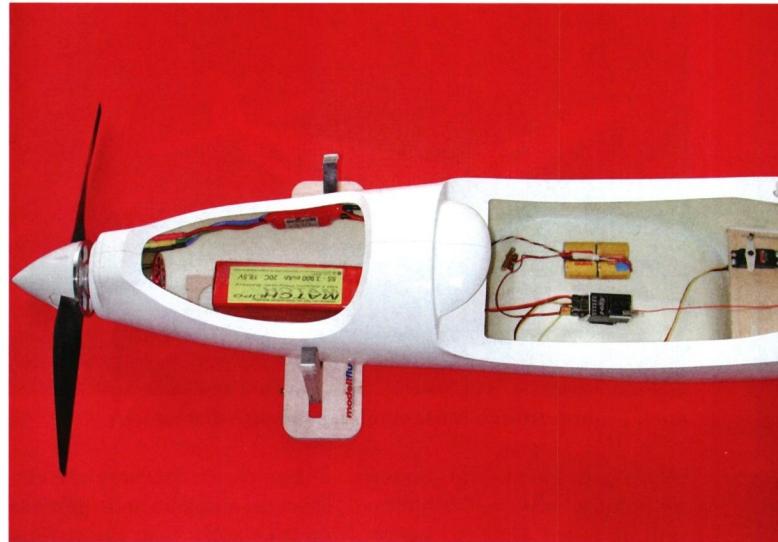
and went above and beyond—in other words, they really did everything intuitively right when designing a model.
But nowadays there are computers and related tools—usually called propulsion configurators—that can be used to simulate specific propulsion scenarios. Although their “prediction quality” can vary considerably, they are usually quite helpful
in coordinating the battery, motor (winding), and propeller so that, on the one hand, sufficient power is available, and on the other hand, none of the components operates in the red zone. That’s half the battle, but only half! Because even a propulsion system that works perfectly in harmony can sometimes feel out of place in the model—for example, when the static thrust is correct but the model’s dynamic characteristics weren’t sufficiently taken into account during the design process.
This is where PROmax, a program developed by Dr. Klaus Proetel, comes into play. The model calculation program runs on Excel and takes a comprehensive approach. Unlike most well-known propulsion programs, which only consider the static values of the propulsion system, it incorporates the model and its aerodynamics right from the start. This is no easy task, because the models on our airfields are almost as unique as the people who fly them. A calculation can only ever be as good as the
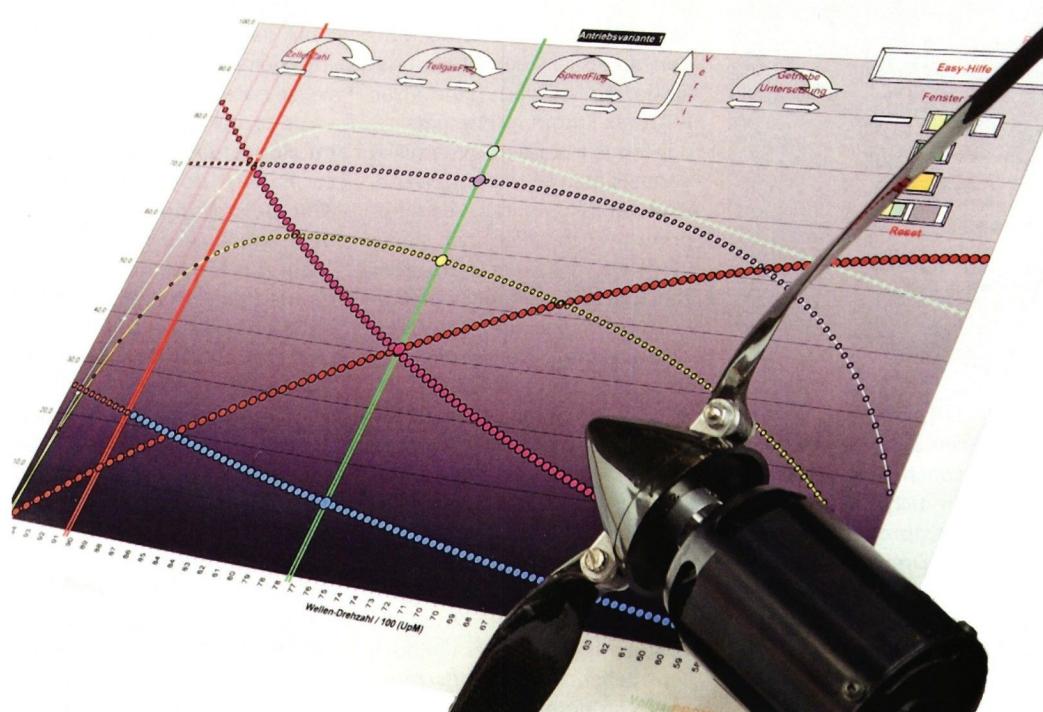
Input values used to feed the model. However, one gets much closer to the mark if, for example, one considers not only the wingspan, the lift-generating area, and the model’s weight, but also knows the glide ratio. This, in turn, is rarely the case. For this reason, the program makes its own assumption here, which is additionally based on the model type, the wing configuration, and the nose diameter. The airfoil profile is
not taken into account, which naturally limits the accuracy of the calculations somewhat. Nevertheless, for high-speed aircraft, it makes a significant difference whether the propulsion calculation focuses solely on static measurements of the $n_{100}$ speed of a propeller or whether truly dynamic characteristics form the basis of the calculation. The developer has, in rather elaborate test runs (presumably in a gray area of the German Road Traffic Regulations), measured the behavior of the propellers under airflow up to
30 m/s (corresponding to approx. 110 km/h) and documented it with the utmost precision using a dual measurement setup in each case. This enables sufficiently accurate extrapolations up to approx. 50 m/s (corresponding to 180 km/h).
In the process, he debunked quite a few marketing claims. It turned out, for example, that while the printed pitch values certainly hold up to angular measurements, with some blades—even at relatively low
As for the E-variants, one would certainly like to know whether they still deliver what they promise when stationary, even at full speed.
In the early days of electric flight, many people couldn’t understand what a speed controller could possibly be used for. People were just happy if anything worked at all. To this day, many calculation formulas are based exclusively on the “full throttle” scenario. However,

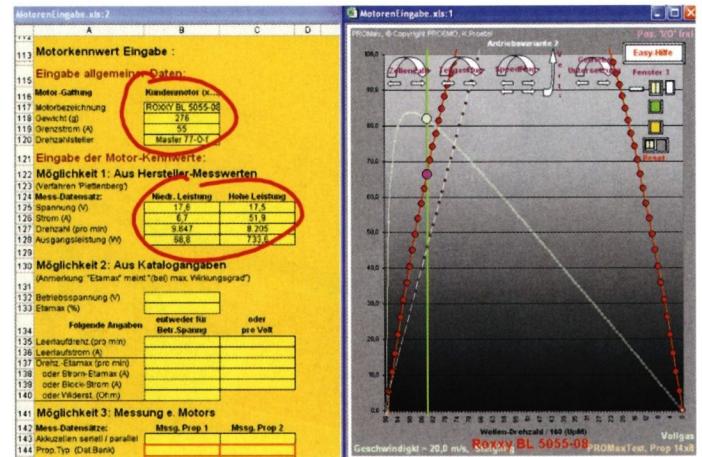
The motor—which remains the heart of every drive system even today—is either retrieved from a (currently expanding) database or entered manually by the user. In the simplest case, the required data can be taken from the product specifications; however, this requires a high degree of trust on the part of the user—or at least a certain willingness to accept the risks involved in making projections.
If binding sets of measurement data from the manufacturer or distributor—or your own measurements—are available, these can be entered into the system as a two-point measurement (see yellow screen). The closer the operating values are to or within the range of the test measurements, the more accurately the PC will calculate.
Those who are used to focusing solely on motor efficiency will discover that PROmax not only addresses this single Eta component but also shows how efficiently the remaining drive components (battery, controller, gearbox, propeller) contribute to the overall result. This often leads to some “aha” moments.
Anyone who not only chooses the right one, but even the best one within their means—
If you want to find the optimal drive system or, for example, want to optimize not only performance but also cost, you can’t avoid comparing systems. PROmax therefore always takes a two-pronged approach, offering an alternative calculation in parallel. This makes direct comparisons possible. You can view them as series of numbers or as a set of graphs, with the latter—in the form of Excel charts—being particularly inviting to “play around” with. Using buttons, you can quickly adjust the individual variants and immediately see what happens when a
cell is added or removed, you ease off the “gas” a bit, the assumed or calculated airspeed changes, or the gear reduction ratio varies. However—and this, unfortunately, must also be said—this dual representation further limits the clarity of the interface, which already takes some getting used to. Because PROmax uses the Excel interface, the cells become very small if you want to keep an eye on them all at once. In any case, the system isn’t necessarily intuitive to use right away, even for Excel fans. But where there’s logic, there’s a way. Getting familiar with the program takes no longer than it does to figure out how to use a new universal charger. The included interactive Easy Help does its part, even if one sometimes gets the impression that less would actually be more in many cases.
Computer simulations tempt us to play a “game without limits.” After all, as a programmer, you don’t want to leave any unused, fallow areas in the memory landscape. That’s why he discovered
In more or less all such programs, the author includes gadgets—little bells and whistles, really—that are nice and entertaining but not necessarily useful or even necessary. Of course, subjective criteria also play a role in evaluating this.
In the author’s opinion, even PROmax is only largely free of such elements. The developers simply didn’t want to leave anything to be desired. For example, it’s possible to determine how much of your hobby budget is being used by entering the prices of individual parts (as long as your wife doesn’t see that).
More interesting, however, are the component weights; when you enter them, the numerous built-in macros not only determine the model’s total mass but also calculate its speed range (approximately). For example, you can see how switching from NiMH cells to LiPos reduces the charging speed. That encourages you to make a new investment! Of course, you can also see the expected motor runtime. If desired, the system also takes air pressure, temperature, and the airfield’s elevation into account. PROmax, of course, also calculates multi-motor models
| Clamping force: | 0.0 | 0.0 | Battery loss (W) | 5 | 0 | 77 | 0 |
| Battery Pack: Cell Type | Sanyo NiMH //20C | Sanyo NiMH //20C | Motor Loss (W) | 18 | 0 | 66 | 0 |
| Nominal voltage per cell ( | 1.25 | 1.25 | |||||
| Internal resistance of cell (mOhm) | 5 | 5 | Propeller RPM (rpm) | 4,963 | 0 | 6,917 | 0 |
| Number of cells in series | 10 | 10 | Motor torque (Ncm) | 48.1 | 0.0 | 48.1 | 0.0 |
| Battery packs in parallel (all drive | 1 | 1 | Results for the drive: | ||||
| Cell capacity (mAh) | 3,400 | 3,400 | Thrust (N) | 2.4 | 0 | 12.4 | 0.0 |
| Weight per cell (g) | 62 | 62 | Motor runtime (min:sec) | 20:07 | 0:00 | 5:11 | 0:00 |
| Purchase price per cell (euros) | 5.50 | 5.50 | Drive weight (g) | 934 | 934 | ||
| Actuator: <Non-rigid type> | future 18.61K | future 18.61K | Total weight of model (g) | 2,234 | 2,234 | ||
| Additional resistance (mOhm) | 0 | 0 | Power-to-weight ratio, motor/drive | M: 0.41 | A: 0.1 | M: 1.39 | A: 0.37 |
| Weight (g) | 45 | 45 | Drive cost (euros) | 441 | 441 | ||
| Purchase price (euros) | 195 | 195 | |||||
| Current Limit (A) | 50 | 50 | Model flight performance: | ||||
| Gas: | 0.58 | 1.00 | # | ||||
| Flight Speeds: | Coupling v2 to v1 | Coupling v2 to v | Drag (N) | 2.4 | 0.0 | 2.4 | 0.0 |
| Velocity v1 (m/s) | 20.0 | 20.0 | Thrust-to-lift ratio (N) | 0.0 | 0.0 | 12.4 | 0.0 |
| Speed v2 (m/s) | = | = | Climb angle (°) | 0.0 | 0.0 | 27.1 | 0.0 |
| Model Specifications | Rise rate (m/s) | 0.0 | 0.0 | 9.1 | 0.0 | ||
| Model Class / Glide Ratio | 13 / Coach | 13 / Trainer | Climb Rate (m/min) | 0 | 0 | 547 | 0 |
| Glide ratio: User-defined | 15 | 15 | Total Ascent (meters) | 0 | 0 | 2,840 | 0 |
| Professional lift coefficient cap | 0.48 | 0.48 | Ascent height (m) | 0 | 0 | ||
| Glide speed (m/s) | 14.2 | 14.2 | Climb time (s) / Final speed | 0 | 0 | 0 | 0 |
| Model Curb Weight (g) | 1,000 | 1,000 | Glide speed (m/s) | 14.2 | 14.2 | ||
| Non-powered components (g) | 300 | 300 | Landing speed (m/s) | 9.9 | 9.9 | ||
| Landing speed with flaps | 7.8 | 7.8 |
The input table provides an overview of all input data.
The trainer, with a glide ratio of 13 and a weight of 2.23 kg, has a drag of 2.4 N during level flight at 20 m/s. In this propulsion example, a “throttle setting” of 0.58 is sufficient to generate the corresponding thrust of 2.4 N. At “full throttle,” marked in green here, the design allows for a climb angle of 27.1 degrees. Incidentally, this design allows for a climb of 2,840 meters in altitude.
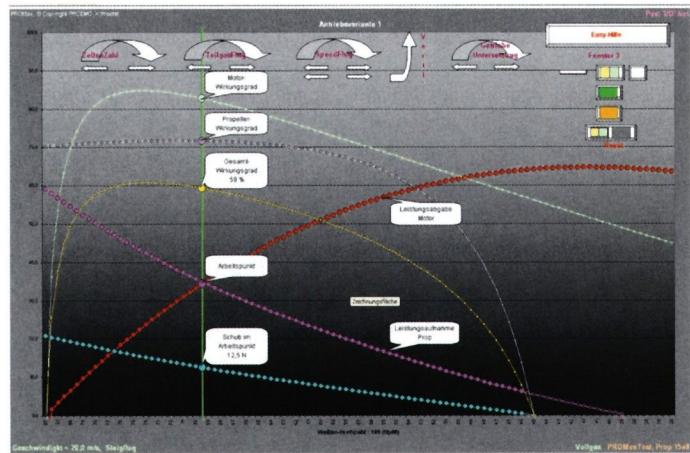
A small selection of display values via an Excel chart. The advantage: By clicking the arrows (at the top), you can adjust all key parameters. The result of the change is then immediately visible.
and even entire towed formations. In this case, the glider is set in the calculation as unpowered but otherwise with all its parameters (weight, approximate aerodynamics) included. The tangible advantage of this calculation system, which encompasses the entire propulsion scenario, is undoubtedly that it provides the user—and here the focus is primarily on those switching to this propulsion system who have previously thought along different lines—with a comprehensive overview of the interrelationships. They can immediately see what else (!) changes when they add just a few cells or switch to a
propeller with a lower pitch and larger diameter. Only once these relationships have been recognized is one able to truly understand electric propulsion.
There’s no question that it will still be possible to have fun with model aircraft without a computer in the future. Anyone who dismisses things like PCs as “newfangled stuff” is unlikely to experience—even through propulsion calculation programs—the kind of acceleration that will catapult them into the 21st century. The program also does not—
It doesn't claim to answer every question. For example, PROmax has absolutely nothing to do with indoor flying. Anyone who feels they already have enough tough challenges to tackle during work hours and would rather leave optimization questions to others shouldn’t waste either time or money here. After all, a program into which so much work has been invested can’t exactly be free (incidentally, the copy protection seems to work as well).
As already hinted at above, the program’s major advantage is that it not only helps calculate electric propulsion but also helps you understand it. Anyone who takes the time to work through the Easy Help guide carefully will learn a great deal of interesting and useful information about electric drive technology (although there is also relevant technical literature available). In this regard, the author has in mind not only the ambitious person switching to electric vehicles but also specialty retailers seeking qualified advice. Given the wide variety of options available today, the latter certainly don’t have it easy. Here, drive solutions could be worked out together with the customer at the counter, and alternatives could be
. Unlike the generally very helpful drive configurators on company websites, the PROmax system is brand-neutral. The customer can exert a significant influence on the decision-making process; they are convinced, not persuaded! It would also be a great help to many if such a program were available within a club or among friends, allowing them to work together on optimizing their drivetrains. Of course, the program isn’t available for free. According to current information on the website (http://www.proemo.de), an annual license costs €95; high school and college students pay €75. In return, PROEMO offers a very comprehensive service—including an introductory consultation by phone. Especially when compared to other, freely downloadable power calculators, this might seem like a lot right now. But it puts things into perspective when you consider that an affordable 3-cell 3,900-mAh LiPo, for example, costs €99 (+shipping fee). If you don’t manage to break it thanks to your growing expertise, you’ve already saved at least 4 €! Even the strictest wife won’t have anything to object to.


News from HEBU

TEAM MANAGER "THIS" BOSSHARD
 Rodito Nussbaumer

YOU KNOW WHAT I MEAN? 125 YEARS OF THE SWISS AERO CLUB
 Emil Giezendanner

F3A EUROPEAN CHAMPIONSHIPS IN ST-MACAIRE, FRANCE
 Matthias Bosshard

SUMMER FUN 2026 AT MG USTER
Martin Wunderli
TRY-OUT DAY AT MFV WETTINGEN
Urs Keller
52. 2026 ALPS CUP
Emil Giezendanner
BY YOUTH, FOR YOUTH
Lorena Betschen
ATOM, THE NEW DOUBLE-DECKER FROM CPLR
Matthias Bosshard
CORSAIR F4U – A WARBIRD WITH A MEMORABLE LOOK
Jürgen Rosenberger, Jürgen Prinz
SMALL, MODEL-LIKE SAILBOATS
Res Dauwalder
What's New at Leomotion.com

TWIN TOWN PARTNERSHIP
Wolfgang Voeller
EURO CONTEST GLIDER ACRO TOUR AUSTRIA 2026

INSIGHTS INTO THE HISTORY OF SEAPLANES

34th HAHNENMOOS ALPINE MODEL AIRPLANE CAMP
Res Dauwalder
WELCOME, NEW MEMBER!
Andrea Bolliger
HORIZON HOBBY/LEMACO NEWS: MICRO OV-10 BRONCO 645 MM BY E-FLITE

FREE FLIGHT IN THE MIDDLE OF SUMMER
Urs Muntwyler
COUPE DES ALPES – OBSERVE AND LEARN
Rodito Nussbaumer
PRIDE AND GOOD IDEAS
 Markus Nussbaumer

THE PC-21 STORY
Emil Giezendanner
NEWS FROM HEBU
 Julia Bucher

FROM 0 TO 100
Markus Nussbaumer
MEMORIES
Wolfgang Völler
NOS REGION – A HUB FOR ELECTRIC AVIATION
Emil Giezendanner
Have you almost forgotten about aircraft that take off and land vertically?
Emil Giezendanner
DO YOU KNOW WHAT I MEAN IN THE LAND OF SMILES?
Emil Giezendanner