
What does "antique model aircraft" mean?
What are antique models, and what is considered “antique”? The dictionary defines “antiquity” as the Greek and Roman eras, which served as the foundation and model for the Western world. However, the first model airplanes were not mentioned in specialized literature until around 1850. During this period, scientists, artists, and other pioneers were mostly working on model airplanes as lone individuals. According to Tilgenkamp, Switzerland’s first model aviation club, the “Modellflugverein Bern,” was
founded in 1915. So, in the world of vintage model aviation, one must ask what time period can be classified as “vintage.” The classic names—Shell, Esso, and Jelmoli models—the Pilot series, the many Degen and Tauss designs, and countless other Swiss plywood models likely deserve the label “vintage.” But are a Graupner Kadett or Kapitän, or a Graupner RC Electra, or any of the balsa models from the 1950s also considered “antique”? In the 1960s, various types of plastic began to gain popularity in model aviation. Today, we are in the age of ready-to-fly models. In history, we use terms
like the Stone Age, Bronze Age, Iron Age, Middle Ages, and Modern Era. For vintage model aviation, we could use terms like “antique,” “vintage,” “historical,” “nostalgic,” “traditional,” and “classic” model aviation. Or how about “antique” and “semi-antique”?
As is the case everywhere, there are different views and opinions. However, there is a clear trend toward building replicas of these plywood historical artifacts that are as authentic as possible. The materials—plywood and pine strips—are processed as precisely as possible according to the construction plans and parts lists. Those who want an absolutely authentic flying experience practice free flight just as they did back then. The majority, however, help these old models achieve great flying success by installing
remote controls as discreetly as possible. Silk covering is authentic and time-tested. Nylon fabric also looks authentic; the visual impression is spot-on. Paper covering is the easiest to work with and is an absolutely authentic material. The downside of paper covering is that after a few years, it becomes brittle and very prone to tearing. A substitute product has proven itself very well here for several years now: tensioning fleece—essentially conventional covering paper reinforced with polyester fibers. The fleece covering matches the visual appearance of conventional paper covering. Tension is also achieved using the tensioning varnish, which is simply an essential part of building an antique model.
| Models | Model Year | Designer | Participants |
|---|---|---|---|
| Adler | 1942 | Robert Mathis | Peter Müller |
| Dyno Engine Model | 1942 | Willy Tauss | Walter Haller |
| Esso | 1941 | Arnold Degen | Erich Rohrer |
| Esso | 1941 | Arnold Degen | Hans Schmid |
| Flamingo | 1943 | Willy Tauss | Alfred Genther |
| Flamingo | 1943 | Willy Tauss | Ruedi Schenker |
| Flamingo | 1943 | Willy Tauss | Christian Tanner |
| Fink | 1943 | Hannes Rüesch | Bruno Ferrari |
| G-41 | 1941 | Emil Glünkin | Ruedi Schenker |
| G-41B | 1941 | Emil Glünkin | Wolfgang Onken |
| Hai | 1943 | Willy Tauss | Alfred Genther |
| Jelmoli 3 | 1943 | Josef Meier | Hans Greising |
| Jelmoli 3 | 1943 | Josef Meier | Hans Grünenwald |
| Kiebitz | 1944 | Willy Tauss | Alfred Genther |
| Kiebitz | 1944 | Willy Tauss | Hanspeter Senn |
| Condor | 1939 | Ernst Zeller | Hansruedi Zeller |
| Lerche | 1947 | H. Zimmerli | Walter Haller |
| Milan | 1940 | Horst Baer | Hans Grünenwald |
| Nabholz | 1942 | Erwin Meier | Walter Engel |
| Panther | 1945 | Willy Tauss | Alfred Genther |
| Pelican | 1941 | Willy Tauss | Kurt Benz |
| Pelikan | 1941 | Willy Tauss | Johannes Caglic |
| Pelikan | 1941 | Willy Tauss | Alfred Genther |
| Pilot 4 | 1940 | Arnold Degen | Hans Greising |
| Pilot 4 | 1940 | Arnold Degen | Fritz Schüpbach |
| Pilot 4 | 1940 | Arnold Degen | Hansruedi Zurlinden |
| Pilot 5 | 1944 | Arnold Degen | Alfred Genther |
| Penguin | 1941 | Hans Marti | Alfred Genther |
| Pro Aero 1 | 1941 | Arnold Degen | Fritz Schüpbach |
| Radio Student Model | 1936 | Werner Schramme | Alfred Genther |
| Rhönadler | 1942 | Heini Kamber | Bruno Ferrari |
| Riedstern Motor Model | 1941 | Alwin Kuhn | Christian Tanner |
| Swiss Student Model No. 2 | 1938 | Laur | Walter Haller |
| Shell 2 | 1938 | Arnold Degen | Hansruedi Zeller |
| Shell 3 | 1942 | Arnold Degen | Walter Steudler |
| Stini 1 | 1948 | Paul Schmitter | Erich Rohrer |
| Stini 2 | 1948 | Paul Schmitter | Gody Bachmann |
| Zürihegel | 42/44 | Arnold Degen | Bruno Ferrari |
| Zürihegel | 42/44 | Arnold Degen | Walter Haller |
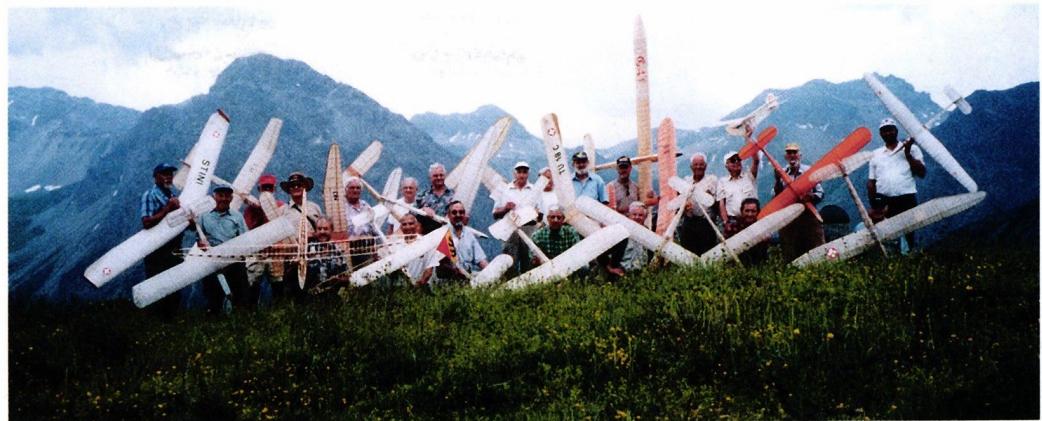
| Former participants in the Arosa competitions from 1937 to 1948 who were present: Werner Hauenstein, Ruedi Schenker, Fritz Schweri |
After attending several vintage model aircraft gatherings in Germany, I realized that in Switzerland, not enough attention is paid to vintage model aircraft. I
saw a film of the 1941 Arosa competition by Charles Zbinden of Bern several times a long time ago. It was—and still is—truly impressive. In addition to this film, the *Aero-Revue* magazines from that era also pointed the way to this historic airfield in Tschuggen. Now it is a wonderful experience to return to this historic site and see the same models as those flown in the competitions from 1937 to 1948—and even to meet some of the participants from back then. Every participant today helps keep a legendary
piece of Swiss model aviation history alive. In today’s age of ready-made models available for purchase, it is particularly gratifying to see these old works of art recreated through meticulous fretsaw work. In these times, when so many things no longer run as smoothly as they used to, traditional values are gaining renewed attention. Take an old blueprint, some plywood, pine strips, and varnish, and enjoy the process of building and flying—and experience the spirit
of a bygone era, when model aviation was held in high regard and inspired great enthusiasm. See you on June 26–27, 2004, at the next gathering on the Tschuggen in Arosa.
Alfred Genther
A gathering exclusively for Swiss plywood glider models, June 26–27, 2004
Alfred Genther
Gumpisbüelstrasse 35
8600 Dübendorf
Tel. 01 821 04 34
Ms. Viviane Keller
Stettbachstrasse 5
8702 Zollikon
Tel. 01 391 90 81
Karl Bucher
Seebnerstrasse 7
8185 Winkel ZH
Tel. 01 862 00 14
Stoff Ciolina
Kramgasse 52
3011 Bern
Tel. 031 311 00 52
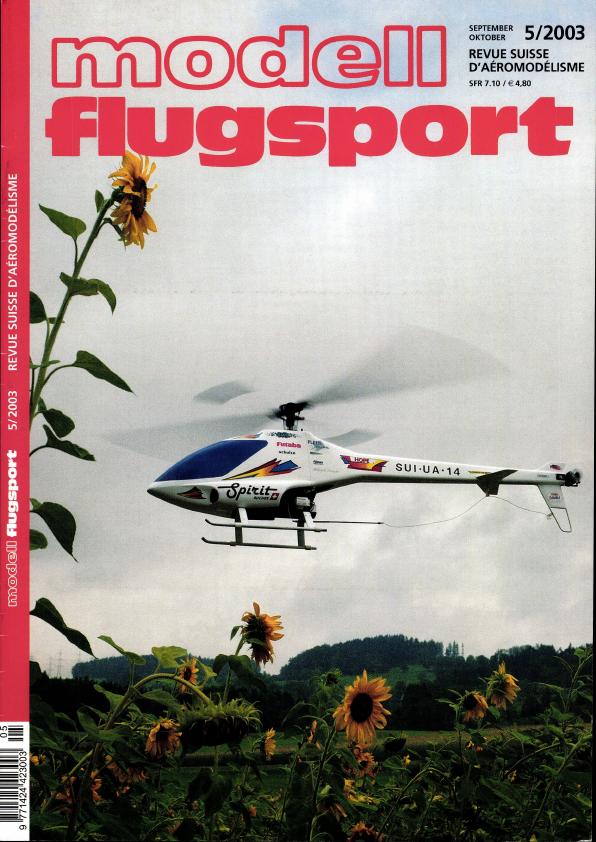

EURO CONTEST GLIDER ACRO TOUR AUSTRIA 2026

THE PC-21 STORY
 Emil Giezendanner

TWIN TOWN PARTNERSHIP
 Wolfgang Voeller

SUMMER FUN 2026 AT MG USTER
Martin Wunderli
CORSAIR F4U – A WARBIRD WITH A MEMORABLE LOOK
Jürgen Rosenberger, Jürgen Prinz
52. 2026 ALPS CUP
Emil Giezendanner
YOU KNOW WHAT I MEAN? 125 YEARS OF THE SWISS AERO CLUB
Emil Giezendanner
News from HEBU

TEAM MANAGER "THIS" BOSSHARD
Rodito Nussbaumer
ATOM, THE NEW DOUBLE-DECKER FROM CPLR
 Matthias Bosshard

F3A EUROPEAN CHAMPIONSHIPS IN ST-MACAIRE, FRANCE
Matthias Bosshard
INSIGHTS INTO THE HISTORY OF SEAPLANES

WELCOME, NEW MEMBER!
Andrea Bolliger
What's New at Leomotion.com

PRIDE AND GOOD IDEAS
 Markus Nussbaumer

SMALL, MODEL-LIKE SAILBOATS
Res Dauwalder
FREE FLIGHT IN THE MIDDLE OF SUMMER
Urs Muntwyler
BY YOUTH, FOR YOUTH
Lorena Betschen
HORIZON HOBBY/LEMACO NEWS: MICRO OV-10 BRONCO 645 MM BY E-FLITE

COUPE DES ALPES – OBSERVE AND LEARN
Rodito Nussbaumer
34th HAHNENMOOS ALPINE MODEL AIRPLANE CAMP
Res Dauwalder
TRY-OUT DAY AT MFV WETTINGEN
 Urs Keller

NEWS FROM HEBU
 Julia Bucher

NOS REGION – A HUB FOR ELECTRIC AVIATION
Emil Giezendanner
MEMORIES
 Wolfgang Völler

70 YEARS OF THE NIDWALDEN MODEL AIRPLANE CLUB
Martin Barmettler
A SPECTACULAR F3A WORLD CUP IN THE PRINCIPALITY OF LIECHTENSTEIN
Emil Giezendanner
FROM 0 TO 100
Markus Nussbaumer