
The 1974 Air Olympics
Report in Words and Pictures by Werner Heise and Bruno Giezendanner
The Scale World Championship took place for the third time. While free-flight and RC world championships have seen a significant increase in the number of participants and participating nations, the turnout at this year’s Scale World Championship remained more than modest, at least in terms of numbers — 6 nations and 18 competitors in RC Scale (F4C) and 4 nations and 12 competitors in Circuit Scale (F4B).
Naturally, this raises the question of whether it is appropriate to refer to a “gathering” of just a few modelers from even fewer countries as a “World Championship.” At the very least, all those who—despite the miniaturization of aircraft—do not believe in a Lilliputian world and take a realistic view must repeatedly acknowledge the questionable nature of wanting to regard scale model building as a competitive sport. In any case, there are many scale modelers who view this hobby much more as a kind of “philosophy of life.” Scale model building is a pleasure! Although building true-to-life model airplanes has gained unprecedented popularity around the world, so-called championships are always relatively—
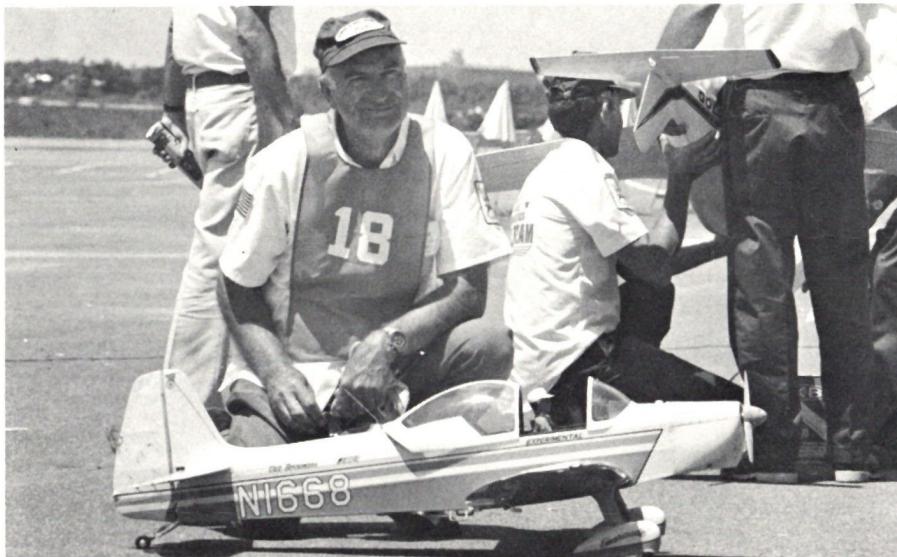
Attendance was rather low. When you think of the many wonderful scale models being built all over Switzerland, a field of just 9 competitors at the Swiss Championship seems like a real letdown. I wonder what could be the reason?
A relaxed atmosphere, the joy of reliving bygone days, romance, and so on—these things can’t be captured in regulations. Otherwise, it wouldn’t be a championship anymore, but “unfortunately just” an ordinary, friendly get-together. Is it perhaps because of these regulations that hardly any “ordinary” scale modeler dares to enter a championship anymore? Are the requirements so high that only a handful of specialists can meet them? Especially when you consider the immense effort required just to gather the authentic documentation. This might still be manageable for common sport aircraft. However, the task becomes quite difficult when it comes to vintage models—and nearly impossible for military aircraft, because numerous dimensions have been intentionally altered and falsified.
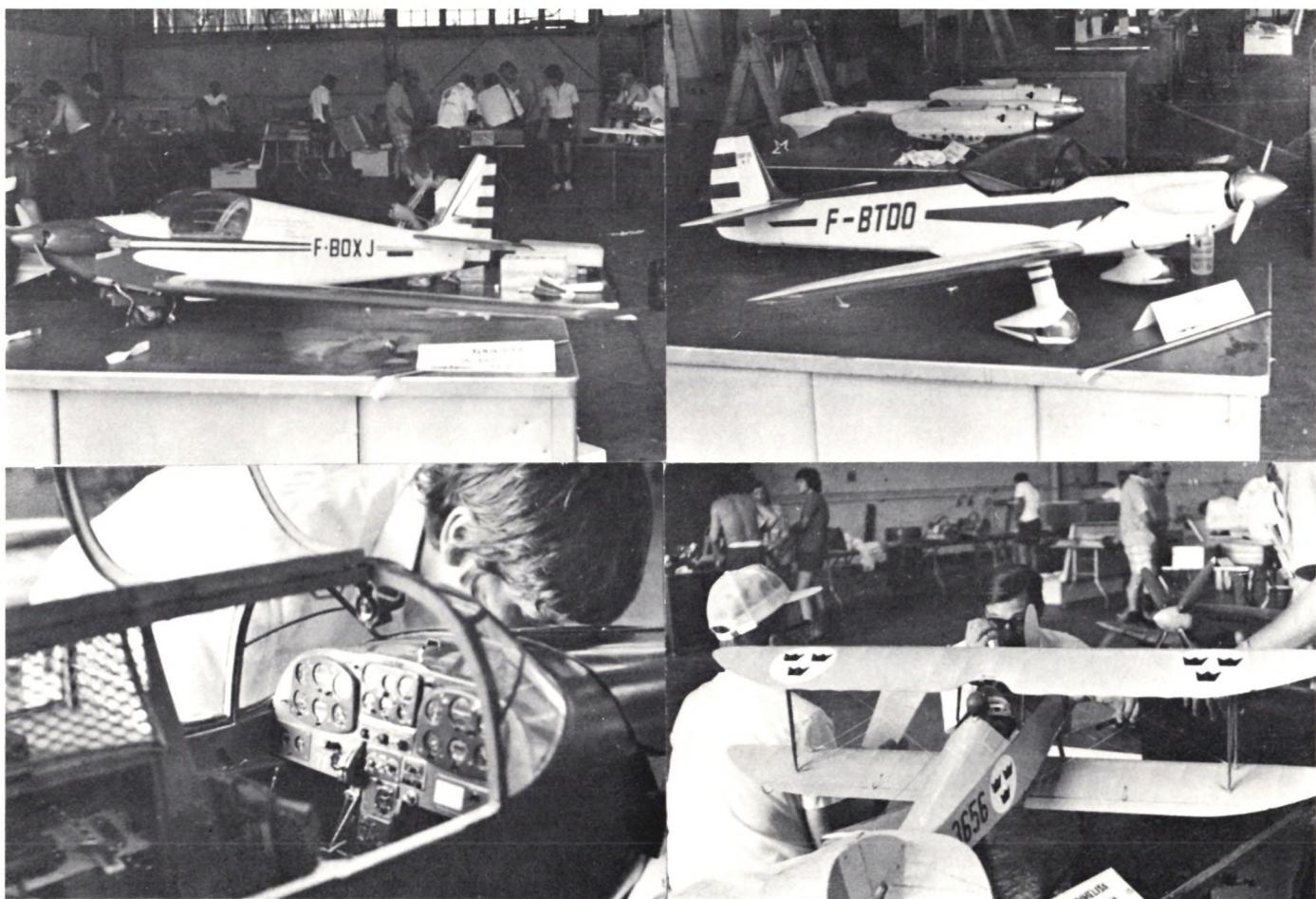
Then there’s the fabrication of details such as landing gear, cockpits, etc., which in some cases require the highest level of precision engineering expertise, and so on. Added to this is the actual flying, where even the takeoff of many models repeatedly poses major problems. This list of problems—which is arguably more than just amateurish—shows that this form of scale model building will never experience widespread growth. Here, development will clearly have to focus on depth, i.e., on quality. In fact, scale model building has made tremendous progress in this direction in recent years.
The triple American victory at this year’s World Championships proves that, in addition to a good build score, the flight evaluation plays a decisive role. World Champion Wischer was in fourth place after the build evaluation. The winner of the construction evaluation, J. Lang of France, was unable to fly his motor glider (Fournier) properly and ultimately finished in twelfth place! Whether one views Lang as a victim of excessive specialization or of the rules is a matter for each individual to judge. Only a few of the scale model builders are also skilled at flying their creations. Although these models were a feast for the eyes even when standing on the ground, one must not forget that airplanes belong in the air—that is their element, and it is there that they truly come into their own.
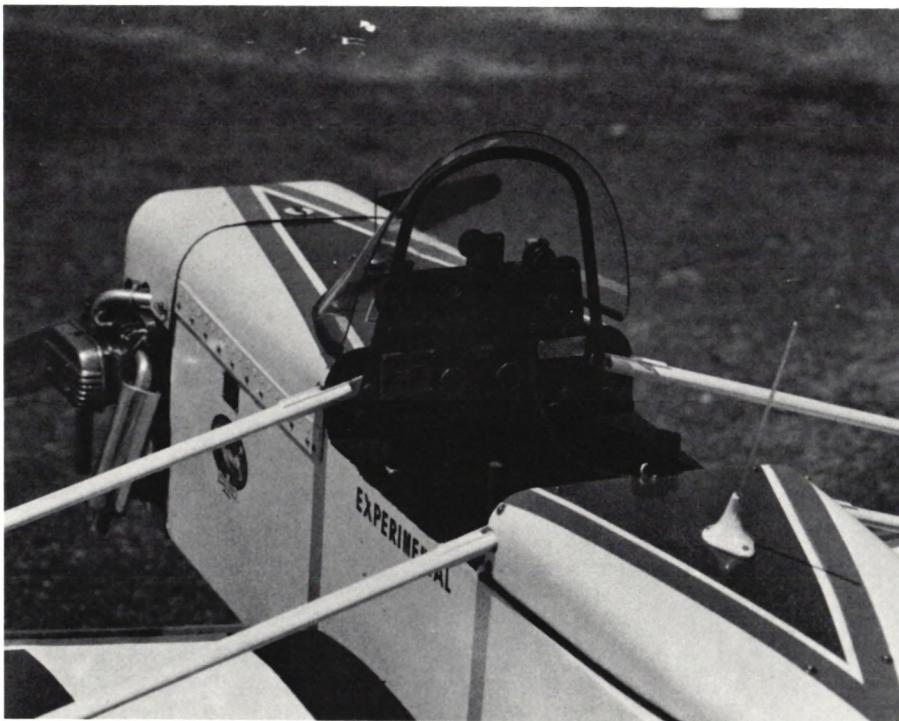
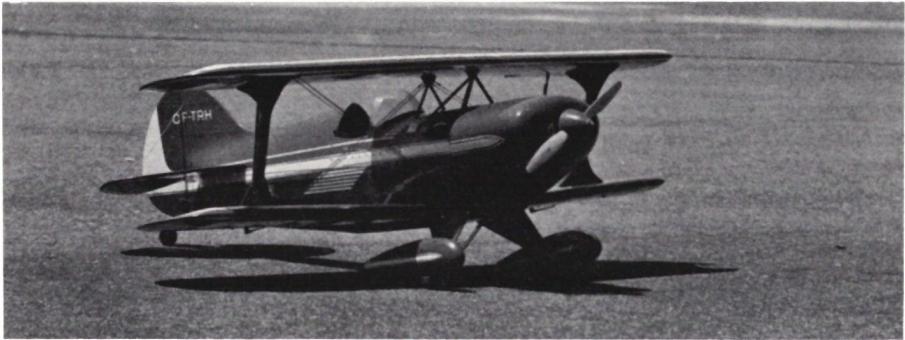
Another important feature of this RC Scale World Championship is that, once again, relatively conventional aircraft such as the Emeraude, Piper Comanche, Cap 20, Piper Cherokee, Shinn 2150 A, etc., have prevailed. These are low-wing aircraft as everyone knows them. For one thing, it’s relatively easy to obtain the plans for these types—preferably directly from the manufacturer—and, for another, the flight characteristics of low-wing models of this design are well known. What is clearly missing is the extraordinary, the experimental. Twin- and multi-engine aircraft, propeller-driven models, delta wings, swing-wing aircraft, rotary-wing aircraft, canard configurations, and so on. It also seems, as in other categories, that taking the leap toward something unique isn’t worth the effort. Competitors take on too many risks. The question is, wouldn’t it be justified—especially in scale model building—to award a special bonus for extraordinary designs? Meant as an incentive! So that the next World Championship doesn’t feature only Cessnas and Pipers? Of course, even ordinary airplanes can be built with exceptional fidelity to the original, and there is certainly still room for development in this direction. But this would be somewhat one-sided if the development of diverse and interesting designs weren’t encouraged.
FINAL RESULTS - 1974 AEROLYMPICS
EVENT: RADIO CONTROL SCALE
| PLACE | NAME | MODEL | COUNTRY | FI-DELITY | CRAFTSMANSHIP | COM-PLEXITY | STATIC TOTAL | ONE | TWO | THREE | TOTAL |
|---|---|---|---|---|---|---|---|---|---|---|---|
| 1 | R. Wischer | Emeraude | U.S.A. | 930 | 870 | 283.5 | 2083.5 | 2,066 | 1,920 | 2,365 | 4,448.5 |
| 2 | J. Roth | Volksplane | U.S.A. | 1,117.4 | 1018.9 | 183.0 | 2,319.3 | 1,672 | 2116 | 2,099 | 4,435.3 |
| 3 | R. Jackson | Piper Comanche 180 | U.S.A. | 838 | 801.9 | 295.0 | 1934.9 | 1,441 | 1952 | 2046 | 3,980.9 |
| 4 | B. Taylor | Fairey Fulmer | England | 672 | 543.0 | 323.5 | 1,538.5 | 1,812 | 2,125 | 2,009.5 | 3,663.5 |
| 5 | R. Fouquereau | Cap 20 | France | 791.5 | 758.0 | 2,655.0 | 1,815.0 | 1,589 | 1,806 | 1,423.5 | 3,621.0 |
| 6 | A. Lunt | Fokker DR1 | England | 187.5 | 783.0 | 288.0 | 1,888.5 | 1,175 | 1,614 | 1,642.5 | 3,531.0 |
| 7 | J. Stromqvist (Jack) | BHT 1 Reauty | Sweden | 711.0 | 710.5 | 355.0 | 1,776.5 | 1509 | 1,623 | 1,685 | 3,461.5 |
| 8 | M. Reeves | Cassutt III M | England | 929.2 | 877.2 | 226.0 | 2032.4 | 1,362 | 497.0 | --- | 3,394.4 |
| 9 | E. Stromqvist (Esbjorn) | Saab Safir | Sweden | 586.5 | 394.5 | 288.0 | 1,269.0 | 2028 | 2,117 | 1,871 | 3,386.0 |
| 10 | E. Brydges | Pitts Spec-SIS | Canada | 652.5 | 533.5 | 289.5 | 1,475.5 | 1,530 | 1,771 | 1,613 | 3,246.5 |
| 11 | B. Klupp | Piper Cherokee Arrow | West Germany | 637.0 | 642.0 | 316.0 | 1595.0 | 1,647 | 1,615 | 1,333 | 3,242.0 |
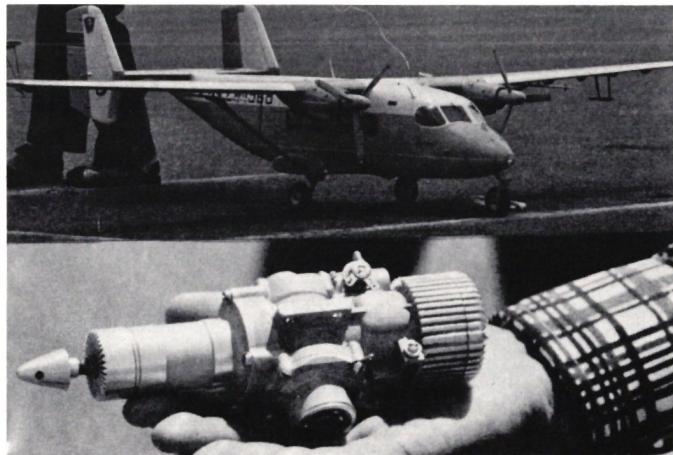
In the West, where RC systems and accessories can be obtained relatively easily and inexpensively, circuit flying leads a rather modest existence, whereas in Eastern European countries, circuit flying occupies a prominent position among RC categories and holds its own very well alongside free flight. This fact also largely applies to scale model circular flight. Here, too, the Eastern European countries play an undisputed leading role and demonstrate an astonishing level of skill. The circular flight pilots have made a decisive contribution to the vibrancy and diversity of this Scale World Championship. They showcased the multi-engine models so sorely lacking in RC, with the Russian pilot Kramerenko even having to custom-build special engines for his AN-14M because standard engines would not have fit in the engine nacelles. It became clear that scale aerobatics can be a rewarding category and actually deserves to be promoted more.
FINAL RESULTS - 1974 AEROLYMPICS
EVENT: CONTROL LINE SCALE
| PLACE | NAME | MODEL | COUNTRY | FI-DELITY | CRAFTS-MANSHIP | COM-PLEXITY | STATIC TOTAL | ONE | TWO | THREE | TOTAL |
|---|---|---|---|---|---|---|---|---|---|---|---|
| 1 | V. Kramarenko | AN-14M | U.S.S.R. | 1104.5 | 1117.5 | 473 | 2695 | 2600 | 2543.5 | 2680 | 5375.0 |
| 2 | J. Ostrowski | Lockheed P-38-L-5LO | Poland | 1022.5 | 1036.5 | 469.5 | 2528.5 | 0 | 2092 | 0 | 4620.5 |
| 3 | M. Reeves | Zlin Acrobat | England | 867 | 750 | 258.5 | 1875.5 | 2167 | 2564 | 2698 | 4573.5 |
| 4 | M. Gretz | Zlin Acrobat 526A | U.S.A. | 791.5 | 766.5 | 247.5 | 1805.5 | 2722.5 | 2456 | 2505 | 4528.0 |
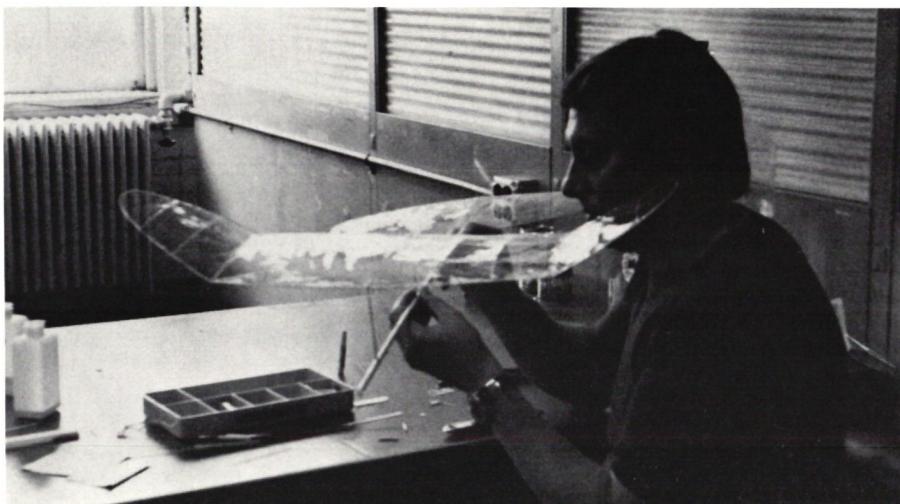
Background: In early January 1974, four idealists came together to revive the “Saalflug” (F1D) model aircraft category, which had already fallen into obscurity in Switzerland. To make the whole endeavor a bit more inspiring, they set their sights on participating in the World Championship. Every spring at the Region 5 chairpersons’ conference, a model category is recommended for promotion. In 1974, it was indoor flying.
The sheer amount of work that had to be done could fill this entire issue. Just a few examples: We relied on translations from the magazines *Modelar*, *CSSR / Aero Modeller*, and *GB*. From German-language books and magazines, we found only older literature. This was followed by the design of our own model. We had to make special tools ourselves: 1/100-gram scales, rubber-winding machines with a 1:50 ratio, etc. Next came the production of all the templates—and, due to the short timeframe, a separate set for each competitor. Microfilm experiments. Airframe bracing tests using chromium-nickel steel wire, Ø 0.02 mm. Finding a suitable hangar for the first flight tests and further training. What followed was building, building—flying, flying!! We also had to pay special attention to transport by airplane and delivery van (always with one person present during transshipment).
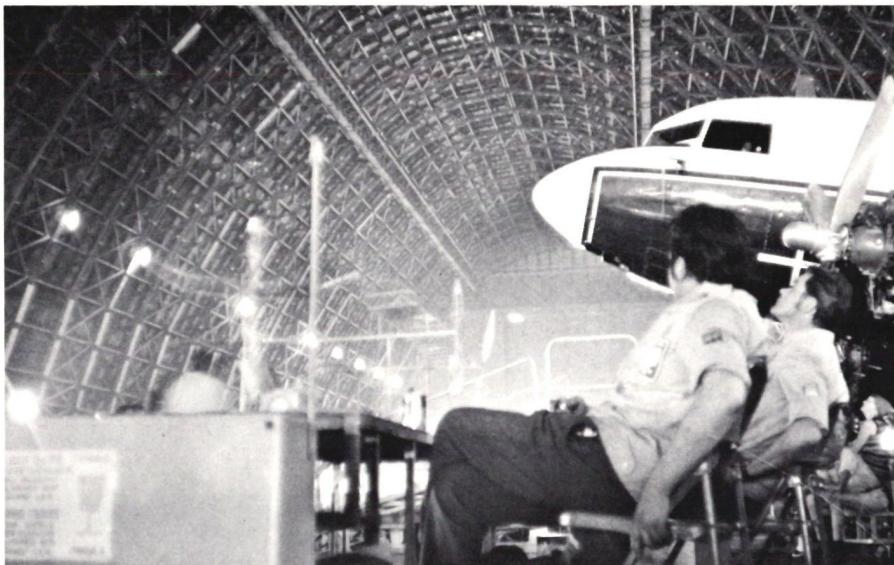
Tuesday, July 2. Departure from Kloten on Balair flight BB 700 at 1:00 a.m. Arrival in New York at 3:00 p.m. We continued our journey in a delivery van and a passenger car provided by the AMA through New York to Lakewood (accommodation for accompanying persons) and Lakehurst (event venue and accommodation for participants in military barracks).
That evening, we would have liked to complete a few training flights. We had to wait three hours because all the beds at the lodging were occupied, and the airship hangar was also closed, so we had no choice but to postpone our plans until the next day.
EVENT: INDOOR
| PLACE | NAME | COUNTRY | ONE | TWO | THREE | FOUR | FIVE | SIX | TOTAL |
|---|---|---|---|---|---|---|---|---|---|
| 1 | R. Czechowski | Poland | 34:27 | 34:50 | 29:01 | 34:56 | 34:53 | 33:34 | 69:49 |
| 2 | B. Servaites | U.S.A. | 33:59 | 6:56 | 33:40 | 32:44 | 25:54 | 33:51 | 67:50 |
| 3 | K. Rybecky | C.S.S.R. | 21:51 | 31:32 | 2:49 PM | 7:39 p.m. | 30:27 | 35:44 | 67:16 |
| 4 | S. Kujawa | Poland | 29:45 | 32:34 | 9:39 | 28:26 | 34:32 | 9:55 | 67:06 |
| 5 | E. Ciapala | Poland | 27:52 | 31:01 | 32:49 | 17:43 | 34:11 | 30:25 | 67:00 |


News from HEBU

TEAM MANAGER "THIS" BOSSHARD
 Rodito Nussbaumer

YOU KNOW WHAT I MEAN? 125 YEARS OF THE SWISS AERO CLUB
 Emil Giezendanner

F3A EUROPEAN CHAMPIONSHIPS IN ST-MACAIRE, FRANCE
 Matthias Bosshard

SUMMER FUN 2026 AT MG USTER
Martin Wunderli
TRY-OUT DAY AT MFV WETTINGEN
Urs Keller
52. 2026 ALPS CUP
Emil Giezendanner
BY YOUTH, FOR YOUTH
Lorena Betschen
ATOM, THE NEW DOUBLE-DECKER FROM CPLR
Matthias Bosshard
CORSAIR F4U – A WARBIRD WITH A MEMORABLE LOOK
Jürgen Rosenberger, Jürgen Prinz
SMALL, MODEL-LIKE SAILBOATS
Res Dauwalder
What's New at Leomotion.com

HORIZON HOBBY/LEMACO NEWS: MICRO OV-10 BRONCO 645 MM BY E-FLITE

TWIN TOWN PARTNERSHIP
Wolfgang Voeller
PRIDE AND GOOD IDEAS
 Markus Nussbaumer

EURO CONTEST GLIDER ACRO TOUR AUSTRIA 2026

INSIGHTS INTO THE HISTORY OF SEAPLANES

34th HAHNENMOOS ALPINE MODEL AIRPLANE CAMP
Res Dauwalder
WELCOME, NEW MEMBER!
Andrea Bolliger
FREE FLIGHT IN THE MIDDLE OF SUMMER
Urs Muntwyler
COUPE DES ALPES – OBSERVE AND LEARN
Rodito Nussbaumer
THE PC-21 STORY
Emil Giezendanner
NEWS FROM HEBU
 Julia Bucher

FROM 0 TO 100
Markus Nussbaumer
MEMORIES
Wolfgang Völler
NOS REGION – A HUB FOR ELECTRIC AVIATION
Emil Giezendanner
Have you almost forgotten about aircraft that take off and land vertically?
Emil Giezendanner
DO YOU KNOW WHAT I MEAN IN THE LAND OF SMILES?
Emil Giezendanner