
The Czech Eldorado
Our stores are filling up with products from Eastern Europe. But what systems are in place to get these models to us at such competitive prices? "Modell Flugsport" took advantage of its trip to the Czech Republic for the Model Hobby exhibition in Prague to raise its profile a bit throughout the country...
East of Prague were a few model airplane builders who, lured by the prospect of money, quickly abandoned their studies to devote themselves to building molded gliders, most of which were intended for competition. Given that the average salary in the Czech Republic was equivalent to 500 Swiss francs, it’s easy to see how the lure of profit quickly turned friendships into rivalries. Several groups thus manufacture high-end products and market them in various ways.
Bretamodel was founded by two friends who will soon be assisted by five employees. They produce modern competition gliders in very dilapidated facilities. Their initial passion was for circuit flying, then wardogs—airplanes used for banner racing. This passion remains evident in one of their products: a molded Mustang. Bretamodel is best known in North America, where the majority of their production is currently headed: the Nemesis for 60" pylon racing, and the Hera or Artemis for F3J. The quality of these gliders is undoubtedly the best currently available in the field. Carefully selected balsa wood for production, fiberglass/carbon fiber skins, hollow wings, carbon fiber spars specially reinforced for torsional strength, and Kevlar-carbon fuselages. Until recently, before the Nyx glider, these craftsmen produced the positive molds by hand: no CNC machines, only molds made conventionally from a putty-filled positive wing. A single mold per model confirms that each one is crafted individually. Fifteen large gliders (F3) and 20 small ones (60") are produced each month. The molds are extremely rigid since they are made of corundum, a very hard and abrasion-resistant material used, among other things, to make grinding wheels. The positive molds for the
The fuselages are also constructed in a very conventional manner. They are made from a Kevlar-carbon composite fabric. A balloon inflated inside the mold presses the fiber into place during the drying and curing phases. The manufacturing process could not be photographed due to trade secrets. For the wings, the servos and control covers are integrated into the molds. A CNC machine for machining molds represents an investment of CHF 50,000. Considering that the average monthly salary in the Czech Republic is Sfr. 500.–, one can imagine how many gliders would need to be produced to make the investment profitable. Bretamodels has embarked on this venture. The challenge now lies in operating the machine and producing molds for external customers—and, above all, in training an engineer within the company who is capable of using it... call for enthusiasts.
We tested the first glider in Breta’s new generation, featuring CNC-machined molds: the Nyx. This glider is available in an all-carbon version for F3B or a lightweight version for F3J and is designed primarily to meet criteria from the Americas. In fact, demand across the Atlantic differs from ours: the dihedral flaps must be able to pivot 90° and therefore be hinged to the underside, and the stabilizer must be cross-shaped—a requirement that also...
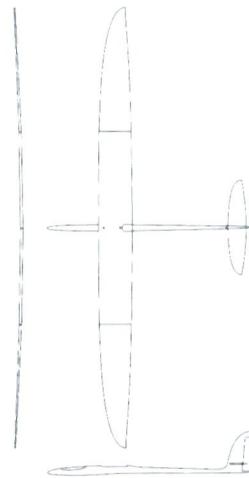
| wing span | 3200 mm |
| length | 1490 mm |
| area | 64 dm2 |
| airfoil wing | HN 354SR |
| airfoil elevator | HN315S |
| flight weight | 2100 g |
| ballast | 600 g |
a model that stands out in Europe. The wing is still in three sections, contrary to the current trend. As for the rest, each customer has their own specific needs, ranging from carbon reinforcements to the glider’s color. Breta remains very open to all these requests, taking every opportunity to improve the model. In addition to feedback from competitors,
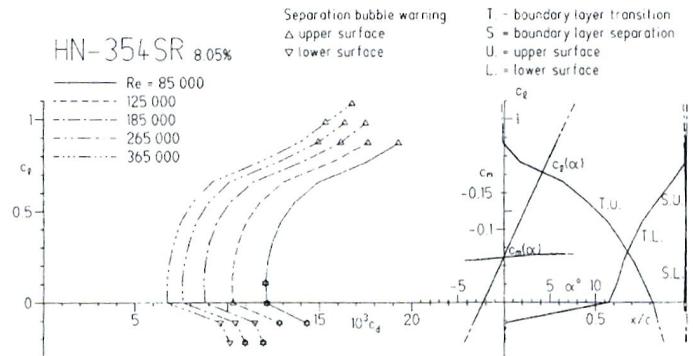
the model’s aerodynamics, proportions, and profile were reviewed by the guru known as “Cappuccino.” Mr. Kapuscinsky is a respected figure in aeronautical research. He quickly established himself, and all of Breta’s projects now pass through his hands before the molds are made. A new feature is the choice of a profile by Norbert Habe, the HN 354 SR, with a thickness of 8.05% and a curvature of 1.64%—which is low for the F3J class. The wingspan is 3.20 meters, with minimum flight weights ranging from 1,900 g to 2,200 g depending on the version. The prototype I had the pleasure of testing weighed 2,000 g. Manual launches
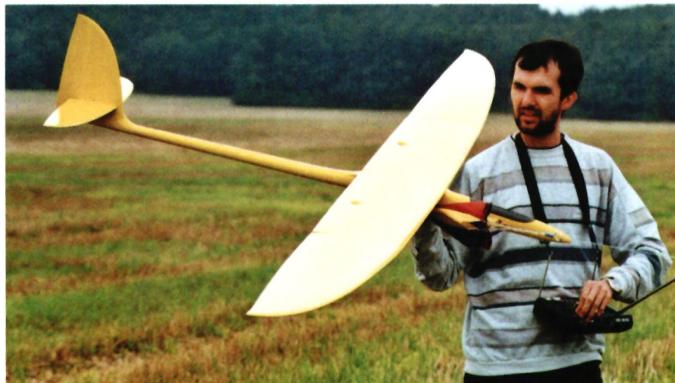
weren't very turbulent in calm, overcast fall weather. The immediate impression after a smooth winch launch at a moderate altitude is how easy it is to fly in spirals. The glider forgives piloting errors without losing altitude. Tight, flat turns are surprisingly effortless. The rudder-aileron interaction is a delight. With this airfoil, I didn’t feel the need to increase the camber in turns or while flying straight to better exploit the day’s weak thermals. The cruise speed doesn’t seem high—which is normal at 31 g/dm³—but what glide efficiency! It wasn’t possible to add more than 400 g of ballast. In this configuration (37 g/dm³), there were no measurable changes in winching performance or ease of handling. The speed along the flight path was slightly increased without significantly altering the spiral characteristics or flight comfort. The ten-minute flight time shouldn’t pose any major problems with the Nyx. Speed readings weren’t exactly dazzling, though. It’s a shame I can’t add the extra 800 g it will need for F3B and F3F. Its wingspan makes itself felt during turns. Simple aerobatics flow smoothly, with the added bonus of inversions—which are difficult with a V-tail. I didn’t have time to adjust the glider to my liking or play with the flaps to learn more about its agility. We’re looking forward to seeing the Nyx in competition in the hands of a skilled pilot. The “landing” configuration was set in the American style, with the ailerons raised and the flaps set at 90°. The glider then literally comes to a stop, and all it takes is a quick dip toward the target to score 100 points. After a day of flying the Nyx, it’s clear that it’s easy to get used to right away—which is unusual for a glider in this category. It has a modern look with its tapered elliptical wingtips (reminiscent of the Estrella) and a subtle dihedral. Its finish is flawless, with no unnecessary details, and its in-flight behavior confirms that these design choices were spot-on. The tail unit is generous—perhaps too much so for F3B. Given the prices in the Czech Republic, I hope the retail price will be under 1,500.–. This is a great glider.
| NYX | F3B/J |
| Wingspan | 3200 mm |
| Length | 1,490 mm |
| Wing area | 64 dm² |
| Wing profile | HN 354SR |
| Profile Stab. | HN315S |
| Weight | 2100 g |
born. I'm looking forward to seeing them compete in Europe. In Switzerland, the Nyx is available at
| Insider Modellbau, run by Eric Müller, a member of the Logo Team in Zollikofen near Bern (http://www.insider-modellbau.ch).
Lubos Pazderka is well known in the F3J world because he is none other than the reigning European champion with the Eraser, which he produces and sells himself (also available from Airtech). This ecology student dropped out of school to build pianos at a large factory in the region, which he regularly flies over during training. Everything else seems “stupid” to him (in his own words), except for his gliders... Lubos now devotes himself exclusively to the production and sale of his glider—
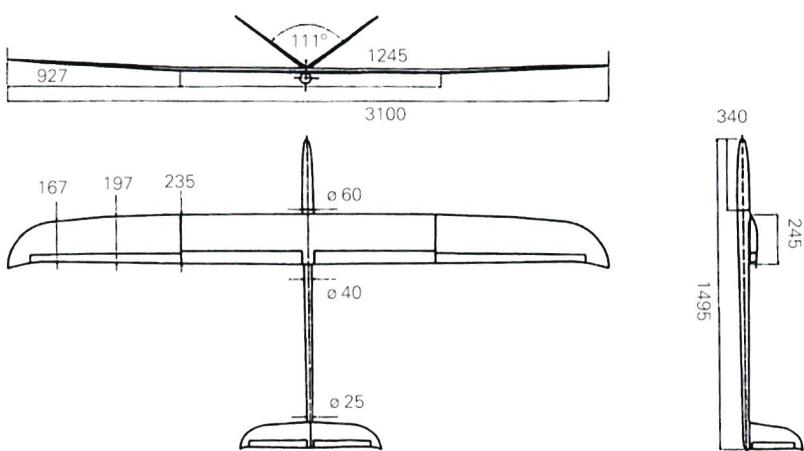
F3B/J glider, the Eraser, available in several versions. “My business is doing so well that I don’t have any time left for training,” he says, holding up his European championship trophy. Today, he and a friend produce 20 models a month for customers all over the world. One could almost say that his glider features a classic molded construction using 1.2 mm Airex for the skin. The fuselage is made of a Kevlar/carbon hybrid fabric. We were able to fly using his settings—the version (without winglets) with which he became European champion. The glider weighs less than 2 kg and has a wingspan of 3.10 m. The airfoil is an MH32. This glider is available in F3B and F3J versions, as well as with winglets (3.17 m). That day, the wind was strong, and there was little sunshine. The thermals
were not very sharp and somewhat choppy. Lubos flies with the ailerons on the throttle stick so that he can intuitively adjust them for the desired flight path. He therefore constantly varies their position while turning. The initial flying experience was a bit disorienting until I found the right balance between the rudder and the highly sensitive ailerons. Any inaccuracies immediately resulted in a loss of altitude. The glide performance was more than adequate in the wind for such a light glider. The flaps in the negative position even helped at times during transitions. As for the rate of descent, there’s no doubt about it: the glider isn’t a champion just because of the pilot! There’s not much to say about winch launches—whether direct, two-person, or with an anchor point. Lubos prefers the winch height—
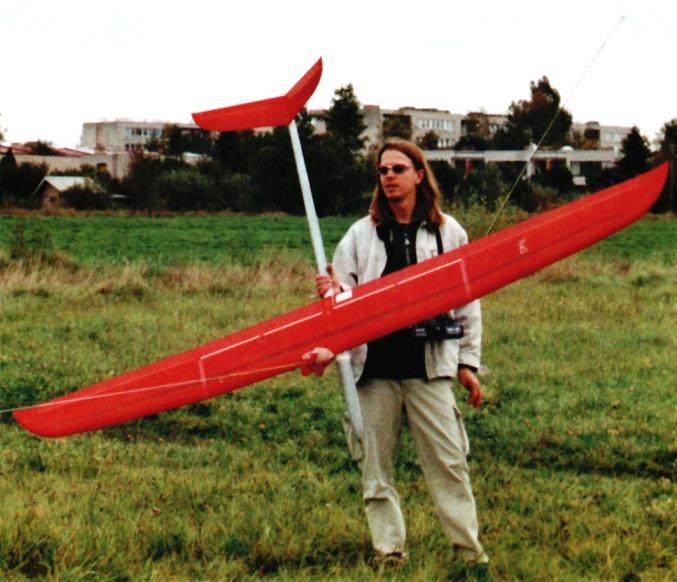
He adjusted his glide time to match the winching duration so he could more easily keep an eye on his opponents while flying above them. The landing was just a formality. Lubos tried to keep the glider hovering motionless over the target for as long as possible before diving toward it at the last second—sometimes rather clumsily and with little regard for his aircraft. Lubos envisions the future of F3J with larger gliders and 2% dihedral profiles. He has often mentioned the HQW 2/8 as his next project. Stay tuned...
T. Ruef
Lubos Pazderka lets us try out his European champion Eraser.

EURO CONTEST GLIDER ACRO TOUR AUSTRIA 2026

THE PC-21 STORY
 Emil Giezendanner

TWIN TOWN PARTNERSHIP
 Wolfgang Voeller

SUMMER FUN 2026 AT MG USTER
Martin Wunderli
CORSAIR F4U – A WARBIRD WITH A MEMORABLE LOOK
Jürgen Rosenberger, Jürgen Prinz
52. 2026 ALPS CUP
Emil Giezendanner
YOU KNOW WHAT I MEAN? 125 YEARS OF THE SWISS AERO CLUB
Emil Giezendanner
News from HEBU

TEAM MANAGER "THIS" BOSSHARD
Rodito Nussbaumer
ATOM, THE NEW DOUBLE-DECKER FROM CPLR
 Matthias Bosshard

F3A EUROPEAN CHAMPIONSHIPS IN ST-MACAIRE, FRANCE
Matthias Bosshard
INSIGHTS INTO THE HISTORY OF SEAPLANES

WELCOME, NEW MEMBER!
Andrea Bolliger
What's New at Leomotion.com

PRIDE AND GOOD IDEAS
 Markus Nussbaumer

SMALL, MODEL-LIKE SAILBOATS
Res Dauwalder
FREE FLIGHT IN THE MIDDLE OF SUMMER
Urs Muntwyler
BY YOUTH, FOR YOUTH
Lorena Betschen
HORIZON HOBBY/LEMACO NEWS: MICRO OV-10 BRONCO 645 MM BY E-FLITE

COUPE DES ALPES – OBSERVE AND LEARN
Rodito Nussbaumer
34th HAHNENMOOS ALPINE MODEL AIRPLANE CAMP
Res Dauwalder
TRY-OUT DAY AT MFV WETTINGEN
 Urs Keller

NEWS FROM HEBU
 Julia Bucher

NOS REGION – A HUB FOR ELECTRIC AVIATION
Emil Giezendanner
MEMORIES
 Wolfgang Völler

70 YEARS OF THE NIDWALDEN MODEL AIRPLANE CLUB
Martin Barmettler
A SPECTACULAR F3A WORLD CUP IN THE PRINCIPALITY OF LIECHTENSTEIN
Emil Giezendanner
FROM 0 TO 100
Markus Nussbaumer