
Thoughts, Reflections, and Conclusions on the FAI/F3B/RC Gliding Rules
On the occasion of the 2nd World Championship in early July 1979 in Amay
That’s just the nature of rules—whether they were created for model aircraft championships or for any other sport. They consistently spark lively, and sometimes even heated, discussions among participants and enthusiasts. The F3B rules are no exception.
Many excellent ideas and arguments are put forward; however, many of these suggestions—certainly well-intentioned—often lack a thorough, detailed analysis of all the consequences resulting from them. This is the only way it could have happened, for example, that at the CIAM conference in Paris in 1977, out of a jumble of differing opinions, a compromise solution emerged: the 12-round limit in distance flying and the reduction from 3 to 2 disciplines per round.
I would like to take this opportunity to list a few proposals that I have heard and read time and again, and then discuss them in more detail, among other things.
- Changes to the landing evaluation criteria for endurance flight. Instead of the current landing point, a landing rectangle or a landing line of limited length is required to prevent touch-and-go landings.
- Increase in flight time for endurance flight from 6 minutes to 8 or 10 minutes.
- Introduction of a landing evaluation in distance and speed flights analogous to that in endurance flights.
- A merger of distance and speed flights into a single discipline. This means a flight over $4 \times 150$ m with 3 turns instead of $2 \times 150$ m with 1 turn.
- Elimination of Discipline B (distance flight) from the F3B program, as this flight task says absolutely nothing about the quality of either the model or the pilot.
- Elimination of the speed flight, since reducing the initial altitude of 150 m to 0 in the shortest possible time, with a glide ratio of 1:2, has absolutely nothing to do with RC gliding.
- For high-launch events, only motorized winches—which should be provided by the organizer whenever possible—should be permitted, in order to give competitors who do not have access to a top-level athlete to assist with the high launch a fair chance.
Based on my many years of F3B experience as a team leader, as a member of the CIAM RC Gliding Training Committee, and as an occasional, somewhat haphazard competitor at international F3B competitions, as well as based on the extensive statistical data collected during the 2nd World Championship in Amay, I would like to take this opportunity to discuss in more detail the various current issues facing RC gliding.
The F3B rules adopted by CIAM in 1973 were—and still are—intended to enable the holding of World Championships and international championships in the RC gliding category among the best RC glider pilots from all countries in a competition that is as fair as possible, yet clearly performance-oriented.
With the introduction of the three-discipline competition, based on the Lombard formula for RC gliders, an excellent set of rules was created that is virtually predestined to promote RC gliding in every respect. Since the same model must achieve, in endurance flight—in the high $c_a$ range—minimum sink rates of 42 cm/s or even lower, and in distance flight, a glide ratio of 1:20 or better, and in speed flying it must achieve average flight speeds of 30 m/s or more, combined with high acceleration forces, the model resulting from these combined requirements becomes a truly good all-around model that will also appeal to the average model glider pilot. If the model meets the requirements—
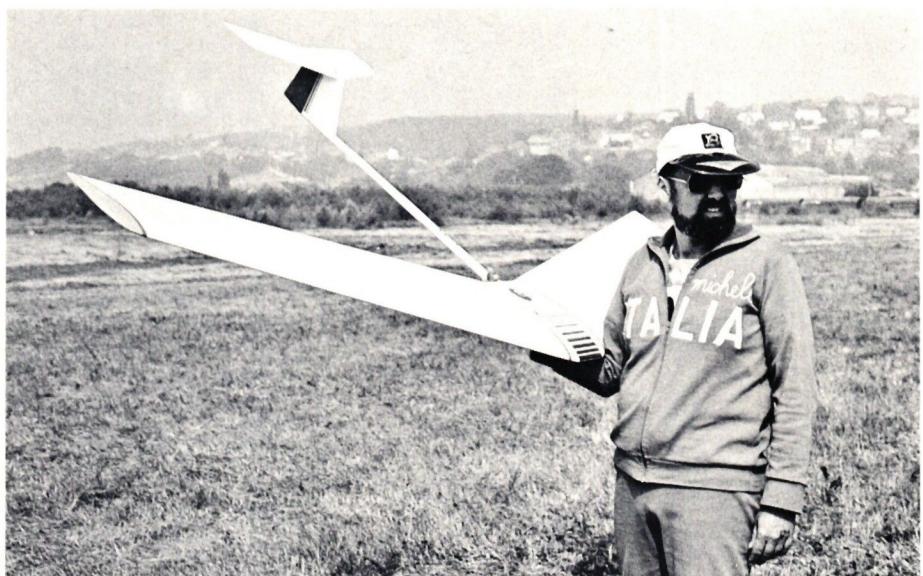
Thanks to its aerodynamic cleanliness, precise wing construction that follows the airfoil profile, geometric symmetry (absolutely no warping), structural strength—it is a feast for the eyes and a true joy even for the non-performance-oriented model glider pilot to be able to fly this model easily and without difficulty, even under conditions where others would already have to give up.
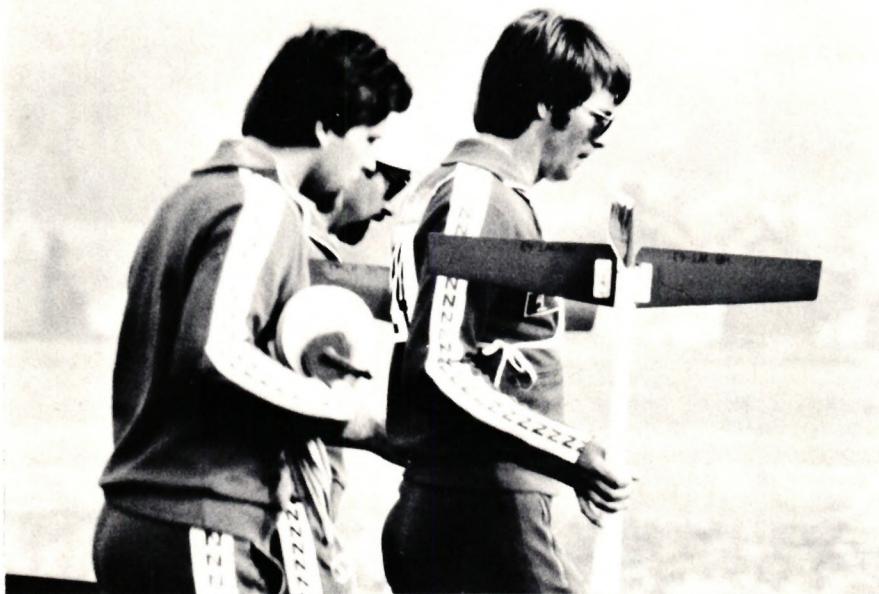
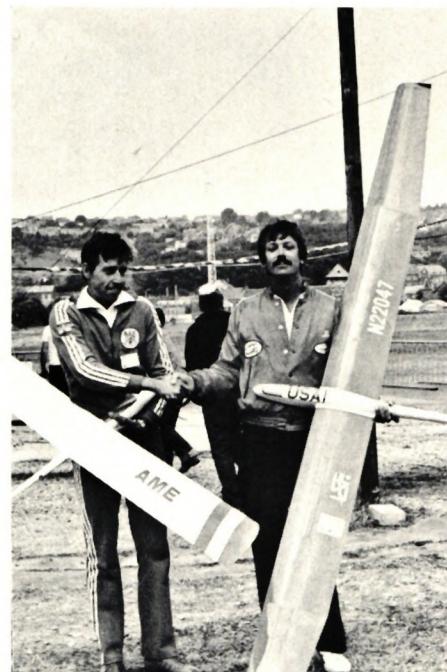
The members of the successful AME club from Innsbruck prove with their Dassel that this view is by no means unfounded. The entire model design was intended exclusively for slope flying in high mountains, and there was no mention of F3B at the time of its conception. The requirements applied to this model—which are now essential for F3B—combined with the consistent application of center of gravity and center of lift calculations for various airspeeds, and flying as close as possible to the zero-moment setting, led to the great and long-lasting successes of this group, which culminated in Anton Wackerle’s victory at the World Championships in 1979.
When the outgoing world champion, Skip Miller, and the US team’s manager, Dan Pruss, took the opportunity to fly the Dassel themselves after the World Championships in Amay, they were extremely surprised by the model’s remarkable good-naturedness and how effortlessly it handled. The feared stalling in turns, even with an increased EWD, simply did not occur. After the flight, the two commented that a great deal needs to happen in the F3B sector in the U.S. over the next two years, although neither of them believes these demands will gain widespread acceptance anytime soon.
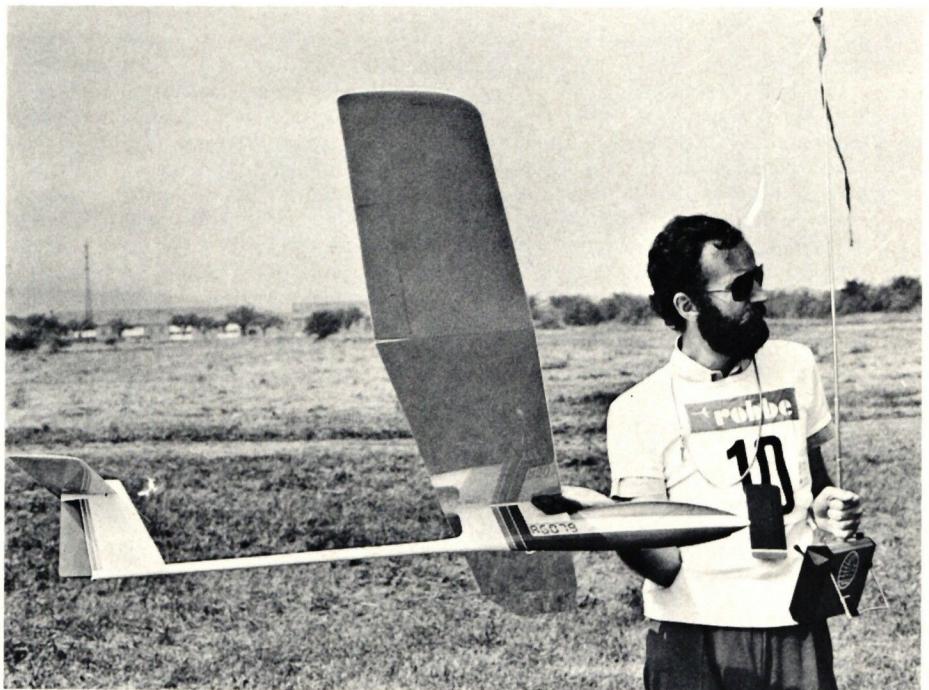
It’s certain that even at world championships, it’s not only—or not yet—“F3B specialists” who compete against one another. It’s also true that such model pilots should participate in both national and international championships, because experience must be gained, and nowhere else can ideas for further development be shared more effectively than at a competition. However, one must be aware that achieving a top ranking with models considered conventionally built today would be a pure stroke of luck. Forcing higher performance—for example, in high-speed flight—which in some cases far exceeds the model’s structural strength, unfortunately still far too often leads to dangerous-looking situations, such as uncontrollable flight conditions or even wing fractures.
For example, geometric or aerodynamic restrictions on the wings—which are intended to lead to more stable flight behavior in the high $c_a$ range, can lead not only to a loss of performance but also, during high-speed flight—due to the varying angles of attack of the wings—to enormous torsional stresses. These stresses become visible when the wings are forced into a negative V-shape by the acting forces. In such a flight attitude, even the slightest gust or a small elevator deflection results in large and sudden load changes and, in the worst case, leads to wing failure.
Adding a large amount of ballast—preferably in the model’s fuselage, since there are no ballast tubes in the wing—is intended to increase the model’s speed, according to the formula $G = v$. However, this often overlooks the structural strength limit of the wings—
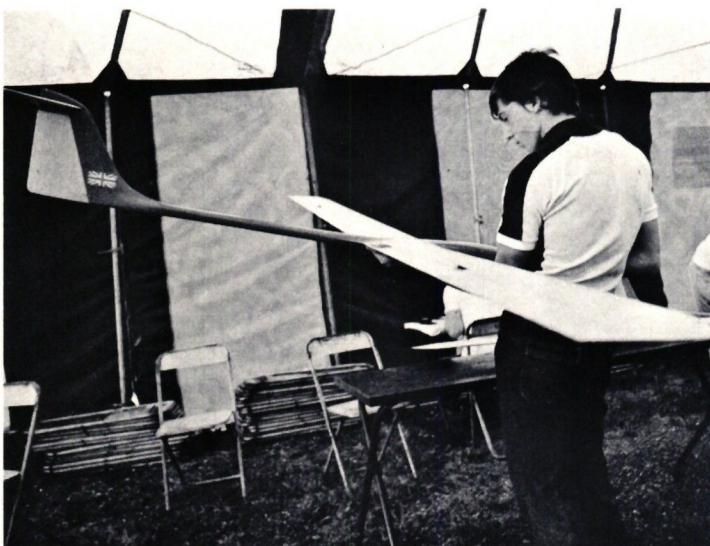
to recalculate. Given the high accelerations that can occur during a turn (in the range of 10–17 g), even the slightest turbulence or a minor control error is enough to cause the wings to stall.
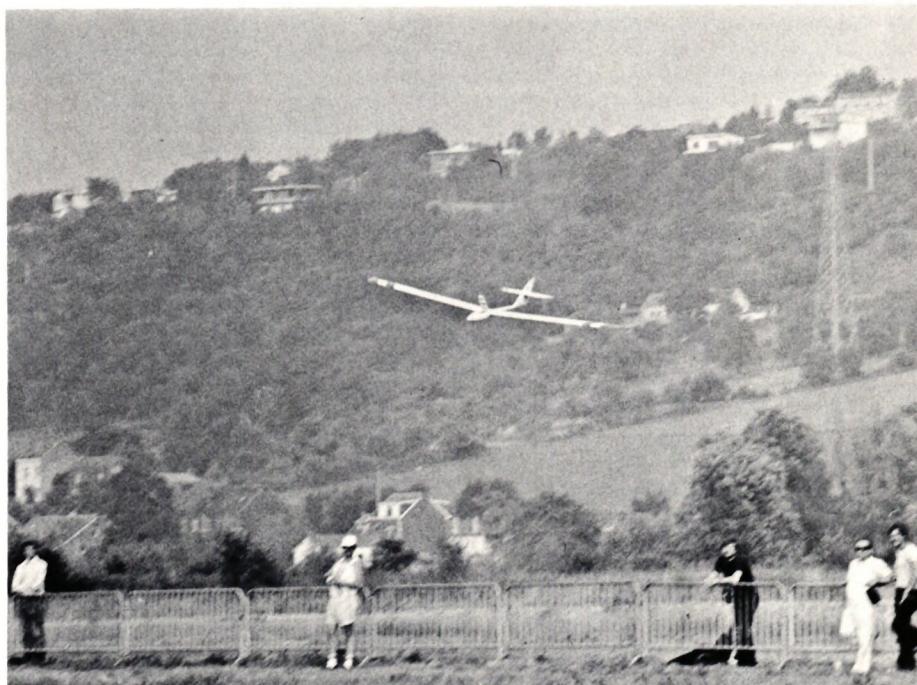
One then becomes frustrated by the futility of high-speed flight, since a glide ratio of “1:2” wipes out the entire 150-meter altitude. However, once one realizes that—in addition to selecting a suitable airfoil—the aerodynamically sound design of the model, its absolutely distortion-free geometry, the appropriate adjustment of the center of gravity to the shifted center of lift, and—last but not least—very fine and precise piloting are the be-all and end-all of speed flying, then speed flying takes on much greater significance. For the average modeler, this ultimately means owning a model capable of flying across a wide speed range and that can still be flown even in strong winds, including on a slope. One is then no longer surprised, however, at how much altitude can be regained from the high speed achieved after launch. With a little thought, glide ratios of 1:2 are out of the question. However, if the model lands immediately after crossing base A following the speed flight—
When it comes to speed flying, there’s really no need to worry about the “performance” of this model anymore.
The results of the speed flight analyzed at the 2nd World Championship in Amay in 1979 show a performance curve for the competitors that is approximately normally distributed according to Gauss. This is obviously a consequence of the fact that, according to the rules, the speed flight is not subject to any limits. This insight must be taken into account, and no changes should be made to the rules. However, measures must be taken to ensure the safety of spectators, volunteers, timekeepers, etc., such as by closing off the side of the course where flying takes place to all persons.
Over the course of its development, endurance flying has evolved into a true form of precision flying, and it would be wise to view it as such. Under wind conditions ranging from 0 to 4 m/s, an average of more than 55% of the competitors at the 1979 World Championships achieved flight times between 5 minutes 45 seconds and 6 minutes. When the average wind speed is 5–8 m/s, the percentage of competitors achieving this time drops to 25–30%, and at wind speeds above 8 m/s, the distribution of times approaches a Gaussian normal distribution, though not particularly pronounced.
What conclusions can we draw?
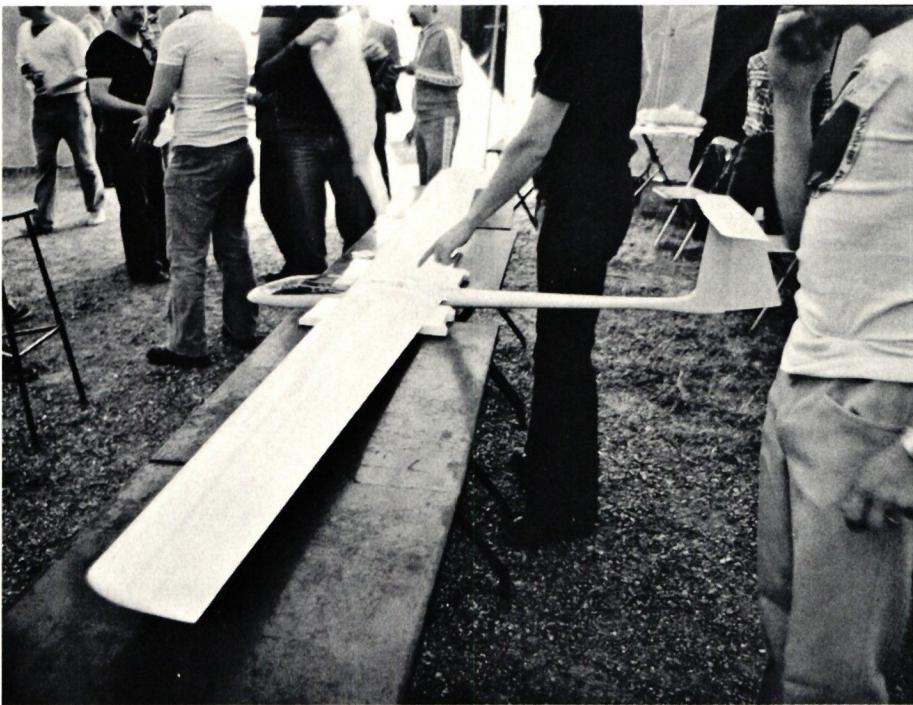
Now, let’s move on to this. It appears that the endurance performance of the models and the pilots has reached the upper limit of 6 minutes. However, since 6 minutes does not represent an absolute upper limit—as it is well known that once the 6-minute mark is exceeded, one point is deducted per second— and since the landing evaluation is geared toward achieving the most precise landing position possible, we should no longer speak of an endurance flight, but rather of a precision flight. Increasing the flight time from the current 6 to 8 or 10 minutes would change very little in the current situation. Even with the slightest thermal activity, flights lasting hours are possible. Only the greater dependence on changing thermal conditions would have a more negative impact on the competition, as is currently the case in distance flying.
Another option would be, for example, to shorten the launch line length for endurance flight to, say, 100 m. However, for organizational reasons, this would have to be applied uniformly across all three disciplines, and this seems to make little sense for either distance flying or speed flying and would lead to the same problem again in a few years.
The only real option left is to increase the precision requirements by raising the number of points awarded per flown se-
precision and a more refined breakdown of the landing score.
However, the current imbalance—in which this precision task is overemphasized in the F3B rules due to the A/B and A/C formulas per round—must certainly be corrected to restore a balanced parity among all disciplines, by returning to the originally excellent 3-discipline-per-round concept.
For the reasons stated above, simplifying the landing evaluation requirements by introducing a landing rectangle or a landing line of limited length would certainly not meet the expectations placed on such a change.
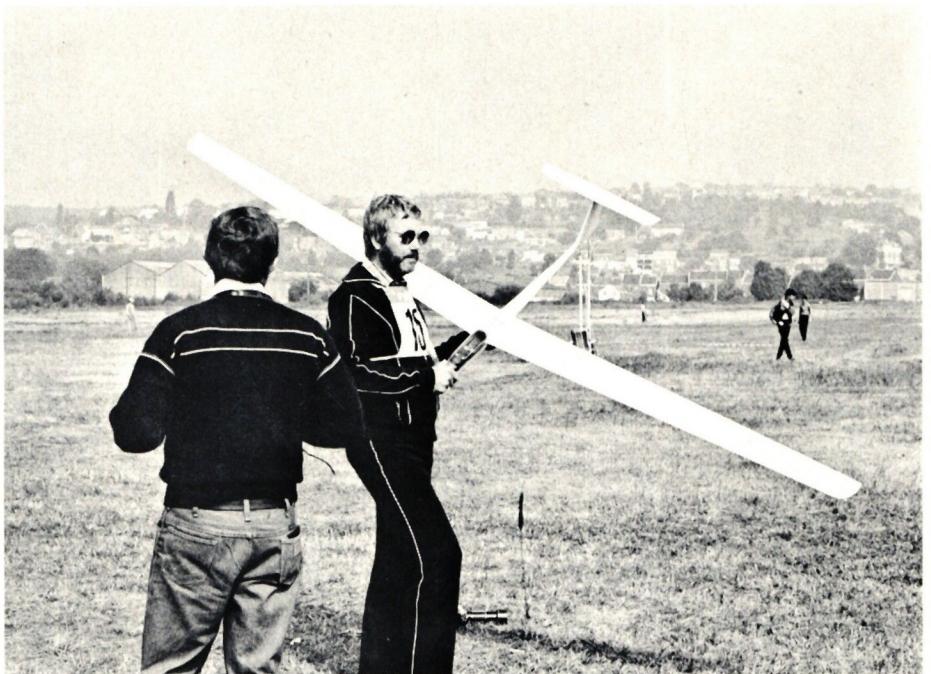
The studies conducted in Amay on performance in distance flying confirmed the negative effects anticipated by many F3B specialists. Due to the limit of 12 laps, on average more than 30% of all competitors completed the full maximum of 12 laps, with the exception of the final round, when average wind speeds of 9.3 m/s were measured. Due to this limitation, the original purpose—namely, to fly the model over the course with an optimal glide angle—has lost much of its significance. For 12 laps, starting from an altitude of 150 m, a glide ratio of approximately 1:15 is required—taking the turns into account—to complete the task. Since no better glide ratios are needed, this hinders further development aimed at improvement.
For 18 laps, however, a glide ratio of at least 1:21 is required. The major problem with distance flying with an unlimited number of laps appears to be the changing influence of thermals over the duration of the discipline. Ideally, one would need to
A distance flight could take place over terrain of the competitor’s choosing. However, imagine the organizational effort required for such a format. In this discipline, though, the competitor has the opportunity to strategically allocate his 4-minute flight within the 8-minute time limit in a tactically sound manner. Furthermore, it is essential to allow for an unlimited number of attempts, similar to the endurance flight. This would eliminate some of the most significant shortcomings in this discipline. In addition, every competitor should at least have the option to shift the model’s flight path parallel to the course, to the left or right, over an unlimited distance.
If a top pilot completes 4 or 5 laps with a model designed specifically for distance flying, while at the same time another competitor in the same starting group is able to complete the full 12 laps 100 meters off the course, then this certainly cannot be attributed to bad luck regarding thermal conditions. Take the time to measure the times the models take outside the baseline during turns. Compare the total time spent outside the course with the time flown within the course, and you’ll be amazed at how many laps are wasted during the turns.
Next, take the time to calculate the center of lift for a $c_a$ value that corresponds to ideal gliding flight. For the distance flight, set the center of gravity close to the calculated center of lift and fly this discipline with the smallest possible EWD. You’ll be amazed at the improvement in your model’s performance. But be careful when landing. Attempting to slow the model down for the landing approach by increasing the EWD will result in a bit of a “juggling act” for the pilot. For the time being, a precision landing is out of the question. If this requirement were to be applied to distance flying as well, the problem would inevitably have to be solved by adjusting the center of gravity during flight or even by using flaps. Certainly a rewarding challenge for F3B specialists, but certainly not the desired outcome for those model aviators who are making this demand.
There are certainly other ways to manage the changing thermal conditions. I’m thinking, for example, of introducing a group-based scoring system or factoring in the speed flown in relation to the distance covered, in other words, taking into account the time required for the distance flight—though it should be noted that flying at high speed in this discipline would not be enough to earn enough points for a good placement.
Finally, a few thoughts on the high-launch problems.
As brilliant as the idea may seem at first glance—that the organizers would provide enough similar high-launch winds—the following must be taken into account. From an international perspective, the number of participating competitors will increase significantly in the future. For example, in 1979 there were still no
Eastern Bloc countries are represented at the World Championships. However, there are signs that intensive work and development are taking place there. Observers at the World Championships as well as at international competitions are closely monitoring these developments here in the West.
In order to make a discipline viable within a reasonable timeframe in the future, the only option is to increase the number of competitors per starting group. Today, as many as 8 competitors are already assigned to the same starting group in the endurance flight. Having the organizer provide and maintain that many high-launch winds is likely to pose a nearly insurmountable problem.
On the other hand, steps must be taken to resolve the issues with line crossings. It seems to me that a more lenient approach to the problem offers the best solution. If a competitor has no opportunity to repeat a start at the end of the current discipline, he will do everything in his power to prevent a line crossover from the very beginning. In addition, every competitor has the opportunity to make an unlimited number of attempts within their discipline time, which would essentially cover all possibilities. As for hand-launched takeoffs, I must state quite clearly here that I have yet to see an RC glider that requires a 100-meter sprinter to be launched, provided that the launch hook has been positioned carefully and the EWD for the launch has been selected correctly. It’s downright frustrating to see how otherwise very good models and skilled pilots fail to determine the correct position of the hook. Certainly, many factors—
It takes some getting used to, but consistent practice during training is guaranteed to bring the desired results.
I hope that with these few observations—which, unfortunately, do not go into nearly enough detail (as there isn’t enough space available at the moment)—I have nevertheless managed to contribute a little to a better understanding of the truly interesting and promising sport of F3B flying. We must learn to adapt to the well-thought-out rules and to approach the models and training in accordance with the requirements set forth, rather than trying to adapt the rules to those who shy away from the effort that is, after all, fundamental to moving forward.
At the national level, the F3B promotion and relegation system has indeed created a solid foundation for the development of top pilots in Switzerland, but this system has also paved the way for healthy growth at the grassroots level. The option to fly only the FAI endurance flight at the Regional Championship was intended to ensure that, despite high participation numbers, at least 5 to 6 rounds could be held, since only a large number of rounds guarantees the fair conduct of an RC gliding competition.
However, if this opportunity is squandered and only 3 rounds are flown under this format, not only is a disservice done to the most important element of a competition—namely, the participants—but, unfortunately, it also means that the very idea behind the whole event has not yet been understood.


News from HEBU

TEAM MANAGER "THIS" BOSSHARD
 Rodito Nussbaumer

YOU KNOW WHAT I MEAN? 125 YEARS OF THE SWISS AERO CLUB
 Emil Giezendanner

PRIDE AND GOOD IDEAS
 Markus Nussbaumer

ATOM, THE NEW DOUBLE-DECKER FROM CPLR
 Matthias Bosshard

SUMMER FUN 2026 AT MG USTER
Martin Wunderli
F3A EUROPEAN CHAMPIONSHIPS IN ST-MACAIRE, FRANCE
Matthias Bosshard
52. 2026 ALPS CUP
Emil Giezendanner
HORIZON HOBBY/LEMACO NEWS: MICRO OV-10 BRONCO 645 MM BY E-FLITE

TWIN TOWN PARTNERSHIP
Wolfgang Voeller
CORSAIR F4U – A WARBIRD WITH A MEMORABLE LOOK
Jürgen Rosenberger, Jürgen Prinz
TRY-OUT DAY AT MFV WETTINGEN
Urs Keller
WELCOME, NEW MEMBER!
Andrea Bolliger
COUPE DES ALPES – OBSERVE AND LEARN
Rodito Nussbaumer
EURO CONTEST GLIDER ACRO TOUR AUSTRIA 2026

BY YOUTH, FOR YOUTH
Lorena Betschen
INSIGHTS INTO THE HISTORY OF SEAPLANES

34th HAHNENMOOS ALPINE MODEL AIRPLANE CAMP
Res Dauwalder
SMALL, MODEL-LIKE SAILBOATS
Res Dauwalder
What's New at Leomotion.com

FREE FLIGHT IN THE MIDDLE OF SUMMER
Urs Muntwyler
THE PC-21 STORY
Emil Giezendanner
NEWS FROM HEBU
 Julia Bucher

FROM 0 TO 100
Markus Nussbaumer
MEMORIES
Wolfgang Völler
NOS REGION – A HUB FOR ELECTRIC AVIATION
Emil Giezendanner
Have you almost forgotten about aircraft that take off and land vertically?
Emil Giezendanner
DO YOU KNOW WHAT I MEAN IN THE LAND OF SMILES?
Emil Giezendanner