
History Relived
A basket welded together from bent steel tubes on a hydraulic lift is supposed to take Kurt Wächter and me to our desired location. As unsteady as two young birds in their nest, we try to adjust our position using two joysticks. Urs Ritter, who is in charge of the Luftwaffe’s historical artifacts at the Dübendorf Museum, is convinced that anyone who can fly a model airplane can also operate our lift. So we maneuver ourselves into vantage points that are inaccessible to the average museum visitor. Our destination: the Nieuport N28 No. 607.
Secured by steel cables, this historical artifact—over a century old—now hangs from the ceiling of the aviation museum, right at eye level for us. I’m trying to capture my impressions in as many photos as possible so I can use them later as a reference when building the model.
The idea of building a slightly larger Nieuport 28 model has been on my mind for a long time; I created the first CAD drawings years ago. The final push came from Roel Kusters’ CAD data, some of which he offers for free download on grabcad.com. Roel used various CAD programs to create highly detailed 3D data based on the Hardesty and Proctor plans. I was able to exchange additional data with Roel, which allowed me to make tremendous progress quickly, even though the data still required some rework before it was ready for use—especially for CAM applications. For example, the lower wing had to be created, and since the imported data did not include all the structural elements, quite a bit had to be added there as well. Scaling the original drawing from a 1:3 scale to a 1:2.5 scale went surprisingly smoothly.
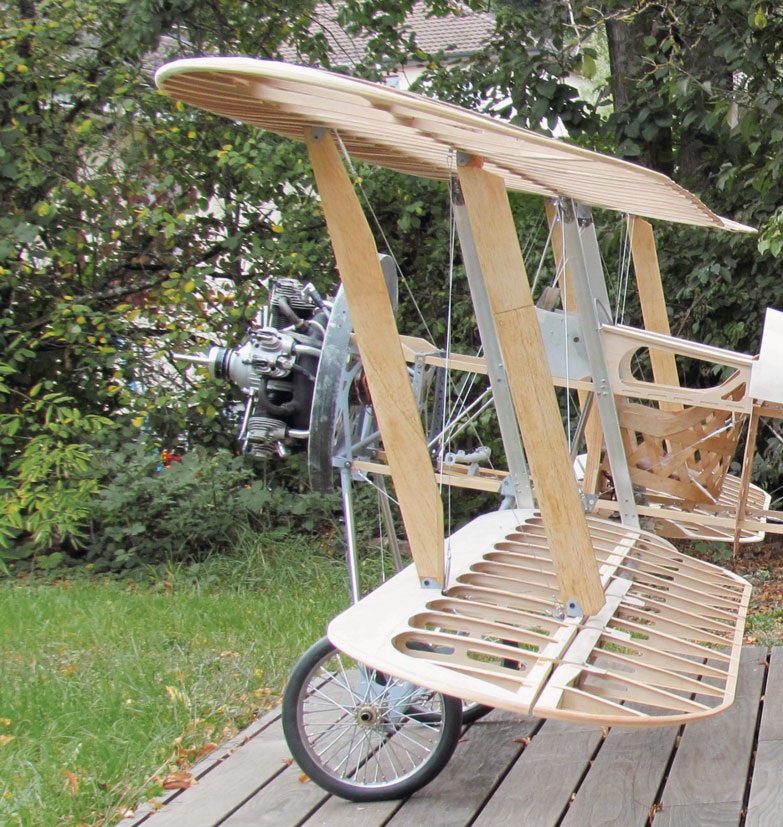
The model's design is very closely based on that of the original. Nevertheless, some changes have been incorporated into the model’s design. For example, the two lightweight half-shells of the wing spar structure were replaced with a box spar. I tried to design all visible areas so that they closely resemble the original. The fittings were laser-cut from 0.5 to 1 mm stainless steel sheet and bent to fit. The aluminum skin panels were cut from 0.3 to 0.5 mm sheet metal, then folded, bent, or embossed. The engine cowling was professionally formed by pressing it over a rotating hardwood block. The components of the wooden structure consist of precisely cut pine strips and 0.6 mm-thick, CNC-milled aircraft plywood ribs and frames. The skin panels are cut from 0.4 mm thick aircraft plywood. The few tubular structures, such as the landing gear struts and spar bracing, consist of 0.25 mm thick stainless steel tubes and were brazed with silver solder where necessary.
The motorization remains a compromise—a Moki 215 instead of a rotary engine. Otherwise, I’d say everything is as it should be. The fuselage construction is worth mentioning. After assembly, it can be disassembled back into its basic components, since all parts are either screwed together or held in place by the bracing. The fuselage frame was pinned together with 1-mm steel pins and braced with 0.8-mm steel wire using aluminum turnbuckles.
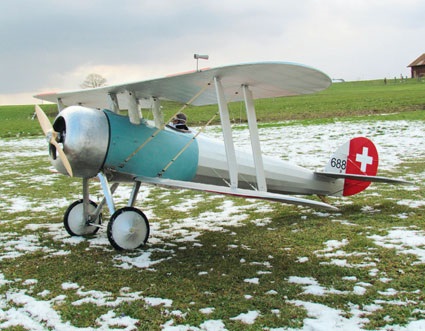
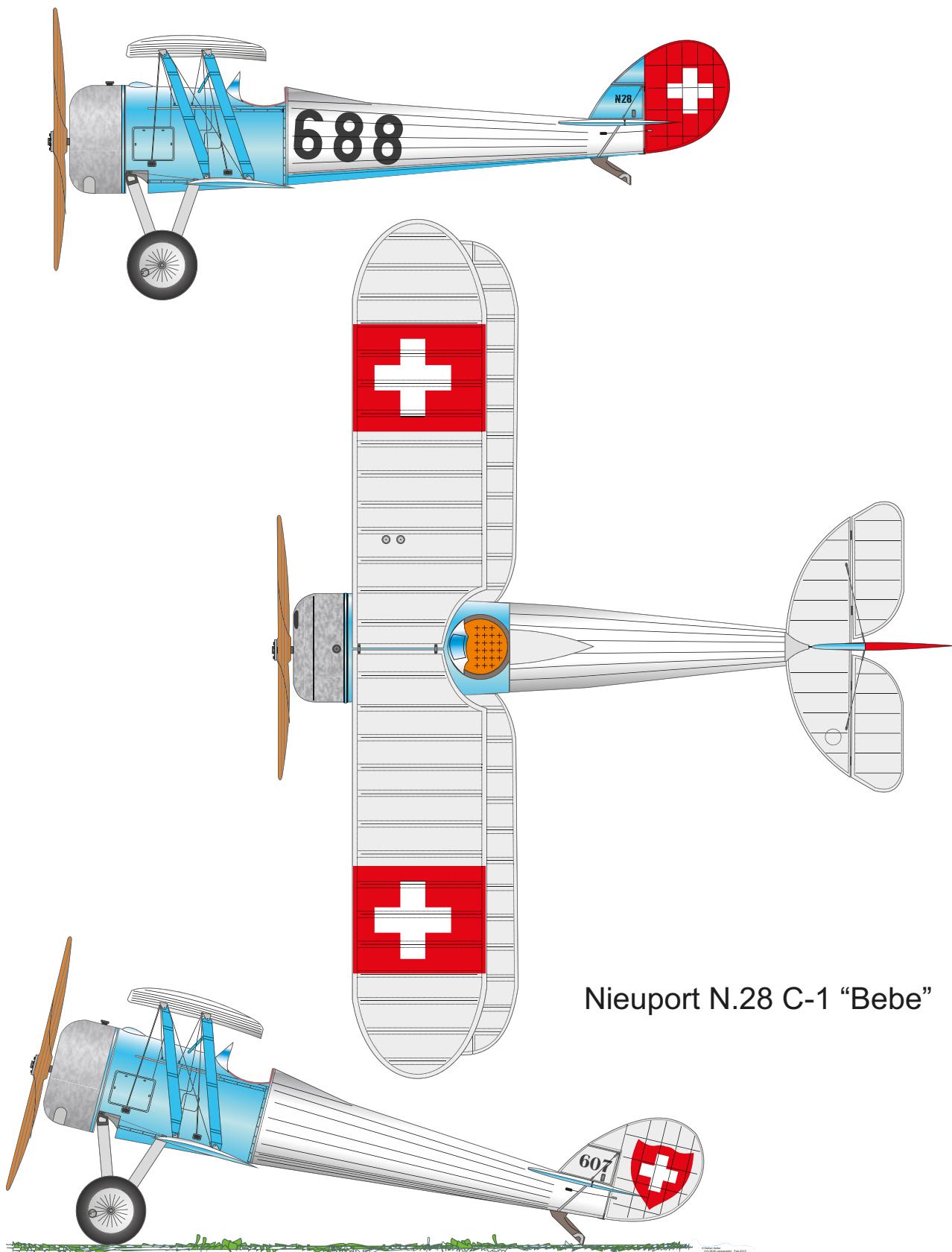
There are also aspects of this model’s construction or approach that I would handle differently on my next model. Nevertheless, I am very satisfied with the result after approximately 800–1,000 parts and hours of construction. The model is intended to reproduce the appearance of No. 688 in the years 1924–25. At the beginning of this period, the aircraft was newly delivered and factory-converted to the A-standard, which involved relocating the reserve fuel tank from the right side to the underside of the fuselage. The armament was omitted for use as a training model for aerobatics and formation flying.
Unlike the current example on display at the Swiss Museum of Transport, neither the rather large “No. 688” was painted on the fuselage side nor was the short canopy installed.
I covered the model with Super Flight SF104, an ultralight polyester fabric, sewed it to the ribs, reinforced it with torn strips, and coated it several times with tension varnish. Finally, I applied the silver paint with a relatively large brush. The national insignia and numbering were also painted freehand with a brush, as was customary at the time. In the original, the side and fuselage spine plywood parts were glued diagonally using form blocks made of thin plywood strips to provide structural rigidity. I tried to imitate this fine striped texture by gluing on strips of covering fabric. This makes the surface more lively, but it turned out to be a bit too prominent.
The model has a simple appearance, which makes the small details stand out all the more.
The newly acquired SLA printer was put to use for the first time on the two Venturi tubes and the pilot’s goggles.
The pilot not only looks great in the cockpit, but every detail is impressive. At the customer’s request, Monika Andres crafts pilots. She sewed the pilot’s outfit exactly as I wanted. I assume that in the 1920s, the flight gear of Swiss pilots had not yet been standardized, so the pilot was dressed in a long leather coat commonly worn during World War I. Like the pilot himself, this coat leaves nothing to be desired—it’s sewn together with a lining and functional outer pockets. The fully equipped pilot, approximately 70 cm tall, weighs only about 600 g, which—even with such a large aircraft and the pilot seated behind the center of gravity—hardly causes any headaches.
The maximum takeoff weight of 25 kg that I was aiming for seemed within reach until just a few days before the maiden flight, when I discovered during initial taxiing tests that the aircraft—unusually for planes of this era—lifts its tail off the ground very late. A re-check of the weight revealed that the center of gravity was slightly ahead of the neutral point, suggesting very little stability about the lateral axis. I didn’t want to make the maiden flight under those conditions. If the pilot remains on the ground, the center of gravity shifts forward only slightly and still remains in the very critically unstable range.
A bitter pill to swallow: It takes 2.5 kg of lead in the short nose to shift the center of gravity into the 12% stability range. Now the takeoff weight, with a comfortable center of gravity, is 27.5 kg.
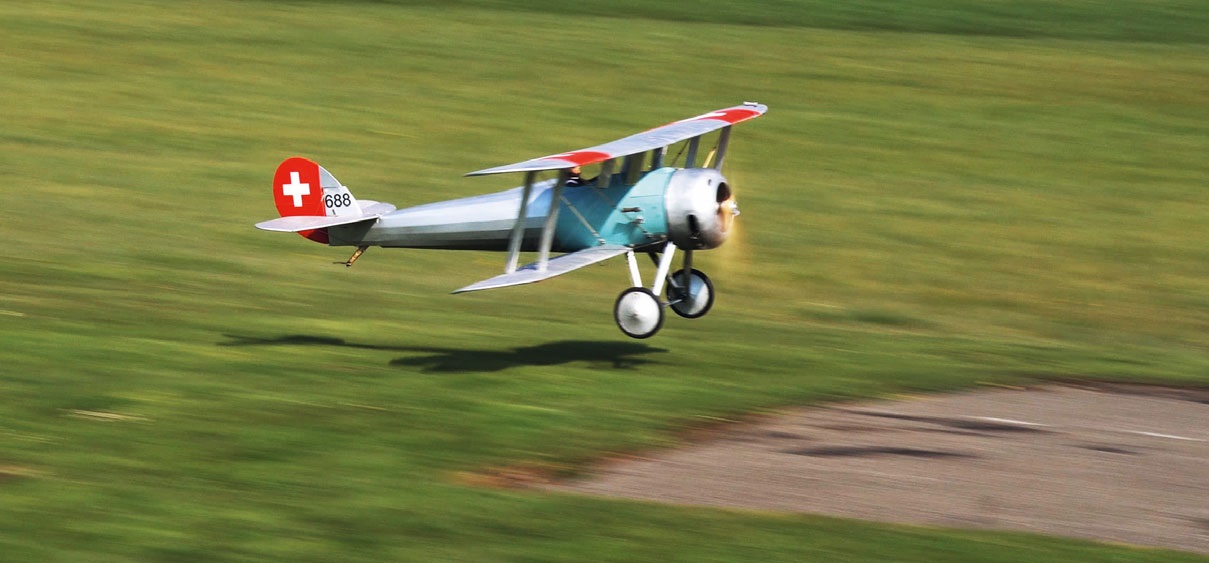
Despite its tail spur, the model maneuvers very well on the ground and shows no unpleasant surprises during takeoff or landing. The controls are very well balanced across all axes, and the aircraft remains stable in the air. Unlike First Lieutenant Achemann back then, I won’t be winning any aerobatics competitions with this model. This is not primarily due to the model itself, but rather to my own model-flying skills. Although the Nieuport was used as an aerobatic trainer, its flight performance can hardly be compared to that of the Bucker, which was designed twenty years later. Nevertheless, the Nieuport N28 remains a very elegant and easy-to-fly model in its class.
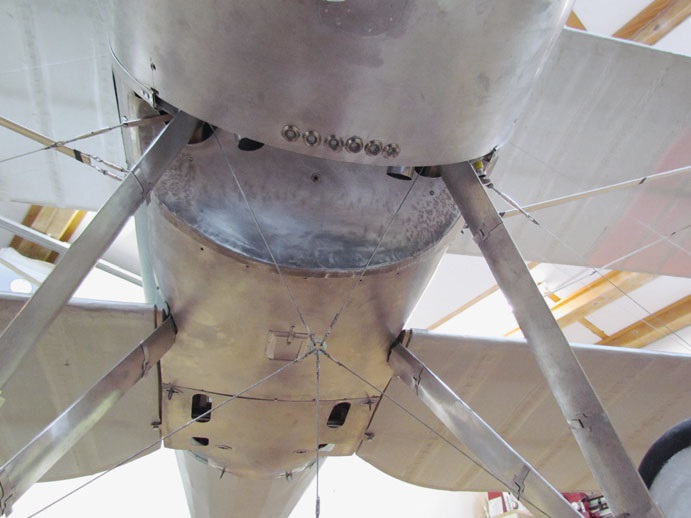
Despite careful maintenance of the aircraft, time has taken its toll: the paint is cracked, the leather is dried out and frayed, and the rubber on the tires is brittle. Preserved memories in worn-out seat cushions and greasy, shiny, well-worn controls—this is the kind of patina that only an original aircraft can have.
Aircraft No. 607, on display in Dübendorf, is the protagonist in well-known stories such as Second Lieutenant James F. Ashenden’s crash landing on June 25, 1918, in Derendingen. After an unsuccessful escort mission, Ashenden lost his way and, running low on fuel, initiated an emergency landing. The uninjured American pilot was arrested by members of the local dental corps and taken to Bern. The American attaché later negotiated an exchange for a German pilot, and Ashenden was able to leave Switzerland on November 28, 1918. The Nieuport N28 fighter—which was modern by Swiss standards and had logged only five flight hours, equipped with twin machine guns—was thoroughly inspected and repaired to make it airworthy. With the military designation 607, the aircraft became part of the Swiss Air Force’s fleet, which at that time could not have been more diverse in terms of aircraft types. The story of First Lieutenant Robert Ackermann is also well documented. Flying this aircraft—which at the time was painted a brilliant red—he won the aerobatics competition at the 1922 International Air Show in Dübendorf. This result may also have been one reason the Swiss government approved the purchase of fourteen additional aircraft of this type. The aircraft, modified to the A Standard, were delivered by the newly founded Nieuport ASTAR, a joint venture between Nieuport, Société Astra, and Compagnie Générale Transaérienne. For the advanced training of military pilots, the Nieuport N28, Fokker DVII, and Hanriot HD1—all icons from World War I—were thus available.
Some details have been forgotten or were deliberately withheld, as public support for the army and willingness to fund further military spending were understandably low during those years. This is exemplified by an article in *Air & Space Magazine* titled “The Dark Side of Glory.”
Hardesty and Proctor plans, 3D CAD data by Roel Kusters https://grabcad.com/library?page=1&time=all_time&sort=recent&query=nieuport
Nieuport N28: America’s first fighter: http://nieuport28.com/
Images from the archives of the Flieger- und Flap-Museum in Dübendorf
Article from “Air & Space Magazine”: The Dark Side of Glory.
https://www.airspacemag.com/military-aviation/world-war-i-pilot-ptsd-180967710/
RIK Modellbau https://www.balsa.ch/
RC Jeti von Gloor und Amsler, Rapperswil https://glooramsler.ch/
Herbis wheels http://www.herbiwheels.de/
Pilot mom, Monika Andres, Email: moni.belo@icloud.com
https://www.mg-wohlen.ch/fliegen-bauen/bauen-projekte/2020/nieuport-n-28
Videos of the
Nieuport N28 model's maiden flight:
https://www.youtube.com/watch?v=JEeeqfFNDro
https://www.youtube.com/watch?v=qSsTnsnXXAY
Stefan Keller's drawings of aircraft types:


News from HEBU

TEAM MANAGER "THIS" BOSSHARD
 Rodito Nussbaumer

YOU KNOW WHAT I MEAN? 125 YEARS OF THE SWISS AERO CLUB
 Emil Giezendanner

HORIZON HOBBY/LEMACO NEWS: MICRO OV-10 BRONCO 645 MM BY E-FLITE

PRIDE AND GOOD IDEAS
 Markus Nussbaumer

TRY-OUT DAY AT MFV WETTINGEN
Urs Keller
F3A EUROPEAN CHAMPIONSHIPS IN ST-MACAIRE, FRANCE
 Matthias Bosshard

52. 2026 ALPS CUP
Emil Giezendanner
ATOM, THE NEW DOUBLE-DECKER FROM CPLR
Matthias Bosshard
SUMMER FUN 2026 AT MG USTER
Martin Wunderli
What's New at Leomotion.com

COUPE DES ALPES – OBSERVE AND LEARN
Rodito Nussbaumer
TWIN TOWN PARTNERSHIP
Wolfgang Voeller
BY YOUTH, FOR YOUTH
Lorena Betschen
34th HAHNENMOOS ALPINE MODEL AIRPLANE CAMP
Res Dauwalder
CORSAIR F4U – A WARBIRD WITH A MEMORABLE LOOK
Jürgen Rosenberger, Jürgen Prinz
SMALL, MODEL-LIKE SAILBOATS
Res Dauwalder
WELCOME, NEW MEMBER!
Andrea Bolliger
FREE FLIGHT IN THE MIDDLE OF SUMMER
Urs Muntwyler
EURO CONTEST GLIDER ACRO TOUR AUSTRIA 2026

INSIGHTS INTO THE HISTORY OF SEAPLANES

THE PC-21 STORY
Emil Giezendanner
NEWS FROM HEBU
 Julia Bucher

FROM 0 TO 100
Markus Nussbaumer
MEMORIES
Wolfgang Völler
NOS REGION – A HUB FOR ELECTRIC AVIATION
Emil Giezendanner
DO YOU KNOW WHAT I MEAN IN THE LAND OF SMILES?
Emil Giezendanner
A SPECTACULAR F3A WORLD CUP IN THE PRINCIPALITY OF LIECHTENSTEIN
Emil Giezendanner