
The Charm of Steam Trains on the Water
“You should finally fly something other than your same old, boring Pipers,” said my son Benjamin, a die-hard fan of the new generation of 3D foam planes. “Yeah, go ahead and make fun of me—I’ll do
whatever I want!” I retorted. But after a short while, the sting of that remark began to gnaw at me, and I secretly looked around to see what else might fit into my already completely overflowing hobby room.
It would have to be something unconventional that you don’t see everywhere. Here’s what the specifications called for: a relatively rare, reasonably true-to-scale, relatively quickly “built” ARF wooden model with a wingspan of just over 2 meters for 5S to 6S power
. Capable of operating with a wheeled landing gear on grass runways, with skis on snow, and—last but not least—with floats on and over water. Of course, the original would also have been operated on floats.
And lo and behold: What do I see one day, leaping out at me from a brochure? A VW Bus—
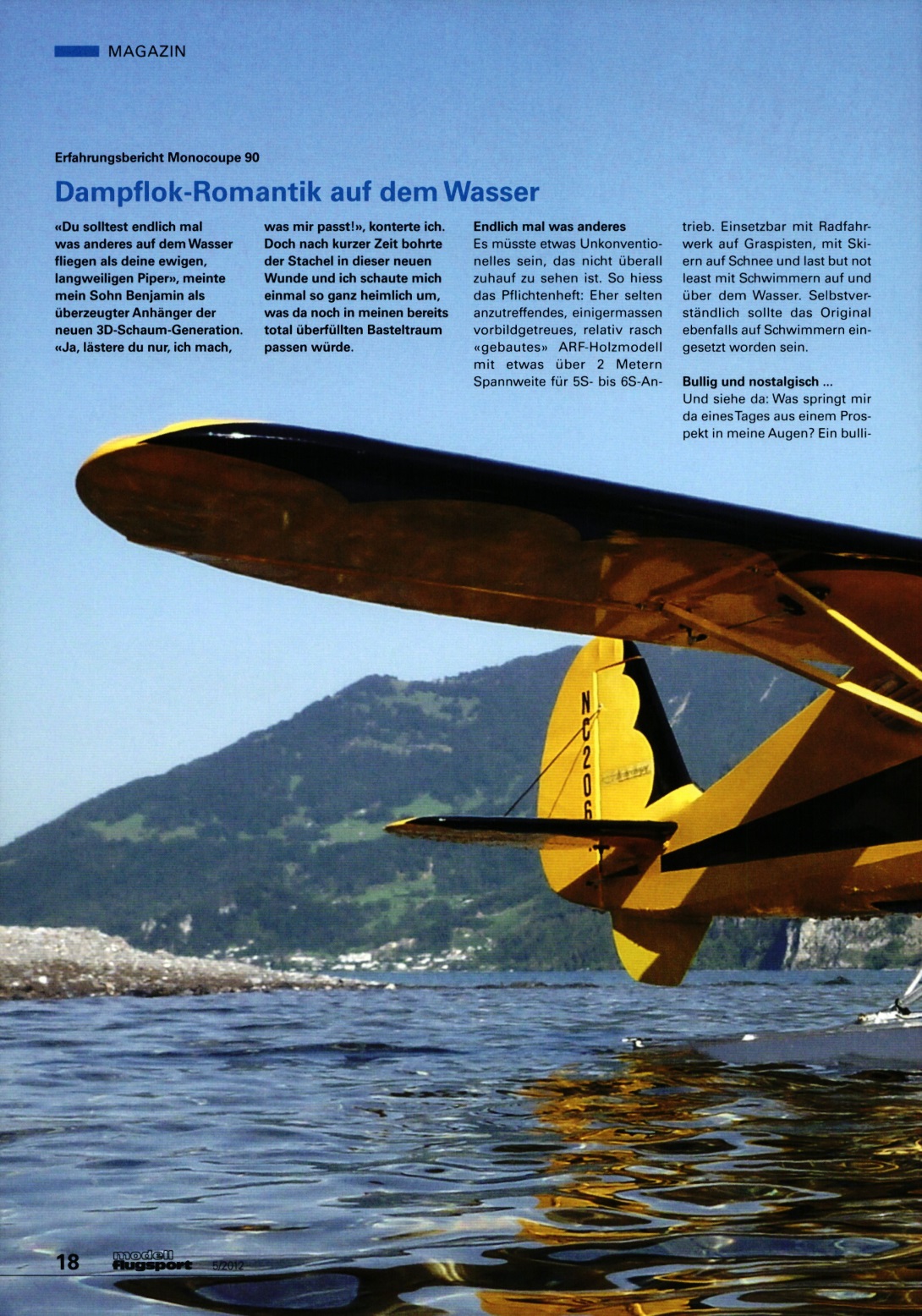
A nostalgic high-wing plane from the 1920s with a radial engine—it’s called the Monocoupe! And it’s a steal, available as a special offer and as a “second-choice” item with “possible color variations.” Reason: The importer, Jamaras, is discontinuing this ARF model. So I bought it and eagerly unpacked it at home. But let’s take it one step at a time...
In the 1920s, businessman and pilot Don Luscombe was tired of flying his Jenny biplane with an open-
and was longing for a small, comfortable airplane with an enclosed cockpit for his business trips—one in which two people could sit comfortably side by side. Although it was the financier Don Luscombe who introduced the Monocoupe—designed according to his specifications—to the market in 1926, the real hero was the former farmer Clayton Folkerts. Born in 1897 on a farm in Grundy County, Iowa, he built—from
parts lying around the farm—no fewer than five man-carrying airplanes between 1916 and 1926. He taught himself the art of aircraft construction and also learned to weld. Folkerts then worked at Central States Aero in Davenport and was commissioned to build the Monocoupe prototype out of wood and steel tubing according to Don Luscombe’s specifications, al-
all beautifully covered with fabric. The Monocoupes subsequently produced and licensed by the Department of Commerce were so successful that in 1928, nearly 90 percent of all light aircraft produced and sold in the U.S. were Monocoupes. →
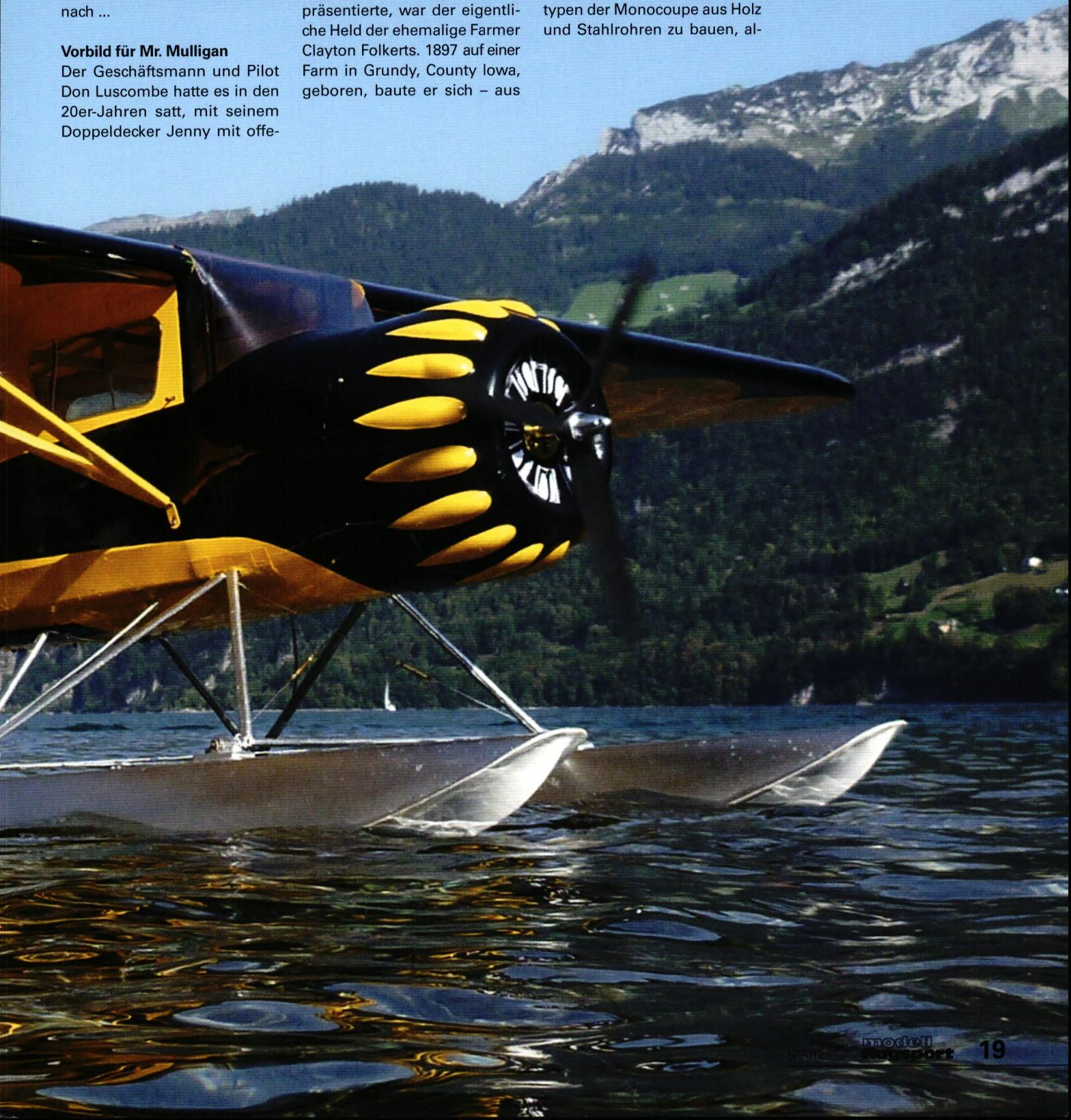
The Type 90 was introduced to the market in 1930. Only the “90 De Luxe” version had landing flaps. Of course, Monocoupes were also fitted with floats, as our somewhat vintage photo shows. The name “Monocoupe” means the following: Mono = only one wing, and “Coupe” is derived from two-seater sports cars—the coupes. Furthermore, there were numerous variants and further developments. Monocoupes with shortened wings and very powerful engines enjoyed great popularity in air races
and also served as models for the DGA-6 racing aircraft, introduced in 1934 and also known as “Mr. Mulligan.”
As mentioned earlier, Jamara is currently phasing out this model, and the last few units are still available in stores. Replacement parts are also still available. Although it isn’t entirely true to the original in every detail, this model—with a wingspan of 2.2 meters—still captures the charm of this classic aircraft. The fuselage and wings are examples of true
lightweight construction, but they don’t seem very sturdy. The fuselage in particular, with its relatively thin frames, gives the impression of being delicate and fragile. But for electric operation, that seemed just right to me. The parts—which, admittedly, aren’t all the same color—are of acceptable quality across the board, though almost all of them need to be sanded down.
Assembly is done as is typical for ARF models: a few adjustments here and there, but
no serious problems overall. To ensure that battery replacement goes smoothly, the windshield is designed to be removable with two latches. A tow hitch is also installed. To refine the model’s appearance, there are still quite a few things that need to be done on your own, such as bracing the tail surfaces and landing gear, adding a cover for the landing gear mount, and so on. So the photos shown here don’t yet reveal my Monocoupe in all its glory. But things like that
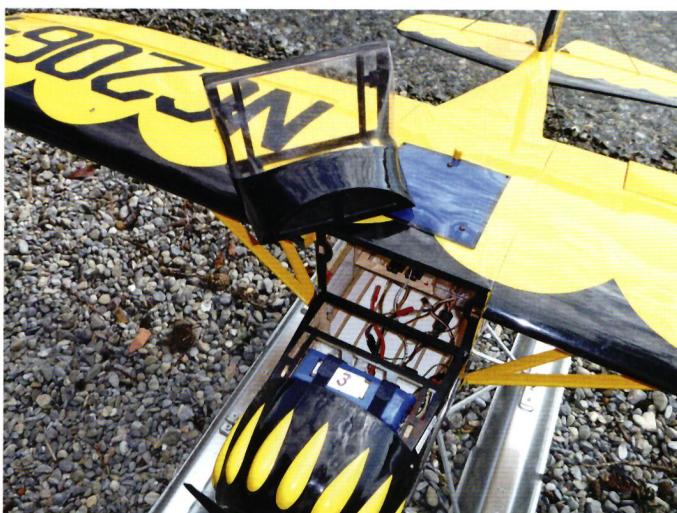
I usually don't get around to them until after I've tested them thoroughly, because you never know if they might fail prematurely... well—knock on wood...
It was clear to me from the start that this beefy model is a real “flying drag” and needs a powerful motor. As is well known, the basic rule for any motorization is that it takes about 250 watts per kilogram of takeoff weight to achieve good flight performance. In addition, Ohm’s
law “power equals current times voltage ($P = I \times U$)” inevitably applies. And now it’s time to do the math! Expected weight: 6 kg, including the float. That results in a power requirement of 1,500 watts. A 6S LiPo has a voltage of roughly 23 volts. The required current is calculated as $I = P/U$, which is about 65 amperes.
Now it’s time to select the components. The Scorpion S4025-12 is chosen as the motor, which can handle 85 amperes and up to 2,000 watts. The proven Phoenix is used as the ESC.
I’m using an Ice Lite 100A, of course without a BEC and with a separate battery for the receiver. Now I’m mounting various propellers and measuring both current and static thrust using a 6S LiPo with 5000 mAh and a 30C rating. A 15×8 electric three-blade propeller, purchased from ready2fly, first needs to be thoroughly balanced. This gives me a slightly greater distance from the propeller tip to the water’s surface and thus less spray when
takeoff. This propeller now delivers the required values: 70 amps at full throttle and about 5.5 kg of static thrust. It also produces significantly less vibration than all the other APC two-blade electric propellers tested. Subsequent flights showed an average power consumption of about 450 mAh per minute. With a 5,000-mAh LiPo battery, this results in a reasonable flight time of about 8 to 9 minutes with a decent power reserve. →
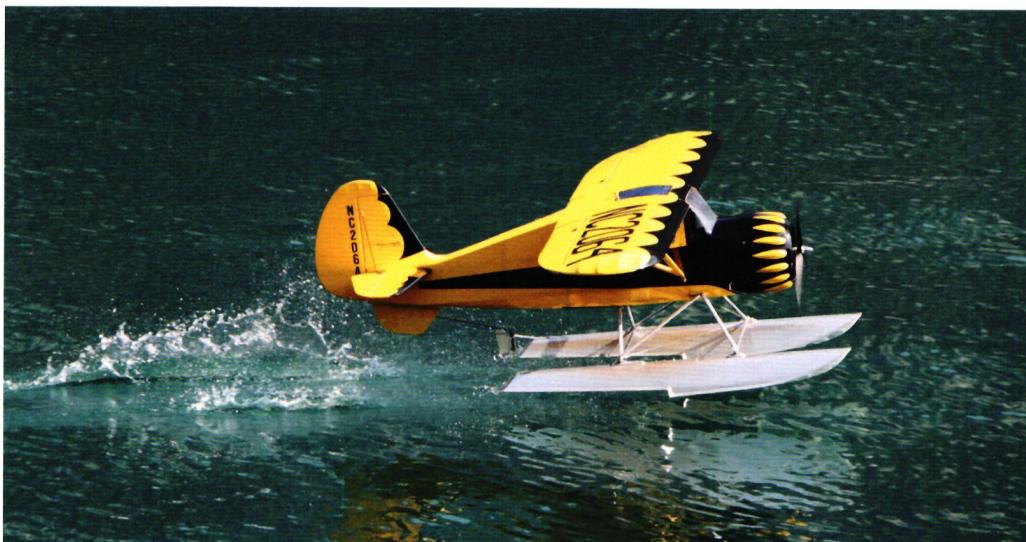
The first flight—without wheel shoes but with slightly larger wheels—goes off without a hitch. The motor setup is optimal and leaves nothing to be desired. After just a few meters, the model is safely airborne and climbs rapidly. The model can be flown very slowly, and its stall behavior is very predictable. Landing without even the slightest bounce, however, is no easy feat. If the model has even a little too much speed and doesn’t touch down 100 percent smoothly, there will be one or two—at most
harmless, bumps. The relatively short model requires quite large elevator deflections to touch down in a three-point landing. As an additional measure, I shift the center of gravity back slightly. This makes the model respond a bit more nimbly to the elevator while still being very easy to control.
Now Hacker's largest fiberglass floats, measuring 1 meter in length, are being installed. Beforehand, these floats are
, since they develop hairline cracks and take on water even during light splash landings. The fuselage must also be reinforced at the point where the rear float linkage is to be supported. In addition, as with the original, an extra tail fin is installed to improve the aircraft’s handling and prevent it from veering off course, especially during takeoff.
For the initial tests, for the reasons already mentioned, only one water rudder will be installed for the time being, and it will be hinged quite simply from the rudder using a wooden
cardboard stick from the rudder. However, even this water rudder can be folded upward, as it is only needed for slow turns while in displacement mode. As is well known, water rudders should no longer touch the water during the glide phase of takeoff. In a later optimization phase, two water rudders will, of course, be installed.
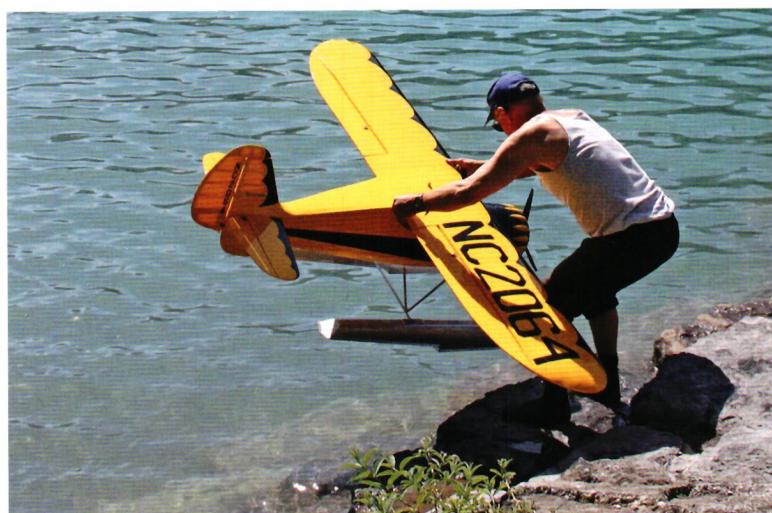
And so it is at Lake Walen, more precisely at my trusty seaplane base in Beetlis, that the maiden flight over water takes place. One spectator remarks somewhat sarcastically: “That big thing is way too heavy to fly!” But as the Latin saying goes: “Quod erat demonstrandum.” The first flight over water goes to the pilot’s complete satisfaction and to the skeptic’s utter amazement.
Thanks to the additional fin, the tendency to veer off course during takeoff is indeed minimal. The flight characteristics have, of course, changed somewhat due to the floats, and the plane flies noticeably more sluggishly, but it’s still easily controllable when flying in a wide-arc style. But—
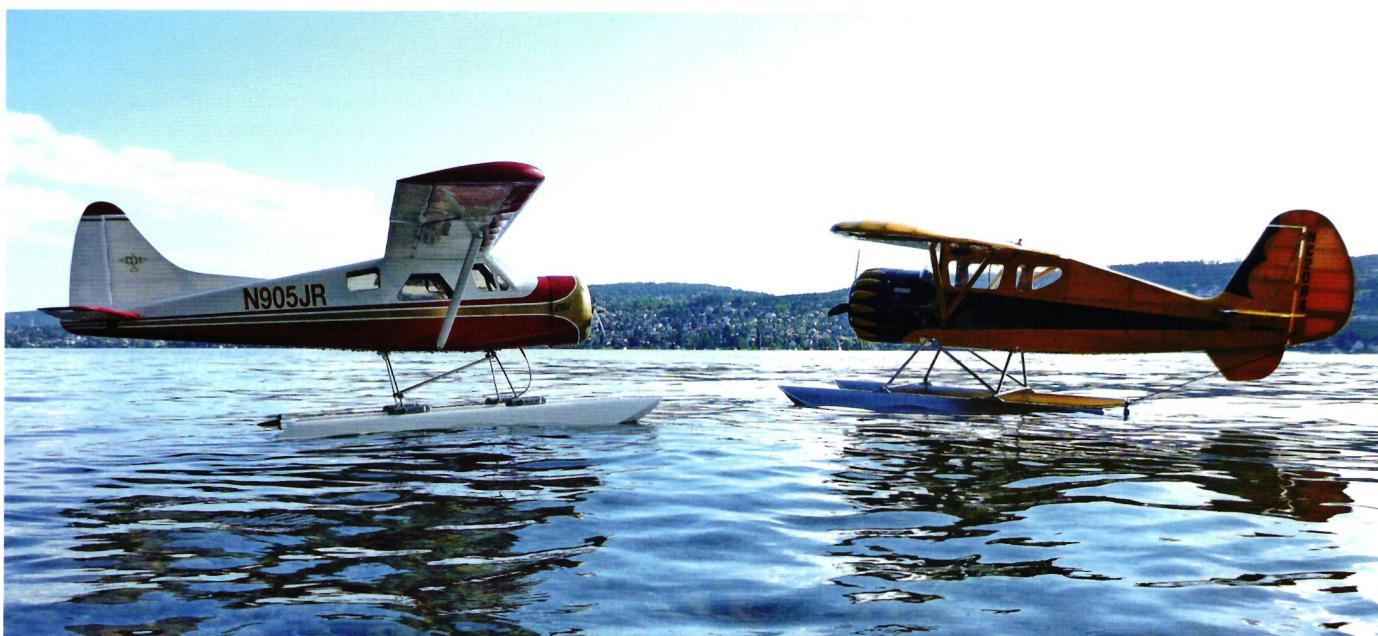
Thanks to the center of gravity being slightly shifted aft and the relatively large elevator deflections, soft landings can now be executed very smoothly even with floats, without any tendency to stall.
And whenever my Monocoupe glides past my colleagues and spectators in a slow, low flyby, you can hear delighted exclamations. Of course,
miss the wonderful rumbling sound of this vintage model. On the other hand, female beachgoers in particular—who are looking for some peace and quiet—are delighted by how quietly the model glides by, and one woman remarks that it’s a wonderful hobby. An entire school class shows up, and the teacher says enthusiastically that they’d seen the model from a distance but hadn’t heard a thing. I realize: After many years of rattling, stinking, and howling, model flying has finally
becoming socially acceptable. And if every seaplane pilot now follows the basic rules of seaplane flying, this trend will continue.
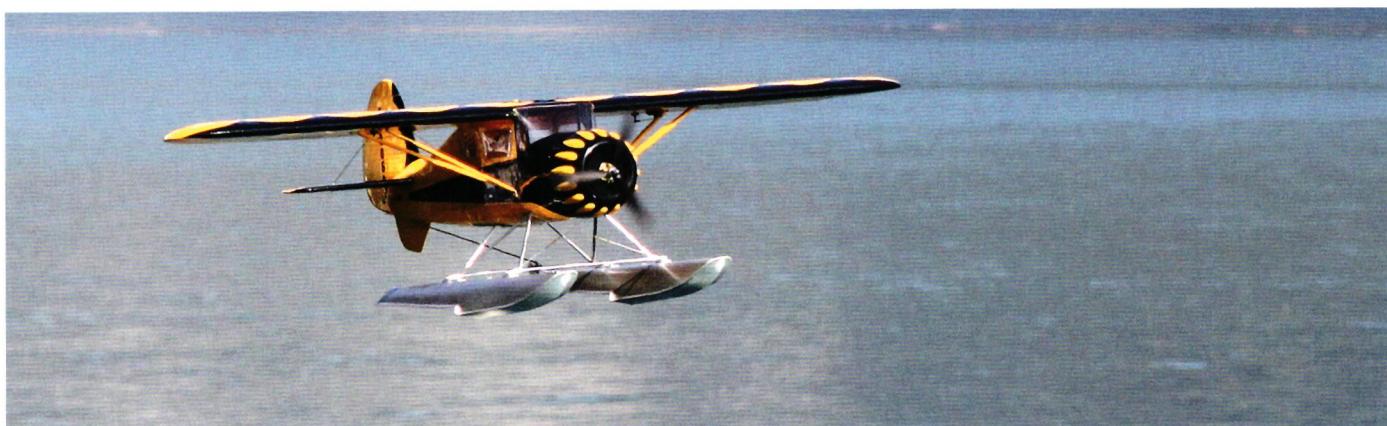
The Monocoupe 90, which Jamara is unfortunately phasing out, exudes a good dose of steam locomotive romance. This quirky, beefy model has proven itself both on land and on water and is admired everywhere. With minimal construction effort and modern—
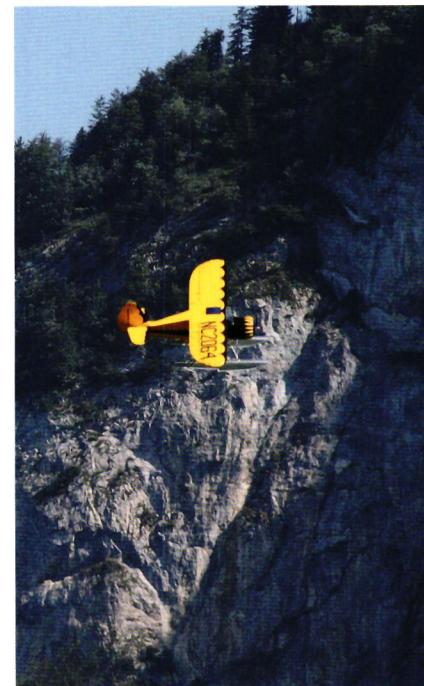
Despite the high engine costs, this is an exceptional model that is very rarely seen and, on top of that, has excellent flight characteristics. ■
*Hans Jürg Baum*


News from HEBU

TEAM MANAGER "THIS" BOSSHARD
 Rodito Nussbaumer

YOU KNOW WHAT I MEAN? 125 YEARS OF THE SWISS AERO CLUB
 Emil Giezendanner

HORIZON HOBBY/LEMACO NEWS: MICRO OV-10 BRONCO 645 MM BY E-FLITE

PRIDE AND GOOD IDEAS
 Markus Nussbaumer

34th HAHNENMOOS ALPINE MODEL AIRPLANE CAMP
Res Dauwalder
TRY-OUT DAY AT MFV WETTINGEN
Urs Keller
F3A EUROPEAN CHAMPIONSHIPS IN ST-MACAIRE, FRANCE
 Matthias Bosshard

52. 2026 ALPS CUP
Emil Giezendanner
ATOM, THE NEW DOUBLE-DECKER FROM CPLR
Matthias Bosshard
SUMMER FUN 2026 AT MG USTER
Martin Wunderli
What's New at Leomotion.com

COUPE DES ALPES – OBSERVE AND LEARN
Rodito Nussbaumer
TWIN TOWN PARTNERSHIP
Wolfgang Voeller
BY YOUTH, FOR YOUTH
Lorena Betschen
CORSAIR F4U – A WARBIRD WITH A MEMORABLE LOOK
Jürgen Rosenberger, Jürgen Prinz
SMALL, MODEL-LIKE SAILBOATS
Res Dauwalder
WELCOME, NEW MEMBER!
Andrea Bolliger
FREE FLIGHT IN THE MIDDLE OF SUMMER
Urs Muntwyler
EURO CONTEST GLIDER ACRO TOUR AUSTRIA 2026

INSIGHTS INTO THE HISTORY OF SEAPLANES

THE PC-21 STORY
Emil Giezendanner
NEWS FROM HEBU
 Julia Bucher

FROM 0 TO 100
Markus Nussbaumer
MEMORIES
Wolfgang Völler
NOS REGION – A HUB FOR ELECTRIC AVIATION
Emil Giezendanner
DO YOU KNOW WHAT I MEAN IN THE LAND OF SMILES?
Emil Giezendanner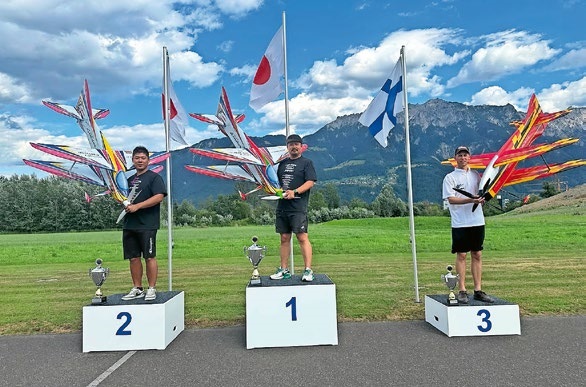
A SPECTACULAR F3A WORLD CUP IN THE PRINCIPALITY OF LIECHTENSTEIN
Emil Giezendanner