
MARCO CANTONI, CHAIR OF TECHNICAL COMMITTEE 5 ON ELECTRIC FLIGHT
Electric flight: more than just adding a motor
While still a niche product in manned aviation, electric motors have long since established themselves in model aviation: they are now the most commonly used propulsion systems for model aircraft. Why has electric aviation (almost) become a victim of its own success, in the view of Technical Commission (TC) Chair Marco Cantoni?
Marco Cantoni discovered electric aviation in the early 1990s. “As a physicist, I have a certain understanding of electric motors and how things work together—I found it interesting.” At the time, Mabuchi motors and nickel-cadmium batteries allowed only very short flights with modest performance. The heavy weight and low capacity of the batteries, along with the poor efficiency and low power of the motors, were synonymous with electric flight. This initially dissuaded him from getting seriously involved in electric flight. By then, he had already gained experience in gliding, aerobatics, and powered flight, and had discovered helicopters. When his job took him to Japan for two and a half years, he was one of the few who had mastered 3D helicopter models. He quickly received an offer to test models for a Japanese manufacturer. Back in Switzerland, the training required to fly a helicopter became too time-consuming, given his work and family commitments. While in Japan, he had been able to purchase an electric glider equipped with a brushless motor—a brand-new technology at the time—from Urs Leodolter. But his renewed interest in electric flight soon took him further.
The FAI’s F5 category currently comprises eight disciplines. F5B, inspired by F3B—the class of fast electric gliders commonly known as “hotliners”—was one of the first. F5D, electric pylon racing, was long held alongside F5B at world championships, but has now been combined with combustion-engine pylon racing for organizational reasons. F5A, aerobatics, and F5C, helicopters, were for some time provisional categories that served as pioneers and paid the price for the technical limitations of early electric motors. What seemed unthinkable 25 years ago is now commonplace in the F3A and F3C disciplines, which were once dominated by combustion engines. There is virtually no category of model aircraft in which electric motors have not supplanted internal combustion engines. Disciplines using scale models that are faithful to the original are a significant and justified exception.
Today, the F5A, F5C, and F5D categories have disappeared, and new disciplines have emerged. To put it provocatively, some of these—in Marco Cantoni’s view—are not typical electric flight categories in the original sense of the term. For example, the F5J category—which Marco Cantoni competes in himself—evolved from the F3J. The flight events are virtually identical in both categories: takeoff, 10 minutes of flight, and precision landing. The only difference is that an electric motor replaces the winch. Similarly, the F5K discipline evolved from the F3K category, “hand-launched gliders.” The models are the same as in F3K, except that they are not launched into the air but are powered by an electric motor. “I took the liberty of telling the CIAM subcommittee that the F5J, F5K, and F5L categories were, in fact, no longer pioneering electric flight categories. I was almost treated like a traitor, but here’s how I explain it: In the aforementioned categories, the motors merely replace winches, arms, or bungee cords, unlike in the F5B category, where everything depends on the motor, the propeller, and how the electronically limited energy is used. The use of telemetry (as in Formula 1), which is part of the mandatory equipment in F5B, is also prohibited in these disciplines.”
The F5B is Marco Cantoni's great passion. “In my view, it was a technological driving force. New developments were quickly incorporated, and anything that was technically feasible was quickly approved. It was in this category that lithium-polymer batteries were first used,” he summarizes. With specialized electric gliders, during the first flight, a 150-meter course is flown as many times as possible within 200 seconds, followed by a 10-minute flight ending with a precision landing. From the very beginning, the Swiss have played a leading role in the F5B category. Urs Leodolter won his first world title in this discipline in 2001. Since then, the Swiss have consistently been considered contenders for the podium at world championships and have often brought home medals. As previously mentioned, the F5B category was closely linked to Pylon Racing (F5D). However, the small propellers on these models spun at about 45,000 revolutions per minute, which produced a shrill noise. In densely populated Switzerland, this became problematic. Eventually, gearmotors were mandated, driving larger propellers that spun at only 10,000 rpm. “But that made us uncompetitive on the international stage. So this category disappeared in our country,” explains Marco Cantoni.
Marco Cantoni has been a member of the national team since 2002. Six years later, he joined the technical committee as the regional delegate for French-speaking Switzerland. His motivation was that he no longer wanted to simply enforce the rules but wished to actively participate in their development. For several years now, he has served as president of the Technical Commission (CT) and is therefore also responsible for ensuring that championships are organized and national teams are formed. The challenge lies in satisfying all categories and disciplines. According to the FAI/CIAM, there are 32 official disciplines in the categories of free flight, circuit flight, RC flight, electric flight, Scale, Space, and drones. “We’re not doing model aviation any favors by trying to organize world championships in every discipline. This leads to pilots poaching each other’s pilots and scheduling conflicts.” Marco Cantoni is personally affected by this problem. During the summer months, he is on the road almost every weekend to compete in Eurotour and World Cup events in the F5B or F5J categories, or in World or European Championships.
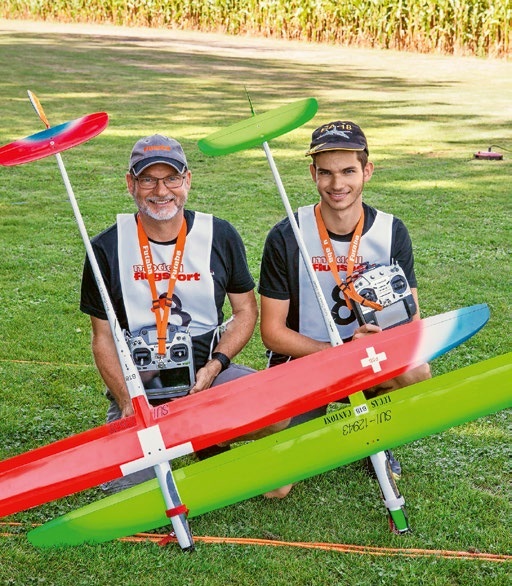
Marco Cantoni has his own airfield for training. As a result, he is rarely seen at his club’s airfield during competition preparation, and when he is, it’s “only” in an aerobatic plane, a helicopter, or a jet—for “the joy of flying” and to catch up with colleagues. This is also due to the operational profile of F5B models. “They’re designed to accelerate to nearly 300 km/h in 1.5 seconds, not to fly at full throttle for an extended period. These aren’t recreational models.” The use of such specialized sport aircraft doesn’t make it easy to find the next generation of pilots. It’s not even because the models are particularly difficult to fly. “When new pilots are mentored by an experienced pilot, they master the models in less than a year and can fly them in competitions,” explains Marco Cantoni. However, these models are hardly usable outside of competition. They aren’t suited for slope flying or group competitions, and there are much better models for enjoying thermal flying.
In disciplines such as F5J, on the other hand, the cost of around 3,000 francs for a high-tech model is a barrier, especially for juniors. This is especially true since you need to buy three versions—for light, medium, and strong winds—in order to compete in a European or World Championship.
The CIAM has also noted that the number of competitive pilots is declining in many disciplines. Changes to the rules can do little to remedy this: “In F5B, however, we have come to the conclusion that too radical a change would lead to the disappearance of the category. It is unrealistic to expect manufacturers to produce a new model for just a handful of pilots worldwide.”
Focusing on key disciplines would be a bold decision. But in general, aerial competitions also seem to have lost some of their appeal. One of the missions of all National Committees is to generate interest in the sport. “I’d be delighted if a group volunteered to host a national team training session at their home. It would be a great opportunity for the group’s members to discover the sport.” Marco Cantoni knows that many people are hesitant to ask competition pilots for advice. “But we’re happy when they reach out to us. They can even ask us simple questions.”
One of Marco Cantoni’s competitors is his son. “This year, he knocked me down from second to third place at the Swiss championships, even though he’d only attended three training sessions,” explains Marco Cantoni. “He’s mainly interested in fast models, especially jet models. But his ambitions extend beyond model aircraft: he’s currently in the middle of his SPHAIR assessment.”
The hobby shared by father and son has also provided unforgettable moments for the whole family. “We competed together in world championships in Japan and Australia. We had a great time there—as a father-son duo during the competition and as a family during the vacation we took for the occasion.”
Interview conducted by Andrea Bolliger
Translation by Jean Thévenaz


News from HEBU

TEAM MANAGER "THIS" BOSSHARD
 Rodito Nussbaumer

YOU KNOW WHAT I MEAN? 125 YEARS OF THE SWISS AERO CLUB
 Emil Giezendanner

HORIZON HOBBY/LEMACO NEWS: MICRO OV-10 BRONCO 645 MM BY E-FLITE

PRIDE AND GOOD IDEAS
 Markus Nussbaumer

TRY-OUT DAY AT MFV WETTINGEN
Urs Keller
F3A EUROPEAN CHAMPIONSHIPS IN ST-MACAIRE, FRANCE
 Matthias Bosshard

52. 2026 ALPS CUP
Emil Giezendanner
ATOM, THE NEW DOUBLE-DECKER FROM CPLR
Matthias Bosshard
SUMMER FUN 2026 AT MG USTER
Martin Wunderli
What's New at Leomotion.com

COUPE DES ALPES – OBSERVE AND LEARN
Rodito Nussbaumer
TWIN TOWN PARTNERSHIP
Wolfgang Voeller
BY YOUTH, FOR YOUTH
Lorena Betschen
34th HAHNENMOOS ALPINE MODEL AIRPLANE CAMP
Res Dauwalder
CORSAIR F4U – A WARBIRD WITH A MEMORABLE LOOK
Jürgen Rosenberger, Jürgen Prinz
SMALL, MODEL-LIKE SAILBOATS
Res Dauwalder
WELCOME, NEW MEMBER!
Andrea Bolliger
FREE FLIGHT IN THE MIDDLE OF SUMMER
Urs Muntwyler
EURO CONTEST GLIDER ACRO TOUR AUSTRIA 2026

INSIGHTS INTO THE HISTORY OF SEAPLANES

THE PC-21 STORY
Emil Giezendanner
NEWS FROM HEBU
 Julia Bucher

FROM 0 TO 100
Markus Nussbaumer
MEMORIES
Wolfgang Völler
NOS REGION – A HUB FOR ELECTRIC AVIATION
Emil Giezendanner
DO YOU KNOW WHAT I MEAN IN THE LAND OF SMILES?
Emil Giezendanner
A SPECTACULAR F3A WORLD CUP IN THE PRINCIPALITY OF LIECHTENSTEIN
Emil Giezendanner