
A Cultural Shift in Electric Aerobatics
Time and again, we model aviators are reminded that our hobby is a technical, structural, and aeronautical representation of manned flight. If we set aside the deliberate replication of scale categories for a moment, this common belief must be clearly rejected, at least in some areas of model aviation. For example, electric model aviation in particular is decades ahead of manned flight. This applies not only to extreme competitive sports but also, for instance, to our elegant, electric-motor-powered large gliders, solar-powered aircraft, helicopters, and even aerobatics.
From a certainly rather amateurish perspective, electric aerobatic models were long considered successful designs if they were capable of “flying the FAI program.” This undifferentiated statement referred to the international F3A aerobatic program. The fact that there was also an FAI program for electric aerobatics (F5A) had almost been forgotten, in stark contrast to the mid-1980s, when two European Championships in electric aerobatics were still being held. In fact, electric aerobatics had always more or less followed the guidelines of internal-combustion-engine aerobatics. For example, in 1987, the competition switched to turn maneuvers and practically adopted the entire layout—including the angles and distances—from F3A; even the judges came almost exclusively from the F3A scene. Anyone who owned an electric aerobatics model could, until the end of 2000, “have the best of both worlds” with that model, so to speak—namely, participate in F3A championships or compete in electric aerobatics competitions. At a lower level of competition in powered aerobatics—in Switzerland, these are regional or interregional championships—these electric aerobatic models were and still are able to compete without any problems.
In modern F3A programs—where a high degree of perfection is made possible in particular by the tremendous increase in engine power—the use of an electric motor
powered aerobatic models are virtually out of the question today. Although the F3A rules still allow for the use of electric motors, the
Developments in the weight-to-power ratio in F3A have become so extreme that an electric aerobatic model equipped with conventional NiCd or NiMH batteries would be at a massive disadvantage. Just 10 years ago, electric aerobatic pilots were able to compensate for the performance gap compared to gasoline-powered aerobatics—as well as the heavy battery weight—through extremely lightweight construction. Today, F3A aerobatics also employs sophisticated weight management, so that the weight differences between the fuselage, tail, and wings have become almost negligible. The only—and so far the last—attempt to compete in an F3A World Championship with an electric model took place in 1993 and was anything but a success story for electric flight. Ultra-light batteries could offer a solution, but they would have to deliver at least as much power as NiCd cells. The battery weight would likely be reduced from today’s approximately 1.8
kg for 30 cells should not exceed 500 to 700 g in order to achieve a reasonably comparable weight-to-power ratio. Therefore, for the time being, electric propulsion clearly leads to a dead end when it comes to more demanding requirements in F3A—though this should not mean that persistent designers should stop trying.
In electric aerobatics, many interesting experiments with a wide variety of designs have been conducted over the past twenty years. However, the goal has always been to find a reasonable compromise between airspeed, rate of climb, and flight duration. Of course, there were always missteps, most of which stemmed from profiles that were too thin and aerodynamically optimized, slender fuselages. Furthermore, many designs were too small to compete in F3A competitions and thus not attractive enough to the judges. Most models, however, were simply too fast. The ones that were most successful were more or less scaled-down F3A models. Electric models designed specifically for F3A have, of course, also proven themselves in electric aerobatics in recent years, since, as mentioned at the beginning, the entire concept of electric aerobatics was based on F3A principles.
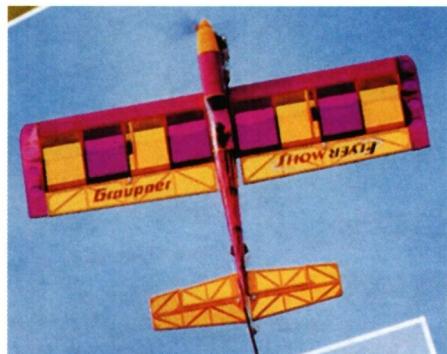
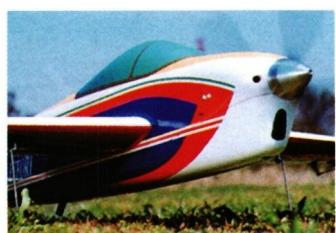
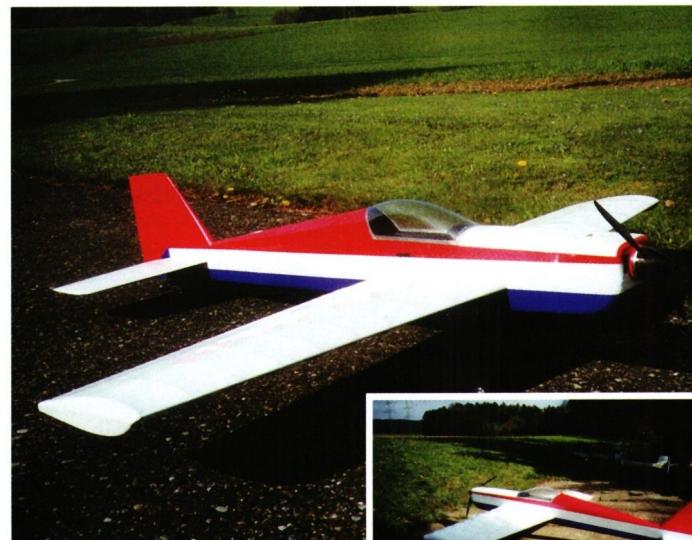
It's easy to imagine a trend toward fun flyers like this new "Show Flyer" model from Graupner. Wingspan: just over 150 cm.
In March 2000, the CIAM delegates (FAI) approved a completely new set of F5A rules, which have been in effect since the beginning of 2001. The key point here is that this time, the rules were specifically tailored to electric flight rather than being a watered-down copy of the F3A rules. The members of the International Electric Flight Commission recognized that electric aerobatics as a competitive sport could only be saved through a radical transformation. I am not aware of any FAI model aviation category in which such a dramatic change has ever taken place. The guiding principle behind this is simple and assumes that the amount of energy the model can carry is fixed—or, rather, limited by the weight of the battery. We now have the option of using up this energy more quickly with a high-power propulsion system or flying around for a longer time at lower power. The new regulations generally require short programs (max. 5 min, including takeoff and landing), but in exchange call for more spectacular displays, which can only be achieved with higher power.
This previously mentioned measure to combat monotony was supplemented by a second one, whereby each competitor puts together his own program and, in doing so, fine-tunes it—based on the capabilities of his model—by selecting specific moves and combinations of moves.
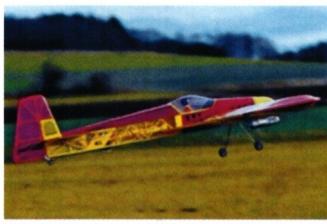
can. The third point that will clearly make electric aerobatics more appealing to spectators is the small flight space in which the entire program is flown—F3A-style flying will lose some of its significance due to the elimination of defined turn sequences. However, elegant turns are still required here as well, though they will come into their own in the overall impression. And one more thing:
Electric aerobatics competitions no longer have to be held far away from residential areas; instead, they can certainly take place in large sports and recreational facilities, which will increase their appeal for both non-motorized junior pilots and spectators. However, it will likely take some time for this new concept to gain acceptance.
- Any electric model may be used. Manual launch is permitted, but results in a slightly lower score for the “overall impression.”
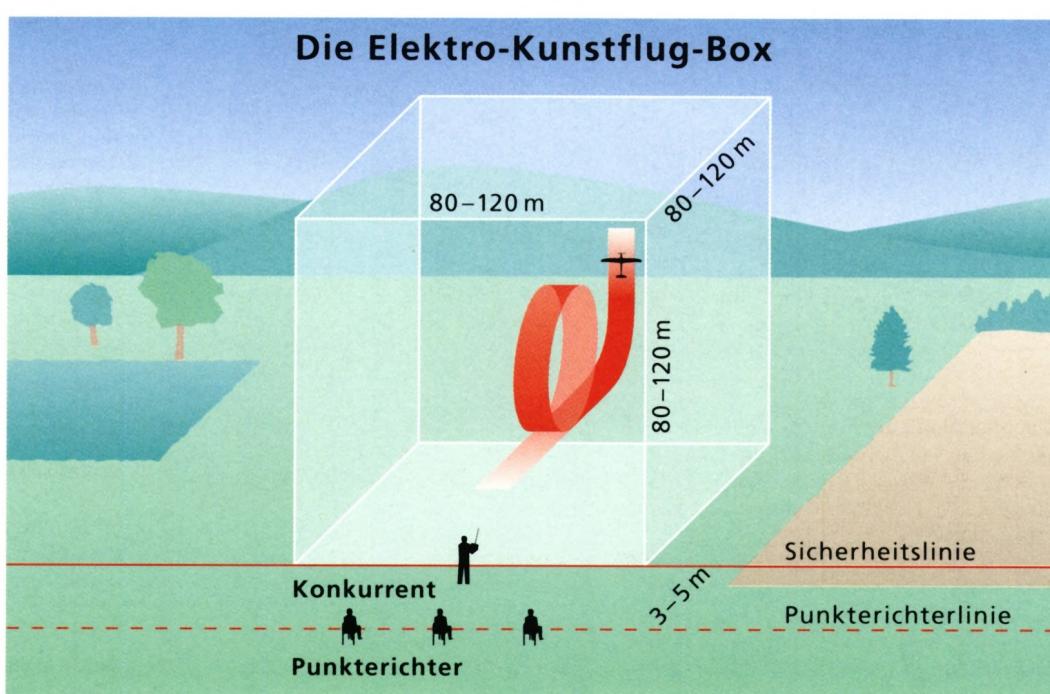
- The flight area consists of a cube-shaped box with sides measuring 80 to 120 m. The maneuver program should be performable on standard sports fields.
- The flight distance ranges from 50 to a maximum of 120 m, so it is extremely short.
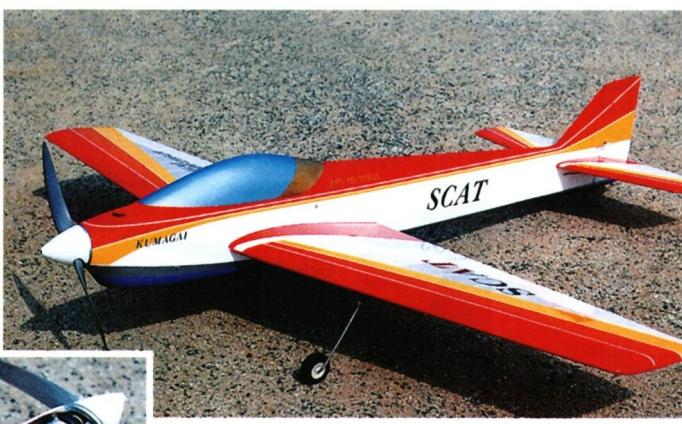
- Each competitor puts together their own routine from a catalog: there is an upper limit on the total coefficient.
- The competitor has the option of performing a larger number of simpler maneuvers or a smaller number of more difficult ones.
- Likewise, they can adapt their routine to their model or its propulsion system—that is, they can choose fewer maneuvers but with vertical climbs, or more maneuvers—which means a longer flight time—with fewer vertical climbs.
- The maneuvers can also be flown perpendicular to the scoring line (3-D style).
- Turn maneuvers are not listed on the scoring sheet and are not evaluated as (individual) maneuvers, but are instead factored into the “overall impression.”
- In the finale, the competitor’s routine is accompanied by music (tapes are also permitted—but not smoke).
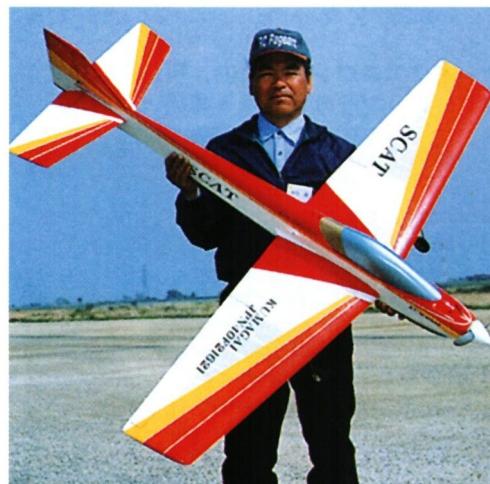
It is difficult to predict today what developments will emerge in the field of electric aerobatic models. This, of course, has made the whole subject highly interesting. What is certain is that future electric aerobatic models will be even less suitable for use in F3A—and, of course, vice versa. F3A aircraft with electric powerplants—which are usually equipped with 30 cells (= approx. 1.8 kg)—would likely be too cumbersome and otherwise unsuitable for performing the required maneuvers in such a confined space. In F3A, wide flight paths are required, with pronounced straight sections between maneuvers. In F5A, a 10-meter separation is required between the center and turn maneuvers! It is also certain that future electric aerobatic aircraft will have to fly considerably slower than has been the case so far—the highly elegant fuselages optimized for speed are therefore even less promising than before. I can most easily imagine models along the lines of “fun flyers,” although, based on my modest experience so far, the longitudinal stability would likely need to be greater—which would have to be achieved with longer fuselages, if necessary, but especially with different wing geometries and airfoils. I would consider model weights of 4 to 5 kg a thing of the past. No sooner
had the regulations been established when an expert remarked that a skilled Hot-Liner pilot might well have a chance here. Anyone who manages to stay within the prescribed box with their Hot Liner is in the running—I can only confirm that—and this would also bring the slender fuselages back into favor; moreover, hand launches are permitted. This example should also clearly illustrate just how far electric aerobatics has come from F3A. Either way, anyone who wants to get involved in electric aerobatics has the opportunity to break into new dimensions with experience and creativity. Who’s up for this new challenge? I wish everyone lots of fun and am happy to provide further information.
*E. Giezendanner*
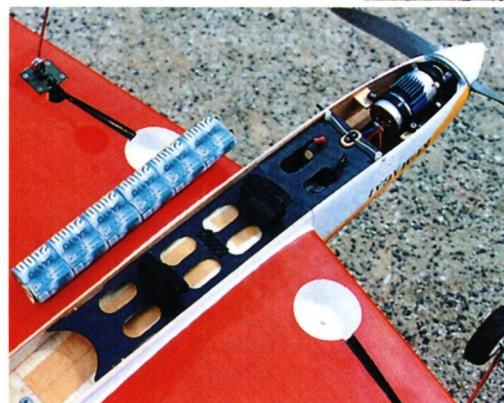
Conzelmann Modelltechnik offers the small electric aerobatic model “POGO,” which has outstanding performance characteristics. Wingspan: 84 cm. 10 cells, 500 mAh.
At an aerobatics competition for small electric models (Schnuppis) held as part of the Militky Cup, we had the spectators handle the scoring and had a surprisingly positive experience with it. Otherwise, F3A judges have been successfully used for electric aerobatics competitions practically everywhere. Scoresheets must also be carefully prepared for the new F5A concept. Prior training or basic certification as an F3A judge is not required. In accordance with the FAI Sporting Code, we are therefore planning to develop a judge training program for electric aerobatics. Consequently, we must anticipate that the entire development process for electric aerobatics will take two to three years.
| Criteria | Qualifications | Final | ||
|---|---|---|---|---|
| K max. | Max. Points | K max. | Max. Points | |
| Precision of each figure, perfection | 25 (max. 7 figures) | 250 | 50 (max. 10 figures) | 500 |
| Overall impression (including turn maneuvers, takeoff, and landing) | 15 | 150 | 15 | 150 |
| Presentation of the maneuvers, landing inside or outside the landing area | (10 without landing gear) | (100) | (10 without landing gear) | (100) |
| Attractiveness, originality | 10 | 100 | 10 | 100 |
| Harmony, Rhythm, Elegance (with music) | – | – | 25 | 250 |
| Total | 50 | 500 | 100 | 1,000 |
| No. Base Figure | K | Option 1 | K | Option 2 | K | Option 3 | K |
|---|---|---|---|---|---|---|---|
| 1. Positive loops (at least 2) | 2 | with roll(s) | 3 | with a snap | 4 | Rosette | 7 |
| 2. Inverted loops (at least 2) | 3 | with roll(s) | 4 | with a snap | 5 | Rosette | 8 |
| 3. Square loop | 3 | with 2 half rolls | 4 | with 4 half rolls | 5 | with 4 full rolls | 6 |
| 4. (Cuban) Eight | 3 | horizontal/square | 4 | vertical square | 5 | Vertical square with two rollers | 6 |
| 5th roller(s) | 2 | two | 3 | slow | 4 | 2 counter-rotating rollers | 5 |
| 6. Dotted rolls (at least 2) | 3 | 4-point | 4 | 8-point | 5 | 4-Reverse-Point Roll | 6 |
| 7. Knife Cut | 3 | Reverse with half roll | 4 | Reverse with full roll | 5 | lapel with snap | 6 |
| 8. Roll circle with 4 half rolls | 4 | with 4 full rolls | 5 | with 4 full rolls in the opposite direction | 7 | with one roll | 8 |
| 9. Twist | 1 | 3 turns | 2 | 2 counter-rotating turns each | 3 | 3 rotations on the back | 4 |
| 10. Immelmann | 2 | combined with half rolls | 3 | combined with full rolls | 4 | combined with a reel and a snap | 5 |
| 11. Humpty Bump (positive) | 2 | negative | 3 | combined with a full roll or 4-point roll | 4 | combined with a roll and snap(s) | 5 |
| 12. Torque reels (at least 3) | 3 | five | 5 | six | 6 | more than six | 8 |
| 13th cylinder positive with 2 half rolls | 3 | positive with full rolls | 4 | negative with half or dotted rolls | 5 | negative with full rolls or snap(s) | 6 |
| 14th Turn | 2 | up and down with half rolls | 3 | Up and down with full rolls | 4 | Up with a roll and down with a snap | 5 |

EURO CONTEST GLIDER ACRO TOUR AUSTRIA 2026

THE PC-21 STORY
 Emil Giezendanner

CORSAIR F4U – A WARBIRD WITH A MEMORABLE LOOK
 Jürgen Rosenberger, Jürgen Prinz

TWIN TOWN PARTNERSHIP
Wolfgang Voeller
SUMMER FUN 2026 AT MG USTER
Martin Wunderli
YOU KNOW WHAT I MEAN? 125 YEARS OF THE SWISS AERO CLUB
Emil Giezendanner
52. 2026 ALPS CUP
Emil Giezendanner
News from HEBU

ATOM, THE NEW DOUBLE-DECKER FROM CPLR
 Matthias Bosshard

TEAM MANAGER "THIS" BOSSHARD
Rodito Nussbaumer
F3A EUROPEAN CHAMPIONSHIPS IN ST-MACAIRE, FRANCE
Matthias Bosshard
INSIGHTS INTO THE HISTORY OF SEAPLANES

WELCOME, NEW MEMBER!
Andrea Bolliger
FREE FLIGHT IN THE MIDDLE OF SUMMER
Urs Muntwyler
PRIDE AND GOOD IDEAS
 Markus Nussbaumer

What's New at Leomotion.com

SMALL, MODEL-LIKE SAILBOATS
Res Dauwalder
BY YOUTH, FOR YOUTH
Lorena Betschen
HORIZON HOBBY/LEMACO NEWS: MICRO OV-10 BRONCO 645 MM BY E-FLITE

COUPE DES ALPES – OBSERVE AND LEARN
Rodito Nussbaumer
34th HAHNENMOOS ALPINE MODEL AIRPLANE CAMP
Res Dauwalder
TRY-OUT DAY AT MFV WETTINGEN
 Urs Keller

NEWS FROM HEBU
 Julia Bucher

NOS REGION – A HUB FOR ELECTRIC AVIATION
Emil Giezendanner
MEMORIES
 Wolfgang Völler

70 YEARS OF THE NIDWALDEN MODEL AIRPLANE CLUB
Martin Barmettler
A SPECTACULAR F3A WORLD CUP IN THE PRINCIPALITY OF LIECHTENSTEIN
Emil Giezendanner
FROM 0 TO 100
Markus Nussbaumer