
His name is Rebell
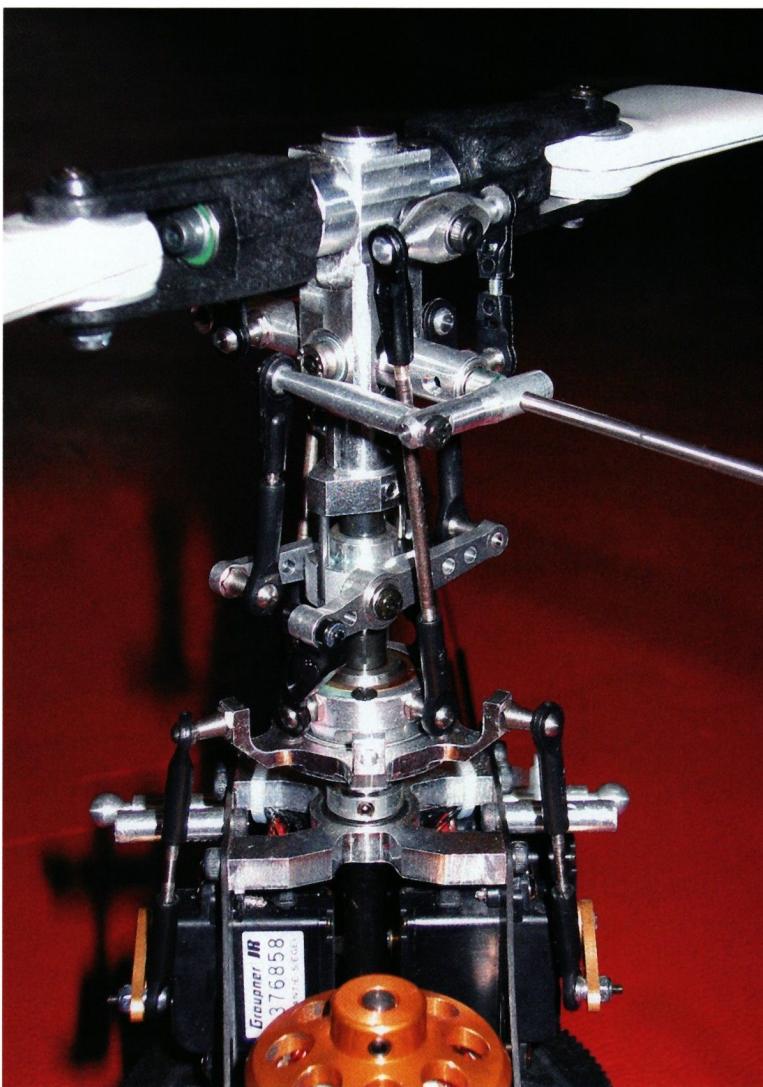
The standard construction kit (LE) contains all the mechanical components, most of which are machined from aluminum. Attracted by the look of the ME version, I chose that one. It differs from the standard version in its side panels, gyro and battery mounts, landing gear, vertical stabilizer, and several other small parts—all beautifully machined from carbon-fiber sheets.
To build this machine, you have to enjoy working with mechanics, because the construction kit includes all the assembly components divided into plastic bags. It’s worth noting that all the parts, as well as the fasteners, are included in the kit. Even the swashplate needs to be assembled. The assembly manual is richly illustrated, but
the text is a bit too brief. Currently, the French translation is not available, but it should be coming soon. If you follow the assembly order outlined in the manual, everything will go very smoothly. The only advice I would give is to install the cyclic plate control servos before attaching the side panels, as access to the screws is limited once the mechanical components are in place. Since the Bell bar is relatively short, I would also advise 3D enthusiasts to lengthen it.
Once that was done, it was time for the motor. I followed Roland Schriber’s advice and installed the 10-pole Torcman TM 350-20 in my model. The manufacturer lists its power output as 600 W. I paired it with the Hacker Jet-Master 40-3P Opto-Heli ESC. Programming is straightforward. The only thing to keep in mind is the motor timing. To protect both the motor and the ESC, it’s essential to set the timing to 18°, which corresponds to a motor with between 6 and 10 poles.
The motor pinion that came with the machine had 17 teeth. After
| Length: | 940 mm |
| Height: | 300 mm |
| Rotor diameter: | 1050 mm |
| Tail rotor diameter: | 210 mm |
| Weight without batteries: | 1,620 g |
| Total weight: | 2,580 g |
During flight tests, I noticed that the motor was overheating, as was the ESC. Since I fly with 16-cell Sanyo 3300 NiMH HV batteries, the motor wasn’t operating within its optimal efficiency range, and the ESC shut down due to thermal overload while I was in flight... After various tests, I settled on a 14-tooth pinion. These batteries have very low internal resistance. Since the ideal rotor speed is between 1,900 and 2,000 min⁻¹, I think this combination is ideal for aerobatics.
Now for the electronics. I used four Graupner DS 361 servos. To allow for a pitch adjustment of +10° / –10°, I installed extended servo arms. To
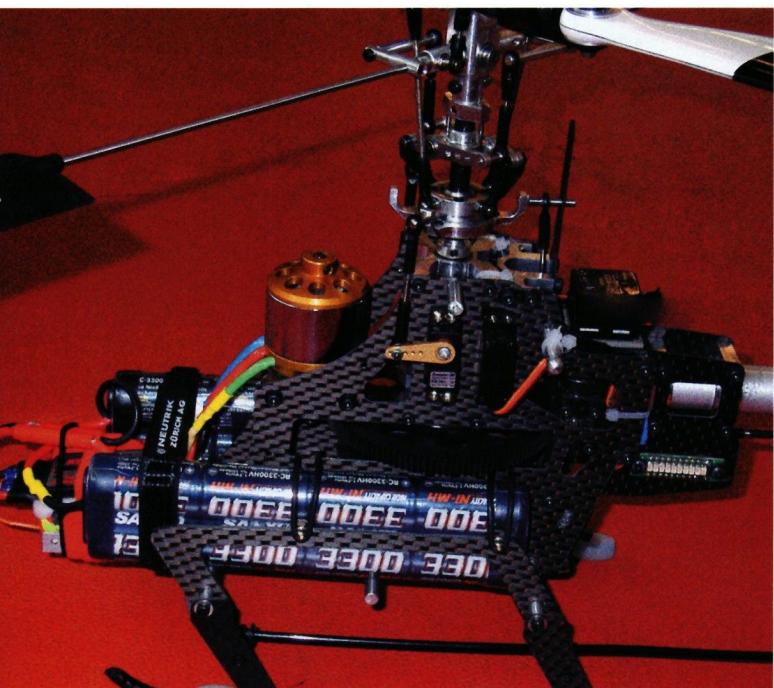
To avoid interference, I installed the receiver under the rotor shaft and the motor controller at the very front. The gyro is mounted on its bracket behind the rotor shaft. A 4-cell battery for the receiver was also installed at the front of the frame. With the radio programming complete, all that was left was to test fly this Rebell.
The initial tests proved more than successful, and a vibration-free machine took flight right before my eyes. Since I hadn’t yet had the chance to actually fly it outdoors, I fine-tuned the machine indoors. I must say that its power is not at all suited to this type of flight, because it picks up speed very quickly, and given its weight, it still has a certain amount of inertia.
The only criticism I would dare to make concerns the design of its landing gear. It’s too straight, and slightly “hard” landings bend or break the mounting screws on the frame.
In closing, I must say that, aside from its excellent flight characteristics, the Rebell’s main selling point is undoubtedly its price. It is available for Fr. 418.– for the LE version (all aluminum) and Fr. 590.– for the ME version in carbon fiber. Add the motor-speed controller set for Fr. 395.–, and you get a high-quality model at a more than reasonable price. Two-tone fiberglass and carbon-fiber cockpits are also available as an option. For additional, reliable information, please contact the importer, Sarbach RC-Helitechnik in Brig, at 027 923 91 71 or visit their website at www.rc-helitechnik.ch. So, happy flying to everyone, and see you on the runways.
Philippe Roch

EURO CONTEST GLIDER ACRO TOUR AUSTRIA 2026

THE PC-21 STORY
 Emil Giezendanner

TWIN TOWN PARTNERSHIP
 Wolfgang Voeller

SUMMER FUN 2026 AT MG USTER
Martin Wunderli
CORSAIR F4U – A WARBIRD WITH A MEMORABLE LOOK
Jürgen Rosenberger, Jürgen Prinz
52. 2026 ALPS CUP
Emil Giezendanner
YOU KNOW WHAT I MEAN? 125 YEARS OF THE SWISS AERO CLUB
Emil Giezendanner
News from HEBU

TEAM MANAGER "THIS" BOSSHARD
Rodito Nussbaumer
ATOM, THE NEW DOUBLE-DECKER FROM CPLR
 Matthias Bosshard

F3A EUROPEAN CHAMPIONSHIPS IN ST-MACAIRE, FRANCE
Matthias Bosshard
INSIGHTS INTO THE HISTORY OF SEAPLANES

WELCOME, NEW MEMBER!
Andrea Bolliger
What's New at Leomotion.com

PRIDE AND GOOD IDEAS
 Markus Nussbaumer

SMALL, MODEL-LIKE SAILBOATS
Res Dauwalder
FREE FLIGHT IN THE MIDDLE OF SUMMER
Urs Muntwyler
BY YOUTH, FOR YOUTH
Lorena Betschen
HORIZON HOBBY/LEMACO NEWS: MICRO OV-10 BRONCO 645 MM BY E-FLITE

COUPE DES ALPES – OBSERVE AND LEARN
Rodito Nussbaumer
34th HAHNENMOOS ALPINE MODEL AIRPLANE CAMP
Res Dauwalder
TRY-OUT DAY AT MFV WETTINGEN
 Urs Keller

NEWS FROM HEBU
 Julia Bucher

NOS REGION – A HUB FOR ELECTRIC AVIATION
Emil Giezendanner
MEMORIES
 Wolfgang Völler

70 YEARS OF THE NIDWALDEN MODEL AIRPLANE CLUB
Martin Barmettler
A SPECTACULAR F3A WORLD CUP IN THE PRINCIPALITY OF LIECHTENSTEIN
Emil Giezendanner
FROM 0 TO 100
Markus Nussbaumer