
Introductory Text 5P
With these instructions for a briefing on the launch slope, we continue where the article from the previous issue (in German) titled “Accident Prevention and Influence in Model Aviation” left off. The discussion on safety and behavior is never exhaustive; this topic will remain relevant to pilots of all levels for as long as they fly. Our ideas, conventions, and rules are tested against reality, especially when we fly in groups outdoors.
The checklist below is a guide to ensuring a pleasant and safe day of flying. It is intended for the pilot giving the briefing, but also serves as a summary for all pilots.
Why 5P? – In any case, once there are 5 or more pilots present, any flying area becomes so crowded that each pilot must pay significantly greater attention, and it is no longer possible to fly carelessly in all directions—as is the case, for example, when a group
of 2–3 friends—always the same ones—flies on the slope behind the house. Five points represent the maximum number of topics that can reasonably be covered without delaying the start of the eagerly awaited flights and without overloading one’s memory.
In my opinion, the first point—namely, the welcome message—is the most important:
Each of us wants to do everything we can to ensure that everyone enjoys a wonderful day of flying!
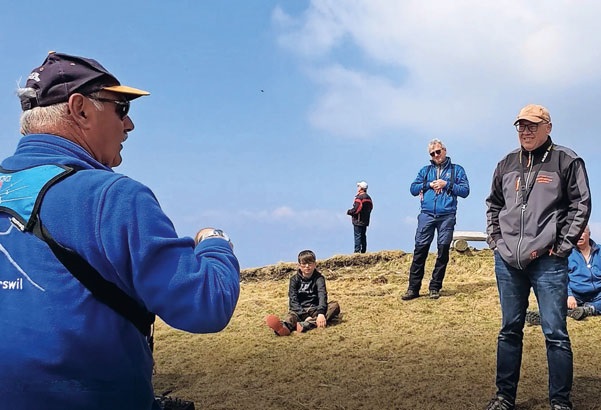
1. Welcome Message
- Hello everyone, hi guys, guten Morgen, hello pilots, buon giorno, dear pilots.
- Our goal is to spend a pleasant, relaxed, and carefree day together.
- To ensure this is possible even when several pilots—5 or more—share a flying area, we’ll hold a briefing, as recommended by the Swiss Model Aircraft Federation.
- It’s important that everyone participate; it takes about 10 minutes to go over the 5P—the 5 points.
- This is for the safety of us pilots, as well as spectators and passersby, and our models in the air.
2. Staying in a Group
- All pilots should stay grouped together so that we can hear each other clearly, even in strong winds.
- Exception: during takeoff and landing. These two maneuvers must be announced in advance in a loud and clear voice.
3. Announcements
- Announcements are made in a loud and clear voice. They are delivered in a tone distinct from the usual one.
- Takeoff: “May I take off?”—get the OK from each pilot. If not, do not take off.
- “Takeoff” is announced by the pilot or the takeoff assistant.
- Landing: “I’m about to land” is the first announcement, when the model is still high in the air. Pilots may request to land first or to make a quick pass.
- After the announcement, it is not advisable to continue flying.
- “I’m landing.” The pilot who is in the landing phase is no longer required to try to avoid other models.
- “I have to land” is the phrase to use when there are no other options left.
- The model must be removed from the runway immediately. Then announce: “Runway clear.”
- Quick passes with momentum: “I’m coming from (location name).” All location names (towns, mountain names) must be clearly stated. No more than four locations. One indicates the direction ahead, at a 90-degree angle to the slope. The term “Bangladesh” refers to a vertical approach from below toward the top. If other maneuvers follow a pass, the announcement at the end of those maneuvers is: “I’m clear.”
- “Landing area clear” is the announcement used when the pilot has landed their model and returned it to the preparation area. Only then may the next pilot land or perform a low-altitude pass.
4. Distances and Circling Flights
- We maintain a distance of at least 20 m. This applies to everyone who is flying, not flying, watching, or passing nearby.
- A circular flight involves flying 360-degree circles around the pilot’s position. As soon as four or more pilots are in the air, we refrain from this maneuver because it distracts other pilots and restricts their flight maneuvers.
5. Respect
- We will adhere to these rules today until the end.
- We apologize if, despite our best efforts, we have flown too close to people or model aircraft.
- Any causes for dissatisfaction are discussed calmly after landing in a collaborative and constructive manner.
- We avoid dissatisfaction and collisions by occupying the nearby airspace only briefly, if necessary. Keywords: circular flight, rapid turns, and aerobatic maneuvers at eye level; flitting in all directions right in front of someone’s face with a lightweight model.
- Any questions? Are there any pilots among us who are unfamiliar with these principles and would like some instruction?
Thank you very much. Have some great flights and plenty of happy landings!


News from HEBU

HORIZON HOBBY/LEMACO NEWS: MICRO OV-10 BRONCO 645 MM BY E-FLITE

PRIDE AND GOOD IDEAS
 Markus Nussbaumer

TEAM MANAGER "THIS" BOSSHARD
 Rodito Nussbaumer

YOU KNOW WHAT I MEAN? 125 YEARS OF THE SWISS AERO CLUB
 Emil Giezendanner

F3A EUROPEAN CHAMPIONSHIPS IN ST-MACAIRE, FRANCE
 Matthias Bosshard

ATOM, THE NEW DOUBLE-DECKER FROM CPLR
Matthias Bosshard
SUMMER FUN 2026 AT MG USTER
Martin Wunderli
What's New at Leomotion.com

52. 2026 ALPS CUP
Emil Giezendanner
TWIN TOWN PARTNERSHIP
Wolfgang Voeller
34th HAHNENMOOS ALPINE MODEL AIRPLANE CAMP
Res Dauwalder
CORSAIR F4U – A WARBIRD WITH A MEMORABLE LOOK
Jürgen Rosenberger, Jürgen Prinz
SMALL, MODEL-LIKE SAILBOATS
Res Dauwalder
TRY-OUT DAY AT MFV WETTINGEN
Urs Keller
WELCOME, NEW MEMBER!
Andrea Bolliger
FREE FLIGHT IN THE MIDDLE OF SUMMER
Urs Muntwyler
COUPE DES ALPES – OBSERVE AND LEARN
Rodito Nussbaumer
EURO CONTEST GLIDER ACRO TOUR AUSTRIA 2026

BY YOUTH, FOR YOUTH
Lorena Betschen
INSIGHTS INTO THE HISTORY OF SEAPLANES

THE PC-21 STORY
Emil Giezendanner
NEWS FROM HEBU
 Julia Bucher

FROM 0 TO 100
Markus Nussbaumer
MEMORIES
Wolfgang Völler
NOS REGION – A HUB FOR ELECTRIC AVIATION
Emil Giezendanner
DO YOU KNOW WHAT I MEAN IN THE LAND OF SMILES?
Emil Giezendanner
Have you almost forgotten about aircraft that take off and land vertically?
Emil Giezendanner