
Hansheiri Thomann: The Story of a Great Free-Flight Pilot
In the 1950s and 1960s, remote-control systems were largely absent from model aviation. The development of such devices was still in its infancy. Model airplane enthusiasts were primarily interested in free-flying, uncontrolled model airplanes. Competitions with up to 100 or more participants were the norm. In many cases, the number of participants even had to be limited (national competitions, performance competitions, etc.).
Early risers can watch a model sail glide silently and gracefully in wide arcs overhead during their morning walk. The owner is Hansheiri Thomann. Before sunrise, he set out from Winterthur on his bike—with his models strapped to his back—and rode the nearly 20 km to the Frauenfeld Allmend to thoroughly prepare for the World Championships in
Wiesbaden. Once training is over, he heads back to Winterthur. At 7:30 a.m. sharp, Hansheiri begins his work as a mechanical engineer in the wind tunnel. Hansheiri Thomann was born on August 2, 1929, and grew up in Münchwilen. Even at a young age, young Hansheiri was fascinated by everything that moved in the air—the large birds of prey high in the sky and the gray heron
on approach, and of course the few airplanes that could still be counted in the sky back then. Also the Zeppelin passing by in the distance, and the little streams of meltwater on the dirt roads. No wonder he soon tried his hand at building models that could mimic the large birds. While he started with smaller beginner models from kit sets, he soon began building “full-size” models. At the age of thirteen, he built
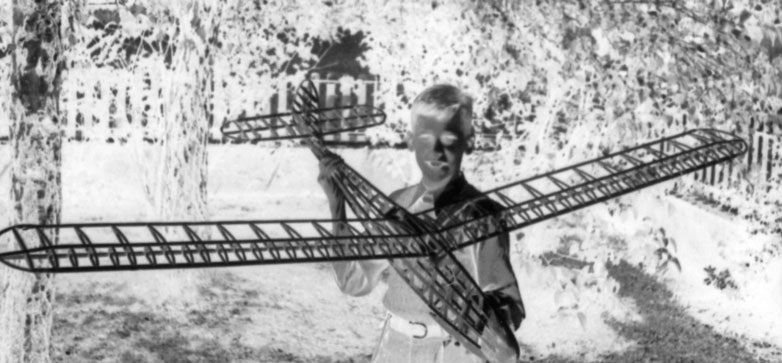
he built a pelican. A penguin followed. With this model, he immediately noticed a weak spot in the thin rear section of the fuselage, which often led to a fuselage fracture. By reinforcing it, he eliminated the risk of breakage. With this penguin, seventeen-year-old Hansheiri wins his first competition in Kirchberg. Anyone who sees one
of these models—built exclusively from plywood and pine strips—can only imagine the perseverance and skill required to build them. The fretsaw is in high demand.
During his early years, Hansheiri tried his hand at a wide variety of categories. A Riedstern, powered by the legendary Dyno, flew quite well. Flying a water-launched model that could take off and land on a lake is one of his fondest memories. Subsequent attempts with larger engines resulted in “breakage, breakage, and more breakage” (his own words). So, he moved away from that type of model flying. Building flying wings also made it into his “selection,” but it was only a brief episode, since you set the geometry during construction and then can’t change anything—boring. Then there are the gliders. These elegant models, now built with modern materials like balsa, really speak to him. He ultimately remains loyal to this category throughout his entire model-flying career.
From 1948 until around the end of 1954, his high school graduation exams, his studies at ETH Zurich as a mechanical engineer, and his military service caused intermittent breaks in his model flying. After graduating from high school in Frauenfeld, his close connection to his model flying club in Frauenfeld unfortunately began to fade noticeably. While studying at ETH, unsurprisingly, he developed a keen interest in courses on aerodynamics, aircraft statics, and lightweight construction.
While studying, Hansheiri came across a theory in 1952 that showed that
a low moment of inertia in the model is crucial for good flight characteristics. This means: wing tips that are as light as possible, and especially the fuselage ends and tail unit. In other words, light yet sufficiently robust—a fascinating engineering problem. This is where he began: Conventional models have a short and relatively heavy rear fuselage section. This must be balanced by a fuselage nose up to 30 cm long. Hansheiri builds models with a very short fuselage nose of only 13 cm. The rear fuselage section between the wing tip and the elevator nose is extended to 84 cm, compared to the previous approximately 65 cm. This requires an extremely lightweight construction and meticulous material selection. Hansheiri builds the elevator using balsa wood and Japanese paper, weighing only 7 grams. The rear fuselage section, including the rudder, weighs a total of 22 grams. These groundbreaking advancements result in a tremendous improvement in longitudinal stability. This is a major achievement by Hansheiri. His insights are immediately adopted and have a pioneering influence on the further development of free-flight models.
Hansheiri’s extreme construction method is difficult to achieve. However, shorter fuselage noses (20 cm and less) and extended rear fuselages (around 75 cm) are structurally feasible and become the standard. Inspired by Hansheiri, German free-flight modeler Andreas Mederer was one of the first to build his models with an extremely short nose and a lightweight rear section. With this model, his friend Gerd Erichsen became world champion in Wiener-Neustadt in 1963.
To enable optimal use of thermals in tight turns, Hansheiri builds his models asymmetrically. The wing on the inside of the turn is considerably longer than the outer one, allowing for left-hand turns without having to push the model. The
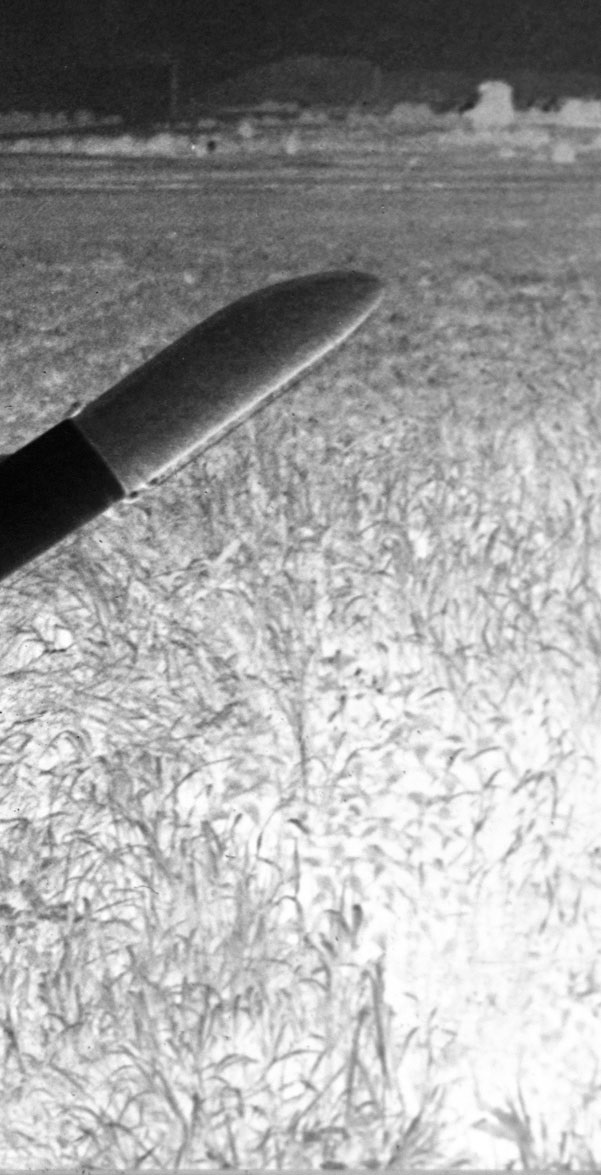
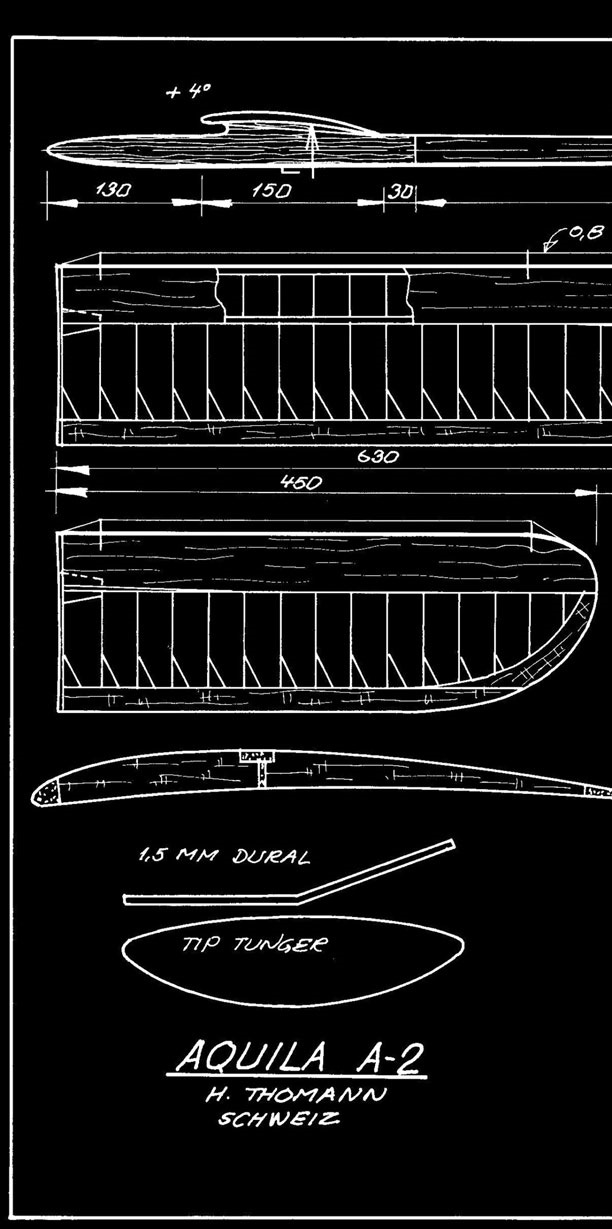
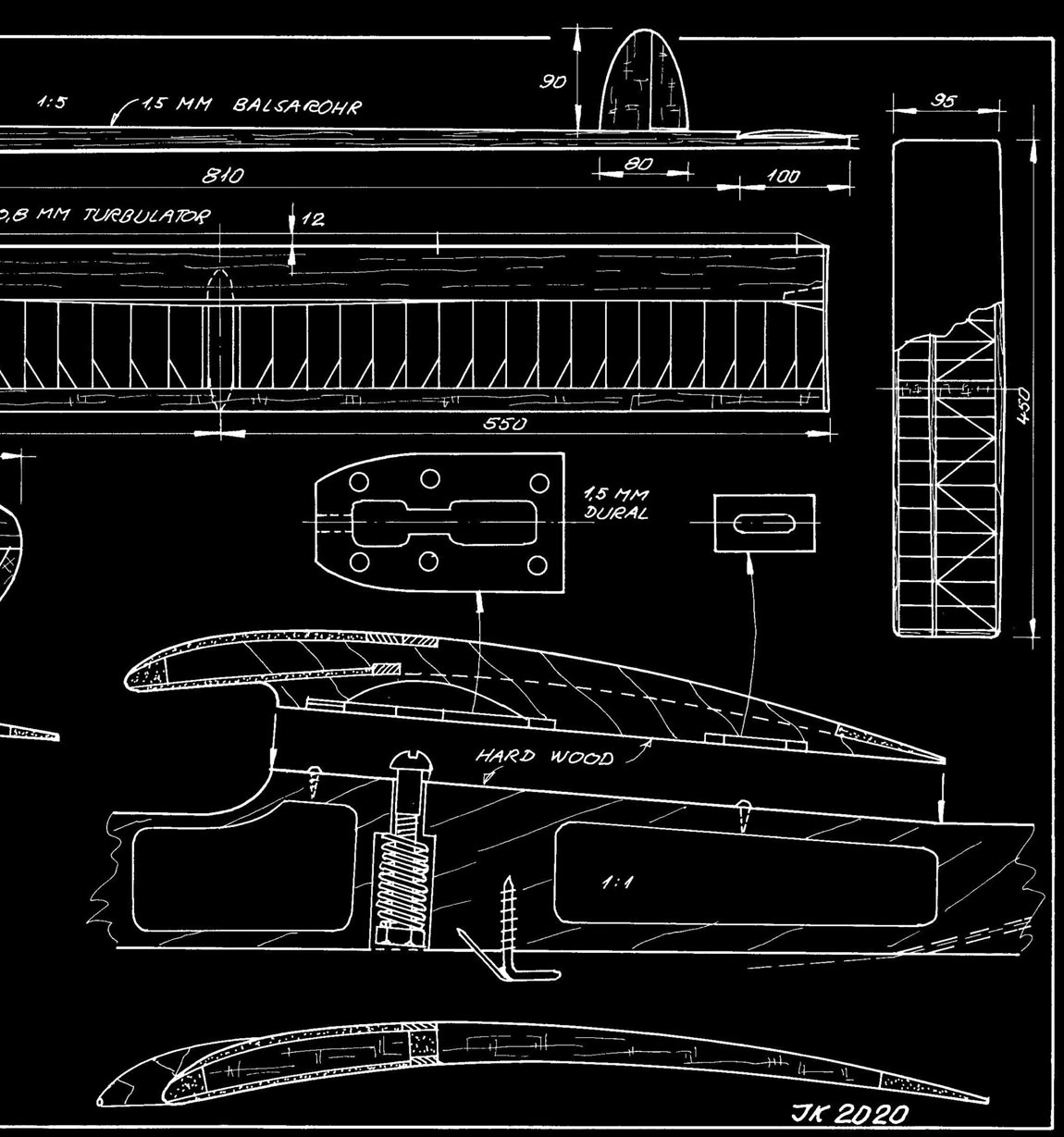
The wings of his models are planked in the first third on both the top and bottom surfaces. This creates a closed tube: top surface – leading edge spar – bottom surface – spar web (now called a D-box). This was a novelty at the time. This design greatly enhances torsional rigidity, and the wings are virtually impossible to twist. An ingenious, gap-free wing mounting system featuring a coil spring attachment is another effective result of continuous optimization.
- He brings talent and enthusiasm to the table.
- Key motto: improve, don’t overdo it.
Example 1:
The model is hanging by the tail end from a fork in a tree branch high up in a tree. During the “rescue,” the elevator breaks. Hours of deliberation: How can the elevator be attached to the fuselage so that it detaches rather than breaks? This also helps during landing if the elevator touches an obstacle.
- If you push the limits (necessary), you can marvel at the flight maneuvers of a model aircraft without an elevator that’s plummeting from 50 meters in the midst of severe turbulence during a storm.
Example 2:
During spiral-dive landings and similar stresses, the fuselage tube behind the wing can break. Days of deliberation: How can the torque from the wing acting on the fuselage be reduced? This led to the use of a coil spring to secure the wing (see the Aquila construction plan).
Example 3:
A spectator grabs the model by the fuselage in front of the rudder and brings it
back with a friendly smile. How many frames need to be installed so that the tube doesn’t buckle under this treatment? See the Aquila construction plan.
Hansheiri has only one goal: to represent Switzerland at the World Championships. The members of the national team are selected through performance competitions or separate qualifying rounds. In his first performance competition, Hansheiri placed second. He went on to win two more, finishing ahead of the entire elite free-flight competition. At the qualifier for the World Championships in Peretola, Florence, he achieved the full 180-second flight time in all seven flights for the first time. At the 1954 World Championships in Odense, Denmark, a storm was raging. His model performed well, and after the fourth launch, it had the best time. During the final launch, a strong gust of wind sent the model spinning around like a leaf. This resulted in a poor flight time, yet he still managed a respectable 8th place out of 68 competitors. A year later, in Wiesbaden: After the fourth launch, Hansheiri was once again in first place, this time tied with Rudi Lindner. Hansheiri and Rudi Lindner were considered true high-launch virtuosos at the time. They were able to tow their models for minutes on end using a simple high-launch hook. On the fifth launch, Hansheiri chose a bad moment. He towed for a long time trying to find an updraft. Because the fuse was getting shorter and shorter, he had to release the model in unfavorable thermal conditions. The result: a poor flight in the downdraft. Nevertheless, it was enough for a very good 6th place (out of 79 competitors). Ultimately, at the World Championships in Florence, he lost second place due to a timing error and finished in the still-outstanding
third place (66 competitors).
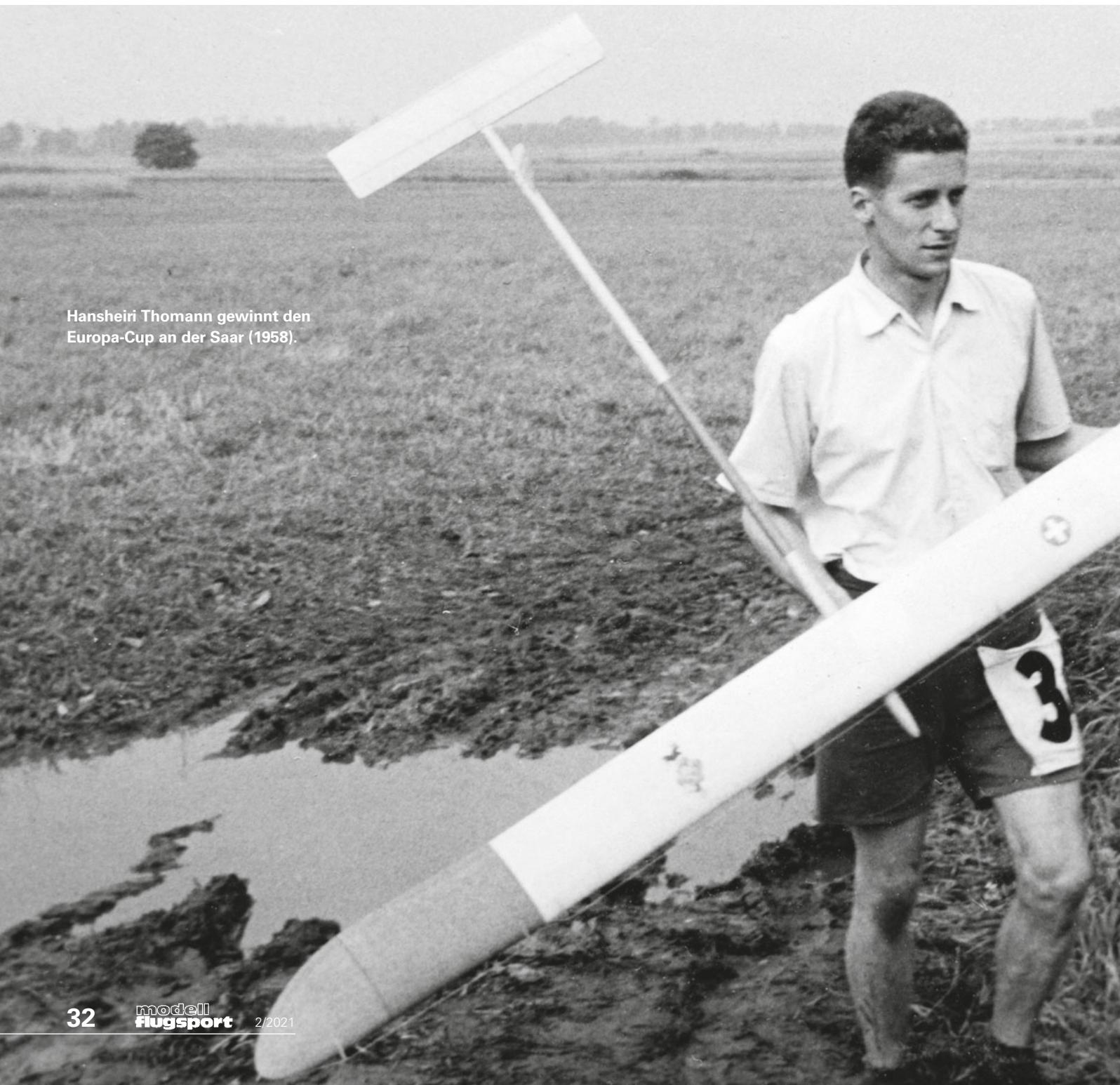
In 1956, Hansheiri competed with the Swiss team in the European Cup in Ensheim, Saar. The great effort paid off. He won against strong competition
in windy and turbulent conditions. No Swiss free-flight pilot has since managed such a string of top performances. Alongside World Champion Rudi Lindner and Max Hacklinger
He soon became one of the top three pilots of that generation of free-flight pilots.
In the spring of 1957, the entire family moved to Sweden.
Shortly after arriving in Sweden, Hansheiri was warmly and readily welcomed by the Swedish model airplane enthusiasts, whom he had known since the World Championships in Florence. He was soon offered
the very active Gamen Norrköping club (180 km between Stockholm and Norrköping!). He formed wonderful friendships with the members of this club.
In 1958, the globally distributed model-making magazine *Aero Modeller* published a plan of his revolutionary *Aquila* with all the details. Numerous variations of this model followed, all with the goal of creating a
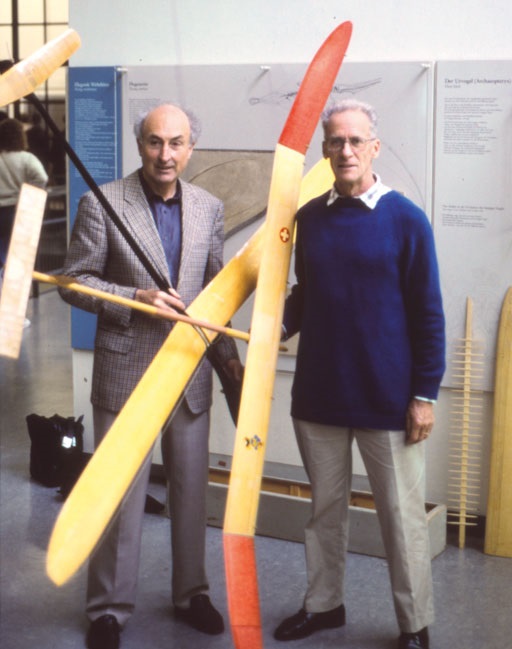
To develop a “thermal hunter” that would dive right into the thermal bubbles. Without much success. That’s why Hansheiri decided to launch a new line. The goal was the lowest possible sink rate for calm weather, modeled after the flight of owls at dusk. That’s why he named it “UHU.” In the summer of 1958, during a visit from his in-laws, his father-in-law stepped in with great skill during critical phases. This collaboration fostered a special bond with the model. Furthermore, the “UHU” proved to be a capable thermal hunter and was used in most subsequent competitions. The “UHU” survived the move to Switzerland and all the disappointments unscathed. For a few years now, it has been enjoying its retirement alongside Max Hacklinger’s “Urubu” and the Lindner Spider at the Deutsches Museum in Munich.
In 1958, Hansheiri traveled once again from Sweden to the Saar for the European Cup. There, he won for the second time. The model he flew there attracted a great deal of interest and was described by the then team captain and chief expert of the
AeCS, Arnold Degen, as the most beautiful model of the European Cup. A little “anecdote” on the sidelines of the European Cup: The winning models were to be flown as a demonstration. When Hansheiri went to retrieve his model from the team tent, a fifth-grader—equipped with a meter stick, notepad, and pencil—was kneeling next to it, having almost finished a rough sketch with all the necessary measurements. Hansheiri says with a laugh: “Come on, let’s not disturb the boy. He should finish his ‘plan.’” Sweden has many lakes that freeze solid in winter. These are ideal venues for a winter competition—one of the main events of the year. Hansheiri participates regularly. He consistently places near the top and wins the competition in 1961 despite strong competition. Thanks to his good, friendly relationships, Hansheiri served as team captain of the Swedish national team at the 1959 World Championships in Bourg-Leopold, Belgium, and in 1961 in Leutkirch.
In February 1959, he won the Helsinki-Norrköping city competition in Helsinki on a massive ice rink. There was almost no turbulence that day—ideal conditions for the “UHU.” Hansheiri competed in the 1967 winter competition with his “UHU” and won it. This was his
last competition. A very fitting farewell to a great model aviation career.
As one of his final activities in model aviation, Hansheiri published several articles in *Aero Revue* and the English-language *Aero Modeller*. His research findings on airfoil profiles garnered significant international attention. This led to the development of three new, widely used airfoils: the F4 for calm weather, the F5 for turbulent conditions, and the F6 bulge airfoil for stormy weather. This article, “Airfoils,” which remains relevant to this day, has been republished in “Thermiksense” ([www.thermiksense.de](http://www.thermiksense.de)) in the “Infothek”/“Aerodynamics and Construction Technology” section, under “Wing Profiles.”
In 1957, Hansheiri was offered the opportunity to take a very interesting job in Sweden. So he and his wife traveled to Sweden in a Volkswagen Beetle (their child was “left” with his mother for the time being). It turned out that, by a stroke of luck, he had made the right decision. At the Swedish Aeronautical Research Institute (FFA), he was able to follow the optimization of the Saab Draaken and the development of its successor, the Viggen.
gen. He himself is involved in basic research. The focus is on the heating of missiles at high speeds. Wind tunnels are available that can accelerate air to seven times the speed of sound in order to conduct the experiments. Due to the move and starting his new job, his model aircraft hobby was put on the back burner for the time being. Sometime in 1959, a professor friend of his who worked at KTA Stockholm (the equivalent of ETH Zurich) asked him, “Why don’t you pursue a doctorate?” This led to another period of study involving a great deal of learning and exams, which Hansheiri completed in 1964 with a doctorate. “On the side,” Hansheiri gave lectures at the University of Uppsala. So, for the time being, there was once again little time left for model aircraft flying.
In 1967, Hansheiri was appointed full professor of fluid mechanics at ETH Zurich. The family thus returned to Switzerland with wonderful memories of Sweden and all their many friends. Together with a colleague, he now heads the Institute of Fluid Dynamics. The institute primarily investigates unsteady flows: whistling faucets, chairlifts spinning in the wind, and so on. Outfits for athletes—including ski racers (Russi), ski jumpers, bobsledders, and others—are tested in the wind tunnel to demonstrate practical problems to students in an easy-to-understand way. To balance his demanding professional life, Hansheiri spends a lot of time in the great outdoors. He loves strenuous physical activity: mountain hikes in the summer and cross-country skiing in the winter. He has competed in the famous Engadin Ski Marathon 44 times. During his numerous forest runs, ideas for lectures and reports take shape in his mind.
After entering the “AHV class” in 1994, Hansheiri found himself with a great deal of freedom. Before that, he had been fully occupied with research, lectures, administrative work, and exam schedules. Now he was suddenly free. He and his wife travel around the areas near Switzerland. They especially enjoy spending time together with their large family. The latest Christmas photo shows 27 people, including four children, ten grandchildren (born every two years from 1985 to 2005
) and two great-grandchildren. Their second home in Samedan—where numerous exams were prepared and submitted doctoral dissertations were reviewed—serves as a wonderful base. From a one-year-old’s “first steps” to challenging climbing routes, anything is possible. His wife serves as the “minister of the interior,” while Hansheiri is more like the “minister of foreign affairs.” His relatives also love nature and the mountains. Together, they go on hikes and mountain tours. A special attraction
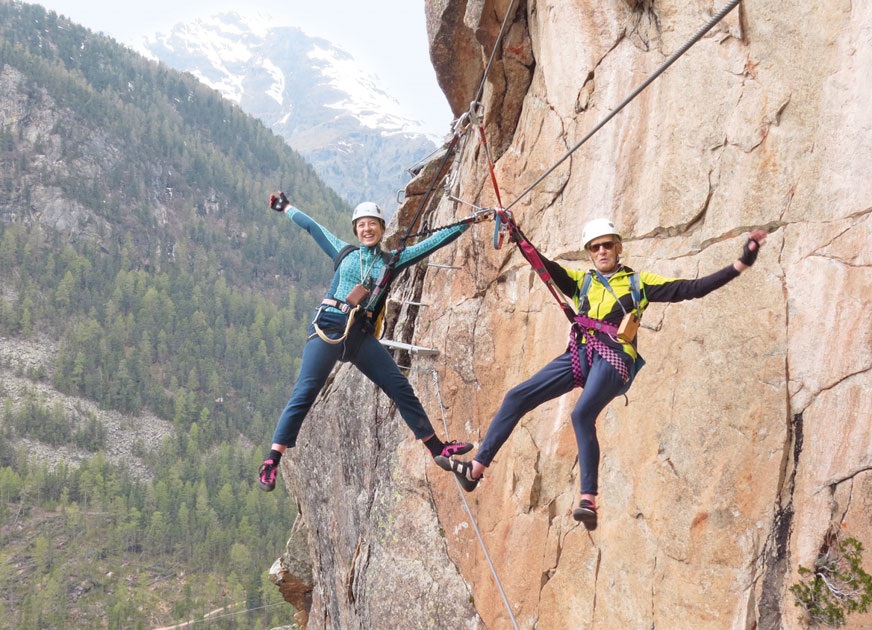
is the “Fiamma.” A smooth granite spire high above the Bergell Valley, which his grandfather must always lead. A very popular photo subject. The “La Resgia” via ferrata near Pontresina is another draw. When planning the next day’s activities during a visit, the plan is practically always: via ferrata.
Hansheiri is convinced that these athletic activities—in which he often pushes his body to its limits—have helped him maintain good health and fitness. He hopes he’ll still be able to do it next year as well. At our request, Hansheiri went to great lengths to record his fascinating life story on the computer. He has contributed greatly to the sport of free flight. We thank him and hope that, in the best of health, he will be able to spend much more time with his family and at his second home in Samedan, as well as in the beloved mountains of Graubünden.
Model builders had a selection of kit sets to choose from. After building their first model from one of these kits, most model aviators turned to the drawing board and sought success with their own designs. These ongoing efforts led to continuous improvements in model construction and enhanced flight performance. Among the pioneers of that era were, in particular, the two German free-flight modelers Max Hacklinger and two-time world champion Rudi Lindner. The third member of this trio is the Swiss modeler Hansheiri Thomann. Through their research findings and the development of corresponding models, these three made a significant contribution to the current technical state of free-flight models.


News from HEBU

TEAM MANAGER "THIS" BOSSHARD
 Rodito Nussbaumer

YOU KNOW WHAT I MEAN? 125 YEARS OF THE SWISS AERO CLUB
 Emil Giezendanner

HORIZON HOBBY/LEMACO NEWS: MICRO OV-10 BRONCO 645 MM BY E-FLITE

PRIDE AND GOOD IDEAS
 Markus Nussbaumer

34th HAHNENMOOS ALPINE MODEL AIRPLANE CAMP
Res Dauwalder
TRY-OUT DAY AT MFV WETTINGEN
Urs Keller
F3A EUROPEAN CHAMPIONSHIPS IN ST-MACAIRE, FRANCE
 Matthias Bosshard

52. 2026 ALPS CUP
Emil Giezendanner
ATOM, THE NEW DOUBLE-DECKER FROM CPLR
Matthias Bosshard
SUMMER FUN 2026 AT MG USTER
Martin Wunderli
What's New at Leomotion.com

COUPE DES ALPES – OBSERVE AND LEARN
Rodito Nussbaumer
TWIN TOWN PARTNERSHIP
Wolfgang Voeller
BY YOUTH, FOR YOUTH
Lorena Betschen
CORSAIR F4U – A WARBIRD WITH A MEMORABLE LOOK
Jürgen Rosenberger, Jürgen Prinz
SMALL, MODEL-LIKE SAILBOATS
Res Dauwalder
WELCOME, NEW MEMBER!
Andrea Bolliger
FREE FLIGHT IN THE MIDDLE OF SUMMER
Urs Muntwyler
EURO CONTEST GLIDER ACRO TOUR AUSTRIA 2026

INSIGHTS INTO THE HISTORY OF SEAPLANES

THE PC-21 STORY
Emil Giezendanner
NEWS FROM HEBU
 Julia Bucher

FROM 0 TO 100
Markus Nussbaumer
MEMORIES
Wolfgang Völler
NOS REGION – A HUB FOR ELECTRIC AVIATION
Emil Giezendanner
DO YOU KNOW WHAT I MEAN IN THE LAND OF SMILES?
Emil Giezendanner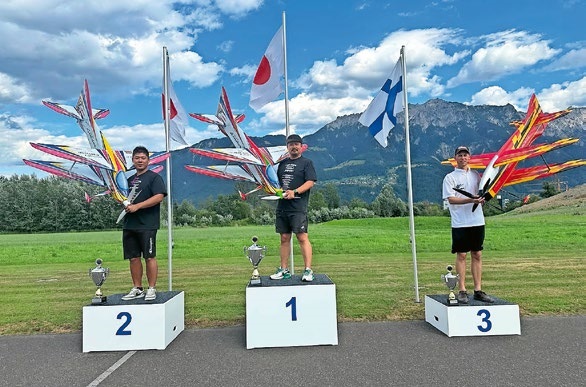
A SPECTACULAR F3A WORLD CUP IN THE PRINCIPALITY OF LIECHTENSTEIN
Emil Giezendanner