
Considerations on Aerobatics with Electric Model Airplanes
In March 2000, CIAM (FAI) delegates adopted an entirely new F5A set of rules, which has been in effect since 2001. The novelty is that this program is no longer based on the F3A program but is specifically designed for electric-powered aircraft. Members of the International Electric Flight Commission thus concluded that this category could only be saved through radical changes.
Since the early 1980s, electric aerobatics had been more or less a replica of what was happening in combustion-engine aerobatics. Thus, in 1987, the concept of linked maneuvers was introduced by applying the flight windows and distances used in F3A. Even the judges came almost exclusively from that category. Until the 2000s, the owner of an electric aircraft could compete in two categories: the combustion engine category up to the Swiss championships, and electric competitions. At the regional and interregional levels, an electric model was fully competitive.
With the new F3A program, which demands the highest level of precision and gear-reduced motors to maximize engine power, an electric model can no longer keep up. It’s not that the rules prohibit electric motors, but rather that the power-to-weight ratio has become unbalanced due to the use of conventional NiCd and NiMH batteries. In the past, electric models compensated for their weight disadvantage with ultra-lightweight construction. Today’s F3A has evolved in such a way that weight differences in the tail, fuselage, or wings no longer matter. The last attempt to enter an electric model in the world championships dates back to 1983, and it was anything but good publicity for the category. An equivalent solution could be found by using batteries with the same power output as today’s but weighing no more than 500 to 700 g, instead of the 1,800 g of the current 30-cell batteries. It is therefore clear that electric aerobatic flight has reached an impasse.
Over the past 20 years, we have seen the development of many interesting designs. The challenge was to strike a balance between flight speed, climb performance, and flight time. There were also many mistakes made in choosing airfoils that were too thin or fuselages that were too narrow. Many models were too small to appeal to the judges. Most models were simply too fast. In the beginning, modified F3A models were successful. Electric models specially adapted for F3A had their moments of success, confirming what we mentioned earlier: that electric flight was based on its combustion-engine counterpart.
The guiding principle is to limit the amount of energy—that is, batteries—carried on board based on weight. We therefore now have the choice of quickly converting this energy using large motors or, conversely, opting for a longer flight time. As a general rule, the new regulations
require a relatively short routine (max. 5 minutes, including takeoff and landing). Spectacular routines will require more power and will therefore be time-limited. Measures taken to combat monotony are complemented by others that require the pilot to compose his own routine. By choosing maneuvers that are intelligently sequenced, the pilot can best showcase his or her own abilities and those of the model. The final factor contributing to greater audience appeal is the reduced maneuvering area, which requires the pilot to perform the program close to the audience. With the exception of rolls, maneuvers must be performed perpendicular to the runway axis. The back-and-forth movement regulated by transition maneuvers in F3A will become less important. As a general rule, elegant maneuvers are required, as the overall impression is what counts.
Finally, electric aerobatics competitions no longer need to be held exclusively in isolated areas but can also take place near residential areas and sports venues. Understandably, the appeal to young and novice audiences is growing.
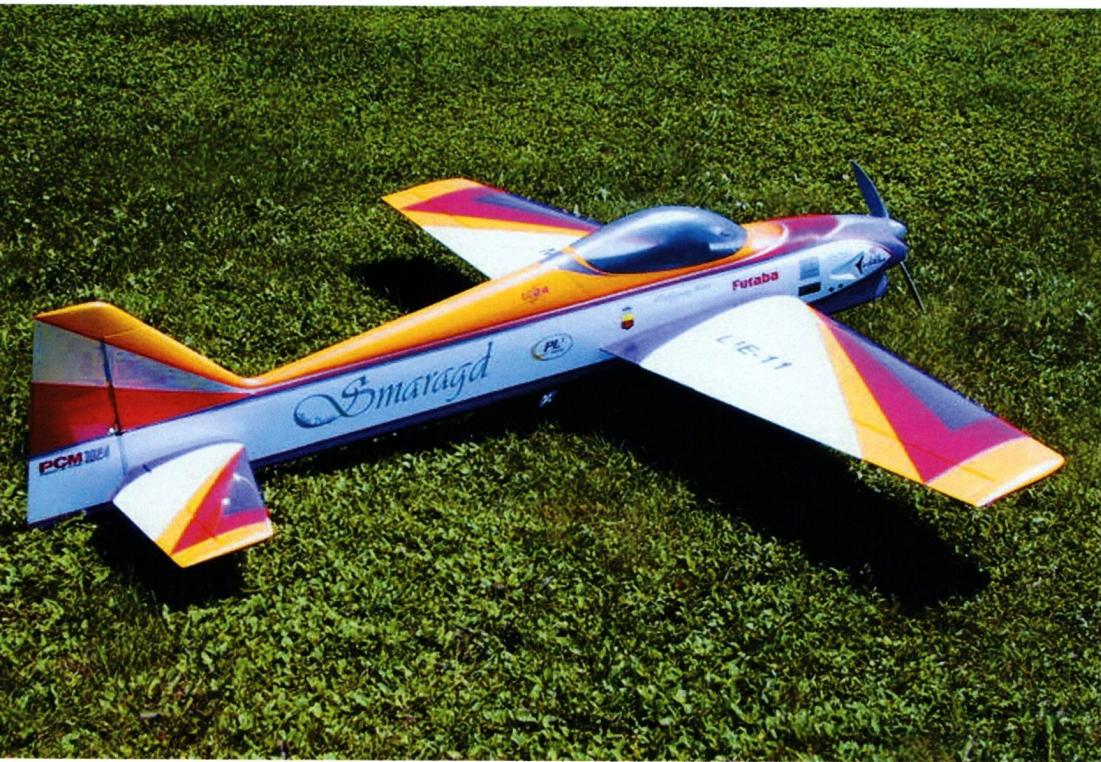
Against machines such as this Smaragd by W. and R. Matt, it is impossible to compete with state-of-the-art electric models. This has been true ever since engine displacement restrictions were lifted.
As part of the Militky Cup, we asked spectators to judge the performances of small electric models (Schnuppis). It was a surprisingly positive experience. In addition, we successfully enlisted the help of F3A judges. For the new F5A format, judges will need to receive new instructions. Prior training as an F3A judge is not required. According to the FAI Sporting Code, a training program for electric flight judges is planned.
| Criteria | Qualification | Points (max.) | Finals | Points (max.) |
|---|---|---|---|---|
| Accuracy per figure, perfection | 25 (max. 7 figures) | 250 | 50 (max. 10 figures) | 500 |
| Overall impression (including transition maneuvers, takeoff, and landing), execution of maneuvers, landing on or off target | 15 (10 without landing gear) | 150 (100) | 15 (10 without landing gear) | 150 (100) |
| Entertainment value, originality | 10 | 100 | 10 | 100 |
| Harmony, rhythm, elegance (with music) | — | — | 25 | 250 |
| Total | 50 | 500 | 100 | 1,000 |
| No. | Basic Figures | K | Option 1 | K | Option 2 | K | Option 3 | K |
|---|---|---|---|---|---|---|---|---|
| 1. | Positive loops (at least 2) | 2 | with barrel(s) | 3 | with a snap | 4 | Rosette | 7 |
| 2. | Inverted loops (at least 2) | 3 | with barrel roll(s) | 4 | with a snap | 5 | Rosette | 8 |
| 3. | Square loop | 3 | with 2 half-barrels | 4 | with 4 half-barrels | 5 | with 4 barrels | 6 |
| 4. | Eight Cuban | 3 | horizontal square | 4 | vertical square | 5 | vertical square with 2 barrels | 6 |
| 5. | Barrel(s) | 2 | two | 3 | slow | 4 | 2 barrels traveling in the opposite direction | 5 |
| 6. | Faceted barrel (min. 2) | 3 | 4 facets | 4 | 8 facets with barrel | 5 | 4 facets in both directions | 6 |
| 7. | Slice volume | 3 | on each side with half-barrel | 4 | on each slice | 5 | on each slice with Snap | 6 |
| 8. | Barrel circle with 4 half-barrels | 4 | with 4 barrels | 5 | with 4 barrels in the opposite direction | 7 | with one barrel | 8 |
| 9. | Spin | 1 | 3 turns | 2 | 2 x 2 counterclockwise turns | 3 | 3 laps on your back | 4 |
| 10. | Immelmann | 2 | combined with a half-barrel roll | 3 | combined with a barrel roll | 4 | combined with barrel and Snap | 5 |
| 11. | Positive Humpty Bump | 2 | negative | 3 | combined with barrel or 4-faceted barrel | 4 | combined with barrel and Snap(s) | 5 |
| 12. | Torque Roll (min. 3) | 3 | five | 5 | six | 6 | more than six | 8 |
| 13. | Positive cap (against the top) with 2 half-barrels | 3 | positive with barrel | 4 | negative with half-barrel or faceted barrel | 5 | negative with barrel or Snap(s) | 6 |
| 14. | Reversal | 2 | with a half roll going up and down | 3 | with a roll while going up and down | 4 | with a barrel roll on the way up and a snap on the way down | 5 |
- All electric models may be used, including hand-launched ones, which will have their “overall impression” coefficient reduced.
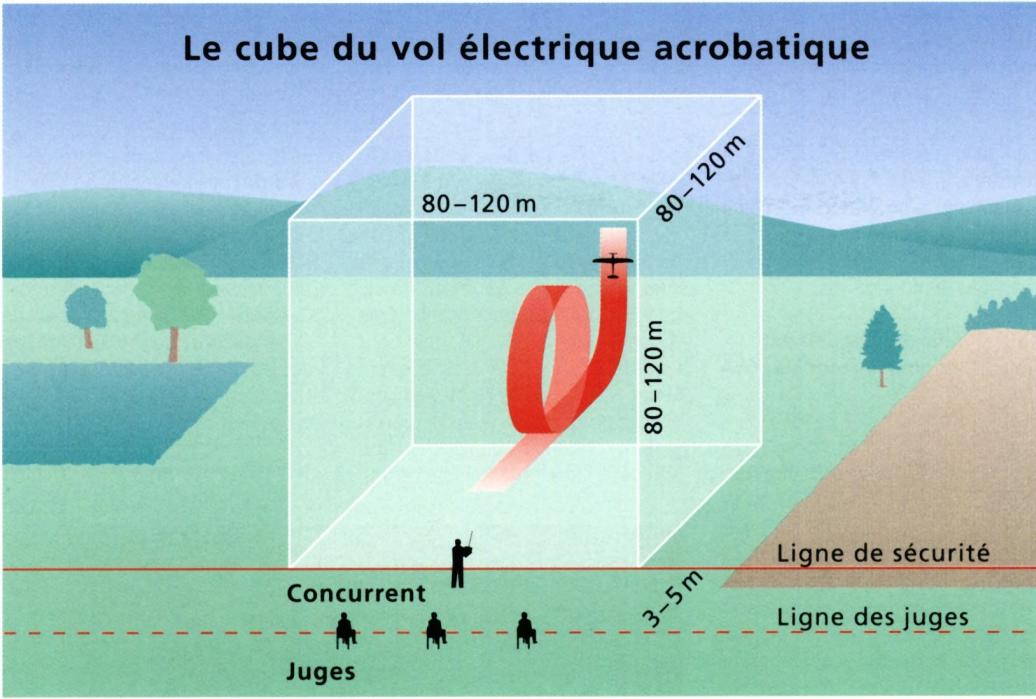
- The flight area is confined to a box measuring 80 to 120 m in length. The event must be able to take place within the space of a sports field.
- The flight distance will range from 50 to 120 m, which is very short.
- Each competitor designs their routine based on a catalog of maneuvers. The overall coefficient is thus capped at a maximum.
- Competitors can choose between many simple maneuvers or a few complex ones.
- Competitors will adjust their model’s motor based on the difficulty of the maneuvers they choose.
- Maneuvers may be performed perpendicular to the judges’ line, “in 3D.”
- Transition maneuvers will not be included in the overall routine but will
into the overall impression score.
- In the finals, the finalists’ routines will be accompanied by music. Banners are permitted, but smoke bombs are not.
It is still difficult to say which direction future developments will take. This uncertainty makes it all the more interesting. What is certain is that the models will become less and less suitable for F3A, and vice versa. F3A electric models are often equipped with 30 cells (approx. 1.8 kg) and are therefore unsuitable for performing the routine in a confined space. In F3A, pilots cover enormous distances between maneuvers, whereas in electric flight, 10 meters is sufficient between a maneuver performed at the center of the cube and a transition maneuver. Electric aircraft will certainly have to fly more slowly, which makes the use of fuselages
optimized for speed. One can imagine a trend toward fun-fly with improved longitudinal stability, achieved through longer fuselages, wings with different geometries, and new airfoil profiles. Models weighing 4 to 5 kg should be a thing of the past. Owners of Hot Line models should be able to hold their own, provided they can maneuver within the flight cube.
Fans of streamlined fuselages won’t have an advantage, and hand-launching is permitted. This example illustrates how the F5A differs from the F3A. Anyone who wants to contribute to this development can do so with experience and creativity. I hope you have a lot of fun, and I’ll be happy to keep you updated on the latest news.
*E. Giezendanner
(translated by T. Ruef)*
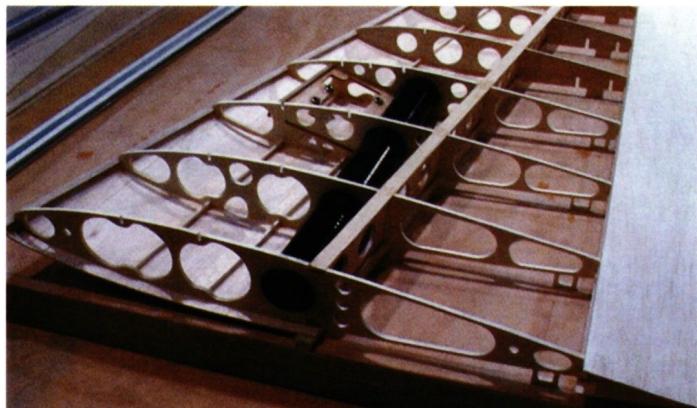
The E-Factor, built by German aircraft designer Michael Ramel, is the only electric aerobatic aircraft to have made a significant impact on the European F3A scene. In strong winds, however, the limited engine runtime poses a problem.

EURO CONTEST GLIDER ACRO TOUR AUSTRIA 2026

THE PC-21 STORY
 Emil Giezendanner

TWIN TOWN PARTNERSHIP
 Wolfgang Voeller

SUMMER FUN 2026 AT MG USTER
Martin Wunderli
CORSAIR F4U – A WARBIRD WITH A MEMORABLE LOOK
Jürgen Rosenberger, Jürgen Prinz
52. 2026 ALPS CUP
Emil Giezendanner
YOU KNOW WHAT I MEAN? 125 YEARS OF THE SWISS AERO CLUB
Emil Giezendanner
News from HEBU

TEAM MANAGER "THIS" BOSSHARD
Rodito Nussbaumer
ATOM, THE NEW DOUBLE-DECKER FROM CPLR
 Matthias Bosshard

F3A EUROPEAN CHAMPIONSHIPS IN ST-MACAIRE, FRANCE
Matthias Bosshard
INSIGHTS INTO THE HISTORY OF SEAPLANES

WELCOME, NEW MEMBER!
Andrea Bolliger
What's New at Leomotion.com

PRIDE AND GOOD IDEAS
 Markus Nussbaumer

SMALL, MODEL-LIKE SAILBOATS
Res Dauwalder
FREE FLIGHT IN THE MIDDLE OF SUMMER
Urs Muntwyler
BY YOUTH, FOR YOUTH
Lorena Betschen
HORIZON HOBBY/LEMACO NEWS: MICRO OV-10 BRONCO 645 MM BY E-FLITE

COUPE DES ALPES – OBSERVE AND LEARN
Rodito Nussbaumer
34th HAHNENMOOS ALPINE MODEL AIRPLANE CAMP
Res Dauwalder
TRY-OUT DAY AT MFV WETTINGEN
 Urs Keller

NEWS FROM HEBU
 Julia Bucher

NOS REGION – A HUB FOR ELECTRIC AVIATION
Emil Giezendanner
MEMORIES
 Wolfgang Völler

70 YEARS OF THE NIDWALDEN MODEL AIRPLANE CLUB
Martin Barmettler
A SPECTACULAR F3A WORLD CUP IN THE PRINCIPALITY OF LIECHTENSTEIN
Emil Giezendanner
FROM 0 TO 100
Markus Nussbaumer