
Autonomous Mobile Field Charger
On several occasions, it can be useful to have a portable battery charger with you in the field. At the top of a mountain after an hour’s hike, I found myself in the fog with a model aircraft enthusiast and his hand-launched model. I thought he had the ideal model for flying in those conditions in such a small area. He then pointed out to me that his flight time was limited and that he never knew how much flight time he had left with a 350 mAh battery.
I’m an F5J competitor, and I also face the problem during training of having to regularly recharge small batteries (650 mAh)... so I built myself a portable charger.
This isn't anything new. People commonly charge their batteries by plugging the charger into the car's battery without wondering whether the car will be able to start again at the end of the day. Here’s a little anecdote: at the F3J European Championship in Hungary, where temperatures reached 40 °C, the Swiss team drained the battery of their shuttle bus in a single day… and restarted the car using model-car batteries!
If you're looking for a compact charger, the M6D is worth considering. With dimensions of 98 × 68 × 35 mm and a weight of 220 g, two charging outputs with balancing connectors (1-6S), and a 5V/2.1 A USB output, it’s one of the smallest chargers on the market and comes at a very attractive price (<100 CHF)!
Its power input (and outputs) use XT60 connectors. The input voltage can range from 7 to 28 V! This allows for
a wide range of battery options!
The first idea is to use a Li-ion battery ranging from 12V (3S) to 24V (6S) or a LiFe battery. Li-ion batteries are mainly made up of the well-known 18650 or 26650 cells. Be careful, however, when choosing a supplier—not all Chinese products are reliable! Prices that seem too good to be true often hide batteries that don’t meet their specifications! You can also purchase power tool battery packs in Switzerland. In that case, you’ll need to modify them yourself, which isn’t recommended for beginners. The advantage of these packs is that most of them include a built-in battery management system (BMS). Despite this, I opted for a high-capacity 3S/8000 mAh LiPo battery, the “bashing” version, which is often sold for scale model trucks. It’s easy to find in Switzerland, reliable, high-quality, and affordable… but be careful—it doesn’t have a battery management system (BMS).
A battery is capable of delivering a certain amount of energy. This is calculated by multiplying its capacity by its average voltage. Let’s take the example of a 4S/650 mAh F5J battery; its energy is: $14.8 \text{ V} \times 0.65 \text{ Ah} = 9.62 \text{ Wh}$ . My power battery is a 3S/8000 mAh battery; its energy is: $11.1 \text{ V} \times 8.0 \text{ Ah} = 88.8 \text{ Wh}$ . Roughly speaking, the number of possible charges is: 88.8 Wh / 9.62 Wh = 9.23... so I can expect to be able to charge 9 4S/650 mAh batteries...
$$\text{Energy (Wh)} = \text{voltage (V)} \times \text{capacity (Ah)}$$
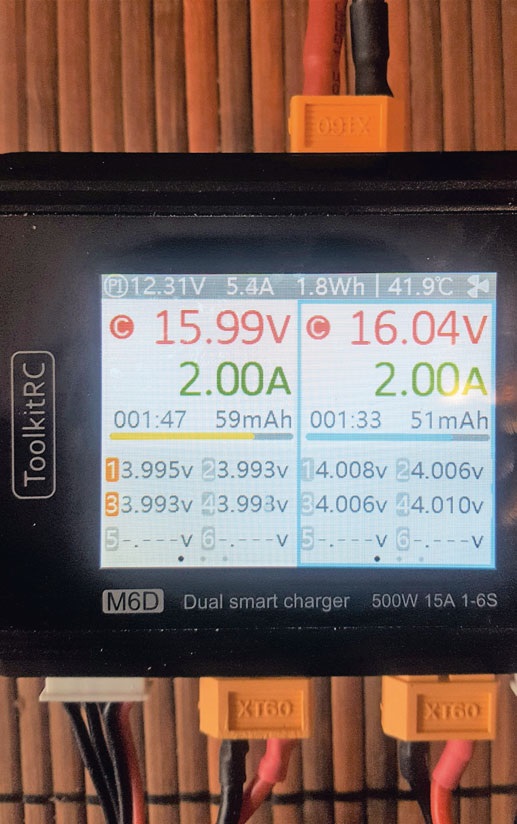
- Voltage
- Current
- Power Output
- Temperature
- Voltage
- Current
- Charging time
- Energy Delivered
- Cell voltage
Actual results may differ from this figure because the battery being charged isn’t necessarily empty, the power supply battery must meet its specifications, and our charger will draw some energy from it in the process (efficiency).
Given the desired energy capacity for the power battery, you can choose a 3S, 4S, or 5S battery, as the charger supports these different voltage ranges.
When a LiPo battery drops below 3.0 V per cell, it will degrade and eventually be destroyed...
The M6D charger allows you to select, preset, and save three power sources, each with its own settings for maximum input power, maximum current, and voltage range. Be sure to set the ten-
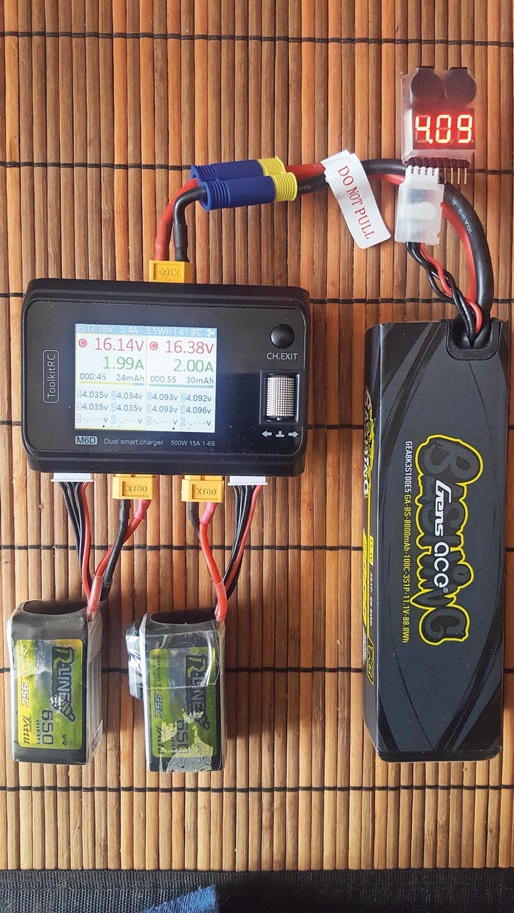
Minimum input battery voltage of 3.2 V or 3.3 V multiplied by the number of cells. The power supply battery voltage is displayed on the charger's screen.
I’ve enhanced the power supply’s safety by connecting a buzzer to the balancing terminal, which sounds a loud alarm as soon as any battery cell drops below 3.3 V.
Important: In all cases, when the charger is not in use, you must disconnect the power supply—either by unplugging the power battery or by installing a switch to break the circuit—because otherwise the charger will continue to draw power... And, as a safety rule, you must always stay close to a battery that is charging!
I found that this setup provides a charging solution in the field that meets my needs. A few preliminary calculations will tell you whether this makes sense for your applications, particularly for charging high-capacity batteries. With this power battery setup, you can cover a full day of flying for F5J-style use with three batteries. However, turbine/helicopter and aerobatic plane enthusiasts will quickly run out of power!
This setup weighs about 1 kg, which I sometimes have to carry in my backpack. There are also commercial products available for high-power applications, such as the Leomotion Portable Power Supply 13.2 V/100 Ah (11 kg) priced at 600 CHF, but that’s in a whole different league.


News from HEBU

TEAM MANAGER "THIS" BOSSHARD
 Rodito Nussbaumer

YOU KNOW WHAT I MEAN? 125 YEARS OF THE SWISS AERO CLUB
 Emil Giezendanner

HORIZON HOBBY/LEMACO NEWS: MICRO OV-10 BRONCO 645 MM BY E-FLITE

PRIDE AND GOOD IDEAS
 Markus Nussbaumer

34th HAHNENMOOS ALPINE MODEL AIRPLANE CAMP
Res Dauwalder
TRY-OUT DAY AT MFV WETTINGEN
Urs Keller
F3A EUROPEAN CHAMPIONSHIPS IN ST-MACAIRE, FRANCE
 Matthias Bosshard

52. 2026 ALPS CUP
Emil Giezendanner
ATOM, THE NEW DOUBLE-DECKER FROM CPLR
Matthias Bosshard
SUMMER FUN 2026 AT MG USTER
Martin Wunderli
What's New at Leomotion.com

COUPE DES ALPES – OBSERVE AND LEARN
Rodito Nussbaumer
TWIN TOWN PARTNERSHIP
Wolfgang Voeller
BY YOUTH, FOR YOUTH
Lorena Betschen
CORSAIR F4U – A WARBIRD WITH A MEMORABLE LOOK
Jürgen Rosenberger, Jürgen Prinz
SMALL, MODEL-LIKE SAILBOATS
Res Dauwalder
WELCOME, NEW MEMBER!
Andrea Bolliger
FREE FLIGHT IN THE MIDDLE OF SUMMER
Urs Muntwyler
EURO CONTEST GLIDER ACRO TOUR AUSTRIA 2026

INSIGHTS INTO THE HISTORY OF SEAPLANES

THE PC-21 STORY
Emil Giezendanner
NEWS FROM HEBU
 Julia Bucher

FROM 0 TO 100
Markus Nussbaumer
MEMORIES
Wolfgang Völler
NOS REGION – A HUB FOR ELECTRIC AVIATION
Emil Giezendanner
DO YOU KNOW WHAT I MEAN IN THE LAND OF SMILES?
Emil Giezendanner
Have you almost forgotten about aircraft that take off and land vertically?
Emil Giezendanner