
Growth Challenges
Most of the model aircraft clubs in our region are located in areas that, by Swiss standards, are undergoing the greatest industrialization and economic development, have the highest level of residential construction and the largest population growth, and, moreover, have the highest land prices. Everything is growing, expanding, increasing—except for the amount of land. This fact—or so it sometimes seems to me—looms like a menacing monster over our model aviation movement.
The urbanization of our countryside has irrevocably begun and is, in some cases, well advanced. Land is becoming scarce, and where it is still used for agriculture, farming is so intensive that farmers are reluctant to give up even a few square meters; for they either want to hold on—or sell. Furthermore, many farmers in the immediate vicinity of cities are so embittered by the inconsiderate behavior of ever-growing streams of weekend visitors that they categorically refuse to allow anyone to set foot on their property or drive on their farm roads. As a result of this trend, model aircraft enthusiasts—including rural groups—face particularly challenging conditions. Although a new model airfield is opened in our region from time to time (two new sites are expected this year), this is nowhere near sufficient to meet the demand and keep pace with the growth rate. Model aircraft enthusiasts must make greater efforts in this regard. This is primarily a task for the individual groups, as only they are sufficiently familiar with local conditions. It also seems to me that greater decentralization of model airfields would be sensible and desirable. Furthermore, it is easier for “locals” to negotiate with the authorities, since they are more likely to be heard as voting members of the community and, on top of that, know the people involved personally. Many model aircraft enthusiasts have still not lost their faith in the “model aircraft authorities” in this regard—for them, the following saying applies: Help yourself, and then the Aero Club will help * you.
The fact that many people, particularly in our region, are increasingly beginning to vehemently resist “nuisances of all kinds” is an indirect consequence of our economic growth. The development of massive industrial and residential complexes over the past 10–20 years, along with the enormous increase in air and road traffic, has in many ways overwhelmed our environment and its capacity for natural regeneration. However, the increasing specialization of professional work and the drive for growth and performance also place excessive demands on people’s mental well-being. And whereas in the past, working people could relax (regenerate) at home after a strenuous day’s work, today they are greeted at home by the radio and television; during their vital night’s rest, they are disturbed by motorcycles circling the neighborhood, the slamming of car doors, and cars speeding away. If they finally try—as a last resort—to escape into nature, they find themselves stuck for two hours in a stinking traffic jam, and at their traditional beach, they come across a sign that reads “No Swimming.” We know the results of this human overload: aggression, dissatisfaction, intolerance, irresponsibility, and complete indifference. It is precisely these psychological problems that plague our model aviation community far more than, say, the noise from our little motors—which is, after all, disproportionate to the noise that is tolerated (street traffic, summer night festivals, church bells, etc.) and never occurs at night.
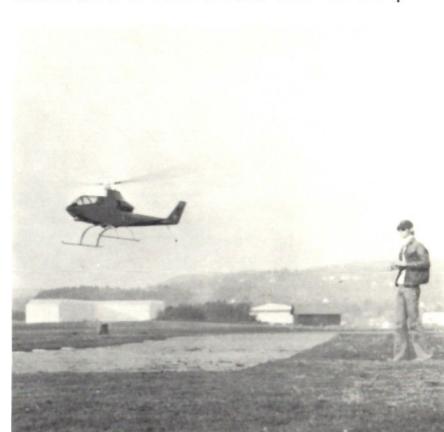
Therefore, no one should believe that this problem can be solved by technical means alone (further improvements to mufflers, electric aircraft, etc.). Here, too, it is clear that technical improvements must be followed by further measures of a socio-psychological and political nature. The timing is quite favorable for us: the federal government, the canton, and the municipalities are currently spending hundreds of thousands of francs to provide the public with meaningful recreational opportunities (sports facilities of all kinds, recreational facilities, workshops, youth centers, etc.). It is high time that we try to foster understanding for model aviation among authorities and the public—specifically, that model aviation has been contributing to solving the leisure problem for decades with great idealism, and without placing a burden on the public treasury. We must prove that model aviation is not an environmental problem, but rather a stimulating and versatile recreational activity and sport—and that it would therefore make more sense from a sociopolitical perspective to promote and support such activities rather than hinder them. Time and again, I am astonished to see how much discussion can take place in individual government agencies over a tiny airplane engine, while at the same time they turn a blind eye to foul-smelling, black industrial smoke with astonishing speed. In one municipality where some residents complained about model airplane noise, it was conclusively proven that the noise actually came from chainsaws used by loggers working in the nearby forest—and anyone who now thinks the chainsaws were banned as a result, probably doesn’t believe in storks either, but can at least claim a certain degree of naivety.
I wouldn’t be surprised if my previous remarks had given the reader the impression that active participation in model aviation is on the decline or even doomed. That impression needs to be corrected immediately. Model aviation is gaining a large number of enthusiasts year after year. However, these numbers cannot be estimated based on the membership figures of model flying clubs or regions—although our region has seen sustained growth for many years—but rather, above all, by the business generated by model aviation. The model-making industries in the United States, England, Germany, and Italy reflect the rising popularity of model aviation. Model aviation is the only flying sport with the potential to become a mass sport, which of course brings with it numerous problems—and not just of a technical nature; the frequency clutter can be solved electronically one day—but it seems much more difficult to me for model aviators to maintain a sense of community among themselves. Already today, in our region, we are no longer able to hold a region-wide RCS slope flying competition because the number of participants is too large. However, increased fragmentation and compartmentalization are making it increasingly difficult to maintain contact between the groups and among individuals. I’ve mentioned on other occasions that there was a time when all of Switzerland’s model aviators could fit around a single regulars’ table. But don’t think for a moment that those people all saw eye to eye back then—there were differences of opinion there, too. What seems important to me is the overarching goal: model aviation. The fact that the chairmen of Region 5 decided to publish this newsletter is, in my opinion, an expression of the fact that, despite our growth and all the problems associated with it, we still have this goal in mind—but above all, that we can only pursue our shared interests by working together. In this sense, I believe that, due to increasing external pressure, a welcome “twilight of the gods” has begun.


News from HEBU

TEAM MANAGER "THIS" BOSSHARD
 Rodito Nussbaumer

YOU KNOW WHAT I MEAN? 125 YEARS OF THE SWISS AERO CLUB
 Emil Giezendanner

HORIZON HOBBY/LEMACO NEWS: MICRO OV-10 BRONCO 645 MM BY E-FLITE

PRIDE AND GOOD IDEAS
 Markus Nussbaumer

TRY-OUT DAY AT MFV WETTINGEN
Urs Keller
F3A EUROPEAN CHAMPIONSHIPS IN ST-MACAIRE, FRANCE
 Matthias Bosshard

52. 2026 ALPS CUP
Emil Giezendanner
ATOM, THE NEW DOUBLE-DECKER FROM CPLR
Matthias Bosshard
SUMMER FUN 2026 AT MG USTER
Martin Wunderli
What's New at Leomotion.com

COUPE DES ALPES – OBSERVE AND LEARN
Rodito Nussbaumer
TWIN TOWN PARTNERSHIP
Wolfgang Voeller
BY YOUTH, FOR YOUTH
Lorena Betschen
34th HAHNENMOOS ALPINE MODEL AIRPLANE CAMP
Res Dauwalder
CORSAIR F4U – A WARBIRD WITH A MEMORABLE LOOK
Jürgen Rosenberger, Jürgen Prinz
SMALL, MODEL-LIKE SAILBOATS
Res Dauwalder
WELCOME, NEW MEMBER!
Andrea Bolliger
FREE FLIGHT IN THE MIDDLE OF SUMMER
Urs Muntwyler
EURO CONTEST GLIDER ACRO TOUR AUSTRIA 2026

INSIGHTS INTO THE HISTORY OF SEAPLANES

THE PC-21 STORY
Emil Giezendanner
NEWS FROM HEBU
 Julia Bucher

FROM 0 TO 100
Markus Nussbaumer
MEMORIES
Wolfgang Völler
NOS REGION – A HUB FOR ELECTRIC AVIATION
Emil Giezendanner
DO YOU KNOW WHAT I MEAN IN THE LAND OF SMILES?
Emil Giezendanner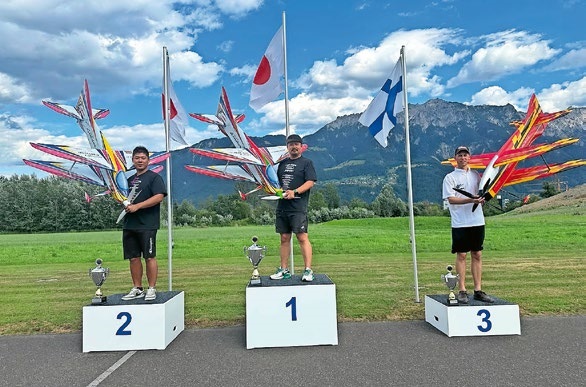
A SPECTACULAR F3A WORLD CUP IN THE PRINCIPALITY OF LIECHTENSTEIN
Emil Giezendanner