
Franz Meier – A Scale Pioneer Through Creativity and Innovation
"And if they haven't come crashing down, then they are still alive today,
" wrote Franz Meier in 1967.
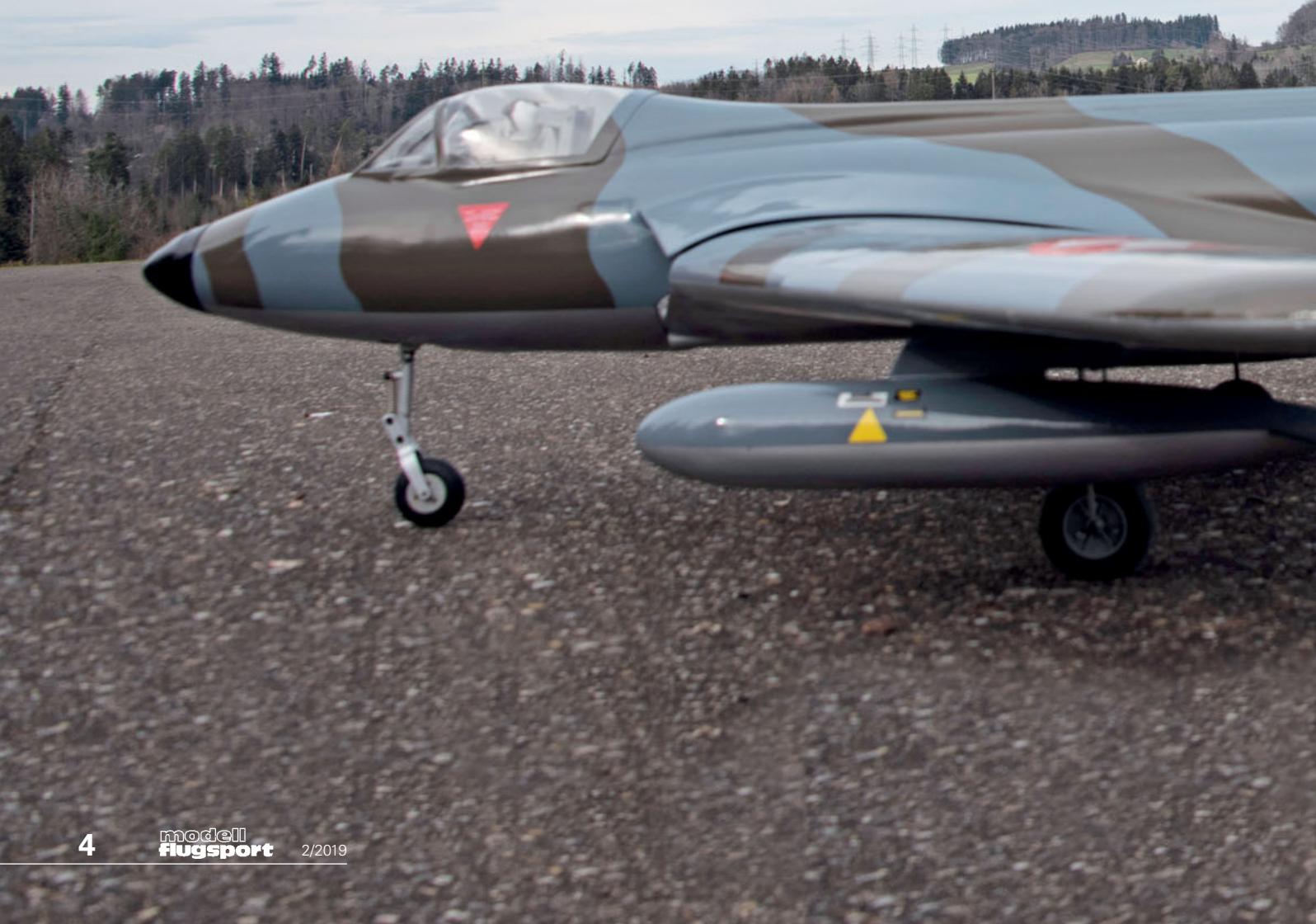
In fact, there are reportedly still a few models by Franz Meier in existence. His models are particularly popular among collectors—both those in need of repair and even those ready to fly. The Hunter Mk 58 was—and still is today—a true cult model and was likely built in the hundreds, both domestically and abroad.
Franz Meier (1930–2018) from the Zurich Oberland was already renowned throughout Switzerland and beyond for his scale model airplanes as early as the 1960s. A trained carpenter who later became a technical draftsman, he possessed the ideal combination of design, technical, and craftsmanship skills for successful scale model building. His drawings—what we would call “analog” today, created on a drafting board—were among the finest. Many of them were available from Neckarverlag in the 1960s and 1970s. Attention to detail and outstanding precision were his hallmarks. Here’s a typical example: After the somewhat labor-intensive process of making the spinner for the Hunter, Franz was asked: “Why go to all that trouble and effort? It doesn’t matter whether the spinner radius is correct or not—the main thing is that the plane flies; at an altitude of 300 meters, no one’s going to notice anyway.” Franz answers this himself
himself: “It does matter; because a scale model must be built in such a way that you can tell at a glance which type it’s supposed to represent.”
In his Hunter report, Franz wrote: “I’ve never flown the model myself. Flying isn’t my strong suit. Designing and building are my areas of expertise.”
Franz Meier attended various competitions every year. He didn’t fly himself; he left that to his friends, who also advised him on test flights and modifications. At competitions and world championships—where his models and replicas were often put to use—Franz worked behind the scenes. As a technical expert, mechanic, and repairman. But in doing so, he did not step into the spotlight, and—except in team competitions—his name did not appear on the leaderboards. His son Renato later took the reins more and more. It’s easy to imagine that this was a great source of satisfaction for his father.
After the first FAI World Championships in RC aerobatics (1960, Dübendorf), the radio-controlled models became more or less similar. High-wing and low-wing aircraft, with an average wingspan of 140 to 160 cm, and two biplanes equipped with 5- to 10-cc engines. In the scale model scene as well, the models generally fell within this range. Biplanes were also included. In 1974, for example, the American Robert M. Wischer became world champion with his Emeraude. Other participants flew the Volksplane, Piper Comanche, Cap 20, Shinn 2150, and so on. Franz’s jet models with swept wings were a true innovation and a wonderful addition. His first jet models were the Crusader, the Sabre, and finally the successful Hunter model, which, according to one of his reports (1967), he had long dreamed of building. Franz wrote the following about these models: “The Hunter now concludes a series of experimental jet models. I built these models to investigate and test the behavior of swept-wing designs in model aircraft construction, and I can say that this work has yielded more than positive results. This lays the groundwork, and for the sake of model aviation, it would be welcome if these models were to inspire many successors.” Anyone who today in
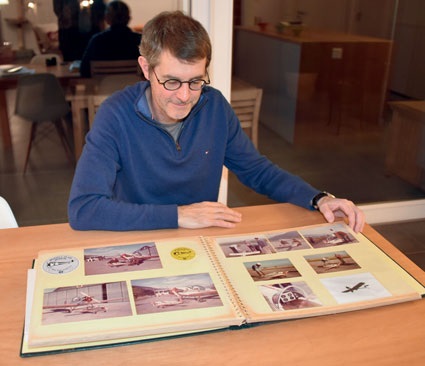
Franz Meier with the Polikarpov I-153 “Chaika” (Seagull). This was Franz’s last completed model, built in the late 1990s. The design is very elaborate, constructed entirely of wood. It features a folding wing and retractable landing gear that rotates 90 degrees into the fuselage. Wingspan approx. 210 cm, weight approx. 11 kg, powered by an OS 4-stroke Boxer 50 cc engine.
Franz always sought out unique design challenges in the construction process and the implementation of a functional solution in his models.
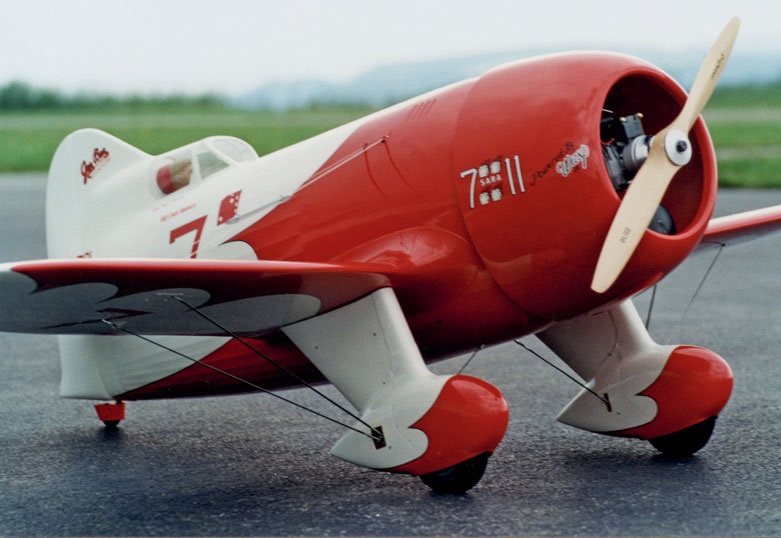
The Gee Bee R-2. Franz has always been fascinated by unusual prototypes, which is why he also built a model of the Gee Bee. Wingspan: approx. 200 cm; weight: approx. 9 kg; engine: ZG 45 cc.
Anyone familiar with the modern jet scene knows, of course, that “his” Hunter remains one of the most popular models.
Franz Meier built his scale models at an incredibly rapid pace. By participating in competitions both at home and abroad, as well as in world championships, Franz gained a wealth of experience that served as the foundation upon which other model builders were able to successfully build and fly their models time and again. He shared a wealth of valuable knowledge through his clear drawings and detailed building instructions. In addition, Franz worked as a technical writer, which allowed him to pass on his expertise to model aviators. In doing so, he not only gave the Swiss scale modeling scene a truly unique boost but continues to serve as a role model for all homebuilders to this day. “The first Hunter is ready for takeoff, and as I write these lines, the second model is already on the workbench,” Franz Meier, 1967.


News from HEBU

TEAM MANAGER "THIS" BOSSHARD
 Rodito Nussbaumer

YOU KNOW WHAT I MEAN? 125 YEARS OF THE SWISS AERO CLUB
 Emil Giezendanner

ATOM, THE NEW DOUBLE-DECKER FROM CPLR
 Matthias Bosshard

SUMMER FUN 2026 AT MG USTER
Martin Wunderli
F3A EUROPEAN CHAMPIONSHIPS IN ST-MACAIRE, FRANCE
Matthias Bosshard
52. 2026 ALPS CUP
Emil Giezendanner
TWIN TOWN PARTNERSHIP
Wolfgang Voeller
PRIDE AND GOOD IDEAS
 Markus Nussbaumer

CORSAIR F4U – A WARBIRD WITH A MEMORABLE LOOK
Jürgen Rosenberger, Jürgen Prinz
TRY-OUT DAY AT MFV WETTINGEN
Urs Keller
HORIZON HOBBY/LEMACO NEWS: MICRO OV-10 BRONCO 645 MM BY E-FLITE

EURO CONTEST GLIDER ACRO TOUR AUSTRIA 2026

BY YOUTH, FOR YOUTH
Lorena Betschen
INSIGHTS INTO THE HISTORY OF SEAPLANES

SMALL, MODEL-LIKE SAILBOATS
Res Dauwalder
What's New at Leomotion.com

COUPE DES ALPES – OBSERVE AND LEARN
Rodito Nussbaumer
34th HAHNENMOOS ALPINE MODEL AIRPLANE CAMP
Res Dauwalder
WELCOME, NEW MEMBER!
Andrea Bolliger
FREE FLIGHT IN THE MIDDLE OF SUMMER
Urs Muntwyler
THE PC-21 STORY
Emil Giezendanner
NEWS FROM HEBU
 Julia Bucher

FROM 0 TO 100
Markus Nussbaumer
MEMORIES
Wolfgang Völler
NOS REGION – A HUB FOR ELECTRIC AVIATION
Emil Giezendanner
Have you almost forgotten about aircraft that take off and land vertically?
Emil Giezendanner
DO YOU KNOW WHAT I MEAN IN THE LAND OF SMILES?
Emil Giezendanner