
Robi Disler, the Grand Old Man of Alpine Model Gliding
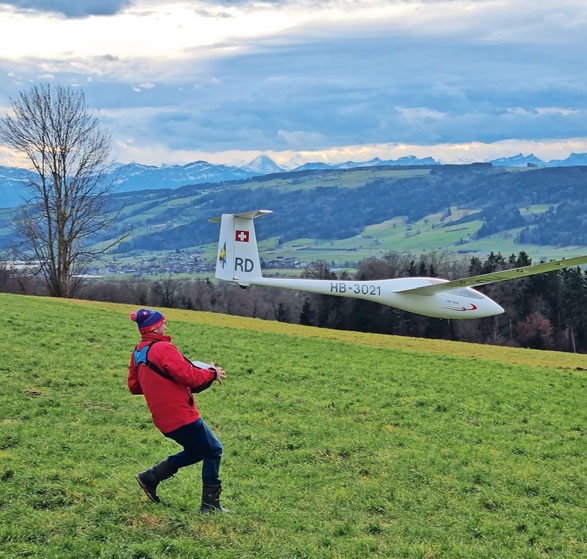
For decades, Robi Disler has been flying large, homemade scale gliders, preferably on mountain slopes. He designed his gliders for slow, long-range flying in thermals. Now 76 years old, he always launches his gliders himself. Thanks to his vast experience and meticulous flight preparation, neither “absafers” nor distant out-of-field landings can rattle him.
In August 2022, during the IGG meeting at Hahnenmoos, MFS had the opportunity to interview Robi Disler.
Even back in school, I was building and flying A2 free-flight gliders. After years of doing a lot of sports—including skydiving—I got back into model building and flying in 1979.
Almost exclusively. Occasionally, I also fly tow planes at my model flying club's airfield. I fly a Swiss Trainer with a 100-cc engine and a Kruk with a 170-cc engine.
Definitely on the hillside.
I am a trained cabinetmaker. For 29 years, I also trained apprentices and served as a workshop manager, always in the woodworking industry.
Yes. I buy the fiberglass fuselages, and I build the wings and tail sections myself. I think I’ve built a total of about 20 to 25 airplanes, with wingspans ranging from 5.3 to 8 meters.
Yes, the DG 303 with a 6.5-meter wingspan. Unfortunately, I lost it after it skidded during a forced landing at Gnipen.
1:2.5 to 1:3. That way, the gliders weigh only about 16–18 kg, and I can carry them to the launch sites by myself. At 20 kg, I have to take short breaks every now and then while climbing. With larger models, I can fly farther—which is my “obsession”...
I prefer two-seaters because they’re lighter. The long front section of the fuselage helps save weight. I always make sure to build the model slightly behind the center of gravity. Two-seaters are beautiful to look at when flown “low,” that is, below eye level.
Photos of the originals—some taken by me—and three-view drawings, with dimensions included when possible. Detailed original plans aren’t necessary, since I’m not a “scale fetishist.” The airplane just has to look good and fly well. The handling has to be right.
My airplanes need to be able to fly slowly—that’s an important criterion. I’m a “cruiser.” Most of the time, I use airfoils with about 2.5% camber, Eppler airfoil strips E-209/207/205 with thicknesses ranging from 13.8% to 10.4%, and E-203/201/193 with thicknesses ranging from 13.5% to 10%
Thick, or sometimes E-68/66 with a thickness of 13.1 to 10.1%, and older profiles from Ritz. For a more recent design, I chose an HQ profile with a 2.5% camber. With these profiles, all gliders launch easily from the hand and can be landed slowly, even though they don’t have flaps.
Always using a positive mold. I cut the profile cores out of Styrofoam using a hot wire. Then I install the spar. It consists of a continuous 16 mm wide upper and lower chord made of fine-grained pine strips, 8 mm thick at the wing root and 2 mm thick at the wingtip. The spar has no web. For my most recent models, I’ve additionally reinforced the pine spars with carbon rovings. After installing these components in the core, I cover it with 0.9 mm thick poplar veneer, applying it to both the top and bottom surfaces in a single step. I like to use poplar wood because it has no pores and can be easily covered with iron-on film.
In the wing negatives that I keep. If a pine spar is broken, I insert a new one with a shank length of 70 to 80 mm. Then I fit a new piece of skin. I clamp the surface in the wing molds with screw clamps while the epoxy resin cures. Afterward, the repair area is coated with thin fiberglass mesh, filled with putty, and finally covered with film. After several repairs, when there are increasing layers of filler on the surface, I fill the area, dry-sand it, fill it again, wet-sand it, and then paint it. By applying two coats of filler, I prevent sanding through the surface and exposing wood fibers, which stand up as the filler dries, resulting in an unsightly painted surface. Whenever possible, I also prefer to use iron-on film for repairs. It’s easier and faster.
Only on rare occasions. I once laminated
Once, I laminated the fuselage of a DG-202 with a 6-meter wingspan. Another time, I built the master model for a DG-1000, which went to Rosenthal and was ultimately cast by Paritech. Fuselage construction is too time-consuming and too expensive for me.
It’s minimal. I’ve always had success with this so far. None of my gliders has ever crashed due to poor reception or electronic failure on the plane. Inside the fuselage, you can see a tangle of cables; it might look “old-fashioned,” but it’s proven itself. An electronics technician once told me that having all the cables neatly arranged side by side could actually cause problems.
Always equipped with a single 16-channel receiver, a dual power supply, and a battery switch that can withstand high temperatures.
No, I only have the transmitter display the battery voltage and reception quality.
That's right. For me, it's all about what I see and how it feels.
I choose a model that seems best suited for the forecast weather. The main factor is whether I expect strong winds or will be flying in thermals. Still, there are times when I haven't brought the right model with me.
I'm familiar with all the areas where I fly. That's why I know how to approach the area in case of a forced landing. Using my binoculars, I observe
the terrain below. Do I spot an electric fence that wasn’t there before? You can often spot them easily by the fluttering of the electric wires. Are the leaves or branches of a deciduous tree moving? Does a flag in the valley indicate wind? If the wind is moving a flag, I can count on it reaching the slope at some point. And yet, every now and then, something just breaks...
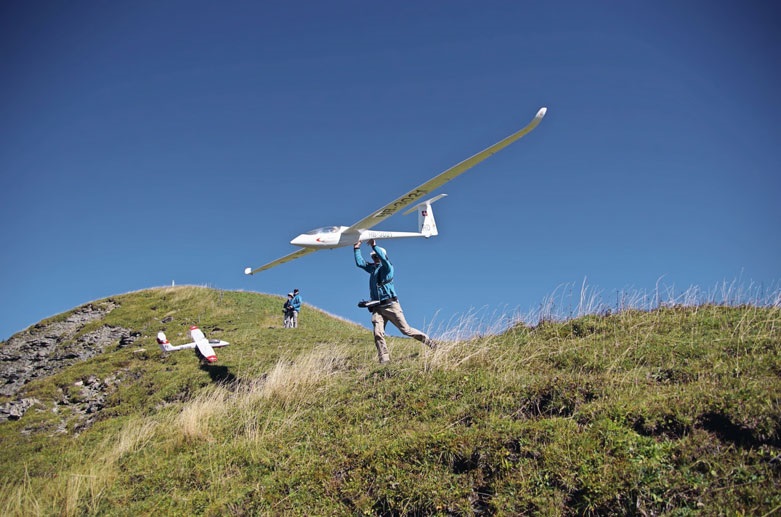
Yes, mostly by hand. I only use a catapult launch when a hand launch isn’t possible, the ground is sufficiently level, and the grass has been mowed short or grazed down. Before I head to the launch site, I use binoculars to look for signs of wind at the launch site and to gauge the wind speed. I only carry the catapult up if I absolutely have to. After all, I can wait until the conditions are right. Sometimes I have to hold back and be patient until there’s enough headwind for a hand launch.
They're on the ground because the pilots had to land again due to a lack of updraft. Why do you do that?
Because then I have plenty of space to fly! (laughs) Or maybe I see something others don’t, which makes me confident that it’ll work out. My planes are big and therefore take up a lot of airspace. I don’t want to take up airspace when others are still in the air and have to watch out for me. Whenever possible, I always fly in a way that avoids visual crossings with other models. That’s why I like to take off when the airspace is clear, but always knowing where I can make an emergency landing if necessary. I’ve already scouted that out with binoculars beforehand, and I’m already familiar with the area.
And.
That's not a nightmare for me. I know that something
can break. Since I build them myself, I’m not stressed out, because repairing my airplanes isn’t a big deal thanks to the way I build them. As a retiree, I have plenty of time for it, after all.
3.4 km as the crow flies and 600 m below the launch site, in Austria. I took off a little too early, about 200 m above the Hotel Schneekönig on Lake Falkert. I found some very weak thermals and kept searching, but unfortunately without success. In the end, I had to land on the opposite slope, without any damage.
Because then the thrill I need is gone. That excitement of flying out to look for thermals. If I find thermals and can gain altitude, the day is saved. As a “backdoor option,” I have the planned outlanding site, which others don’t even consider. At
For "motorized" pilots, the stress sets in when the engine won't start. If an off-field landing isn't possible, I won't fly.
Bad landings. Or I misjudge the altitude by 10 to 15 meters when making a field landing. Recently, in Entlebuch, I collided with a runway marker pole that I hadn’t spotted from above with my binoculars because it was painted black. The most important thing during a forced landing is sufficient speed. Fly toward the slope at a good speed, pull up slightly, and wait until the plane comes to a stop.
I usually do this at the start of the flying season. For example, I make sure that a
fence is still in the same place as the year before. Physically, I have no problem descending to the alternate landing site after climbing to the takeoff point to scout it out. The way I fly, an alternate landing has to be planned. If something does happen anyway, I’m just out of luck.
Conduct a pre-flight check of the aircraft; check the battery charge level. Stay close to the other pilots to ensure communication. Do not fly over people. Since I usually fly slowly while searching for thermals, I have time to closely observe the airspace ahead of me. I’ve been flying my gliders in the mountains for nearly 50 years, so I have experience in assessing weather developments
If the weather deteriorates, I stop flying in good time. I want to be able to disassemble the glider and load it up before the rain starts. I have great respect for lightning. I’ve lost colleagues who were killed in crashes while retrieving their models. Proper footwear is also a must.
The IGG’s concept—flying together with like-minded people—immediately won me over. The IGG gatherings in the early years were a real hub for sharing expertise. Only about 10% of the pilots came with store-bought gliders; the rest had built their own. I benefited greatly from that. Today, it’s practically the other way around. People only ask where they can buy the model, not how it was built.
It looks pretty grim. I’ve heard that in Austria, Germany, and Italy, the maximum flying altitude could be limited to 150 m above ground level and 150 m from the slope. I don’t know what I’m supposed to do with my large-scale models if such regulations are enacted in Switzerland. What really matters is that the general aviation community knows which mountains are used for model gliding.
Our club recently celebrated its 30th anniversary. Neighbors were also invited. The turnout was amazing; many guests took introductory flights. Although we have two young members in the club, the aging of the pilot population is unmistakable here as well.
*Interview: Georg Staub*
Safety Tips from Robi Disler
- good hiking boots
- sturdy clothing
- Extra warm clothes in case the weather changes
- Sun, wind, and rain protection
- Cell phone with emergency numbers saved
- Identification
- Binoculars
- Check several weather forecasts (apps, etc.)
- Risk of hail, heavy rain, or a sudden drop in temperature?
- Set a schedule for a timely, weather-dependent descent
- Identify the locations of mountain huts, alpine buildings, etc.
- Start your descent early
- Avoid exposed locations (risk of lightning even before the rain!)
- Seek shelter in a mountain hut in good time
- During a thunderstorm, crouch under a rock overhang or in a hollow, with one foot next to the other
- Choose a safe piloting location (stable footing, no risk of falling)
- Determine the prevailing wind direction
- Determine the landing area, walk it over, and check for hidden obstacles
- Determine the direction of the landing approach based on wind direction, slope, etc.
- Observe the flight area to identify areas of updrafts and downdrafts
- Reconnaissance the off-field landing site(s) with binoculars and/or on foot
- Determine the approach direction to the off-field landing site (wind direction, slope)
- Reconnaissance the accessibility of the off-field landing site
- Stand close together to ensure communication
- Announce takeoffs, flybys, and landings well in advance and loudly
- Use the airspace considerately; maintain a safe distance from other models
- Treat hikers, etc., with courtesy
- Fly over only at a safe altitude
- Avoid if possible
- Keep searching for an updraft until a landing in an open field is unavoidable
- Call in an assistant to serve as an observer in a timely manner
- Be aware of obstacles (trees, buildings, pedestrians, animals, fences, power lines)
- Check the wind direction in the landing zone with binoculars
- Circle over the landing zone until the correct altitude is reached
- Monitor altitude using an altimeter or by observing the shadow cast by the aircraft
- Fly straight toward the slope at sufficient speed until the aircraft comes to a stop
- Stay calm despite the possibility of losing your model
- Don’t overestimate your personal fitness (after a decline comes a rise!)
- If possible, do not descend alone
- Descend on existing trails or in open terrain whenever possible
- Use a rope and carabiner for safety on steep terrain
- When rescuing from tall trees, avoid risks; call in specialists
There’s an interesting story behind the loss of the DG 303, Robi Disler’s favorite plane.
One morning, a neighbor called me. Her mother had called her to say that a model airplane had crashed on their alp the day before and was now lying in pieces on the meadow. This alp is located below the Rossberg landslide area—easily accessible by car. I told my neighbor that I would go get the remains of the model, since it contained materials like batteries, etc. Besides, we might be able to identify the owner and let him know.
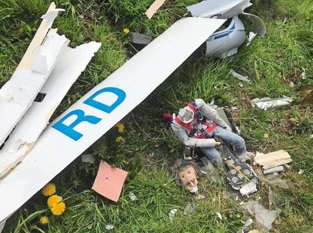
After a flight of just under 20 minutes, we reached the crash site. There was nothing left to salvage. The pilot figure had been thrown from the cockpit, and its head had been torn off in the process. The fuselage was broken and shattered, and the wings were completely destroyed. A total loss! We collected the debris and took it home with us. Who does this model belong to? I posted two cell phone photos of the wreckage on my Facebook page and asked my model-flying friends who the model belonged to. Unbelievable: Within ten minutes, I knew who owned it! I quickly received a message with the name of the model’s owner. Someone from Langenthal(!) called me: “The model belongs to Robi Disler; I called him right away. He told me he’s currently searching for the model in the Goldau area.” A short while later, Robi pulled up at my house and picked up the remains of his DG 303. Robi, whom I hadn’t met before, was relieved that his model hadn’t caused any damage. He also explained to me how this “off-field landing” had happened.
*Markus Nussbaumer*


News from HEBU

TEAM MANAGER "THIS" BOSSHARD
 Rodito Nussbaumer

YOU KNOW WHAT I MEAN? 125 YEARS OF THE SWISS AERO CLUB
 Emil Giezendanner

PRIDE AND GOOD IDEAS
 Markus Nussbaumer

ATOM, THE NEW DOUBLE-DECKER FROM CPLR
 Matthias Bosshard

SUMMER FUN 2026 AT MG USTER
Martin Wunderli
F3A EUROPEAN CHAMPIONSHIPS IN ST-MACAIRE, FRANCE
Matthias Bosshard
52. 2026 ALPS CUP
Emil Giezendanner
HORIZON HOBBY/LEMACO NEWS: MICRO OV-10 BRONCO 645 MM BY E-FLITE

TWIN TOWN PARTNERSHIP
Wolfgang Voeller
CORSAIR F4U – A WARBIRD WITH A MEMORABLE LOOK
Jürgen Rosenberger, Jürgen Prinz
TRY-OUT DAY AT MFV WETTINGEN
Urs Keller
WELCOME, NEW MEMBER!
Andrea Bolliger
EURO CONTEST GLIDER ACRO TOUR AUSTRIA 2026

BY YOUTH, FOR YOUTH
Lorena Betschen
INSIGHTS INTO THE HISTORY OF SEAPLANES

SMALL, MODEL-LIKE SAILBOATS
Res Dauwalder
What's New at Leomotion.com

COUPE DES ALPES – OBSERVE AND LEARN
Rodito Nussbaumer
34th HAHNENMOOS ALPINE MODEL AIRPLANE CAMP
Res Dauwalder
FREE FLIGHT IN THE MIDDLE OF SUMMER
Urs Muntwyler
THE PC-21 STORY
Emil Giezendanner
NEWS FROM HEBU
 Julia Bucher

FROM 0 TO 100
Markus Nussbaumer
MEMORIES
Wolfgang Völler
NOS REGION – A HUB FOR ELECTRIC AVIATION
Emil Giezendanner
Have you almost forgotten about aircraft that take off and land vertically?
Emil Giezendanner
DO YOU KNOW WHAT I MEAN IN THE LAND OF SMILES?
Emil Giezendanner