
Encouraging attendance figures
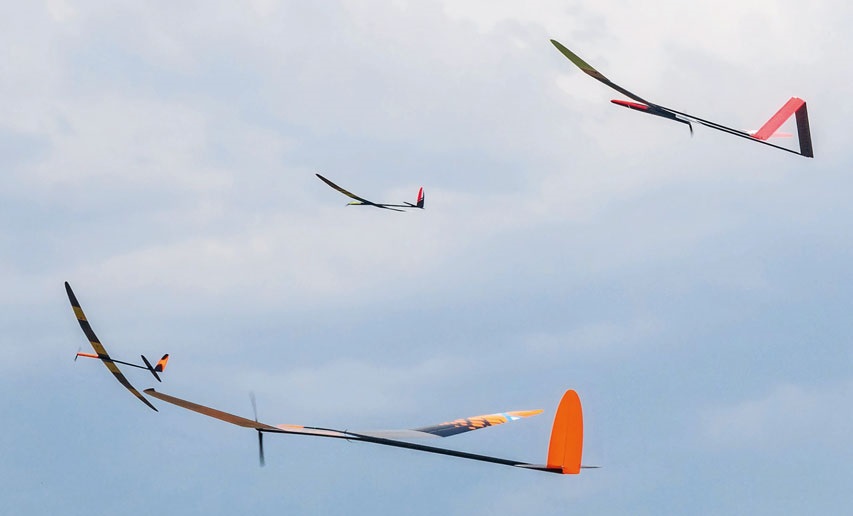
F5J models are lightweight thermal gliders equipped with electric motors and altitude loggers. This competition class is arguably one of the most successful and popular electric flight competitions to date.
A small organizing team from the NOS was able to hold the event under ideal weather conditions at the MG Winterthur airfield in Ricketwil. With over 30 participants—including four juniors—the organizer has nothing to be ashamed of. The entire technical infrastructure, as well as meals for the officials, had to be “flown in,” since the local club was absent.
From the very beginning, the CIAM Electric Flight Commission had advocated for the F5J class to consist of two categories: Juniors and Seniors. This was no easy task at the time, and even in Switzerland, the idea did not sit well with everyone’s entrenched views. The very high turnout at Junior World and European Championships proved the advocates right. The NOS region therefore began training juniors in F5J early on as part of the Young SilentWings program. These very systematic introductory programs began with equipping the models, test flights, and regular training sessions. This was complemented by the affordable procurement of high-performance models. The junior group, which once consisted of eight members, now consists of four. Three have aged out, and one has given up the hobby.
Unfortunately, there has been little response from the other regions so far.
Equipping and setting up modern F5J models requires a great deal of expertise and technical skill. Experience has shown that very few members in our clubs are able to effectively support young people in this class. Fully equipped F5J models are available commercially, but this leads to these high-end sports equipment becoming even more expensive, which makes it difficult to promote the sport among juniors. Solutions are needed.
Everything good has its downsides. Take altitude loggers, for example. They must be certified by the CIAM (FAI). This means that manufacturers must have their devices inspected by a CIAM official. Since dozens of different products are coming onto the market, this is a huge undertaking. In reality, the vast majority of competitors use only two or three different brands. The effort involved is completely out of proportion to the benefit. Another problem is our model airfields. They are very rarely designed in such a way that there are no obstacles to takeoffs and landings in various wind directions. We are forced to make compromises here time and again, especially since critics have so far offered no alternatives. And one last problem: If a model flies very far from the launch site during a competition, it is impossible to determine whether its propeller is spinning—which would only be possible with tampered firmware. That is why very powerful binoculars have been used at previous World and European Championships. In my view, random checks of the loggers would be much more effective. However, this would require an approved testing device, which is still lacking.
With “imaginative” propellers and fuselages, higher internal pressure can be generated in the fuselage during speed flying, which allows for a higher altitude reading on the logger, or, for example, stopping during landing by forming a loop with a measuring tape—though this can be prevented with the nice new roll meters.
As we’re constantly seeing, the increasing digitization of competition isn’t all good news. The additional technical and administrative burden falls particularly on the organizers. Whether this does more harm than good in the long run remains to be seen. We do not want to introduce regulations just to prevent a few isolated instances of cheating.
I’d like to take this opportunity to express my gratitude on behalf of our organizing team: to MG Winterthur for providing their beautiful airfield, to the timekeepers and scorers, to the farmer for allowing us to use his land for parking, and to my colleagues on the NOS Board. They all worked hard to make this event a success.


News from HEBU

TEAM MANAGER "THIS" BOSSHARD
 Rodito Nussbaumer

YOU KNOW WHAT I MEAN? 125 YEARS OF THE SWISS AERO CLUB
 Emil Giezendanner

F3A EUROPEAN CHAMPIONSHIPS IN ST-MACAIRE, FRANCE
 Matthias Bosshard

52. 2026 ALPS CUP
Emil Giezendanner
CORSAIR F4U – A WARBIRD WITH A MEMORABLE LOOK
Jürgen Rosenberger, Jürgen Prinz
SUMMER FUN 2026 AT MG USTER
Martin Wunderli
TRY-OUT DAY AT MFV WETTINGEN
Urs Keller
BY YOUTH, FOR YOUTH
Lorena Betschen
ATOM, THE NEW DOUBLE-DECKER FROM CPLR
Matthias Bosshard
SMALL, MODEL-LIKE SAILBOATS
Res Dauwalder
What's New at Leomotion.com

HORIZON HOBBY/LEMACO NEWS: MICRO OV-10 BRONCO 645 MM BY E-FLITE

TWIN TOWN PARTNERSHIP
Wolfgang Voeller
PRIDE AND GOOD IDEAS
 Markus Nussbaumer

EURO CONTEST GLIDER ACRO TOUR AUSTRIA 2026

INSIGHTS INTO THE HISTORY OF SEAPLANES

34th HAHNENMOOS ALPINE MODEL AIRPLANE CAMP
Res Dauwalder
WELCOME, NEW MEMBER!
Andrea Bolliger
FREE FLIGHT IN THE MIDDLE OF SUMMER
Urs Muntwyler
COUPE DES ALPES – OBSERVE AND LEARN
Rodito Nussbaumer
THE PC-21 STORY
Emil Giezendanner
NEWS FROM HEBU
 Julia Bucher

FROM 0 TO 100
Markus Nussbaumer
MEMORIES
Wolfgang Völler
NOS REGION – A HUB FOR ELECTRIC AVIATION
Emil Giezendanner
Have you almost forgotten about aircraft that take off and land vertically?
Emil Giezendanner
DO YOU KNOW WHAT I MEAN IN THE LAND OF SMILES?
Emil Giezendanner