
On Thousands and Penalties
Romania—did it really have to be Romania of all places! That’s probably what quite a few top F3J pilots must have thought. How else can one explain why renowned pilots—and even entire nations—stayed away from this European Championship! The Swiss national team members Koni Oetiker, Reto Baumgartner, and Gusti Bieli also learned just how unattractive Romania seemed as a host country. Despite intensive efforts, it took a long time to find a second helper—Marc Simon—to join Ruedi Baumgartner. That would later turn out to be an absolute stroke of luck!
In preparation for the European Championships, numerous training sessions were held at Anglikerfeld near Wohlen. The team put the finishing touches on their performance at national and international F3J competitions. Koni Oetiker won the final Winter League competition and also took the highly coveted first place in Kriessern, leaving father and son Lammlein (Tobias is the reigning F3J Junior World Champion) behind him. Gusti Bieli advanced to the fly-off in Forli, Italy, once again proving his skills. The team’s youngster, Reto Baumgartner, has also achieved many strong results. When it comes to models, all three pilots rely on tried-and-true designs. Koni Oetiker and Gusti Bieli mainly fly the Sharron from HKM, while Reto Baumgartner prefers the Pike Superior, which he also distributes as a dealer in Switzerland.
The team was well prepared, and everyone was looking forward to the European Championships with confidence. But then fate struck. The night before their departure for Romania, Koni Oetiker’s father died unexpectedly. With a heavy heart, Koni had to announce that he would be withdrawing from the European Championships. It was also a bitter blow for the rest of the team members.
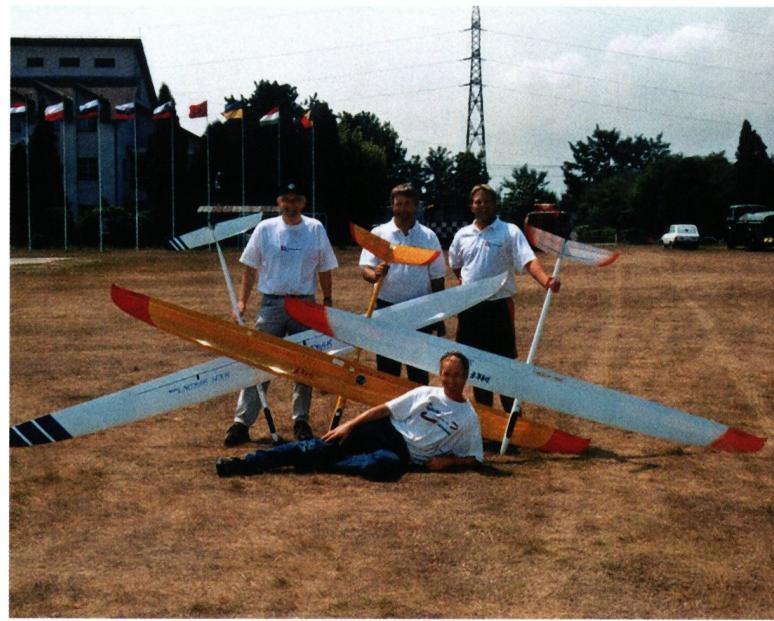
The number of participants had dwindled to the absolute minimum of 4, which was the only way to even qualify for the European Championships! In a rush, they tried to nominate Ruedi Baumgartner as a pilot. With the help of the SMV (thanks again) and some gentle pressure on the local organizers, they finally succeeded.
For the trip, we took the car train from Feldkirch to Vienna. The remaining 650 km through all of Hungary to Deva in Romania were then very exhausting and put our nerves to the test! After a 12-hour journey (from Vienna), the team arrived in Deva, exhausted, as darkness was falling. A taxi driver correctly interpreted the pilot’s somewhat helpless look and guided the new arrivals to the Hotel Deva in no time at all—free of charge, mind you! Marius Conu from the Romanian organizing committee was already there, ready to welcome the Swiss national team. After a restless first night—the Hotel Deva is located right on a busy thoroughfare—we headed to the airfield for the first time. We were welcomed as guests by the local gliding club. The field was the ideal size and featured impressive infrastructure, including a real control tower. Inside a large hangar were several aging two-seater gliders with unusual tail surfaces—T-tails with a V-shape! There were also two Wilga tow planes and an all-metal aerobatic glider in the style of the Fox, of which the owners are particularly proud. After the model inspection and a simple opening ceremony—attended by Deva’s mayor and his wife—the zero round took place the following day, serving as a dress rehearsal of sorts. Then, finally, the first round began. Gusti Bieli was the first to be called to the starting line and posted a solid score of 996.4 points. Reto Baumgartner also flew a full round, and with a good landing, he qualified as well. Ruedi Baumgartner, on the other hand, hadn’t quite found his stride yet—874.5 points weren’t enough! Then came the shocker! Reto’s timekeeper had written down only 6 minutes on the score sheet instead of nearly 10, and Reto hadn’t noticed. This drastically reduced his chances of advancing to the final round. As if that weren’t enough, the only helper, Marc Simon, suffered a painful groin strain during one of the very first launches! Thankfully, the injury didn’t get any worse. Marc gritted his teeth and bravely continued to haul models up the hill. Over time, he developed a very unique running style. Hopping across the field like a kangaroo, he was able to spare his battered groin. With consistently strong performances in rounds 2 and 3, Gusti moved up to 2nd place in the overall standings. Reto worked his way
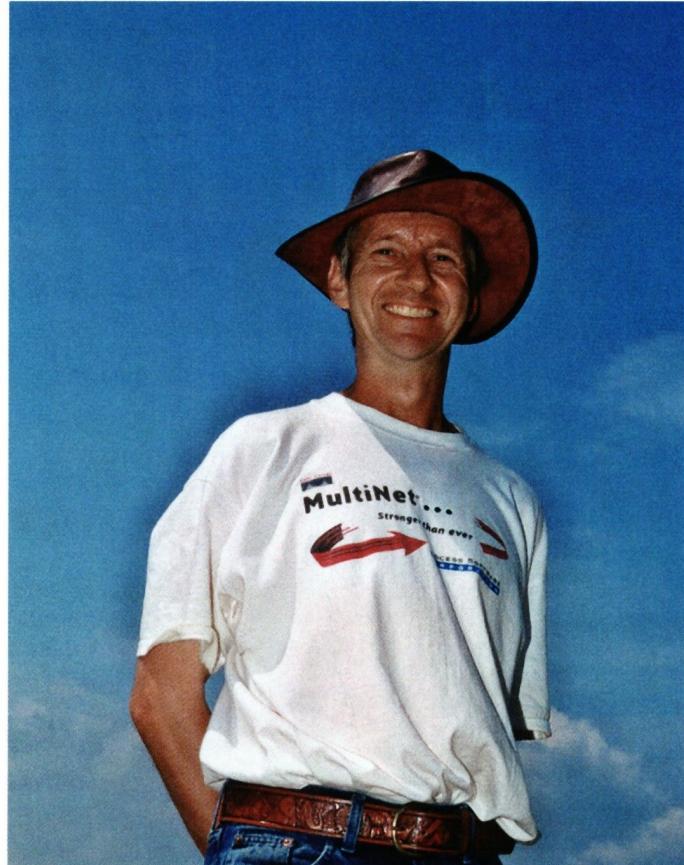
After his botched start, he steadily moved up the ranks, while Ruedi still hadn’t quite found his stride. Starting in Round 4, however, he was able to shake off his nerves and gradually achieved better results. Gusti had to settle for 964 points in Round 4. On the downwind landing, his model skidded too far—just 85 landing points! In rounds 5 and 6, all three pilots flew very well and were able to keep up with the best. Gusti convincingly scored over 1,000 points in round 6 and was still on track for the fly-off. A glance at the leaderboard showed he was in 4th place behind three Czech pilots, just ahead of Dieter Rybold from Germany. Unfortunately, that was about to change abruptly in Round 7! Due to the shifting wind, Gusti decided to approach the landing point via the launch corridor. This is officially permitted, but the takeoff corridor is considered a safety zone and must not be flown over at an altitude of less than 3 meters. In Gusti’s case, however, the timekeeper determined that he flew lower than 3 meters. That meant a penalty: minus 100 points. The dream of a fly-off was over—penalties carry over until the very end. To make matters worse, the competition director came running across the field and made it unmistakably clear to the dismayed pilot and the timekeeper: “You flew over it!” The result: in addition to the penalty, the landing points were lost, plus an additional 30 penalty points! The timekeeper, for his part, hadn’t seen any overshoot. Too bad, because this flight would have earned 1,000 points as well. It stung to squander such a strong starting position in this way. Gusti was relegated to the lower ranks in one fell swoop. In rounds 8 and 9, Ruedi and Reto lost few points and were able to climb up the rankings one place at a time. Gusti had to restart in round 8; this result meant his final score was discarded.
In the end, the Swiss team had to settle for 27th place for Gusti Bieli, 29th for Reto Baumgartner, and 37th for Ruedi Baumgartner. Naturally, they were not satisfied with this result. With a little luck and, above all, more strategic thinking, Gusti could have made it to the fly-off and Reto could have secured a spot in the top 15. The new European champion was Jan Kohout of the Czech Republic, ahead of Juraj Adamek of Slovakia and Lubos Pazderka, also from the Czech Republic. Dieter Rybold of the German team finished in an unfortunate fourth place, despite having been in the lead at the halfway point of the final round. With his consistently strong performances, he would have more than deserved a spot on the podium! The Czech team won the team title in commanding fashion, ahead of the Slovaks and the Dutch. In the junior division, Thomas Fischer from Germany won by the narrowest of margins ahead of Martin Rajsner from the Czech Republic and Markovic from Slovenia. Junior World Champion Tobias Lammlein had to settle for 4th place. However, he was still allowed to stand on the top step of the podium. Along with his teammates Tho-
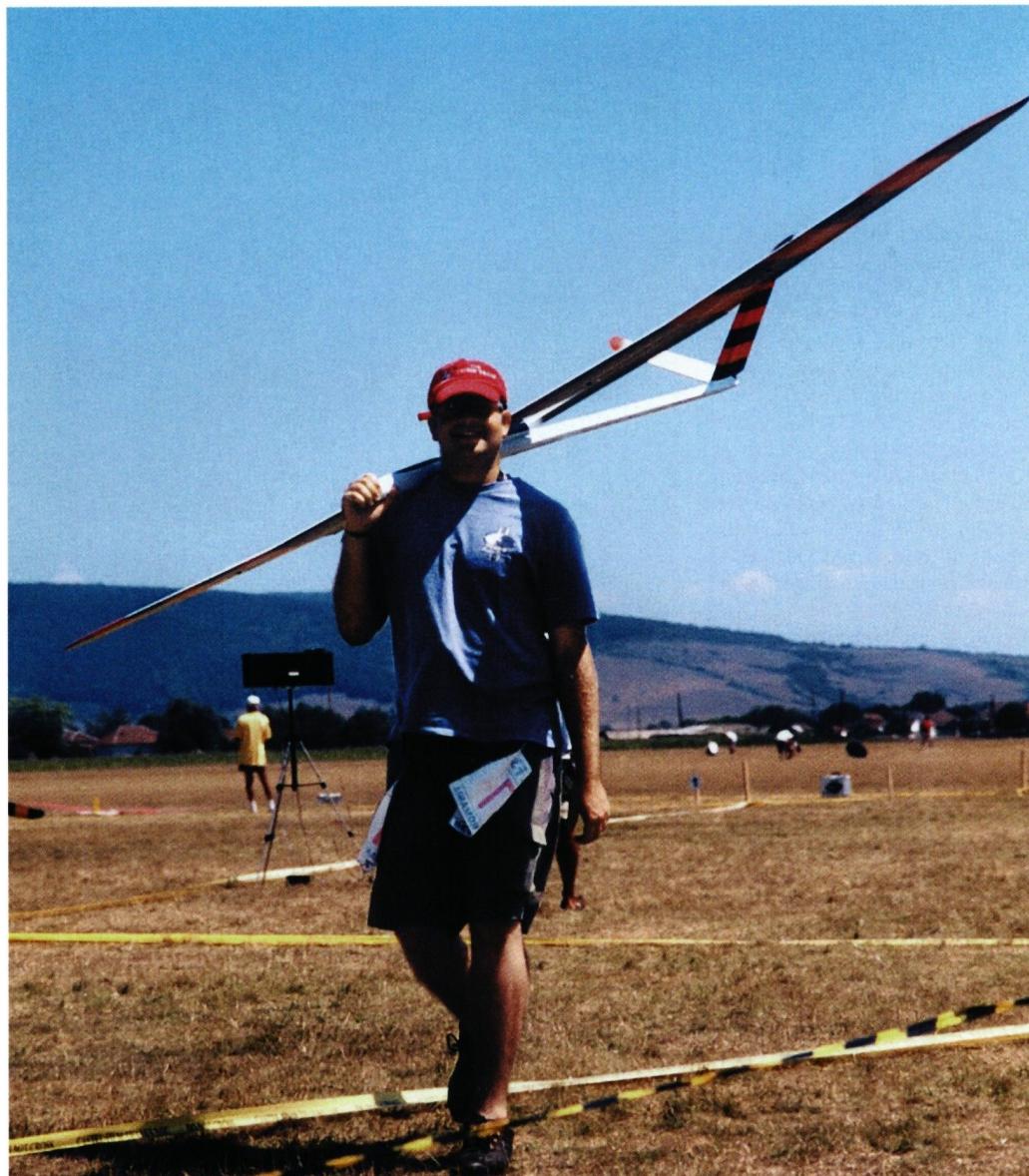
Together with Mas Fischer and Benedikt Feigel, he won the European Team Championship title. The complete results and photos from the European Championship can be found at www.f3j.ch.
The Romanian organizers did an excellent job, and the competition officials had everything under control. Fortunately, there were hardly any collisions between models, resulting in very few re-flights. Overall, the competition was conducted with exceptional sportsmanship.
Among the models, the HKM Sharon and Space types dominate. They remain the top choice for many pilots and are at the forefront in terms of performance and handling. The Pike models were also well represented. Jan Kohout claimed the European Championship title with this model. The lightweight version of the Stork 2 Pro from Heinrich also impressed. Fortunately, there are still home-built models, even if their appearance is sometimes a bit unconventional. One thing is clear: all of these models are high-performance. Making full use of that performance is the true art—and the key to success!
The trip to Romania left all participants with mixed impressions. On the one hand, there are beautiful landscapes crisscrossed by wide, meandering rivers and untouched nature as far as the eye can see. On the other hand, there are industrial areas with terrifying industrial buildings and smoking chimneys that defy description! Typical of the country are the roadside villages, each one looking exactly like the next. A fairly good paved road runs right through the center of these villages, bordered on either side by narrow gravel shoulders. These serve as sidewalks, where pedestrians and cyclists on their old-fashioned bicycles jostle for space. Then come the simple houses. Exposed gas lines running from house to house provide the energy supply. Also striking are the power lines that wind their way through the villages at a low height. In addition, you must constantly watch out for single-horse carts loaded with corn or grass. Farmers let their (only?) cow graze along the roadside, led by a rope. They wave friendly greetings to the bewildered out-of-town drivers and make an unmistakable gesture—they’d love to have a cigarette! So far, just a few impressions of a country that is so little known to us Western Europeans. The majority of the population lives in
poor conditions and has a huge amount of catching up to do. Nevertheless, Romania has its own unique charm.

EURO CONTEST GLIDER ACRO TOUR AUSTRIA 2026

THE PC-21 STORY
 Emil Giezendanner

TWIN TOWN PARTNERSHIP
 Wolfgang Voeller

SUMMER FUN 2026 AT MG USTER
Martin Wunderli
CORSAIR F4U – A WARBIRD WITH A MEMORABLE LOOK
Jürgen Rosenberger, Jürgen Prinz
52. 2026 ALPS CUP
Emil Giezendanner
YOU KNOW WHAT I MEAN? 125 YEARS OF THE SWISS AERO CLUB
Emil Giezendanner
News from HEBU

TEAM MANAGER "THIS" BOSSHARD
Rodito Nussbaumer
ATOM, THE NEW DOUBLE-DECKER FROM CPLR
 Matthias Bosshard

F3A EUROPEAN CHAMPIONSHIPS IN ST-MACAIRE, FRANCE
Matthias Bosshard
INSIGHTS INTO THE HISTORY OF SEAPLANES

WELCOME, NEW MEMBER!
Andrea Bolliger
What's New at Leomotion.com

PRIDE AND GOOD IDEAS
 Markus Nussbaumer

SMALL, MODEL-LIKE SAILBOATS
Res Dauwalder
FREE FLIGHT IN THE MIDDLE OF SUMMER
Urs Muntwyler
BY YOUTH, FOR YOUTH
Lorena Betschen
HORIZON HOBBY/LEMACO NEWS: MICRO OV-10 BRONCO 645 MM BY E-FLITE

COUPE DES ALPES – OBSERVE AND LEARN
Rodito Nussbaumer
34th HAHNENMOOS ALPINE MODEL AIRPLANE CAMP
Res Dauwalder
TRY-OUT DAY AT MFV WETTINGEN
 Urs Keller

NEWS FROM HEBU
 Julia Bucher

NOS REGION – A HUB FOR ELECTRIC AVIATION
Emil Giezendanner
MEMORIES
 Wolfgang Völler

70 YEARS OF THE NIDWALDEN MODEL AIRPLANE CLUB
Martin Barmettler
A SPECTACULAR F3A WORLD CUP IN THE PRINCIPALITY OF LIECHTENSTEIN
Emil Giezendanner
FROM 0 TO 100
Markus Nussbaumer