
Christen Husky: A Dream Come True
The ZG-45 gasoline engine runs smoothly and steadily at idle; the wind is blowing gently from the front and is directly along the runway axis. Erhard Kunz slowly pushes the throttle lever forward and adjusts the rudder so that his Christen Husky stays perfectly aligned with the runway axis. After a few meters, the Piper-like aircraft lifts its tail and takes off—barely distinguishable from its larger counterpart.
For Erhard Kunz, a longtime model builder and pilot, a dream came true with the successful maiden flight on May 15 of last year. More than two years earlier, Erhard—who, as an honorary member of the MG Strengelbach since its founding nearly 35 years ago, has always been one of its most active pilots—had purchased the Graupner Christen Husky as a kit. Erhard still flies the model, which has a wingspan of just over two meters, and enjoys it immensely. The docile, slow-flying characteristics of the Graupner aircraft—weighing just under five kilograms—soon got the passionate model builder thinking: What would a significantly larger Husky be like to fly and, above all, to tow?
But first, a few words about the original. The Christen Husky bears a strong resemblance to the world-famous Piper Supercup, but is an entirely original design by Christen. The Husky made its maiden flight in 1986; since then, this rugged small aircraft, with its outstanding STOL capabilities, has been used everywhere—whether as a bush or glacier plane, a tow plane, or a club aircraft. With a wingspan of 10.7 meters, the Husky can lift a maximum takeoff weight of 817 kilograms into the air. The aircraft is powered by a Lycoming boxer engine that delivers approximately 134 kW of power.
But back to the model: In the winter of 1999, Erhard began scaling up the dimensions of the smaller Graupner model by a factor of 1.3 and redrawing the plans. He was able to largely retain the design of the kit model. For the engine, Erhard chose the tried-and-true ZG-45. For purely recreational flying, the model—weighing just 9.6 kilograms—would be slightly overpowered with this engine. But since Erhard had planned the Husky as a tow plane from the start, it was perfectly fine for it to generate a few PS under the spacious fiberglass cowling.
After nearly 1,200 hours of construction (including the production of negatives), the Husky—built primarily of wood—took to the air for the first time at the cozy MG Strengelbach airfield. Erhard was able to fully transfer the good-natured flight characteristics of the smaller Graupner model to the large homebuilt aircraft with a wingspan of 2.68 meters. Whether flying solo or in tow, the large Husky presented no unpleasant surprises.
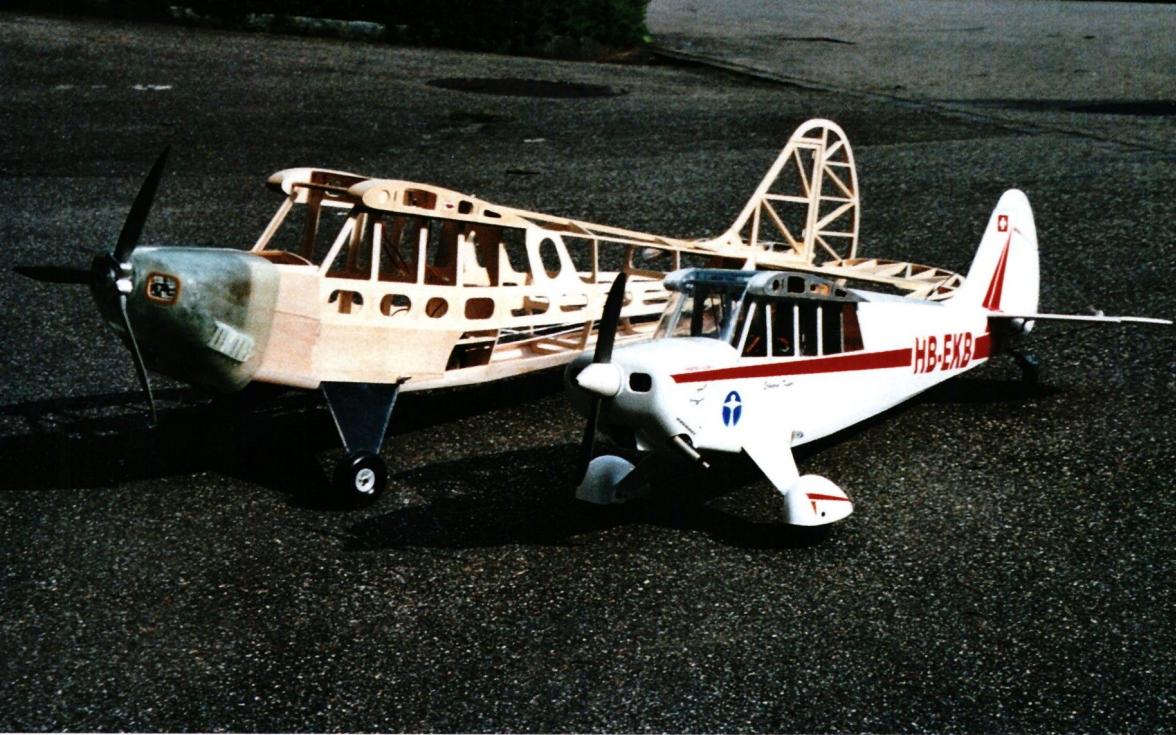
During the 2000 flying season, the Husky quickly became a reliable tow plane. Erhard was particularly impressed by the model’s size and its excellent low-speed flight characteristics. On October 28, 2000, however, the dream turned into a nightmare. In good weather conditions, Erhard was towing a colleague’s glider when malfunctions suddenly became apparent—first in the glider and then in the Husky. While the glider was able to return, the Husky became uncontrollable and crashed uncontrollably during its 80th tow. The result: a total loss, including the engine!
It was understandable to all of us that Erhard was disheartened after this incident. A great deal of work and passion had gone into this model, and all of it was destroyed in a matter of seconds. But Erhard wouldn’t be a model builder if he hadn’t been able to overcome this setback. Before long, he pulled out his plans, molds, and construction sketches and set to work building the Christen Husky 2. Wanna bet that Erhard will soon be standing on the runway on a calm, windless day, slowly pushing the throttle forward and keeping the Husky 2 on course with the rudder until it gains altitude?

EURO CONTEST GLIDER ACRO TOUR AUSTRIA 2026

THE PC-21 STORY
 Emil Giezendanner

TWIN TOWN PARTNERSHIP
 Wolfgang Voeller

SUMMER FUN 2026 AT MG USTER
Martin Wunderli
CORSAIR F4U – A WARBIRD WITH A MEMORABLE LOOK
Jürgen Rosenberger, Jürgen Prinz
52. 2026 ALPS CUP
Emil Giezendanner
YOU KNOW WHAT I MEAN? 125 YEARS OF THE SWISS AERO CLUB
Emil Giezendanner
News from HEBU

TEAM MANAGER "THIS" BOSSHARD
Rodito Nussbaumer
ATOM, THE NEW DOUBLE-DECKER FROM CPLR
 Matthias Bosshard

F3A EUROPEAN CHAMPIONSHIPS IN ST-MACAIRE, FRANCE
Matthias Bosshard
INSIGHTS INTO THE HISTORY OF SEAPLANES

WELCOME, NEW MEMBER!
Andrea Bolliger
What's New at Leomotion.com

PRIDE AND GOOD IDEAS
 Markus Nussbaumer

SMALL, MODEL-LIKE SAILBOATS
Res Dauwalder
FREE FLIGHT IN THE MIDDLE OF SUMMER
Urs Muntwyler
BY YOUTH, FOR YOUTH
Lorena Betschen
HORIZON HOBBY/LEMACO NEWS: MICRO OV-10 BRONCO 645 MM BY E-FLITE

COUPE DES ALPES – OBSERVE AND LEARN
Rodito Nussbaumer
34th HAHNENMOOS ALPINE MODEL AIRPLANE CAMP
Res Dauwalder
TRY-OUT DAY AT MFV WETTINGEN
 Urs Keller

NEWS FROM HEBU
 Julia Bucher

NOS REGION – A HUB FOR ELECTRIC AVIATION
Emil Giezendanner
MEMORIES
 Wolfgang Völler

70 YEARS OF THE NIDWALDEN MODEL AIRPLANE CLUB
Martin Barmettler
A SPECTACULAR F3A WORLD CUP IN THE PRINCIPALITY OF LIECHTENSTEIN
Emil Giezendanner
FROM 0 TO 100
Markus Nussbaumer