
50 Years of Electric Flight: The Quiet Arrival of the Large Gliders
For a long time, large sailplanes equipped with electric motors were considered a rarity. Pure RC gliding—with motors used only in the winches, if at all—has a long tradition in Switzerland and a large following. Large gliders with electric motors have only gained popularity in recent years—with all their pros and cons.
Model airplane enthusiasts and spectators were quite amazed at the 4th Militky Cup in 1977 when they watched Ernst Tscheulin (D) launch his LS-E large glider silently and gently into the sky for the first time. With this demonstration, Ernst also won the technical trophy (Militky Cup) right away. The successful demonstration—which was truly impressive to us at the time—marked
something of a starting point for a new era in the use of large glider models. The models were absolutely silent—just like real sailboats. This led to the large-sailboat competitions that became so popular at the Militky Cup—featuring semi-scale models with fiberglass hulls and Styrofoam-balsa/abachi wings. Wingspans ranged from 3.75 to 5 meters and beyond. Roland Hersperger put on a spectacular show with his SB-10, which had a wingspan of over 7 meters. The very successful motors developed by physicist Heinz Keller (Germany)—the KE 50, KE 80, and KE 100—served as the power sources. In most cases, they were used without gearboxes. Motors with Hectoplett or Geist gearboxes were rather the exception. Power was supplied by 20 to 30 nickel-cadmium (NiCd) cells, and later by nickel-metal hydride (NiMH) cells. The gliders by Ernst Tscheulin were very popular; later, Gierke models were added, as well as models from the East. Replicas of vintage—
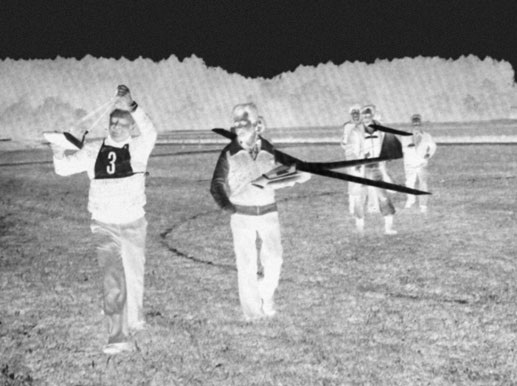
Wooden gliders were a welcome change of pace. The “Grosssegler” competition, held as part of the Militky Cup, enjoyed growing popularity. Fifteen or more participants made their way to Pfäffikon every year. Competitions were also held abroad, particularly
Germany and Italy, competitions were held. A provisional set of FAI rules was even drawn up. Unfortunately, the whole thing has fallen by the wayside, even though today, with telemetry, altitude loggers, and GPS, such competitions could be a great challenge. →
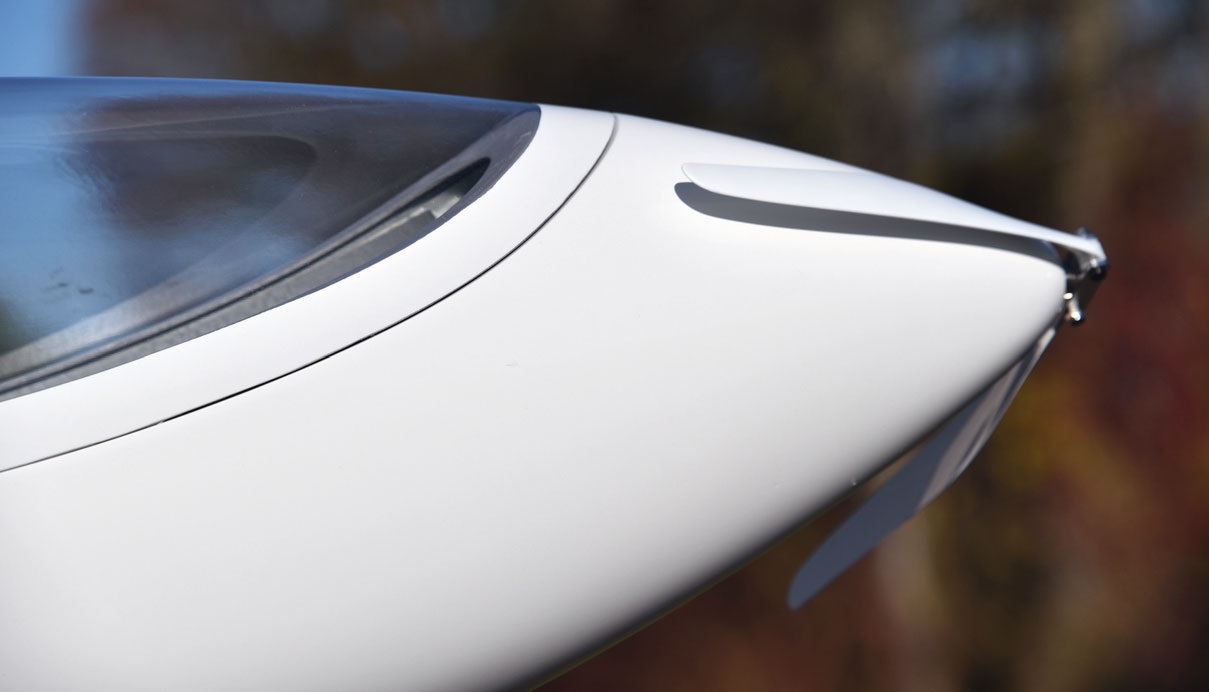
All feature the original fuselage but with new, modern airfoils. The wings are of positive construction, coated with fiberglass and spray-painted white.
All models come RTF with LDS and servos pre-installed.
- ASW17 5 m
- Libelle Standard 4.3 m
- Kestrell 4.8 m
- Jantar 5 m
leomotion.com
The foreign Militky Cup participants really inspired the Pfäffikon Model Flying Club with their elegant large glider models. We flew not only at our airfield, but especially on the surrounding hills. It was often just barely enough for unpowered slope flying. Despite the rubber-
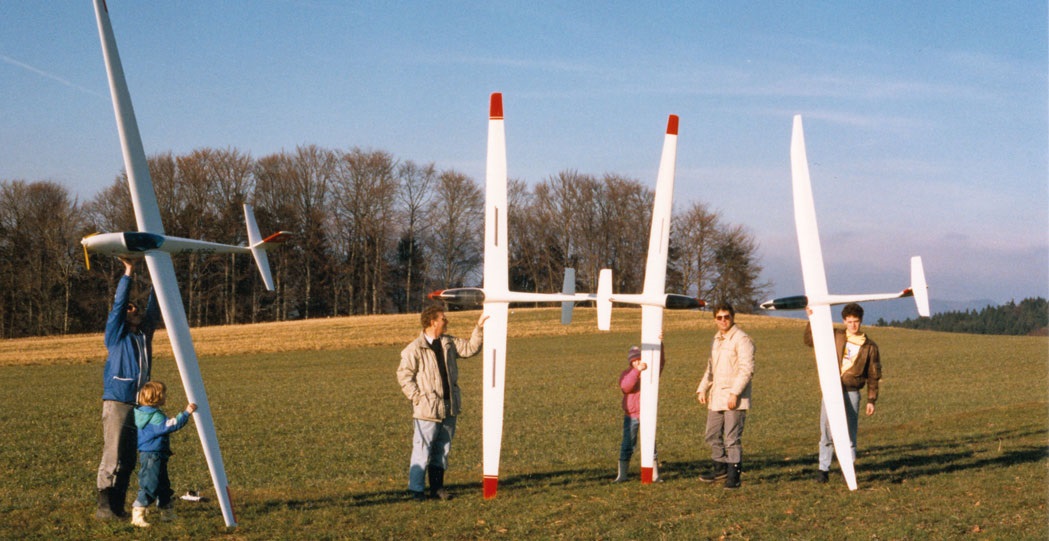
With the Spick and the Motorwinde, flights were always short. Taking too many risks could result in dangerous external loads. That’s where all the Keller 50 engines came in as a welcome help—soon, no one wanted to do without them. The engine performance achieved with a reasonable amount of effort helped the large and rather heavy aircraft (5 to 8 kg) achieve a silent and smooth climb. And as is often the case, our friends from Lake Zurich came to visit one beautiful Sunday, as always with their perfectly built large gliders. When they first saw how brutally we’d sawed off the fuselage noses—replacing them with motor frames, spinners, and folding propellers—preferably yellow or black—they were horrified by our barbaric treatment of the beautiful glider fuselages. It didn’t harm our friendship, but we were certainly pegged as a bit “exotic.” After all, the growing number of large-sailer enthusiasts had founded the IGG at that time, and for a long time, pure gliding was a matter of honor there. To this day, motor gliders are not permitted at some model flying fields. There must be a valid reason for that, too.
The new, high-performance, and lighter LiPo batteries—as well as complete, pre-tuned propulsion kits—have increasingly won over even the skeptics of electric propulsion in the large-sailboat community. The advantages outweigh the disadvantages, which are mostly emotional in nature. The challenge of preventing a crash into the valley is, of course, much greater than simply turning on the motor. In this respect, the “motorless” advocates have a point. On the other hand, the desire for greater safety for these very expensive pieces of sports equipment is understandable. Completely—
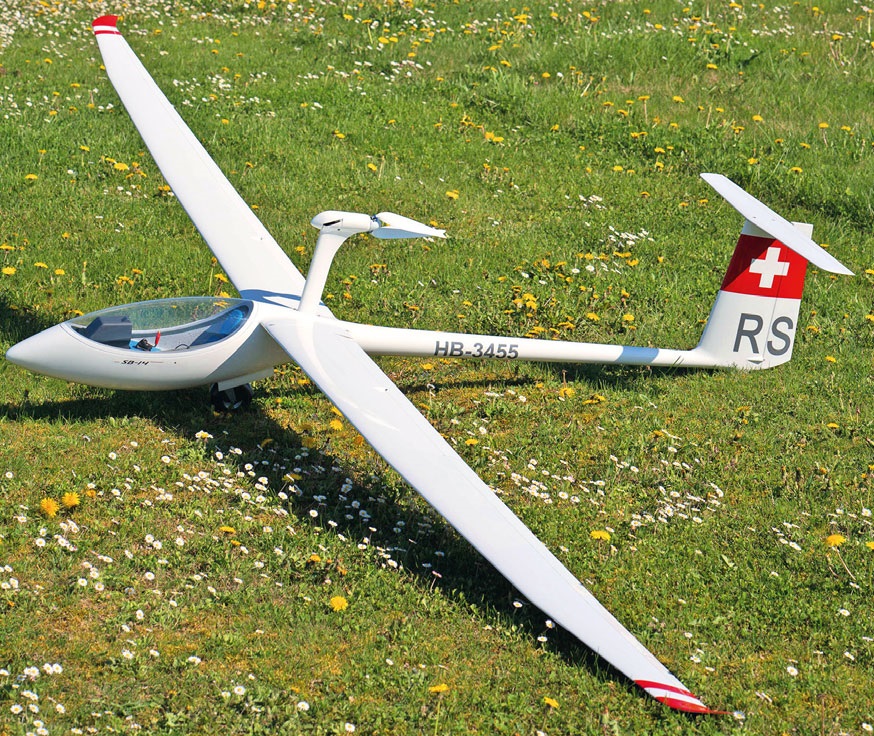
That said, not everyone has a knack for gliding. This doesn’t mean zooming around at 200 km/h or more. The vast amount of energy available to us today allows large gliders to climb almost as often as we like. Maintaining altitude and searching for thermals are thus less important than the ultimate thrill of fast flying—even to the point of a speed rush. To achieve this, airfoils are becoming thinner, wings more stable, and control systems increasingly sophisticated. Now, I don’t mean to stigmatize or even condemn pilots of large gliders who fly fast. But as an occasional glider pilot, I’d like to point out the risks associated with speed flying. The risk of accidents at popular slope-launch sites is well known. Much more
concerns I have regarding the preservation of our flying sites. Speed flying with large gliders is attractive to pilots. But whether neighbors—if there are any—or hikers—
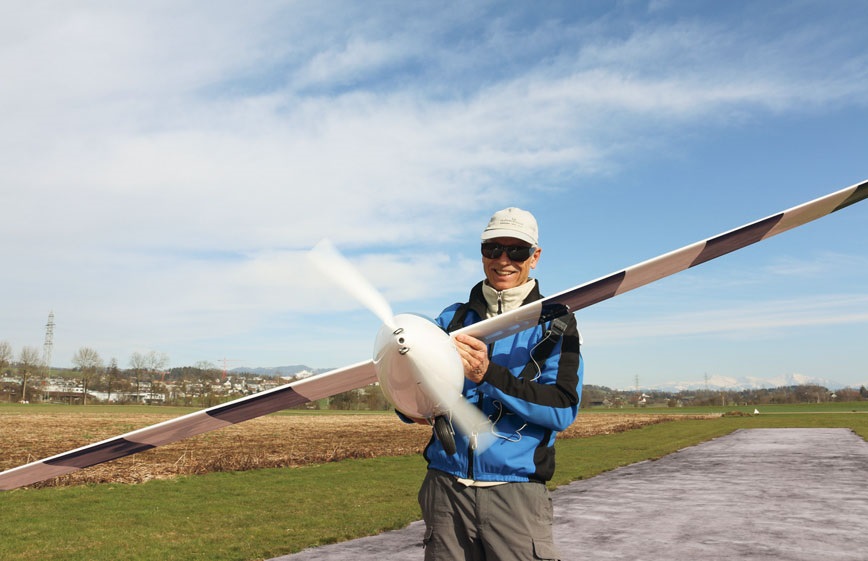
I dare to doubt that many share his enthusiasm. Even without rapidly spinning propellers, these elegant orchids can make quite a whooshing or whistling sound. Noises that, to the uninitiated,
and may provoke aggression. Sure, we’re still lucky enough to be able to use sites where no one is disturbed. But the fact that we could lose beautiful flying sites would be very regrettable and, in most cases, irreversible. I urge everyone to be reasonable!
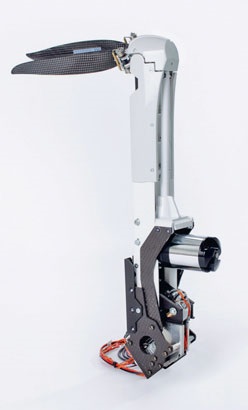
The advantages of electric propulsion for large sailboats described above have been further refined in recent years. Ground takeoff with large gliders is, without a doubt, a wonderful experience. Taking off without relying on an athletically trained launcher, an ingenious catapult, or a tow plane is one of the greatest sensations. Since, despite two-stage landing gear, propellers with smaller diameters but significantly higher rotational speeds must be used, one can hardly speak of “quiet gliding” in this context. Retractable engines can provide a solution, although the earlier fixed-pitch propellers offered little improvement.
Retractable engines mounted on very tall towers or pylons hold more promise. Large, slower-rotating propellers are immediately quieter. I doubt that retractable impeller turbines will catch on, however, because they only deliver their full power at a relatively high flight
, which is anything but ideal, especially during the takeoff phase. Modern impellers are supposed to be quiet, but unfortunately that’s not always the case. Another nice bonus is telemetry: altimeter, airspeed, engine temperature, GPS, etc. Whether pilots can
read and process more than two or three data points simultaneously is questionable.
Well, there are geniuses in this area of model flying, too. I’m not one of them; but I always look forward to beautiful flights with large, gorgeous semi-scale gliders.


News from HEBU

TEAM MANAGER "THIS" BOSSHARD
 Rodito Nussbaumer

YOU KNOW WHAT I MEAN? 125 YEARS OF THE SWISS AERO CLUB
 Emil Giezendanner

F3A EUROPEAN CHAMPIONSHIPS IN ST-MACAIRE, FRANCE
 Matthias Bosshard

SUMMER FUN 2026 AT MG USTER
Martin Wunderli
TRY-OUT DAY AT MFV WETTINGEN
Urs Keller
52. 2026 ALPS CUP
Emil Giezendanner
BY YOUTH, FOR YOUTH
Lorena Betschen
ATOM, THE NEW DOUBLE-DECKER FROM CPLR
Matthias Bosshard
CORSAIR F4U – A WARBIRD WITH A MEMORABLE LOOK
Jürgen Rosenberger, Jürgen Prinz
SMALL, MODEL-LIKE SAILBOATS
Res Dauwalder
What's New at Leomotion.com

TWIN TOWN PARTNERSHIP
Wolfgang Voeller
PRIDE AND GOOD IDEAS
 Markus Nussbaumer

EURO CONTEST GLIDER ACRO TOUR AUSTRIA 2026

INSIGHTS INTO THE HISTORY OF SEAPLANES

34th HAHNENMOOS ALPINE MODEL AIRPLANE CAMP
Res Dauwalder
WELCOME, NEW MEMBER!
Andrea Bolliger
HORIZON HOBBY/LEMACO NEWS: MICRO OV-10 BRONCO 645 MM BY E-FLITE

FREE FLIGHT IN THE MIDDLE OF SUMMER
Urs Muntwyler
COUPE DES ALPES – OBSERVE AND LEARN
Rodito Nussbaumer
THE PC-21 STORY
Emil Giezendanner
NEWS FROM HEBU
 Julia Bucher

FROM 0 TO 100
Markus Nussbaumer
MEMORIES
Wolfgang Völler
NOS REGION – A HUB FOR ELECTRIC AVIATION
Emil Giezendanner
Have you almost forgotten about aircraft that take off and land vertically?
Emil Giezendanner
DO YOU KNOW WHAT I MEAN IN THE LAND OF SMILES?
Emil Giezendanner