
Quality and Safety First
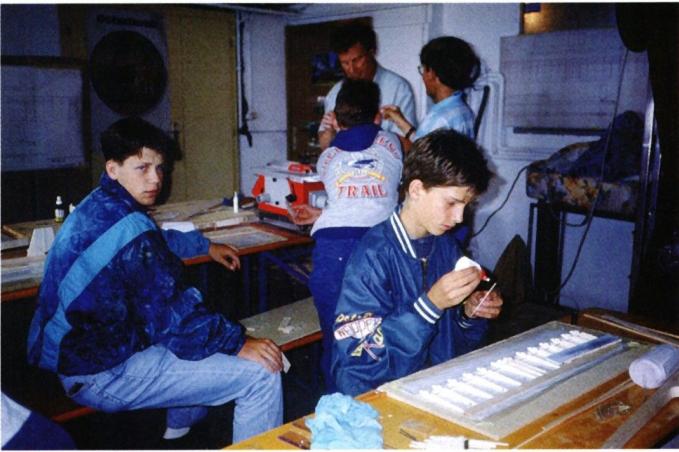
Training and continuing education are becoming increasingly important. While training beginners used to be one of the primary responsibilities of model-building groups, time constraints and the ever-increasing complexity of model building have led to these tasks becoming the exclusive domain of professional flight schools. Supplementary courses offered by model-building clubs in collaboration with public schools have been removed from the basic training curricula. The question is: how do we move forward? Who will guide motivated young people from balsa gliders to complex radio-controlled models, and how will they then find their place within a local club? Who is responsible for the development of beginners or those who wish to improve their skills?
Training and youth programs remain mere words on paper if they are not put into practice. In the context of training, goodwill, commitment, and pedagogical skills are not enough. Trainers must possess in-depth, specialized knowledge. Generalists quickly reach a point where their superficial knowledge forces them to turn to specialists. This has nothing to do with competitive model building. Competition places even greater demands in terms of specialization. We’ll discuss extreme competitive activities further on.
Training in model-making is no longer considered just for young people. New technologies and new materials—without exaggeration—require a lifetime of learning. It doesn’t matter whether you’re 7 or 70. Take, for example, the adjustment required when computers were introduced into our daily lives: they replaced established habits and required everyone to learn new skills—and thus to adapt.
Model building is a comprehensive hobby that encompasses many areas of learning and is a multidisciplinary sport. Very few people consider it a form of training that leads to private or professional piloting activities. Here are the current topics and challenges that modelers must tackle using their basic knowledge:
- Modern
radio-control systems: logical setup, safety, and the interaction of components both within the model and on the ground—such as gyroscopes, regulators, speed controllers, and telemetry systems. - Large internal-combustion
engines: Installation in the aircraft, ignition setup, cooling control, adjustments, noise reduction, starting, accident prevention, maintenance... - Electric
motors: Understanding how to adapt appropriate propulsion components to the model. Accident prevention - Turbines
: Understanding how components work. Installation of the turbine and its electronics, safety, and accident prevention - Helicopter
components: Interaction of various control components, regulators, gyroscopes, adjustments, safety. - Modern
materials: Which materials for which applications, molding, safety, health, working with plastic resins—for example, laminating and painting.
Let’s compare these various topics to realize just how much they’ve changed over the past 20 or 30 years. Whether we look back with pride on the days when we flew balsa wood models without PCM isn’t the point. Our airplanes and helicopters have also evolved, and today we’re talking about speeds of 300 km/h and climb rates of 50 m/s. Competition helicopters are expensive machines. This has consequences that alter our environment (and, conversely, changes in our environment have consequences for our models). - Airspace
Not every environment is suitable for our various model aircraft. Large or fast models require more space. Flying over homes and people may be tolerated with small models such as slow-flyers and other “hand-launched” models, but not with fast or heavy models. Traffic areas and protected zones require our full attention. - Environmental
Protection The expansion of populated areas is bringing us into increasing contact with other recreational activities: horseback riding, dog training, cycling, skateboarding, golf, jogging, etc. Housing and other construction are expanding rapidly. As a result, we must continually deepen our understanding of our rights and monitor land-use plans. - The Duty to Inform
The use of new technologies requires a certain openness: take the case of wind turbines, for example. Someone who knows nothing about them may be overcome by fear, which influences their behavior. Fear is not a technical issue but a psychological one.
The quality of our training is therefore a crucial and indispensable factor in the development of our hobby. Everyone should choose their training based on their means. Don’t forget: experience is always one of the most effective ways to learn, especially for self-taught individuals. The main challenge is maintaining a broad perspective on events. Clubs and associations bear a large part of the responsibility for training. Unfortunately, clubs still have many burdens to bear. There are many positive examples worth mentioning. Without attempting to list them all, I’ll mention just one concept that particularly caught my attention because of its openness: the GM Wimmis Alpine Camp.
In our organizations, the higher up the hierarchy you go, the fewer rules there are. Aside from the training of our officials, the requirements for roles such as instructors or coaches, for example, are not specified. Very few regions have taken steps toward training or continuing education. In the Basel region, various seminars on different topics are organized. In the Zurich region, symposia have been held for the past 20 years on topics such as aerobatics, electric flight, helicopters, and, this year, large gliders. To date, several thousand interested individuals have participated. The conference of group leaders from the NOS (Northeast Switzerland) is organized so that attendees can learn something new. This has led to various communications to the groups, including the organization of helicopter tuning days and training camps. The electric flight committee is considering whether to organize or continue camps. The scale symposium will be organized by FAKO F4. Among these technical committees, the free flight committee—among others—regularly provides updates on new flight techniques and equipment. Circular flight enthusiasts share information through internal newsletters, which is certainly another good source of information.
Many clubs offer basic training courses. Depending on the region, very rigorous courses may be required! Every accident can call flight sites into question. According to my information, much more could be done in each club. As already mentioned, in addition to time and money, there is often a shortage of qualified personnel.
In the MFS editorial guidelines, information and training play important roles. Through coverage of new products on the market, construction techniques, safety information, and other experiences with products, we provide educational and informative content to a wide range of readers, tailored to their interests. Various major associations provide videos on selected topics, such as helicopters. Demonstration CD-ROMs, educational software (teachware) for learning—including simulators—will become increasingly important. The obvious opportunity in the training market—particularly for theoretical training—is, of course, the Internet. At a recent seminar, the possibility of accessing libraries and computing centers at technical schools for “online” propeller calculations was demonstrated.
In summary: training and continuing education are also becoming increasingly important in model aircraft building. There are several sources, learning methods, and delivery media. This requires a broader perspective as well as coordination. Model-making schools will gain in importance in the future. In this field as well, education will come at a cost.
This article is in no way intended to suggest that there is a state of emergency in the Swiss model-making community. The question is rather whether what currently exists meets future needs. If we improve our collaboration or our resources—including by increasing our membership dues—we might be able to enhance what’s available. Is the current offering sufficient, or are people able to identify their needs and find what they need within the existing offerings to fill those gaps?
An important step is to break down needs into defined modules. These modules would then be organized into a systematic framework so that modelers can maintain an overview while using and combining them according to their individual needs. In the next issue of MFS, I will propose a modular training program.
An additional resource to help navigate this maze of training options is an MFS-Q booklet in which each person can list their training activities. This booklet is not intended to be used as a reference or even to be distributed; rather, it is clearly meant to serve as a personal record. Each person is responsible for their own training. I can certainly see this booklet serving as a basis for discussions with professionals at model aircraft schools or within a club. Similarly, it could be useful if a club official needs to decide whether a modeler may or may not use a specific model in a particular setting. For anyone interested, this MFS-Q will be available by Christmas.
Another step that needs to be taken is the certification of flight schools. The criteria must be developed by the school administrators themselves. A small commission would then be able to assess compliance with these criteria. Under no circumstances should this lead to the bureaucratization of training, as is often observed. This small certification committee must remain neutral and independent. The costs associated with flight schools must be kept as transparent as possible. Naturally, these so-called “free” training programs come at a cost but should be offered to customers as a sales service by the stores providing these services.
This topic is not new. As early as the 1940s, the AéCS began training instructors with funding from Pro Aero. The first seminars were held in Arosa. For a long time, these courses provided the technical and strategic foundation for generations of modelers. I proposed a concept for training youth instructors to the board of the Swiss Pro-Aero Foundation as part of my responsibilities at the Pro-Aero youth camp. The arguments were evidently so convincing that Pro-Aero spontaneously made funds available to organize a youth instructor seminar. Training specialists could have been involved, particularly in the context of project-based learning. Unfortunately, the director of the AéCS refused, claiming that the youth camps were functioning very well without it. This example demonstrates the influence that those who stifle new ideas can have. Since then, there have been no further proposals that were sound from both a financial and conceptual standpoint. Despite this, we must bring this issue back to the table and revisit the financial aspects with the Pro-Aéro Foundation. Perhaps the idea was simply proposed too early!
In most sports, training coaches and other team leaders is standard practice. Their role is essential in preparing athletes and during competitions. Anyone who thinks this applies only to professional sports is mistaken. In the amateur context, the role of coaches and trainers in the success or failure of athletes is crucial. In model making, we would very much like to be able to count on this support. Therefore, we need to improve conditions to facilitate volunteer or part-time support. Simply stumbling upon a competent person is no longer enough to achieve consistent and tangible improvements. One of the main challenges in training a new generation of elite athletes—including in model sports—remains the increasingly acute problem of balancing sports with studies (or a career). In both the professional world and in sports, demands are increasing dramatically. Under these conditions, the task of team leaders and coaches is not made any easier.
E. Giezendanner
(translation by C. Ruef)

EURO CONTEST GLIDER ACRO TOUR AUSTRIA 2026

THE PC-21 STORY
 Emil Giezendanner

CORSAIR F4U – A WARBIRD WITH A MEMORABLE LOOK
 Jürgen Rosenberger, Jürgen Prinz

TWIN TOWN PARTNERSHIP
Wolfgang Voeller
SUMMER FUN 2026 AT MG USTER
Martin Wunderli
YOU KNOW WHAT I MEAN? 125 YEARS OF THE SWISS AERO CLUB
Emil Giezendanner
52. 2026 ALPS CUP
Emil Giezendanner
News from HEBU

ATOM, THE NEW DOUBLE-DECKER FROM CPLR
 Matthias Bosshard

TEAM MANAGER "THIS" BOSSHARD
Rodito Nussbaumer
F3A EUROPEAN CHAMPIONSHIPS IN ST-MACAIRE, FRANCE
Matthias Bosshard
INSIGHTS INTO THE HISTORY OF SEAPLANES

WELCOME, NEW MEMBER!
Andrea Bolliger
PRIDE AND GOOD IDEAS
 Markus Nussbaumer

What's New at Leomotion.com

FREE FLIGHT IN THE MIDDLE OF SUMMER
Urs Muntwyler
SMALL, MODEL-LIKE SAILBOATS
Res Dauwalder
BY YOUTH, FOR YOUTH
Lorena Betschen
HORIZON HOBBY/LEMACO NEWS: MICRO OV-10 BRONCO 645 MM BY E-FLITE

34th HAHNENMOOS ALPINE MODEL AIRPLANE CAMP
Res Dauwalder
COUPE DES ALPES – OBSERVE AND LEARN
Rodito Nussbaumer
TRY-OUT DAY AT MFV WETTINGEN
 Urs Keller

NEWS FROM HEBU
 Julia Bucher

NOS REGION – A HUB FOR ELECTRIC AVIATION
Emil Giezendanner
MEMORIES
 Wolfgang Völler

70 YEARS OF THE NIDWALDEN MODEL AIRPLANE CLUB
Martin Barmettler
A SPECTACULAR F3A WORLD CUP IN THE PRINCIPALITY OF LIECHTENSTEIN
Emil Giezendanner
FROM 0 TO 100
Markus Nussbaumer