
Under the Spell of Kinetic Energy
Dynamic soaring (DS) in the “classic” sense is a frequent and fascinating topic of discussion among model glider enthusiasts. The technique is now well established [1,2]. DS speed records are regularly broken and currently stand at approximately 880 km/h [3]. The sound barrier is thus slowly but surely coming within reach.
I myself have had the privilege of experiencing the thrilling sensation that arises when one dares—contrary to ingrained instincts—to fly with the wind into the still or rotating air of the lee, then turn the glider to carry the kinetic energy (= speed) back against the wind and carry it into the field, repeating this maneuver a few times. With each lap, the speed increases, and after a few laps, my ballasted F3B RTG Red Kite reaches speeds of around 250–300 km/h, pushing both me and the glider to our respective flying and structural limits. That’s when I call it quits, so I climb toward the orbit and convert the kinetic energy into potential energy (= altitude) until my nerves have calmed down with some more leisurely acrobatics and the fascinating game can begin anew.
The principle of using differences in airflow to give my glider more and more kinetic energy—that is, speed—inspired me to develop a new thermal flying technique, which I discovered, tested, and refined at our airfield in the well-known thermal fields (= standard thermals). I’ve never read or heard of this before; rather, I developed this technique on my own. In this article, I’d like to share it with other model glider pilots and introduce it to a wider audience. I call it DTS (Dynamic Thermal Soaring).
Let’s take a look at a cross-section of a thermal updraft:

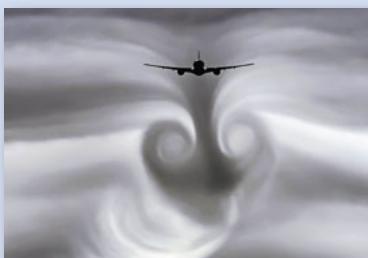
The photo used is from [4] and actually shows a wake vortex with edge vortices from a commercial airliner. However, if you flip a section of it upside down, you can clearly visualize the structure (cross-section) of a thermal updraft. I have added arrows and comments to the selected section:
Every thermal pilot is familiar with this principle: A bubble of warm—and ideally also moist—air forms over heated ground and detaches (e.g., at an obstacle). This is why it’s also referred to as a lift. The bubble begins to rise, drawing more heated air in its wake. A tube of warm, rising air—also called a “beard”—forms behind the bubble. When the air is humid, additional heat is released during ascent through condensation, thereby amplifying the thermal effect relative to the surrounding air.
A ring-shaped rotor forms around the updraft tube, similar to a ring of cigarette smoke, with downdrafts developing on its outer edge. A photo [5] showing rising smoke from Mount Etna illustrates this effect from below.
Even a mushroom cloud is ultimately nothing more than very strong thermals and therefore has a similar shape.
In classic thermal flying, pilots use the warm air to climb by circling flat and centered within the bubble or the “beard.” If the pilot fails to center properly within the beard, they begin to feel the lateral downdrafts of the surrounding rotor, which can be unpleasant. Pilots instinctively try to avoid these.
Just as the lee—which is actually feared in dynamic soaring (DS)—in dynamic-thermal soaring (DTS), one turns these very downdrafts on the outer edges of the rotors into an ally by flying into them boldly and with a suitable dynamic flight strategy. An effective flight path looks like this: →
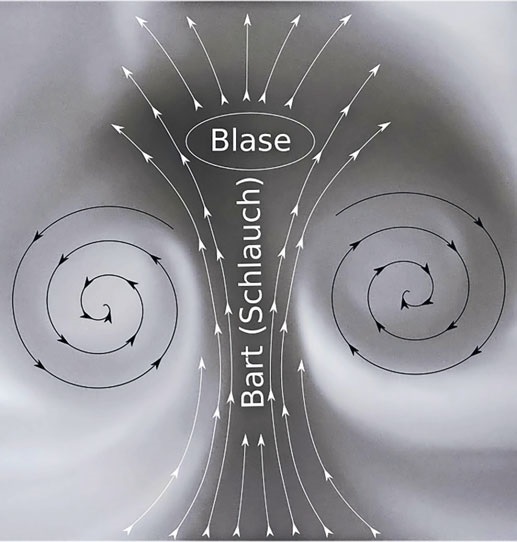
First, you expand the normal, flat thermal circles in the beard into ellipses. When you then feel the rotor’s downdrafts at the long ends of these ellipses, you flip the aircraft onto its back there and dive downward, carried by the downdrafts and their tailwind. This causes the aircraft to gain speed very quickly. You bank sharply at the bottom, experiencing correspondingly high G-forces, then raise the nose approximately 30 to 45 degrees and climb back up across the beard with maximum lift in the updraft (with flaps extended). Once back on top on the other side, however, you’re still far from having lost all the speed you gained when it’s time to go back into a inverted flight and dive down with the downdraft on the opposite side. This way, you gain additional speed with every horizontal figure-eight without losing altitude overall, until the glider’s whistling grows louder and louder. Because you still have to fly half a roll each time, you won’t reach the top speeds achieved in the “classic” DS. Nevertheless, even with the DTS, both pilot and aircraft can quickly reach their limits. So it’s time here, too, to pull up and enjoyably reduce the crosswind and stress with a bit of aerobatics.
Since, under good conditions and with little crosswind, you often have longer-lasting thermals, you can, if necessary, fly right back in and start the fun all over again.
Incidentally, snap flaps (i.e., reversing the elevator and delicately blending it with the flaps and ailerons) greatly enhance this DTS flying technique.
It doesn’t always have to be horizontal figure eights. Once you get the hang of it, you can also harvest and maintain kinetic energy using other situationally creative, dynamic, and acrobatic flight paths. The general flying strategy here: push forward boldly in the downdrafts (invest, go with it), use speed against the wind, and pull with flaps set in the updrafts (flare, harvest). The whole thing is really fun! It sounds easier than it actually is, though, because you usually can’t see the thermal columns, bubbles, and rotors directly. They aren’t marked anyway. It helps to practice this in familiar conditions (with standard thermal columns). Watching birds and clouds, as well as having a good telemetry vario, also helps in gauging the prevailing conditions. But when things really take off, you can safely turn off the vario—at that point, it’s just a matter of going from one limit to the next anyway.
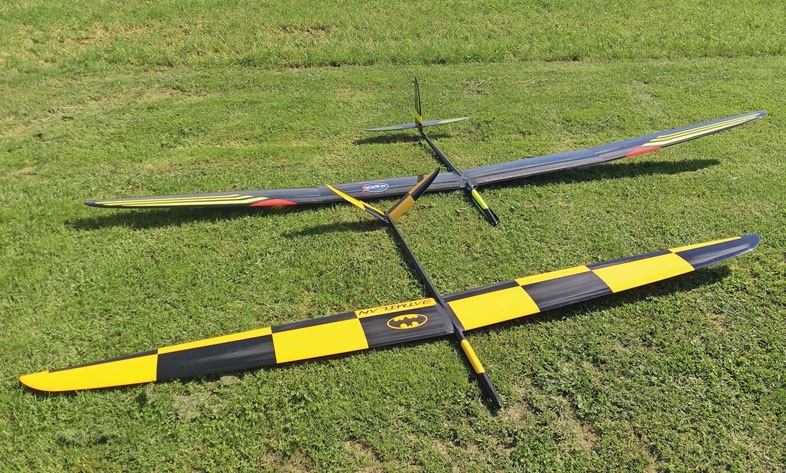
RTG Rotmilan (aka Batmilan) and Valenta Carbonita “NASA Thermal Research Plane.”
- [1] Wikipedia DS:
https://de.wikipedia.org/wiki/Dynamischer_Segelflug- [2] DS presentation:
https://www.youtube.com/watch?v=nv7-YM4wno8&t=216s- [3] DS record:
https://www.youtube.com/watch?v=4eFD_Wj6dhk- [4] Photo of jet wingtip/downwash vortex: https://www.quantamagazine.org/an-unexpected-twist-lights-up-the-secrets-of-turbulence
-20200903- [5] Photo of Mount Etna: http://starship-magazine.org/index.php?page=item&issue=5&pages=100ff
To fly the DTS trajectory presented here, I used a 4-meter Discus from Paritech and a 5-meter Skywalker XL from Baudis, both of which are self-launching models that are highly visible due to their size and, thanks to their sufficient mass, have enough structural strength to withstand the high G-forces that can occur during DTS flight maneuvers. But even the RTG F3B Red Kite mentioned at the beginning was able to really let loose using this DTS technique thanks to a high launch above our field. In weaker conditions, an F5J glider—such as the Carbonita from Valenta—can also be flown with due caution and finesse.
I’m already looking forward to the spring thermals so I can indulge in the fun of DTS once again!


News from HEBU

TEAM MANAGER "THIS" BOSSHARD
 Rodito Nussbaumer

YOU KNOW WHAT I MEAN? 125 YEARS OF THE SWISS AERO CLUB
 Emil Giezendanner

F3A EUROPEAN CHAMPIONSHIPS IN ST-MACAIRE, FRANCE
 Matthias Bosshard

SUMMER FUN 2026 AT MG USTER
Martin Wunderli
TRY-OUT DAY AT MFV WETTINGEN
Urs Keller
52. 2026 ALPS CUP
Emil Giezendanner
BY YOUTH, FOR YOUTH
Lorena Betschen
ATOM, THE NEW DOUBLE-DECKER FROM CPLR
Matthias Bosshard
CORSAIR F4U – A WARBIRD WITH A MEMORABLE LOOK
Jürgen Rosenberger, Jürgen Prinz
SMALL, MODEL-LIKE SAILBOATS
Res Dauwalder
What's New at Leomotion.com

TWIN TOWN PARTNERSHIP
Wolfgang Voeller
EURO CONTEST GLIDER ACRO TOUR AUSTRIA 2026

INSIGHTS INTO THE HISTORY OF SEAPLANES

34th HAHNENMOOS ALPINE MODEL AIRPLANE CAMP
Res Dauwalder
WELCOME, NEW MEMBER!
Andrea Bolliger
HORIZON HOBBY/LEMACO NEWS: MICRO OV-10 BRONCO 645 MM BY E-FLITE

FREE FLIGHT IN THE MIDDLE OF SUMMER
Urs Muntwyler
COUPE DES ALPES – OBSERVE AND LEARN
Rodito Nussbaumer
PRIDE AND GOOD IDEAS
 Markus Nussbaumer

THE PC-21 STORY
Emil Giezendanner
NEWS FROM HEBU
 Julia Bucher

FROM 0 TO 100
Markus Nussbaumer
MEMORIES
Wolfgang Völler
NOS REGION – A HUB FOR ELECTRIC AVIATION
Emil Giezendanner
Have you almost forgotten about aircraft that take off and land vertically?
Emil Giezendanner
DO YOU KNOW WHAT I MEAN IN THE LAND OF SMILES?
Emil Giezendanner