
Crashes and collisions are not uncommon, but they cause no damage
In model aviation, there are always new developments and trends that have brought about significant changes or, at the very least, have secured a permanent place in this branch of model building. Take electric flight, for example, which became a major topic about 40 years ago. In my local area at that time, it was Dani Bucher who, like many others, did pioneering work. His models, Sniff and Pfiff, were the leading figures in electric flight in Switzerland.
What I find remarkable about this story is the fact that it involves model aviation in the truest sense of the word. Furthermore, the aircraft are scale models. The driving forces behind this project all come from the manned aviation sector and also have a background in model aviation. This applies to practically everyone I know who is involved in production. Mathieu from OPALE in France, Ahn Jae Woong in Korea (pilot and GS importer) from FlyPG, Sascha Rentel from Hacker, Ivan Appolini from MIM in Italy (former GS Acro-Nati pilot), and the Rudzan brothers in Slovakia. I don’t know of a single manufacturer in the scene who doesn’t fly a GS themselves. From that perspective, it’s also clear that the vast majority of my customers have a GS background. Some are still active—but many are former GS pilots or those who no longer fly often, and they see RC-Para as a way to reconnect with their (beloved) paraglider. And in fact, flying a model—for example, on a slope—is emotionally very close to real flying for me! Just a few introductory words...
At Easter, I attended a slope-soaring event organized by two private individuals. The Hacker company and Neckar-Verlag then took over the sponsorship and were able to associate the event with their names. Mathias designs model paragliders himself—with great success and enthusiasm. His models are every bit as good as commercial products. Using commercially available software, it’s quite possible to design a model paraglider—though patience and manual dexterity are especially needed for the construction and fine-tuning of the lines. A model paraglider like this uses many square meters of fabric (with a lot of waste) and around 100 meters of lines with 50–100 knots and connections. There is no robotic manufacturing yet. Despite technical aids such as laser CAD for cutting, etc., each model still requires a great many hours of painstaking work. This is one reason why modelers likely consider these products quite expensive. A paraglider pilot, however, might say, “What, only 500 francs?” since he probably had to pay more than ten times that much for his full-size paraglider. But it must be noted—and model builders should take this to heart—that a model paraglider can withstand an incredibly greater amount of stress than a normal model airplane. Sascha Rentel, for example, from HACKER, and I myself—both of whom fly and test extensively—have each broken a glider only once so far. All other damage involved the lines, which are easy to replace, or the pilot figure, the trike, the servos, or the motor. Even in these cases, the potential for financial loss remains minimal—nothing like the damage you have to accept with model airplanes. Sascha and I got tangled up with each other on the Moosberg slope—that is, his ASTRAL and my PRISMA—resulting in minimal damage to the wood of my pilot figure, which put the propulsion system out of commission. However, the figure was still able to glide. Sascha wasn’t damaged at all and took off again right away—even though both models fell to the ground from a height of a good four meters. Unthinkable with glider models, right? But let’s move right on to another advantage of these models. You pack the RC-Para into a medium-sized backpack, and once on the mountain, it unfolds into a model with a wingspan of 2.3 meters or even more—a model that, moreover, has minimal requirements when it comes to landing sites.
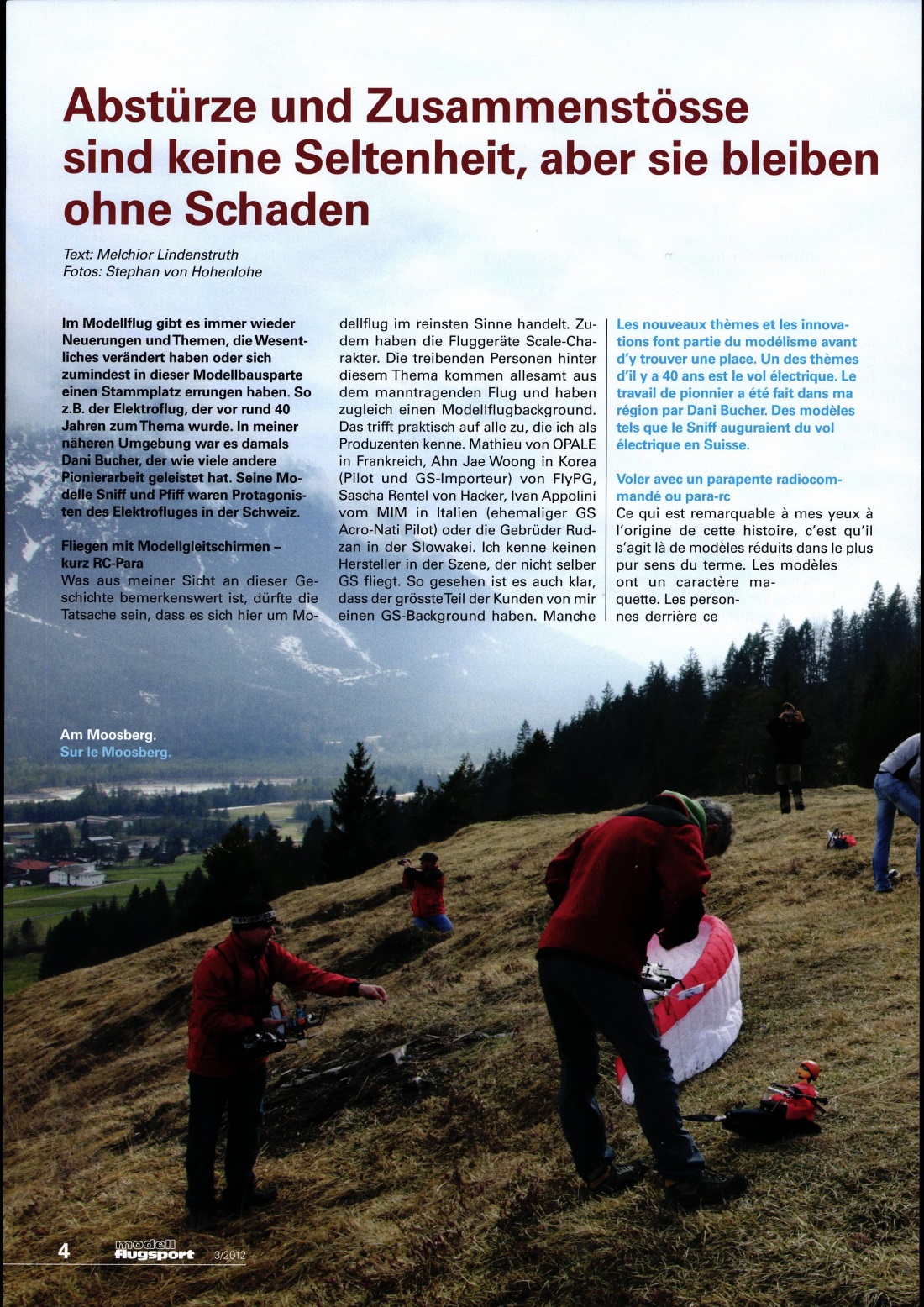
But let’s get to the story: Henrik and I arrived from Switzerland on Good Friday and drove through the Brengen Forest into the Lech Valley. The day was damp and foggy. I thought it was really nice of Henrik to come along anyway. Our chances of flying looked slim. In Warth, as we crossed the pass, the fog quickly cleared, and we had a clear view of the Lech Valley. We were quite amazed, and our excitement shot up from –2 to plus 10 in the blink of an eye! So we drove down into the valley, hoping we’d reach the meeting point soon. But the clouds closed in again, and shortly before we reached Weissenbach (15 km before Reutte, Tyrol), it started to drizzle again.
The son of the family is a co-organizer and also flies RC paragliders. After the last few people arrived, we discussed our plan. Our report of better weather was confirmed by a call to the Elbigenalp flight school. It’s still dry and nice there. So we all drive the nearly 20 minutes up the valley—the road quickly dries out again, and in Elbigenalp, the sun is shining through the cloudy sky. It’s a miracle, but we’re thrilled. Part of the relatively short slope is being used by the flight school and paragliding novices. We’re free to fly our electric paraglider models without hindrance, and the paragliders come over curiously to inspect our little gliders. Soon there’s a buzz in the flying sky. Our rear-mounted motors are relatively loud—a drawback, admittedly. But the rear-mounted motor’s performance is unbeatably efficient. There are models from HACKER, OPALE, FLYPG, Tanny-Boom, and aircontact, as well as a homemade one. A colorful buzz and lots of fun. The first one to get stuck in a tree is Henrik—or rather, his ALULA—since he doesn’t fly RC paragliders. In between flights, he films for me, since I don’t take the time to do it myself—I’m too tempted to fly my five different models here and compare them with others. At one point, at least 50 birds break away from the valley center in a large flock and take flight. I fly after them but can’t keep up. Sascha launches the ASTRAL, and in no time, thanks to his model’s superb climb rate, he’s right in the middle of the flock—at least 300 meters above us. A spectacular sight and an amazing scene that, thanks to Stephan von Hohenlohe’s presence, will surely be featured on one of this year’s upcoming MODELL DVDs. Around mid-afternoon, we head back to Weissenbach—we want to check out the much-praised Moosberg, and by now it’s apparently dry there as well. René has been soaring for half an hour, as he tells us via cell phone. We hastily climb the Moosberg—which, thanks to the valley wind and its southern exposure, is active—with its elevation above the valley of perhaps 150 meters. Now it’s time to fly and fly some more. Every now and then there’s a thermal, and the engines fall silent for a short while. Crashes and collisions aren’t uncommon, but they result in no damage. Most of the time, you just restart the model. My FLASH is set quite sensitively, and when conditions get a bit more turbulent in the evening, there’s the occasional flap. One opens up brilliantly again, and everyone cheers. In the evening, we head back toward the valley—by now, we’re all probably getting hungry. The Moosberg belongs to the glider pilots once more, and we hear the whistling of their wings as they descend.
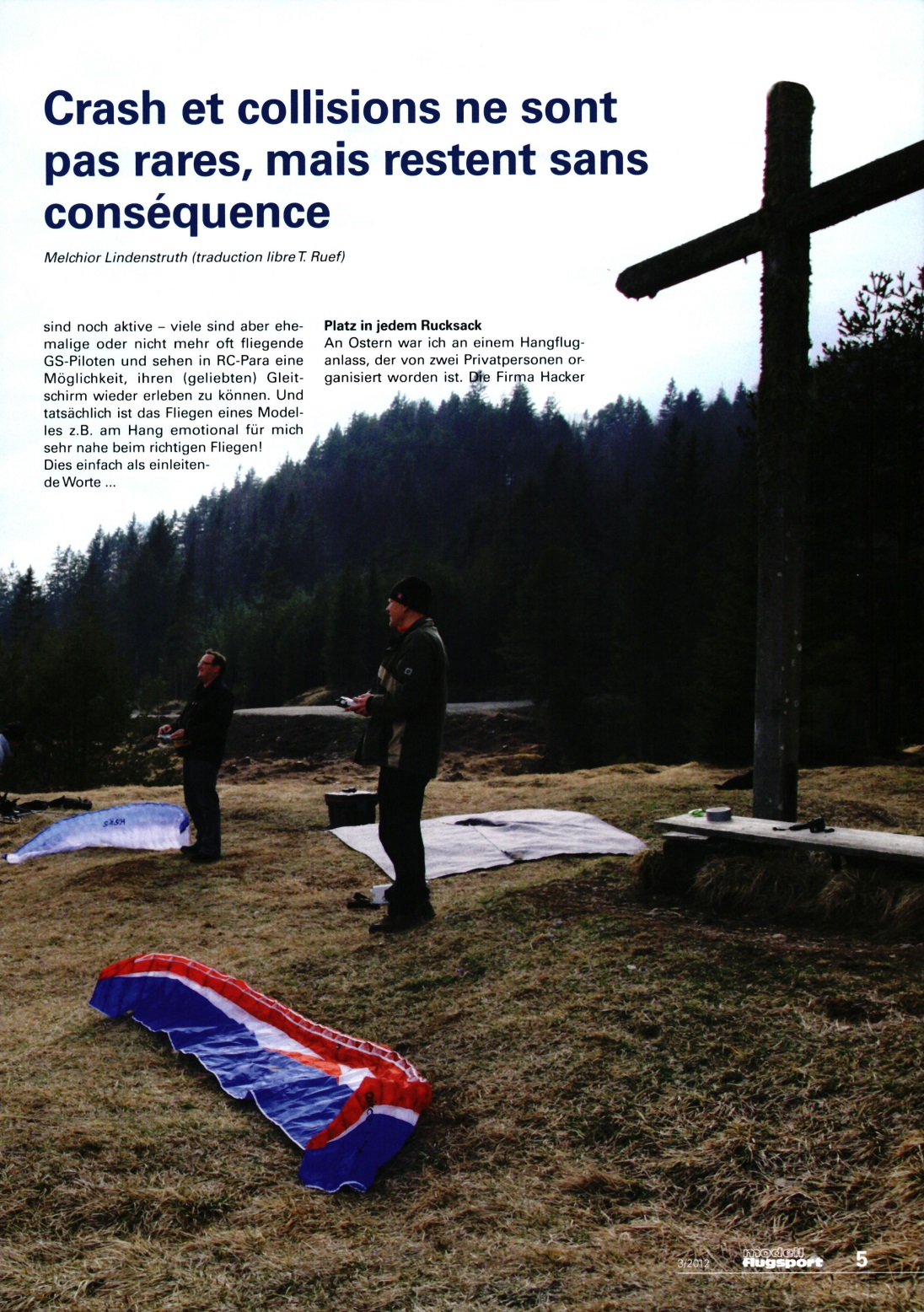
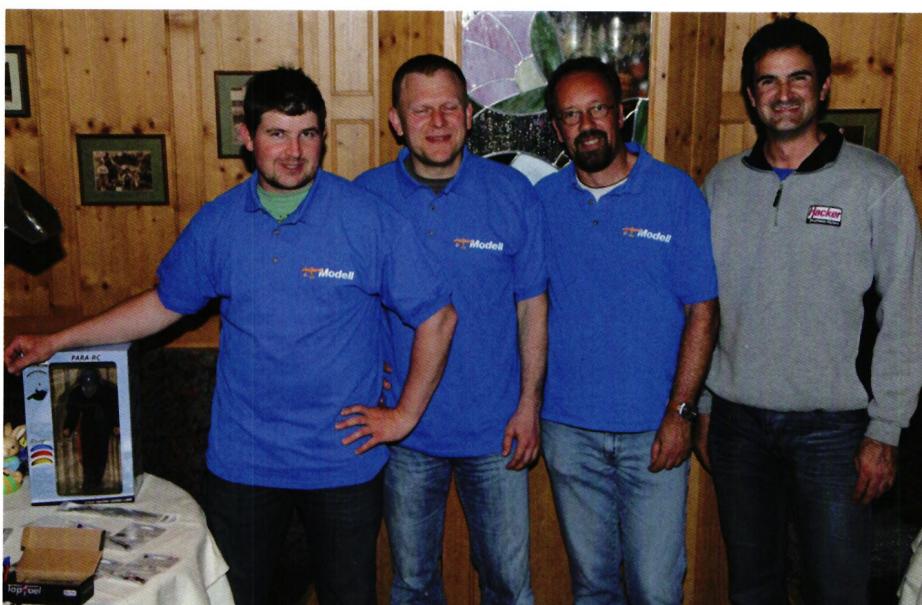
What an amazing day—and what a blast to fly RC paragliders with so many other pilots. In conditions like these, flying a model paraglider is truly fantastic! You should stick to flying these models on good days and in suitable terrain. Damage report: Two models flew away—both due to a technical defect. One was found high up in a fir tree, and the other wasn’t found at all. Everyone else’s models were intact or had only minor damage that could be quickly repaired. It’s great when events like this are organized by private individuals! It really goes off without a hitch. We greatly appreciated the support from HACKER and Neckar Verlag. I’m now looking forward to the next event, which I’d also like to recommend to you: June 8–10 at Hahnenmoos—right on our doorstep and in familiar terrain. I’d be delighted to welcome some of you there—with or without an RC paraglider.


News from HEBU

HORIZON HOBBY/LEMACO NEWS: MICRO OV-10 BRONCO 645 MM BY E-FLITE

PRIDE AND GOOD IDEAS
 Markus Nussbaumer

TEAM MANAGER "THIS" BOSSHARD
 Rodito Nussbaumer

YOU KNOW WHAT I MEAN? 125 YEARS OF THE SWISS AERO CLUB
 Emil Giezendanner

F3A EUROPEAN CHAMPIONSHIPS IN ST-MACAIRE, FRANCE
 Matthias Bosshard

ATOM, THE NEW DOUBLE-DECKER FROM CPLR
Matthias Bosshard
SUMMER FUN 2026 AT MG USTER
Martin Wunderli
What's New at Leomotion.com

52. 2026 ALPS CUP
Emil Giezendanner
TWIN TOWN PARTNERSHIP
Wolfgang Voeller
34th HAHNENMOOS ALPINE MODEL AIRPLANE CAMP
Res Dauwalder
CORSAIR F4U – A WARBIRD WITH A MEMORABLE LOOK
Jürgen Rosenberger, Jürgen Prinz
SMALL, MODEL-LIKE SAILBOATS
Res Dauwalder
TRY-OUT DAY AT MFV WETTINGEN
Urs Keller
WELCOME, NEW MEMBER!
Andrea Bolliger
FREE FLIGHT IN THE MIDDLE OF SUMMER
Urs Muntwyler
COUPE DES ALPES – OBSERVE AND LEARN
Rodito Nussbaumer
EURO CONTEST GLIDER ACRO TOUR AUSTRIA 2026

BY YOUTH, FOR YOUTH
Lorena Betschen
INSIGHTS INTO THE HISTORY OF SEAPLANES

THE PC-21 STORY
Emil Giezendanner
NEWS FROM HEBU
 Julia Bucher

FROM 0 TO 100
Markus Nussbaumer
MEMORIES
Wolfgang Völler
NOS REGION – A HUB FOR ELECTRIC AVIATION
Emil Giezendanner
DO YOU KNOW WHAT I MEAN IN THE LAND OF SMILES?
Emil Giezendanner
Have you almost forgotten about aircraft that take off and land vertically?
Emil Giezendanner