
Built from scratch
“Built from scratch” means practically the exact opposite of ARF (Almost Ready to Fly)—namely, building a model from the ground up. And that’s exactly what my colleague and president of the Grischhei Model Flying Club (ZH), Heinz Lattmann, did: He simply obtained a blueprint along with a few parts and then, with the utmost care, hand-cut every single rib—yes, every intricate balsa and plywood piece—himself! After about 1,200 hours of construction, it was finally ready for its maiden flight at Grischhei: an AT-6 like you rarely see.
When Heinz asked me about three years ago to search the internet for various AT-6 designs, I knew right away: True to the motto “Mirror, mirror on the wall, who builds and flies the most beautiful models in the Säuliamt?”, he wanted to set an example once again. And when I found an incredible number of different designs online—ranging from the original yellow US Air Force trainer from the 1930s to today’s Reno Racer in the brightest colors—I was curious to see what would soon appear at our airfield. Heinz chose the AT-6 mainly for two reasons: First, he fell in love with this beautiful aircraft, and second, he hoped this beauty would offer easy-going handling.
Over the years, I’d occasionally sat back with a nice glass of Coca-Cola Zero to admire the project’s latest progress, and as a shameless ARF fan, I never ceased to be amazed at how anyone could put themselves through something like this—but finally, the time had come: The AT-6 was ready for its first photo shoot! So I visited Heinz, armed with a camera and a voice recorder, as
in his new workshop and picked the worms out of this gifted woodworm’s nose one by one. Smiling, Heinz revealed to me that he’d specifically made sure this project would take a long time to build. The reason: His hangar was already bursting at the seams.
To build his new masterpiece, Heinz bought the plans for a 1/5-scale AT-6 from Zirolí and a used ZG 62 at the flea market in Dübendorf,
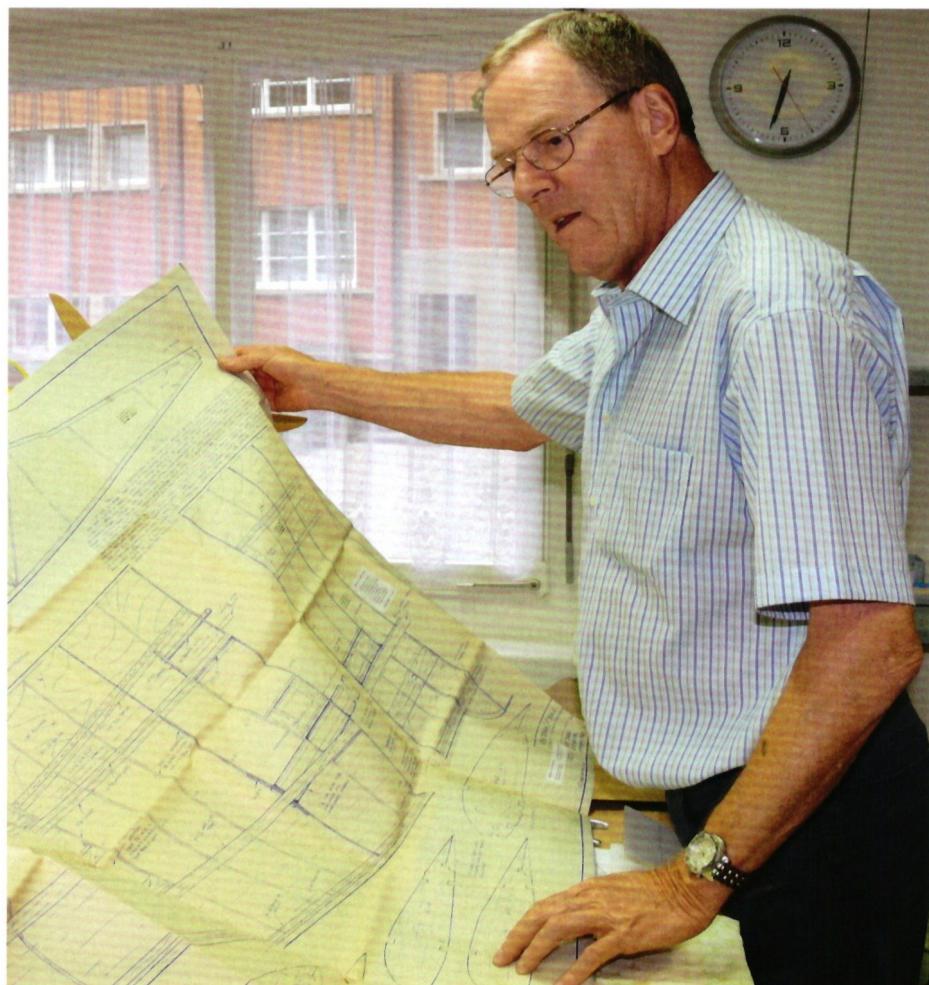
the right pneumatic landing gear from Robart, as well as the engine cowling and canopy—and, of course, a huge amount of wood. His main tool was the band saw, but he also made good use of the good old fretsaw.
The Ziroli AT-6 is built to a 1:5 scale. This results in a wingspan of about 260 cm and a wing area of about 97 dm². The model weighs 13 kg ready to fly. This results in a wing loading of 134 g/
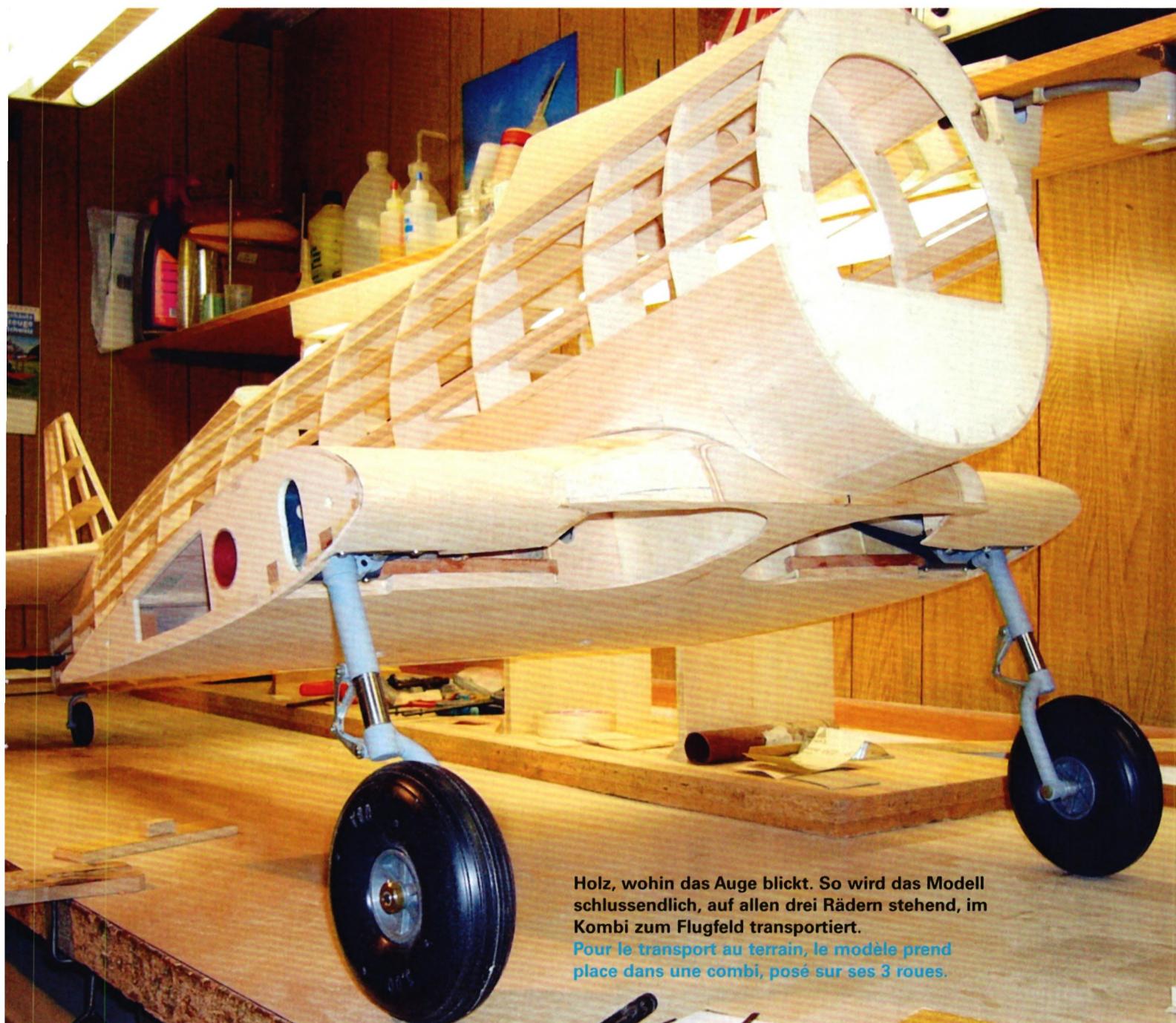
dm². That’s not exactly low, but it’s still within the acceptable range for a model of this type. This AT-6 consists of a fuselage and a three-piece wing. The landing gear, including the pneumatic system, is integrated into the center section of the wing. For easy transport, the center section is mounted to the fuselage and the landing gear is extended. This allows the fuselage assembly to stand securely on both the main and auxiliary landing gear and can be easily transported in a station wagon. Once at the airfield, the model is ready for takeoff in just a few minutes.
Heinz mounted the used ZG 62—which had already been through quite a bit and had a few broken cooling fins—onto the vibration-absorbing HydroMount. I’ll let you in on a secret right now: as you’d expect from a ZG 62, it ran absolutely perfectly. Not even the jet needles for full throttle and idle needed to be readjusted! What I can’t forgive Heinz for, though, is that he doesn’t start the engine by hand—as befits such a machine—using the ingenious EasyStart system, but instead uses the electric starter in a completely unstylish way! Come on, Heinz! But that brings me to the end of my envious criticism. I had to find something to complain about, after all...
Pneumatic suspensions are, from a technical standpoint, elegantly designed systems. The suspension servo simply has to actuate a control valve with absolutely no force; the heavy lifting is done by
the compressed air. The speed at which the struts extend and retract can be adjusted at the valves. This way, one wheel after another—just like the original—extends and retracts. When I shared my concerns with Heinz about the airtightness of pneumatic suspensions, he had the following to say: Two months ago, he pressurized the system to 7 bar with his compressor. Shortly before my visit, he checked the pressure and found there was still a full 5 bar left! The wheels are from Sullivan and are foam-filled. As a result, there’s hardly any indentation, even after prolonged periods of inactivity.
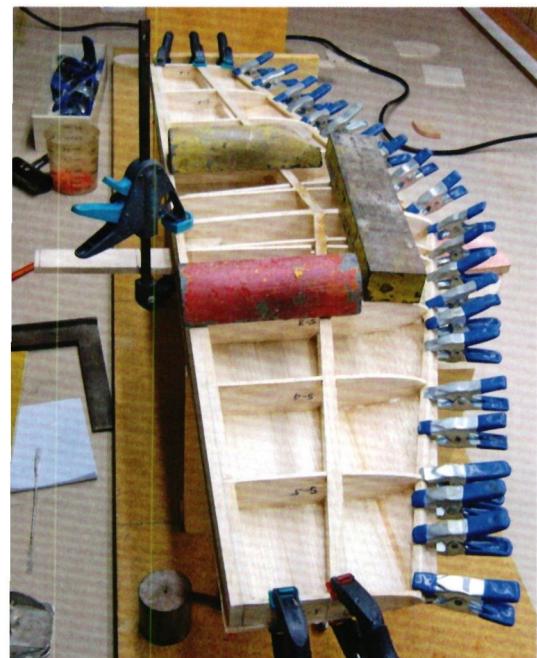
The model has a conventional construction: ribs and skin made of balsa wood, reinforcements and spars made of
hardwood. For weight reasons, the tail surfaces are covered with film; the fuselage and wing are “glassed,” as they say in Swiss German. Heinz applies a very thin layer of epoxy to the finished, sanded balsa planking, followed by very lightweight fiberglass cloth. After curing, the surface is sanded briefly, and another layer of epoxy is applied. It is then sanded again as much as possible without damaging the fiberglass mesh. In my colleague’s spray booth, a layer of gray filler is applied and finely sanded. After precisely matching the color, a two-component clear coat is applied professionally. However, my colleague made a slight miscalculation regarding color accuracy and didn’t account for the influence of the gray filler
. And indeed, you can see extremely subtle color differences between the yellow of the film on the tail section and the two-component clear coat. Next, the entire model goes through a veritable “purgatory”—that is, the paint is baked at 80 degrees Celsius. The wooden structure withstands this fairly high temperature without any problems, and there are neither cracks nor warping. However, Heinz carried out certain very delicate spray-painting tasks on the canopy and the dummy engine himself. The real art here lies not in the spraying, but in the painstakingly precise and time-consuming masking. The lettering
and national insignia were handled by another colleague, Urs Mailänder, based on photos or images from the Internet. Thanks to the “laminated” wood construction, the model weighs only 13 kg—not too heavy, yet incredibly sturdy. At most, only a super-expensive carbon-fiber construction would stand a chance of keeping up. However, if Heinz were to build another AT-6, it would have a slightly extended nose section. Although Heinz had focused on an extremely lightweight design in the tail section, he had to—with a heavy heart—add no less than 800 grams of lead to the nose.
We model airplane enthusiasts all know it: The intensity of the jitters before a maiden flight depends on the number of hours spent building it, the money invested, and the expectations of our dear—and quick-to-criticize—colleagues. That’s why it was clear that our dear Heinz, before his maiden flight—
how could it be any other way—would complain of shaky knees. But we know this: As is well known, the performance-to-fear curve rises until the point where fear turns into panic, and then drops steeply into the abyss. So: Fear, yes; panic, no! Besides, we model airplane enthusiasts actually love this very
thrill. That’s probably why we don’t play with model trains or collect stamps while sitting on the stove bench. And how wonderful it is when the great scare is over, the heart begins to beat at a normal rate again, and the model stands before you once more after a successful landing! That’s exactly what mere mortals will never, ever
understand: Why would anyone put thousands of hours of work into something and then expose that expensive work of art to such a huge risk? But there’s an explanation that’s very easy for anyone to understand: They’re just crazy...
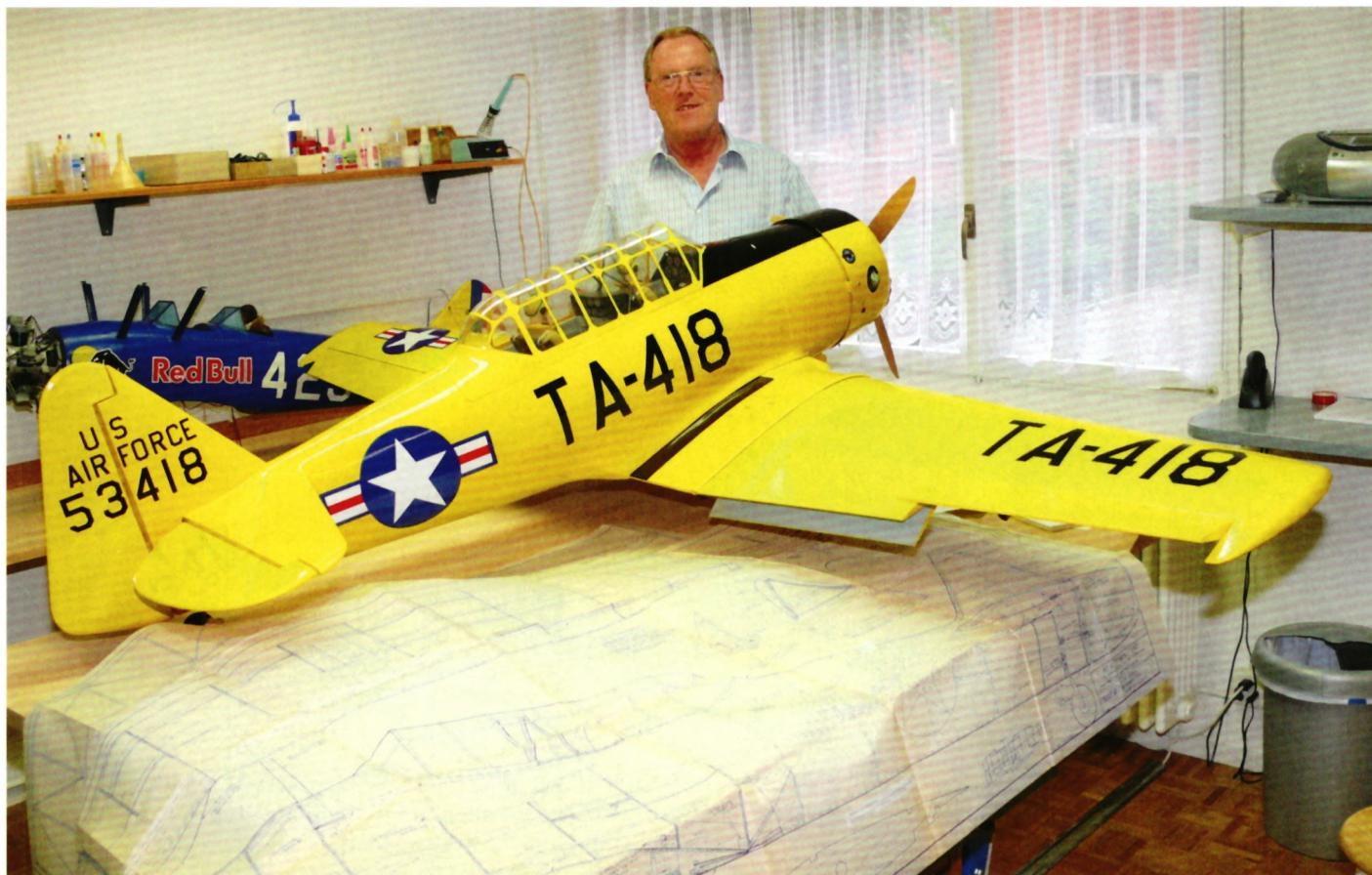
So Heinz carefully pushes the throttle stick forward, and the optimally damped ZG 62, with its 22×10 three-blade propeller, purrs contentedly. But the crosswind is quite strong—and gusty, too. The windsock is horizontal and perpendicular to the runway. It doesn’t help at all when helpful colleagues pull it down to try to make it look like there’s no wind. A visibly tense Heinz has to take off in a relatively strong crosswind. Will his nerves hold out? The whole group is on the edge of their seats, because everyone knows what’s at stake. But the brave pilot keeps the AT-6 steady on course, and the beauty picks up speed. Then our still-unblemished maiden in yellow slowly but surely begins to take off on her maiden flight. But it doesn’t. Since it already has enough speed and the end of the runway is approaching, Heinz pulls up quite briskly. Gently, without any haste, it takes off beautifully and transitions into a stable climb. After one or two circuits, Heinz retracts the landing gear true to the prototype and notes: No trim necessary! The masterpiece flies as steady as if on rails, and the whole group delights in the magnificent sight of the flight. However, as we all know, flying also means landing, and the time comes to bring the AT-6 down from the sky as elegantly as possible
. Since the fuel in the tank and the pilot’s nerves are slowly running out, he decides against testing the landing flaps and attempts the landing without braking. And indeed, despite the still gusty crosswind, Heinz manages the landing, and the model comes to a stop on the runway. The overjoyed pilot can now accept his colleagues’ congratulations and, given the adverse flying conditions, decides against another flight. His comment:
Fantastic flight characteristics—a real treat!
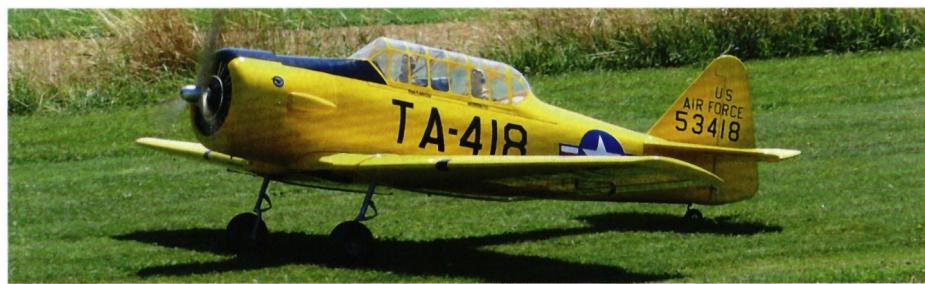
The AT-6 project has been a complete success for our president, Heinz. The enormous effort that went into building it was well worth it. This model isn’t just a showpiece on the ground—its fantastically beautiful flight performance is also a true delight for us spectators.
Bravo, Heinz! We’re proud of you!


News from HEBU

TEAM MANAGER "THIS" BOSSHARD
 Rodito Nussbaumer

YOU KNOW WHAT I MEAN? 125 YEARS OF THE SWISS AERO CLUB
 Emil Giezendanner

SUMMER FUN 2026 AT MG USTER
Martin Wunderli
F3A EUROPEAN CHAMPIONSHIPS IN ST-MACAIRE, FRANCE
 Matthias Bosshard

52. 2026 ALPS CUP
Emil Giezendanner
PRIDE AND GOOD IDEAS
 Markus Nussbaumer

ATOM, THE NEW DOUBLE-DECKER FROM CPLR
Matthias Bosshard
CORSAIR F4U – A WARBIRD WITH A MEMORABLE LOOK
Jürgen Rosenberger, Jürgen Prinz
TRY-OUT DAY AT MFV WETTINGEN
Urs Keller
TWIN TOWN PARTNERSHIP
Wolfgang Voeller
BY YOUTH, FOR YOUTH
Lorena Betschen
INSIGHTS INTO THE HISTORY OF SEAPLANES

SMALL, MODEL-LIKE SAILBOATS
Res Dauwalder
What's New at Leomotion.com

HORIZON HOBBY/LEMACO NEWS: MICRO OV-10 BRONCO 645 MM BY E-FLITE

COUPE DES ALPES – OBSERVE AND LEARN
Rodito Nussbaumer
EURO CONTEST GLIDER ACRO TOUR AUSTRIA 2026

34th HAHNENMOOS ALPINE MODEL AIRPLANE CAMP
Res Dauwalder
WELCOME, NEW MEMBER!
Andrea Bolliger
FREE FLIGHT IN THE MIDDLE OF SUMMER
Urs Muntwyler
THE PC-21 STORY
Emil Giezendanner
NEWS FROM HEBU
 Julia Bucher

FROM 0 TO 100
Markus Nussbaumer
MEMORIES
Wolfgang Völler
NOS REGION – A HUB FOR ELECTRIC AVIATION
Emil Giezendanner
Have you almost forgotten about aircraft that take off and land vertically?
Emil Giezendanner
DO YOU KNOW WHAT I MEAN IN THE LAND OF SMILES?
Emil Giezendanner