
Electric Flying for Everyone Chipmunk by Hirobo
Smaller Japanese electric model airplanes with modest power systems (6–7 cells; inexpensive motors with gearboxes) are beginning to capture the market overseas and in Europe—a market that German “gigantism” believed it could ignore. I recently demonstrated, based on my experience with the Hirobo Professor, that something is emerging here that will certainly help us spread understanding and interest in the cleanest propulsion system to every corner of our aviation community.
It’s not as if model manufacturers from the Far East simply had the development of usable electric model airplanes for the general public fall into their laps, so to speak. Kyosho’s early attempts with small aerobatic models weren’t very promising; in my opinion, the main problem was balancing the model’s size, wing loading, and powerplant.
EZ’s first attempts with the Elec 1800 also turned out to be more than amateurish, even though it’s still bought relatively often here. The fuselage was too flimsy, and the powertrain was unusable—the gearbox seems to have been taken from a good old Black Forest cuckoo clock, and the motor soon starts smoking—not because of nicotine addiction, but because of overload caused by the oversized propeller that came with it. The propeller was actually designed for firecracker-powered model planes and only partially meets the requirements of an electric drive. Propellers for smaller electric gliders, made to exemplary standards, are available from Graupner or Aeronaut, for example! The difference between developments in the Far East and here, however, is that over there they are less quick to give up and tend to proceed from small to large rather than the other way around.
However, we must not forget that our greatest electric flight pioneer, Fred Militky—as is so often the case, unrecognized in his own country—took precisely this path twenty years ago, the very path that the Japanese are now consistently pursuing.
Unfortunately, back then, the rapidly advancing electric flight elite refused to recognize that they were nothing more than a handful of isolated specialists who, in the long run, have no future without the simultaneous development of a sustainable foundation for electric flight.
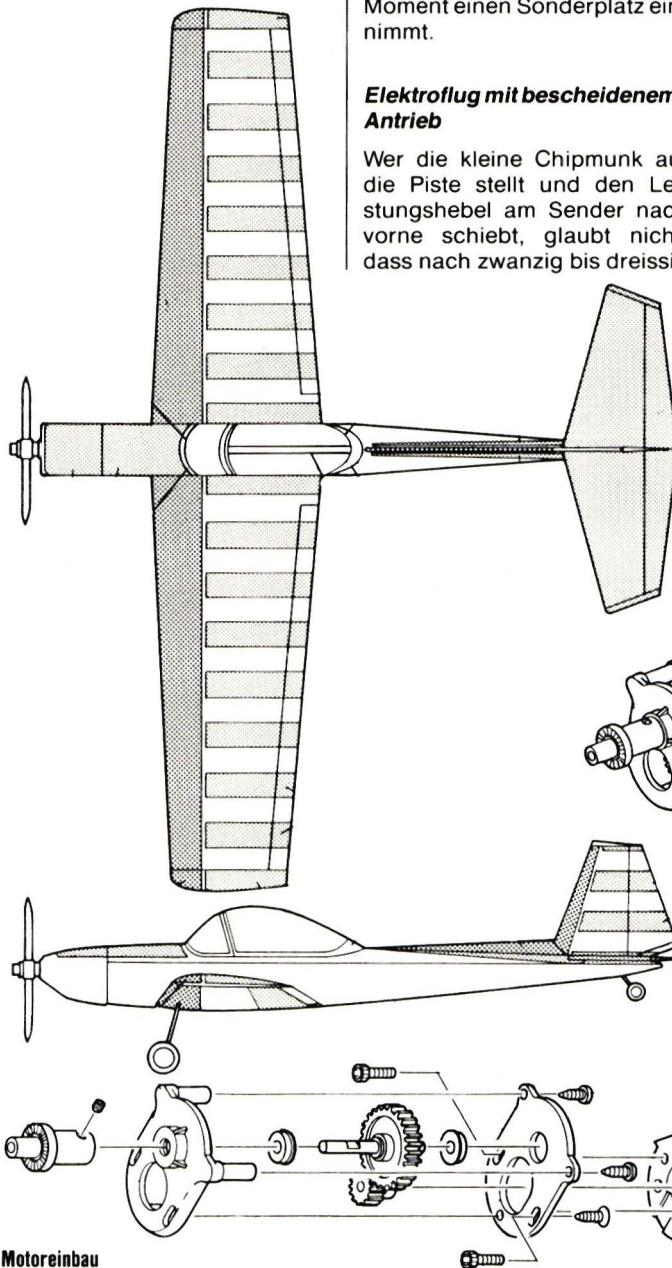
What at first glance seems almost implausible turns out to be a relatively small (130 cm wingspan) but thoroughly successful design for an electric aerobatic aircraft that closely resembles the original. The level of pre-assembly—the wing halves must be joined, adhesive films and the cockpit must be attached, and the RC system and powerplant must be installed—is surprising. The wing is constructed using a wooden rib structure covered with foam, and the fuselage—just like on the Profes-
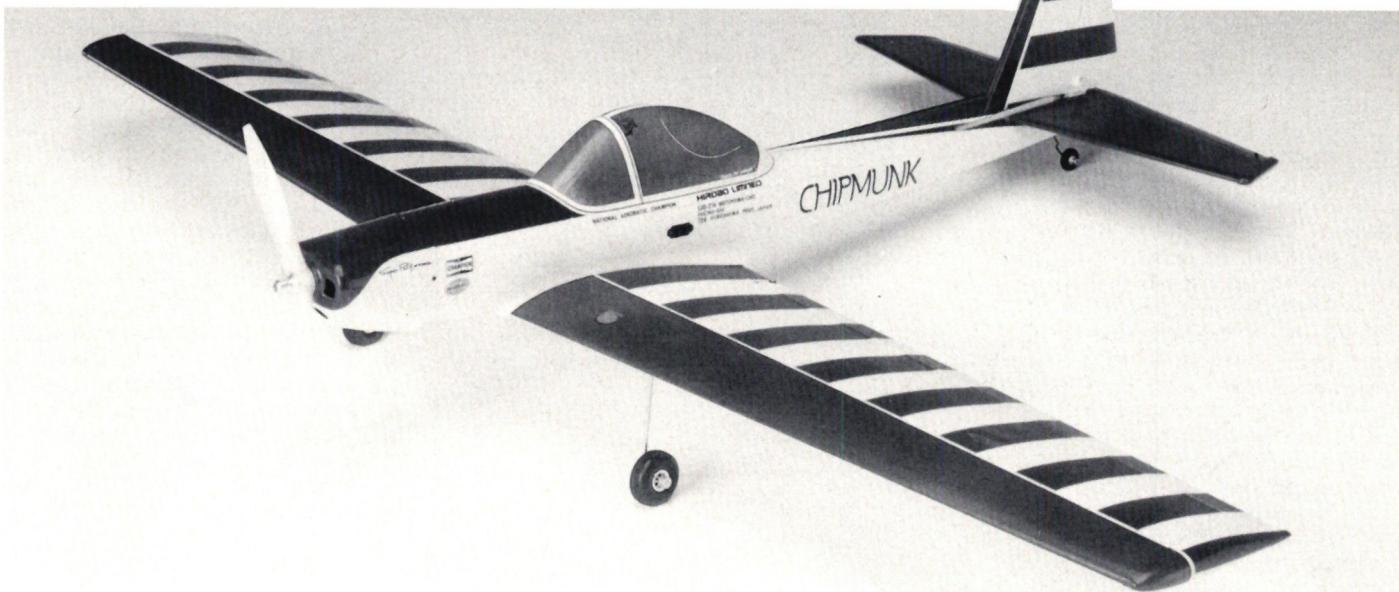
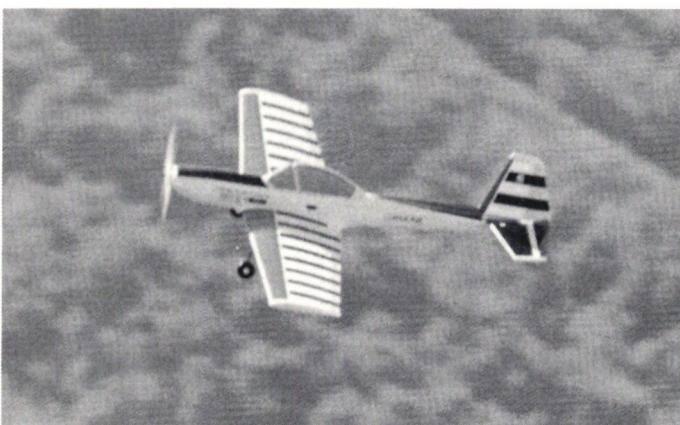
Chipmunk by Hirobo, a small electric model for 6–7 cells
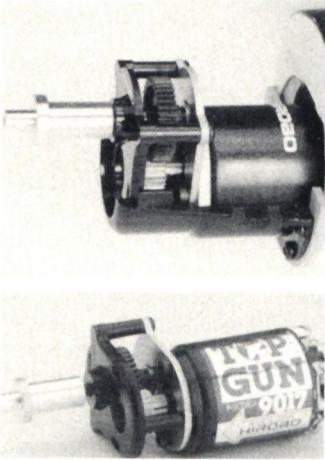
sor—a thin plastic material, like the kind used for packaging (which is why it’s also called the “yogurt cup class”!)—reinforced with wood. The clear canopy was supposed to be glued over the deep-drawn fuselage extension, which didn’t sit well with me. So I reached for an eco-friendly spray can and—after covering the cockpit frames with masking tape—applied a bit of blue paint to make my little Chipmunk look more like the original. I also had trouble getting the paint films to go on without wrinkles; in fact, I only partially succeeded.
Installing the RC system was no trouble at all, once I’d decided to recess the receiver into the large cockpit. Here, too, the motor—which comes with the gearbox already mounted—is strapped onto the plastic mount already attached to the fuselage. To regulate the speed, I use the small 30-A speed controller from Sommerauer—long live local craftsmanship! I was a bit concerned that my small JR servo couldn’t provide as much aileron travel as I’d envisioned for a proper roll. I’ll have to go back to the drawing board on that.
As with the Professor’s model, the landing gear mounting turned out to be a bit flimsy—after a few landings on the grass, the whole thing gets mushy.
One long evening, I couldn’t get my Chipmunk to fly, though I’m no speed demon. For me, models like this—free from the stress of competition—are purely for enjoyment anyway. Sure, there are faster model builders; but
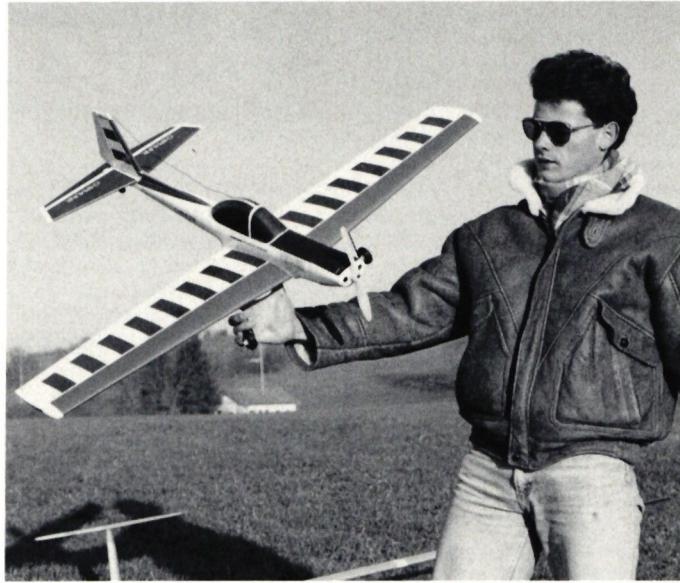
even those that take nights on end to attach rivets. These models are compatible with all approaches. For me, as someone who isn’t a scale modeler, the finished Chipmunk is a little gem and showpiece that currently holds a special place in our home.
Anyone who sets the little Chipmunk on the runway and pushes the throttle lever on the transmitter forward wouldn’t believe that, after twenty to thirty meters of takeoff run, you can pull it a little harder and the model will still lift off. At any rate, at our field, everyone watched the little hopper with some disbelief as it purred back across the field after a delicately executed turn. Sure enough, it flies! However, my six ancient Sanyo cells didn’t give the model any mind-blowing speed. Things look much better with seven cells. With those, you can easily fly rolls and loops. What I also want to try is equipping it with 7–8 900-mAh cells. The small motor is quite well matched to the propeller and airspeed via the gearbox. The little motor doesn’t get excessively hot, and the flight times of six to seven minutes are impressive (tests with 1,700-mAh cells are still to come).
After a takeoff roll of three to four meters on the runway, the model lifts its tail and can then be controlled with ease. The gearbox gives the model a balanced flight speed and thus smooth handling. However, don’t expect the speed to increase dramatically during low-altitude flybys, as it would with a Schnuppi or other small speedsters. The whole experience remains relaxed, and the motor’s RPM barely increases noticeably—exactly how I imagine the difference between an aerobatic plane and a racer. I’m now looking forward to Hirobo’s next release. Greetings from the Joghurtbächerli Club.
Emil Giezendanner


News from HEBU

TEAM MANAGER "THIS" BOSSHARD
 Rodito Nussbaumer

YOU KNOW WHAT I MEAN? 125 YEARS OF THE SWISS AERO CLUB
 Emil Giezendanner

F3A EUROPEAN CHAMPIONSHIPS IN ST-MACAIRE, FRANCE
 Matthias Bosshard

52. 2026 ALPS CUP
Emil Giezendanner
PRIDE AND GOOD IDEAS
 Markus Nussbaumer

ATOM, THE NEW DOUBLE-DECKER FROM CPLR
Matthias Bosshard
CORSAIR F4U – A WARBIRD WITH A MEMORABLE LOOK
Jürgen Rosenberger, Jürgen Prinz
SUMMER FUN 2026 AT MG USTER
Martin Wunderli
TRY-OUT DAY AT MFV WETTINGEN
Urs Keller
TWIN TOWN PARTNERSHIP
Wolfgang Voeller
BY YOUTH, FOR YOUTH
Lorena Betschen
SMALL, MODEL-LIKE SAILBOATS
Res Dauwalder
What's New at Leomotion.com

HORIZON HOBBY/LEMACO NEWS: MICRO OV-10 BRONCO 645 MM BY E-FLITE

COUPE DES ALPES – OBSERVE AND LEARN
Rodito Nussbaumer
EURO CONTEST GLIDER ACRO TOUR AUSTRIA 2026

INSIGHTS INTO THE HISTORY OF SEAPLANES

34th HAHNENMOOS ALPINE MODEL AIRPLANE CAMP
Res Dauwalder
WELCOME, NEW MEMBER!
Andrea Bolliger
FREE FLIGHT IN THE MIDDLE OF SUMMER
Urs Muntwyler
THE PC-21 STORY
Emil Giezendanner
NEWS FROM HEBU
 Julia Bucher

FROM 0 TO 100
Markus Nussbaumer
MEMORIES
Wolfgang Völler
NOS REGION – A HUB FOR ELECTRIC AVIATION
Emil Giezendanner
Have you almost forgotten about aircraft that take off and land vertically?
Emil Giezendanner
DO YOU KNOW WHAT I MEAN IN THE LAND OF SMILES?
Emil Giezendanner