
Electric Propulsion Better Meets the Regulations
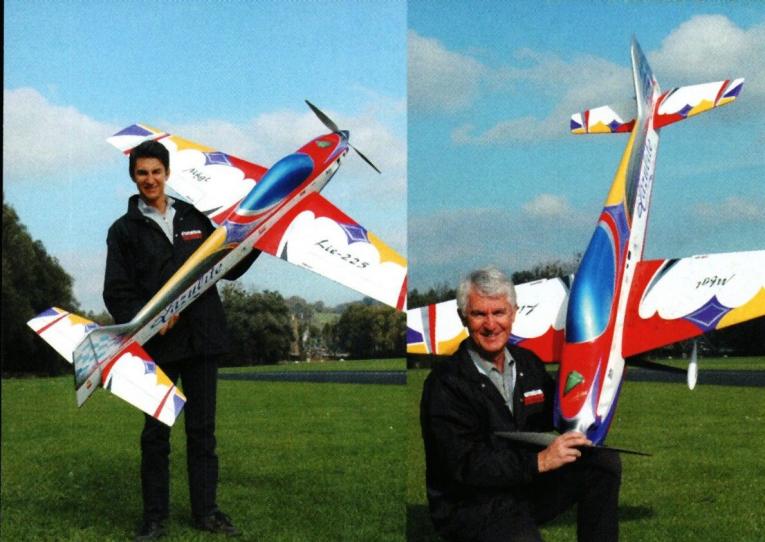
At the recent European Motor Aerobatics Championships (F3A) in Portugal, Roland Matt won the title and Wolfgang Matt took the bronze medal. In an interview with the “mfs” editor, they specifically pointed out that electric propulsion allowed them to better meet the requirements of the F3A regulations than conventional internal combustion engines.
No one in the community—Wolfgang and Roland Matt probably least of all—expected the Liechtenstein F3A team’s tremendous success. To once again clearly put Germany—the European powerhouse of model aviation—in its place and, moreover, to dethrone the long-standing world and European champion came as a surprise to experts. Anyone who wants to beat a multiple world and European champion of the caliber of Christoph Paysan (F) clearly has to fly better. There’s no question about that, even though the 2004 European Championships were expected to be a neck-and-neck race and the better semifinal result—as stipulated by the rules—ultimately decided the top two spots; after all, in the final, both Christoph and Roland scored 2,000 points each. There’s no such thing as “being in the zone” in this context, Wolfgang noted that the European and World Championships in the aerobatics category are essentially marathon events with no fewer than 10 flights to complete, meaning that the finalists spend a total of more than an hour in the air—which should actually be sufficient to determine the champion. Roland won six rounds, and Christoph won four. In addition to the vast potential for expertise and the excellent training conditions—which, of course, must be put to good use—technology and the equipment used play a very decisive role.
Wolfgang and Roland are convinced that the electric motor’s greatest advantages lie in its extremely fine control capabilities, which in turn affect the precision of the flight maneuvers. Having exactly the right amount of RPM or
power at the propeller in every situation—just as much as is needed at that moment—allows for an even more refined and harmonious flying style. In addition, the relatively large propellers (20 to 22 inches in diameter) that are compatible with the gearmotor slow the aircraft down during descent maneuvers, thereby enabling a consistent airspeed during both ascending and descending maneuvers. Propulsion systems with smaller, higher-RPM propellers are therefore not very advantageous in this regard. In conclusion, it can be stated that electric propulsion allows for significantly better utilization of the F3A rules. Generally speaking, as Wolfgang and Roland explained, they flew somewhat slower and closer to the ground. Not extremely so—about 120 to 150 m. This, of course, immediately places higher demands on precision, since even the slightest correction becomes visible at this close range. The level of difficulty also increases considerably with this flying style.
The fast-paced schedule between the European and World Championships leaves no room for lengthy experiments. Often, less than a year separates the two title competitions. Although the Matts lacked experience with electric powertrains, they quickly recognized the major advantages of the electric motor for aerobatics at the 2003 World Championships in Poland, where the American Shulman finished in 7th place powered by a Hacker drive system. A detailed analysis of the American’s flights led to a quick decision in favor of electric propulsion and also to a close collaboration with Hacker Motor GmbH in Niederhummel (Germany). Decisions like these are often a balancing act. It’s hardly possible to make them without taking a bit of a gamble. On the other hand, as the saying goes, nothing ventured, nothing gained. Success has proven the two athletes right: Today, they can look back on a smooth preparation and training phase without any technical glitches. Everything also went perfectly at the European Championships themselves, despite strong winds at the start, dust, and temperatures as high as 34 degrees. The F3A model they used, the “Lazulite,” is based on the internal combustion engine version with minor modifications. I wish them both continued good luck, success, and personal fulfillment.
*E. Giezendanner*
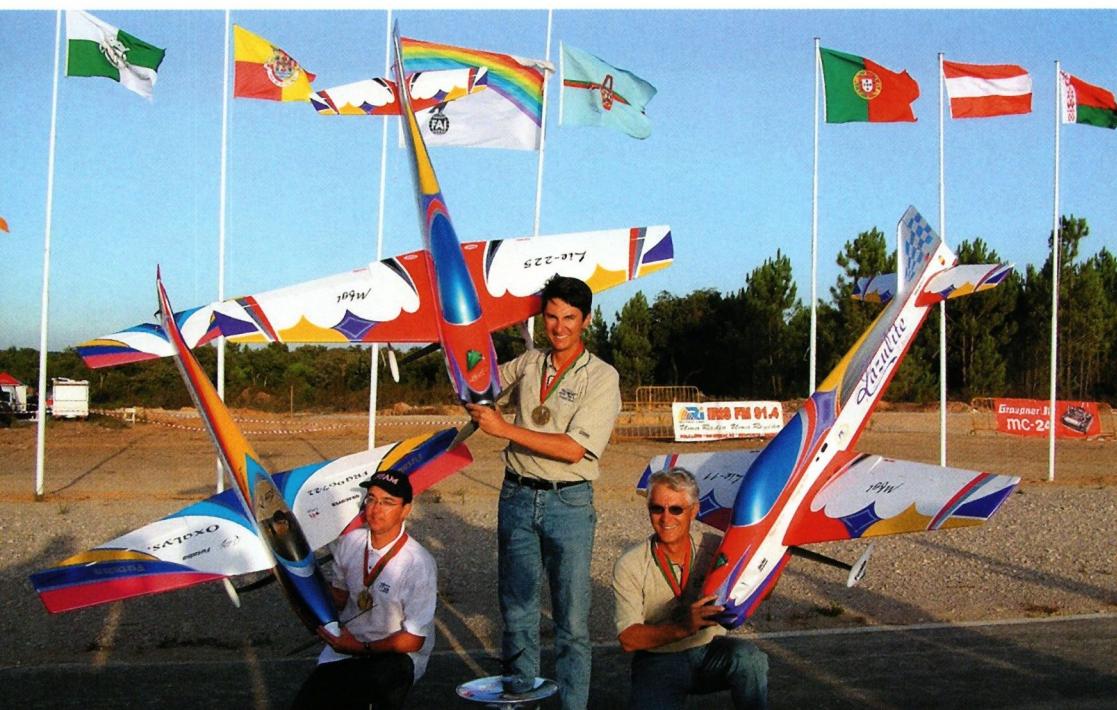
| Wingspan: | 1,890 mm |
| Symmetrical profile: | “Matte” |
| Weight: | 4,950 g |
| Motor: | Hacker C50 XL /13W |
| Battery: | Thunder Power 6,000 mAh |

EURO CONTEST GLIDER ACRO TOUR AUSTRIA 2026

THE PC-21 STORY
 Emil Giezendanner

TWIN TOWN PARTNERSHIP
 Wolfgang Voeller

SUMMER FUN 2026 AT MG USTER
Martin Wunderli
CORSAIR F4U – A WARBIRD WITH A MEMORABLE LOOK
Jürgen Rosenberger, Jürgen Prinz
52. 2026 ALPS CUP
Emil Giezendanner
YOU KNOW WHAT I MEAN? 125 YEARS OF THE SWISS AERO CLUB
Emil Giezendanner
News from HEBU

TEAM MANAGER "THIS" BOSSHARD
Rodito Nussbaumer
ATOM, THE NEW DOUBLE-DECKER FROM CPLR
 Matthias Bosshard

F3A EUROPEAN CHAMPIONSHIPS IN ST-MACAIRE, FRANCE
Matthias Bosshard
INSIGHTS INTO THE HISTORY OF SEAPLANES

WELCOME, NEW MEMBER!
Andrea Bolliger
What's New at Leomotion.com

PRIDE AND GOOD IDEAS
 Markus Nussbaumer

SMALL, MODEL-LIKE SAILBOATS
Res Dauwalder
FREE FLIGHT IN THE MIDDLE OF SUMMER
Urs Muntwyler
BY YOUTH, FOR YOUTH
Lorena Betschen
HORIZON HOBBY/LEMACO NEWS: MICRO OV-10 BRONCO 645 MM BY E-FLITE

COUPE DES ALPES – OBSERVE AND LEARN
Rodito Nussbaumer
34th HAHNENMOOS ALPINE MODEL AIRPLANE CAMP
Res Dauwalder
TRY-OUT DAY AT MFV WETTINGEN
 Urs Keller

NEWS FROM HEBU
 Julia Bucher

NOS REGION – A HUB FOR ELECTRIC AVIATION
Emil Giezendanner
MEMORIES
 Wolfgang Völler

70 YEARS OF THE NIDWALDEN MODEL AIRPLANE CLUB
Martin Barmettler
A SPECTACULAR F3A WORLD CUP IN THE PRINCIPALITY OF LIECHTENSTEIN
Emil Giezendanner
FROM 0 TO 100
Markus Nussbaumer