
Boeing 747-400 – the most aesthetically pleasing airplane in the world
Arnold Meier, a model airplane enthusiast from Bassersdorf, used to stand on the spectator terrace at Kloten Airport or at the end of the runway 40 years ago, admiring the planes taking off and landing. He was particularly taken with the jumbo jet, which he calls the “king of the skies.” In 1997, he decided to build a flyable model of this aircraft.

Arnold Meier—or Noldi, as he’s known among model airplane enthusiasts—didn’t learn to fly model airplanes until he was 60. Fortunately, older folks are constantly taking up model flying. The motto is “Better late than never”! Noldi didn’t leave anything to chance and acquired the necessary skills at a model flying school. Joining the Bassersdorf Model Flying Club then helped him put what he’d learned into practice and perfect his skills. As we all know, sharing experiences and successful flights under a wide variety of conditions are the most important ways to do this. Dear seniors, keep this in mind and tell your friends of the same age, “You, too, can learn to fly model airplanes—Noldi has proven it.”
Building larger model airplanes presents designers with very specific challenges. In addition to structural integrity, control surface mountings, and linkages, transportation and—last but not least—suitable airfields are important issues that must be addressed. This is something I’ve noticed with
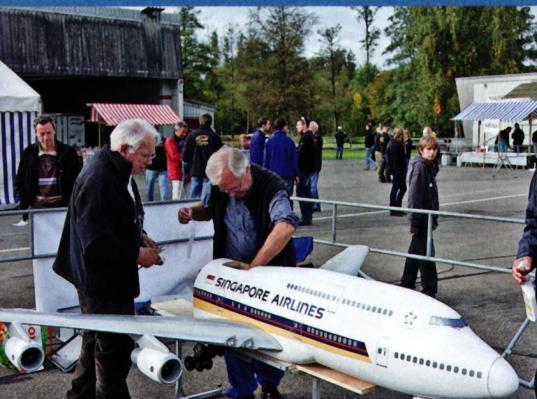
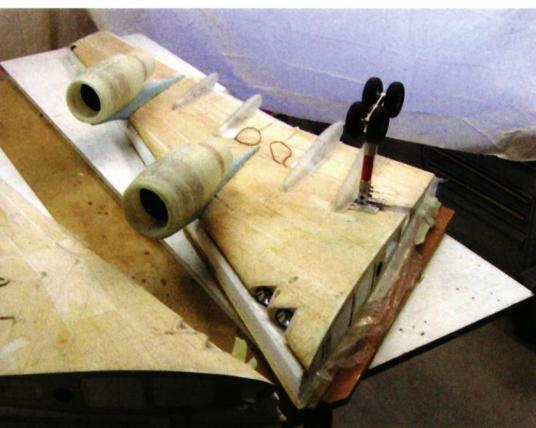
This reminded me of that old anecdote about a colleague who, after successfully building his airplane in his living room, realized that he couldn’t get it outside—neither through the door nor through the window... Motorized models equipped with landing gear require a host of additional and crucial design solutions, which often do not lead to success on the first try. All of this was part of Noldi’s design work. Based on transportation constraints, he opted for a 1:20 scale model, which meant a two-piece fuselage and similarly split wings. Noldi cites the main landing gear as arguably the most difficult hurdle. Arnold Meier, a trained precision mechanic and entrepreneur in the machine tool industry, also solved this problem with ease. With a flight weight of around 25 kg, the landing gear withstood touchdown on grass flawlessly.
Anyone working on longer-term model airplane building projects would do well to take on smaller, yet challenging projects from time to time. They free the heart, mind, and hands—as Pestalozzi would say—and expand one’s pool of experience. Some work that we believe has reached a dead end can suddenly receive new and promising insights when we engage in completely different areas. Arnold Meier, our “Jumbo builder,” also took advantage of this phenomenon by building a Learjet and a PC-21 in parallel with his Boeing 747-400. While building and flying the Learjet, his work with electric turbines (or impellers) in particular provided him with valuable foundational knowledge—for example, regarding the design of the engine nacelles.
When the project began in 1997, electric turbine propulsion was still largely in its infancy. The batteries commonly used at the time were nickel-metal hydride (NiMH) cells. To power his jumbo jet, Noldi would have had to pack more than 8 kg of them into the model. Today, the battery weight with LiPo cells is still around 3 kg. The efficiency of commercially available electric turbines has also been continuously improved since then. Numerous Swiss electric jet pioneers, such as Ueli Amacher, Hans Bühr, Benedikt von Arx, and others, have also made significant contributions to these major advances. Noldi has further optimized the engines through a large number of tests, modifications, and measurements, achieving astonishing thrust values in the process.
A friend visited my workshop at Christmas: “These parts (of an airplane under construction) look familiar to me. I already saw these last Christmas...” Everyone hears comments like these—and even far more cynical ones—not just from the “foam crowd”—when working on long-term projects. For this reason alone, the model builder’s proof of success is the flight itself, even if it lasts only a fraction of a second—just long enough for a photo. However, this is merely a minor side note. The flight is the most important thing because it represents both the crowning achievement and the culmination of a long and certainly not always enjoyable project. The great satisfaction that comes with it lies not only in the certainty that the measurement results and calculations are correct, but above all in the indescribable feeling of having successfully realized a long-held dream through one’s own efforts. On September 28, 2010, the moment had finally arrived for Noldi. As part of the rollout at the MG Bassersdorf airfield, he conducted an initial test to verify the center of gravity and thrust, during which the aircraft briefly lifted off by one meter. The actual maiden flight followed a day later with experienced jet pilot Julius Jezerniczky at the controls (see box). After both flights at the MG Bassersdorf airfield went off without a hitch, the Boeing 747-400 was definitively crowned the “Queen of the Skies” during the 2010 Hausen Air Show. I can only congratulate the builder and all his helpers and wish them many more exciting flights.
More info: www.mg-bassersdorf.ch
Although I’d had the chance to admire Arnold Meier’s Jumbo time and again over the past few years at air shows and exhibitions in the “static display,” I was still very surprised when Noldi called me at the end of September and desperately asked me to fly the plane in as soon as possible. Noldi was under a lot of stress because he had registered the Jumbo for the flight festival in Hausen am Albis and also wanted someone to fly his masterpiece there.
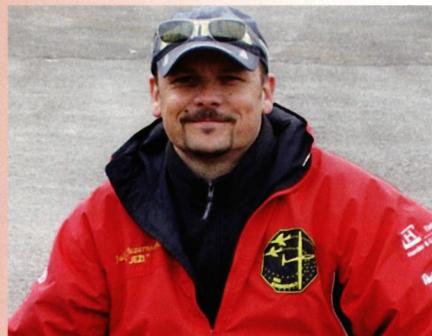
My initial reaction wasn’t very encouraging for Noldi. Given the many years and the considerable costs he had invested in this project, I wasn’t exactly eager—and I don’t think anyone else in the scene was either—to take on that responsibility! Nevertheless, I promised to stop by and see him. A few days later, I was standing in his workshop. Noldi explained all the technical details of the machine to me. We talked at length and ran functional tests. When he let me look through the thick folder of technical documents, it became clear to me that Noldi had planned, calculated, and built everything very meticulously. In the meantime, my club colleague, assistant, first officer, and Power Chief Executive (battery chief) Eugen Bohnenblust had also arrived. I really started to ponder things, and when I looked into the hopeful eyes of the two gentlemen, we set off—without the Jumbo—for the nearby Gerstenacher airfield, home of the MG Bassersdorf. I had flown there a few times before with my jets during the Bassersdorf Air Show and was somewhat familiar with the layout of the airfield. However, my jets are a bit more maneuverable and smaller. So it turned out that I ended up making three familiarization flights with my Wild Hornet that afternoon. Afterward, the two of them looked at me expectantly, and when I confirmed that I’d be flying the Jumbo on its maiden flight the next day, Noldi beamed like a Christmas star!
My arrival the next morning was eagerly anticipated, and I couldn’t help but chuckle a little when I found nearly half the club on the airfield! We performed extensive checks once again, and when the A-380 in the same livery flew past us from Kloten, I knew there was no turning back! I opened the throttle—but the plane wouldn’t really pick up speed, and I had to abort the takeoff just before the end of the runway. We jacked the plane up again, and lo and behold, a bolt near the wheel had come loose and was jamming two of the main landing gear rims. On the second attempt, everything went smoothly: the plane first lifted its nose slowly, and after a few more meters, the main landing gear also lifted off, and the plane flew as if it had wanted to do this much earlier! We first climbed to a safe altitude, and I quickly noticed that the controls felt relatively sluggish. Since there was forest all around, I had to fly with a very wide radius and anticipate my moves. It was also a bit unusual for me that I’ve always been a handheld transmitter pilot, while Noldi flies with a console transmitter.
I flew a few figure-eights with the Jumbo and, for safety reasons, kept the throttle well back. Since we had to start thinking about landing after about three minutes, I left the landing gear down for the maiden flight. After a low flyover at reduced throttle, I set the Jumbo down gently on the ground on my second attempt with the flaps half extended. Of course, we were all very relieved that everything went so well and without a hitch. So we decided to recharge all the batteries right away and send the plane up into the air a second time. This flight also went smoothly, and I subsequently felt confident enough to test-fly Noldi’s Jumbo in Hausen as well, where the airspace and runway conditions are much better.
In conclusion, I can only say that I take my hat off to Noldi’s model-building prowess! The Jumbo flies beautifully and has a breathtaking flight profile that’s almost indistinguishable from the original! In the coming weeks, we’ll conduct further tests on its low-speed flight characteristics. After all, Noldi will soon be flying his life’s work himself...


News from HEBU

HORIZON HOBBY/LEMACO NEWS: MICRO OV-10 BRONCO 645 MM BY E-FLITE

PRIDE AND GOOD IDEAS
 Markus Nussbaumer

TEAM MANAGER "THIS" BOSSHARD
 Rodito Nussbaumer

YOU KNOW WHAT I MEAN? 125 YEARS OF THE SWISS AERO CLUB
 Emil Giezendanner

TRY-OUT DAY AT MFV WETTINGEN
Urs Keller
F3A EUROPEAN CHAMPIONSHIPS IN ST-MACAIRE, FRANCE
 Matthias Bosshard

ATOM, THE NEW DOUBLE-DECKER FROM CPLR
Matthias Bosshard
SUMMER FUN 2026 AT MG USTER
Martin Wunderli
What's New at Leomotion.com

52. 2026 ALPS CUP
Emil Giezendanner
TWIN TOWN PARTNERSHIP
Wolfgang Voeller
34th HAHNENMOOS ALPINE MODEL AIRPLANE CAMP
Res Dauwalder
CORSAIR F4U – A WARBIRD WITH A MEMORABLE LOOK
Jürgen Rosenberger, Jürgen Prinz
SMALL, MODEL-LIKE SAILBOATS
Res Dauwalder
WELCOME, NEW MEMBER!
Andrea Bolliger
FREE FLIGHT IN THE MIDDLE OF SUMMER
Urs Muntwyler
COUPE DES ALPES – OBSERVE AND LEARN
Rodito Nussbaumer
EURO CONTEST GLIDER ACRO TOUR AUSTRIA 2026

BY YOUTH, FOR YOUTH
Lorena Betschen
INSIGHTS INTO THE HISTORY OF SEAPLANES

THE PC-21 STORY
Emil Giezendanner
NEWS FROM HEBU
 Julia Bucher

FROM 0 TO 100
Markus Nussbaumer
MEMORIES
Wolfgang Völler
NOS REGION – A HUB FOR ELECTRIC AVIATION
Emil Giezendanner
DO YOU KNOW WHAT I MEAN IN THE LAND OF SMILES?
Emil Giezendanner
Have you almost forgotten about aircraft that take off and land vertically?
Emil Giezendanner