
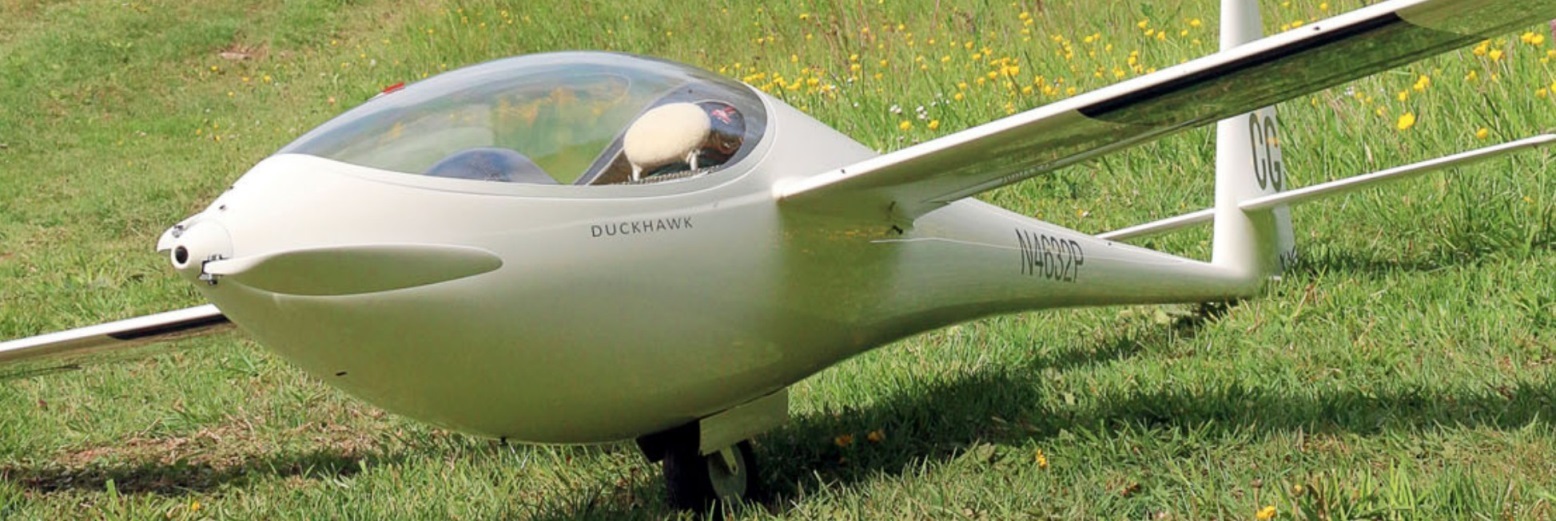
Duckhawk
Duckhawk
For decades, highly capable gliders have been developed in Germany and produced in large numbers using composite construction methods. But in other countries as well, ingenious minds have designed gliders that are at least equally capable. Since they remained one-of-a-kind or were produced in only a few units, they received little attention in the gliding community. One such “exotic” glider is the DuckHawk, developed in the United States. Two models of this “peregrine falcon” are in flight in Switzerland.
Windward Performance Ltd, based at the Bend Municipal Airport in the state of Oregon, has been dedicated for years to the design and construction of highly unconventional gliders. For example, the company played a key role in the construction of the Perlan 2 glider, which is equipped with a pressurized cabin for two pilots and has already reached a record altitude of 23,000 meters above sea level in wave soaring.
Another highly interesting design from this company is the single-seat racing glider DuckHawk, which, according to the manufacturer, is the fastest glider in the world. It consists almost entirely of carbon-fiber prepreg components, which were “cured” in an autoclave under high pressure using negative molds. As of 2016, only four examples of this 15-meter glider had been built. The most powerful version, the DuckHawk VNX, weighs just 208 kg empty and is designed for a top speed of 416 km/h and accelerations of +11/-9 g. The retractable landing gear and the full-span flaperons—which function as ailerons and flaps—are electrically powered. Designer Greg Cole wanted to create a high-strength glider with the DuckHawk that would be suitable for long, fast cross-country flights in dynamic gliding. It is not known whether this flight technique—by which albatrosses cover long distances over the open sea without a single wingbeat—has ever been practiced with a DuckHawk. In any case, it cannot have been a leisurely glide, as the pilot would be subjected to constantly recurring accelerations of 3 to 3.5 g along the undulating flight path.
Just one month after its maiden flight, the DuckHawk prototype demonstrated its high-speed flight capabilities at the American Open Class Nationals in June 2012, when it staged a breathtaking comeback during the final approach to Minden Airport. As an Arcus two-seater piloted by Richard Walters tackled the final nine miles at high speed, the DuckHawk—with National Champion Chip Garner in the cockpit—was still a good mile behind. A comfortable lead for the Arcus, one might think. But then Chip Garner set the flaps to the negative position, applied full throttle, and achieved the seemingly impossible. Right at the runway threshold, the DuckHawk caught up to the Arcus, even though both gliders had followed the same glide path and, as a result, had encountered virtually identical up- and down-draft conditions. To catch up to the Arcus, the DuckHawk had to fly 15 to 20 knots faster without losing any more altitude than its competitor.
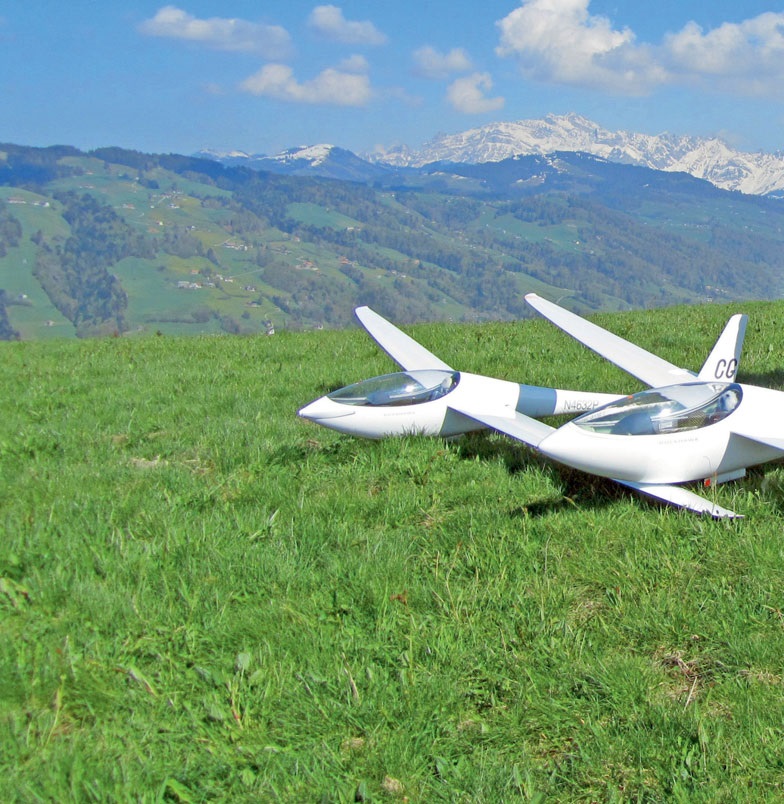
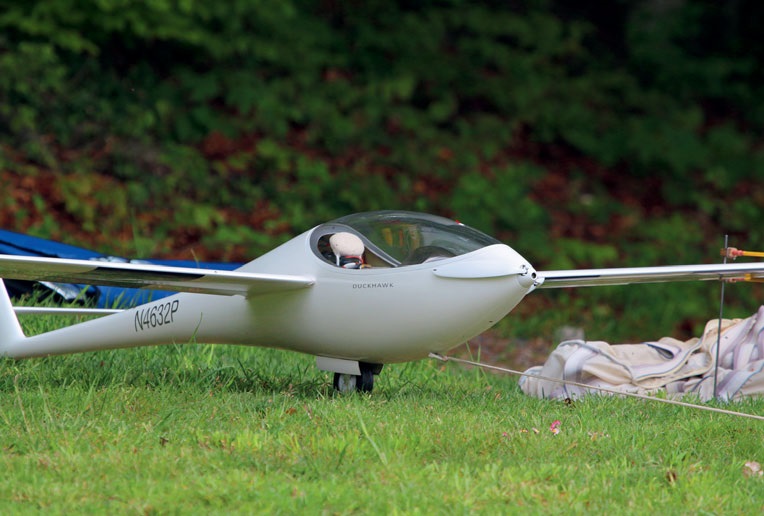
As a well-coordinated team, Richi Oberholzer and I have already built several gliders together that, to the best of our knowledge, had never before been flown as scale models—including the Diana 1, Diana 2, SB 14, and Jonker JS 1. Flying these 1:3.5-scale models is always a blast, though the significant effort that went into building them means they sustain damage with every flight. But eventually, the time comes again for something new. When we came across the DuckHawk—which was unknown to us until then—in the fall of 2014, we were immediately hooked. This unconventionally shaped American peregrine falcon (or duck hawk, as it’s also known in its home country) was to become our next winter project. Its cockpit is strikingly spacious compared to the rear fuselage, tail unit, and wings, which is why even an American well-fed on Budweiser and hot dogs can fit inside with ease. The cruciform tail unit with a high-mounted horizontal stabilizer, the tapered vertical stabilizer with strong sweepback, the elliptical wing planform, and the absence of winglets are a number of other features that give the glider a striking and unique appearance with high recognition value.
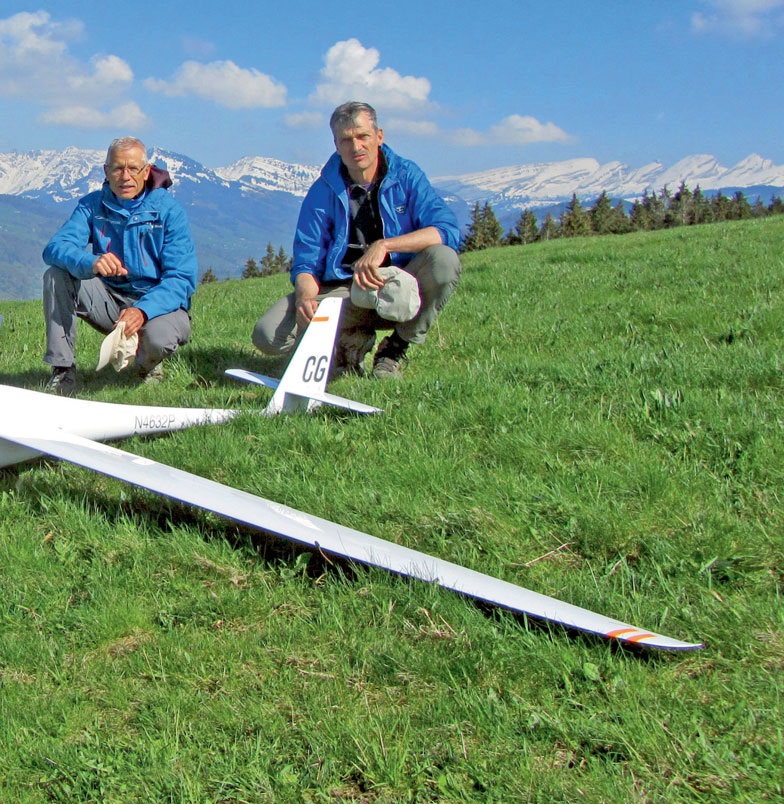
In designing the 1:3.5 scale model, we were able to draw heavily on our experience. Since the high-aspect-ratio elliptical wing planform is very similar to that of the tried-and-true Diana 2, no aerodynamic or structural problems were anticipated. The wing depth was increased slightly to achieve a reasonable wing loading and better airfoil performance. The surfaces of the horizontal and vertical stabilizers, on the other hand, had to be enlarged by about ten percent to ensure sufficient flight stability. For the airfoil, we relied on our GS1 airfoil, which had proven itself on the Diana 2 and other models. Since our DuckHawk, like its prototype, was intended to be a racing aircraft, we kept the airfoil thickness as minimal as possible. With 10% at the root and tapering down to 7% at the wingtip, the resulting airfoil height allowed for a main spar with a reasonable carbon fiber content and just enough space to accommodate three 8- and 10-mm wing servos within the profile contour. As for the flaps, we did not stick to the original design. We omitted the spoilers on the upper surface and divided the flaperons into two flaps per wing on one model and three flaps per wing on the other.
Once again, Richi built a flawless hull mold in no time. It required a great deal of artistic intuition, since we only had a small three-view drawing and a few photos to work with. Together, we laminated the fuselage mold—as always, a grueling process. But in the end, it’s the result that counts. Richi produced the fuselages in record time.
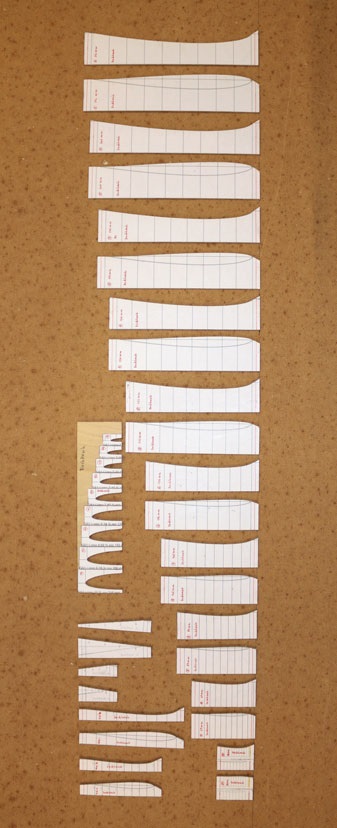
I took care of the detailed design of the wings and tail surfaces. The wings were built using the tried-and-true sandwich construction method described many times before (MFS 2/2010). Since the elliptical plan view had to be adhered to as closely as possible, cutting the Styrofoam cores proved to be a bit more labor-intensive than usual. Each wing is composed of nine wing trapezoids. Consequently, 20 cutting templates (one each for the upper and lower surfaces) were required, which I produced the old-fashioned way using analog techniques with an electric scroll saw. A substantial amount of carbon fiber is housed beneath the 0.6-mm abachi skin. A 90 g/m² biaxial fabric, laminated at an angle of +/-45°, encases the D-box and all wing flaps. The spar core, made of Rohacell 51, is encased in a braided sleeve with varying wall thicknesses. The main spar straps—comprising 26 rovings (24 K) at the wing root and one roving at the wing tip—are dimensioned to safely withstand bending loads in flight while still allowing for a smooth deflection. The wings were finished with 49 g/m² fiberglass fabric, also applied diagonally, and a two-component PU-based primer. Once again, Andi Schwerzmann gave the models a masterfully applied, lightweight two-component spray paint finish, which was polished to a high gloss in just a few hours. Ready for flight, a single wing weighs only 928 grams.
| Wingspan: | 428 mm |
| Fuselage length: | 181 mm |
| Wing area: | 69.1 dm² |
| Weight: | 5,750 g |
| Wing loading: | 83 g/dm² |
| Profile: | GS 1 10% → 7% |
| Motor: | Leomotion 3031-2400 with gearbox |
| Propeller: | RF 17×10 |
| Battery: | 6S1P 3.7 Ah |
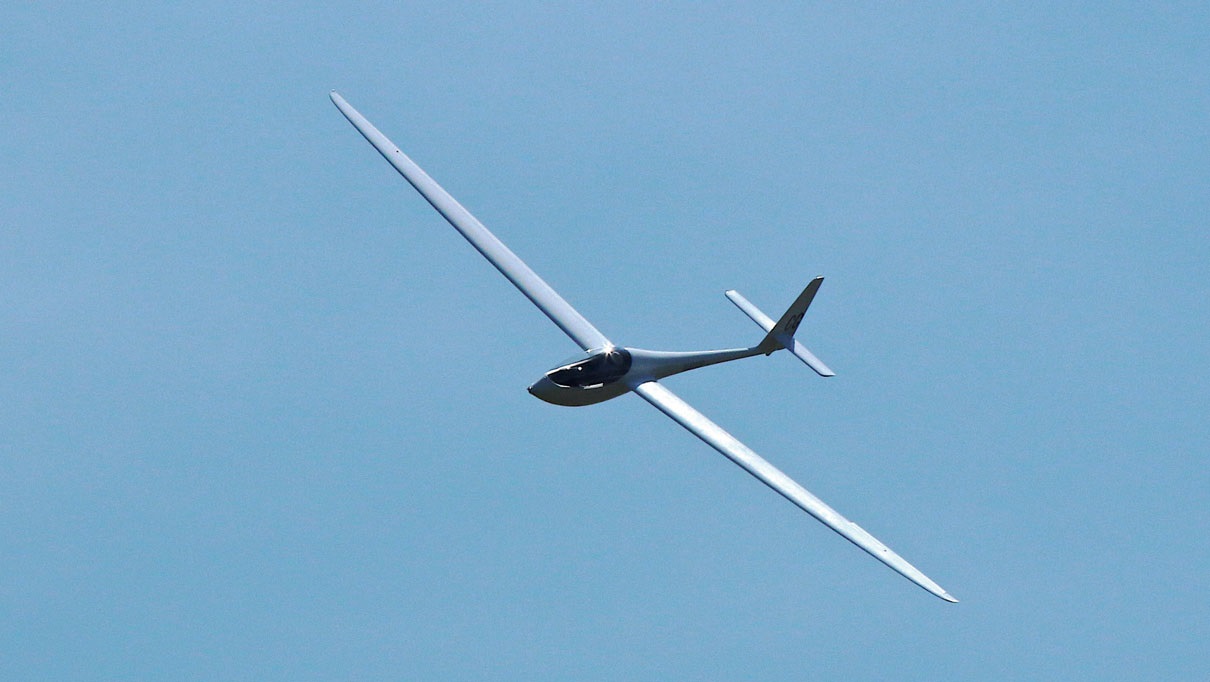
As early as May 2015, my DuckHawk was ready to take its maiden flight. The center of gravity and EWD were spot-on from the start. I immediately felt at home with the plane. It masters the entire range of flight, from lamb-like slow flying to falcon-like fast flying, and—as the only large glider in my collection—it also performs a perfect spin.
Evidently, the model’s lively flight characteristics are very similar to those of the original. Therefore, here is a summary of the impressions reported by pilot Daniel Sazhin after an extended cross-country flight with the DuckHawk covering over 400 km in the vicinity of Blairstone Airport, New Jersey: “The glider does absolutely everything the pilot wants it to. There’s no struggle with the aircraft. The handling at all speeds is excellent. The glider responds well to thermals with positive flaps and can be flown very slowly at 40 knots (74 km/h). If the flaps are set to a negative position using the switch mounted on the control stick, the aircraft immediately accelerates to 160 knots (about 300 km/h), whereupon it shoots into the sky like a rocket.” Daniel Sazhin was amazed at how the computer-assisted electric control system continuously and automatically adjusted the position of the flaps to optimally suit the conditions. He concluded his report with the following remark: “Flying the DuckHawk was an absolute delight, and it would be an honor for me to fly it again.”
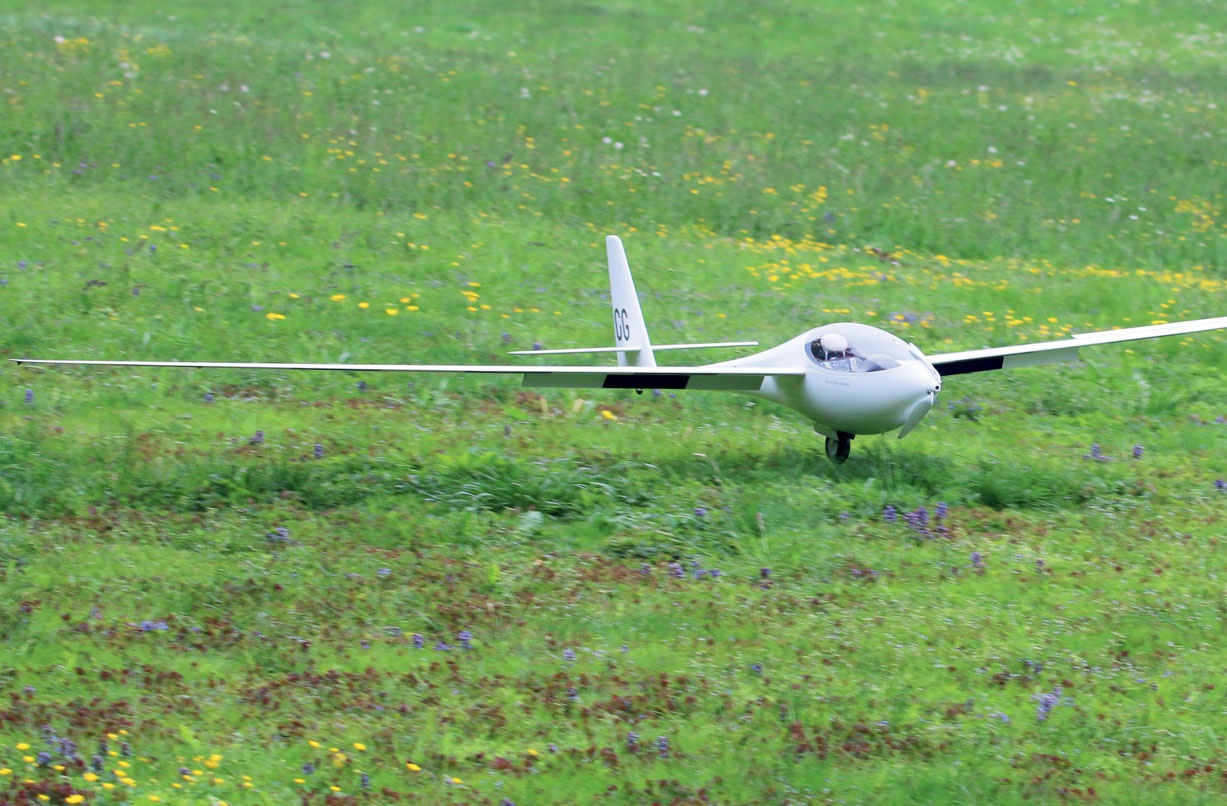
In early June 2015, I sent a brief email to Windward Performance Ltd. about our replica of the DuckHawk, raved about its excellent flight characteristics, and attached a few photos. I received a reply that very same day. They were thrilled and asked for technical details. It turned out that the chief designer, Greg Cole, also flies model airplanes. He was visibly disappointed that he couldn’t purchase a DuckHawk model from us. He drew our attention to his current project, the two-seat touring aircraft GosHawk, which is equipped with the DuckHawk’s wings and an electric motor in the nose of the fuselage and was about to make its maiden flight. Greg Cole suggested that we build a replica of this aircraft as well. I felt a little proud and a little embarrassed, since I had already anticipated this further development to some extent. After all, my DuckHawk had been equipped with a front-mounted electric propulsion system right from the start...


News from HEBU

TEAM MANAGER "THIS" BOSSHARD
 Rodito Nussbaumer

YOU KNOW WHAT I MEAN? 125 YEARS OF THE SWISS AERO CLUB
 Emil Giezendanner

F3A EUROPEAN CHAMPIONSHIPS IN ST-MACAIRE, FRANCE
 Matthias Bosshard

SUMMER FUN 2026 AT MG USTER
Martin Wunderli
TRY-OUT DAY AT MFV WETTINGEN
Urs Keller
52. 2026 ALPS CUP
Emil Giezendanner
BY YOUTH, FOR YOUTH
Lorena Betschen
ATOM, THE NEW DOUBLE-DECKER FROM CPLR
Matthias Bosshard
CORSAIR F4U – A WARBIRD WITH A MEMORABLE LOOK
Jürgen Rosenberger, Jürgen Prinz
SMALL, MODEL-LIKE SAILBOATS
Res Dauwalder
What's New at Leomotion.com

HORIZON HOBBY/LEMACO NEWS: MICRO OV-10 BRONCO 645 MM BY E-FLITE

TWIN TOWN PARTNERSHIP
Wolfgang Voeller
PRIDE AND GOOD IDEAS
 Markus Nussbaumer

EURO CONTEST GLIDER ACRO TOUR AUSTRIA 2026

INSIGHTS INTO THE HISTORY OF SEAPLANES

34th HAHNENMOOS ALPINE MODEL AIRPLANE CAMP
Res Dauwalder
WELCOME, NEW MEMBER!
Andrea Bolliger
FREE FLIGHT IN THE MIDDLE OF SUMMER
Urs Muntwyler
COUPE DES ALPES – OBSERVE AND LEARN
Rodito Nussbaumer
THE PC-21 STORY
Emil Giezendanner
NEWS FROM HEBU
 Julia Bucher

FROM 0 TO 100
Markus Nussbaumer
MEMORIES
Wolfgang Völler
NOS REGION – A HUB FOR ELECTRIC AVIATION
Emil Giezendanner
Have you almost forgotten about aircraft that take off and land vertically?
Emil Giezendanner
DO YOU KNOW WHAT I MEAN IN THE LAND OF SMILES?
Emil Giezendanner