
Indoor Free Flight – The Culture of Slowing Down
Indoor free-flight enthusiasts practice a category of model aviation that places the highest demands on fine motor skills, patience, and concentration. Anyone who has the opportunity to watch a world championship up close will soon be overwhelmed by the magic these aircraft exude.
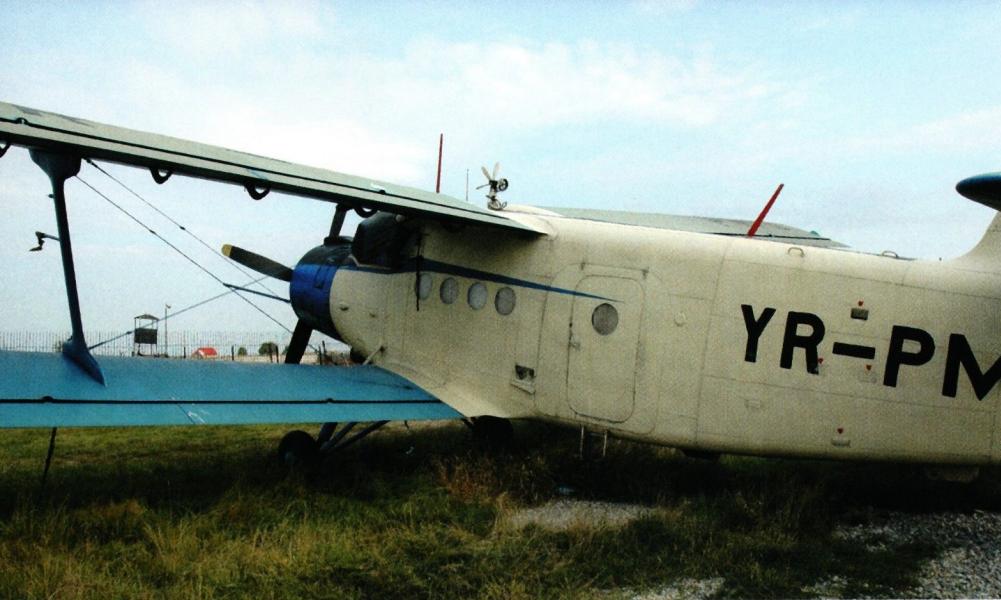
I didn’t immediately say yes when I was asked if I would like to serve as a CIAM delegate on the FAI jury for the 22nd Indoor World Championships in Slanic. However, when I saw that the president of the CIAM Free Flight Commission would be there in person, along with another experienced free-flight pilot, I finally agreed. I assumed that this would sufficiently cover the technical requirements of a jury. I’m quite familiar with the more formal requirements from my experience with other categories. The opportunity came at a good time for me, as I had already been planning to visit the model flying clubs participating in the NOS region’s fundraising project to benefit Romanian junior pilots. The fundraiser itself was carried out very successfully by the Erlenbach Model Flying Club. Third, I wanted—together with representatives of the Romanian federation—to visit airfields that might be considered for the 2006 World Electric Aircraft Championships. So, after a Swiss flight with a wonderful view of the ground, I finally found myself in the state-of-the-art airport terminal in Bucharest, where I was picked up on time by two local model aviators. I then spent the first two nights at the Hotel Olympia, an athletes’ lodge located in the heart of the large national sports center in Bucharest. While the first afternoon was devoted to an intensive city tour that lasted well into the night, on the second day we visited the beautiful Pitesti airfield. I was just as impressed by the huge grass runway as I was by the numerous Antonov biplanes parked around the area with their massive radial engines. Incidentally, this airfield was the venue for the 2002 European Championships in the RC helicopter (F3C) category. It was one of the most beautiful and perfectly organized events of its kind, according to those in the scene. The airfield is scheduled to be relocated in two years. Plans include buildings with accommodations and additional infrastructure. Visiting the clubhouse of the local, very successful model flying club and meeting the junior members there was a particularly wonderful experience. On the third day, we traveled to the university town of Ploiesti. There is also an airfield here with an almost endless grassy area. It’s practically ideal for electric aircraft world championships. The associated buildings can be used for storage and repairs, and even basic accommodations are available. Camping facilities include electricity and water. At the nearby university, where we were personally welcomed by the rector, there are very affordable lodging and dining options. Finally, my two companions took me on to Slanic Prahova, the town where the Indoor World Championships were to take place in the salt mine.
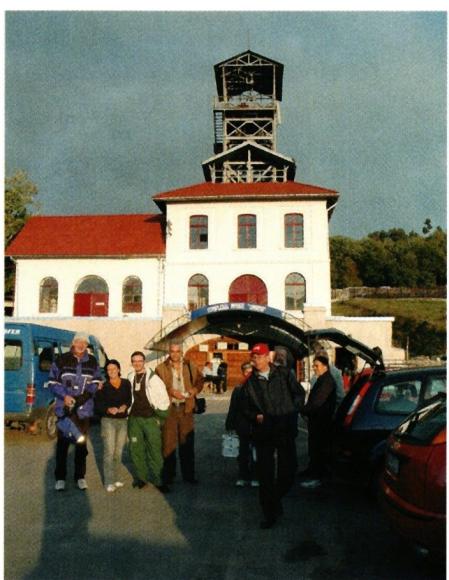
The teams were superbly accommodated at the Hotel Slanic, located above the small village—an older building that is also equipped as a spa hotel for various physical therapies, particularly saltwater baths. The fact that the building had become a bit run-down in places was more than made up for by the excellent cuisine and the friendly, dedicated staff. The entrance to the salt mine was easily accessible from the hotel via a 15-minute walk. Prahova is a charming, very rural area at the foot of the Carpathian Mountains. The many small houses set in romantically overgrown gardens, grazing cows, sheep, and horses, as well as the daily village market with fresh vegetables and delicious fruits, gave the little town a very special charm, despite—or perhaps because of—its modest circumstances. Near the train station, the road led over a bridge directly to the entrance of the salt mine. Two elevators, each over fifty years old, took the competitors down into the large underground halls. When I stepped out of the elevator into the large hall—the venue for the World Championships—I had to adjust not only to the darkness but also to the entire atmosphere. The hall is shaped like an “L.” The sides are approximately 80 and 100 meters long, and the hall is 71 meters high. The shorter side served as the competition area and was accessible only to the competitors, their assistants, and the timekeepers. The longer wing housed the teams’ preparation area as well as a space where the models could be flown in. At the rear of the hall were the restaurant and, finally, the restrooms. The temperature is maintained at approximately 12 degrees Celsius year-round, and the humidity at about 70 percent. The air down here is very still, and the high salt content has a similar effect on the skin as sunlight.
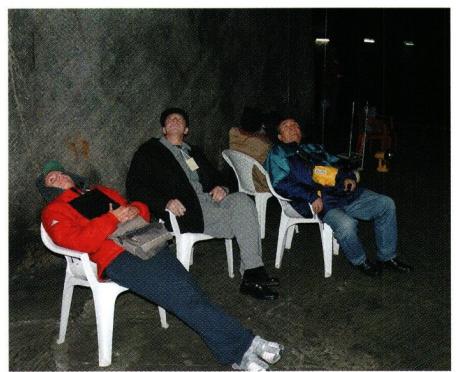
It was a truly unique experience to be out there from morning to night for several days straight. I can’t compare it to anything else. The very special atmosphere was further enhanced by the “slow-down culture” of the indoor scene. Indoor pilots, helpers, and officials are only allowed to move slowly. At times, I felt like a character in the middle of a slow-motion movie. Competitors who carried their models to the launch site or back at a normal walking pace would end up with completely wrecked planes. When preparing the lightweight little planes—with a headlamp and magnifying glass—every move has to be precise. Trembling is probably allowed, but not the slightest flailing. The helpers, timekeepers, and we on the jury also had to adapt to this slowness from that moment on. For hours, we sat—or rather lay—in our chairs and watched the silently circling flying works of art, sometimes glistening in the darkness under the light of a lamp. Often, only the rhythmic flashing—about one rotation per second—of the propeller could be seen. Several times I found myself in a sort of trance-like or dreamlike state. However, the cold creeping slowly through my clothes probably kept me from falling asleep.
I’ve never heard of indoor model airplane enthusiasts calling themselves “pilots.” They seem to be the aviation opposite of Payerne 04 and fly almost exclusively in world championships. Not only in salt mines, but also, for example, at London’s Millennium Hall or at the Cargolifter events in Berlin. The models have a minimum weight of 1.2 grams without the rubber motor. The rubber motor is made of rubber and must not weigh more than 0.6 grams. To what extent the months-long, regular handling of this material constitutes an important “secret” of the competition is beyond my knowledge. The maximum wingspan is 55 cm. In addition to building these models, which requires the finest craftsmanship, flight tactics also play a significant role. If the model comes into contact with walls or the ceiling to the point that it no longer moves or the propeller stops spinning, the timer is paused after 10 seconds, and the flight is over. If a competitor manages to get their model airborne again within 10 seconds, the flight time continues. Using telescopic poles—and at higher altitudes, balloons—competitors therefore try to maneuver their models in such a way that these situations do not arise. But at altitudes of 60 meters and higher, steering with a balloon is an art in itself. If a model became definitively stuck high up on a wall, a single sheet—and only a single sheet—of newspaper could be set on fire during the break below the model. A few minutes later, the resulting bubble of warm air would gently loosen the model from the wall. Larger fires would tear the delicate structures to shreds. Six rounds are flown, and the two best (longest flights) are added together. The longest flight of this World Championship lasted nearly 37 minutes! Flights lasting between 20 and 30 minutes were quite common. Teamwork was another crucial factor for success. The teams from the U.S. and Hungary were exemplary in every respect. While one helper used a spotlight to track the model at high altitude, the competitor—if necessary—stood by with his balloon, ready to intervene. Moreover, they watched the flight paths of their models with enviable calm and composure—as if seconds and medals weren’t at stake. Since there were junior and senior divisions at these World Championships, my estimates put the age difference at no less than 70 years. Where can you still find something like that today? I can say that I’m reasonably familiar with model aviation in (almost) all its forms. Nothing has amazed me quite so much or influenced and reshaped my view of the model aviation world quite as much as the incredible experience of “indoor free flight.” Not only as a challenging category of model flying, but also because, for me, indoor flying stands as a counter-movement to the increasingly addictive culture of one-upmanship that is all about “faster, farther, higher, and more expensive.” Since I come across the word “fascination” at least twice on every page when flipping through German model aviation magazines, I’ll refrain from using it here—but I admire indoor free flight through and through. Perhaps one day this category will manage to inspire a few more enthusiasts here as well. You can count on my support. Who wants to give it a try?


EURO CONTEST GLIDER ACRO TOUR AUSTRIA 2026

THE PC-21 STORY
 Emil Giezendanner

TWIN TOWN PARTNERSHIP
 Wolfgang Voeller

SUMMER FUN 2026 AT MG USTER
Martin Wunderli
CORSAIR F4U – A WARBIRD WITH A MEMORABLE LOOK
Jürgen Rosenberger, Jürgen Prinz
52. 2026 ALPS CUP
Emil Giezendanner
YOU KNOW WHAT I MEAN? 125 YEARS OF THE SWISS AERO CLUB
Emil Giezendanner
News from HEBU

TEAM MANAGER "THIS" BOSSHARD
Rodito Nussbaumer
ATOM, THE NEW DOUBLE-DECKER FROM CPLR
 Matthias Bosshard

F3A EUROPEAN CHAMPIONSHIPS IN ST-MACAIRE, FRANCE
Matthias Bosshard
INSIGHTS INTO THE HISTORY OF SEAPLANES

WELCOME, NEW MEMBER!
Andrea Bolliger
What's New at Leomotion.com

PRIDE AND GOOD IDEAS
 Markus Nussbaumer

SMALL, MODEL-LIKE SAILBOATS
Res Dauwalder
FREE FLIGHT IN THE MIDDLE OF SUMMER
Urs Muntwyler
BY YOUTH, FOR YOUTH
Lorena Betschen
HORIZON HOBBY/LEMACO NEWS: MICRO OV-10 BRONCO 645 MM BY E-FLITE

COUPE DES ALPES – OBSERVE AND LEARN
Rodito Nussbaumer
34th HAHNENMOOS ALPINE MODEL AIRPLANE CAMP
Res Dauwalder
TRY-OUT DAY AT MFV WETTINGEN
 Urs Keller

NEWS FROM HEBU
 Julia Bucher

NOS REGION – A HUB FOR ELECTRIC AVIATION
Emil Giezendanner
MEMORIES
 Wolfgang Völler

70 YEARS OF THE NIDWALDEN MODEL AIRPLANE CLUB
Martin Barmettler
A SPECTACULAR F3A WORLD CUP IN THE PRINCIPALITY OF LIECHTENSTEIN
Emil Giezendanner
FROM 0 TO 100
Markus Nussbaumer