
Hawker Hurricane Mark II au 1/4.5 de Alain Fontana
Alain Fontana, who has been involved in model aircraft building since 1978, is one of those modelers for whom working in the workshop remains at least as important as the pleasure of flying—all for the sake of personal fulfillment. If we take a closer look, this isn’t necessarily about a tradition steeped in white glue, but rather about expressing one’s own creative talents through original, “homemade” solutions that Alain, both as a matter of principle and philosophy, seeks to apply to each of his models, whether they are scale models or pure flights of fancy (we may return to this soon).
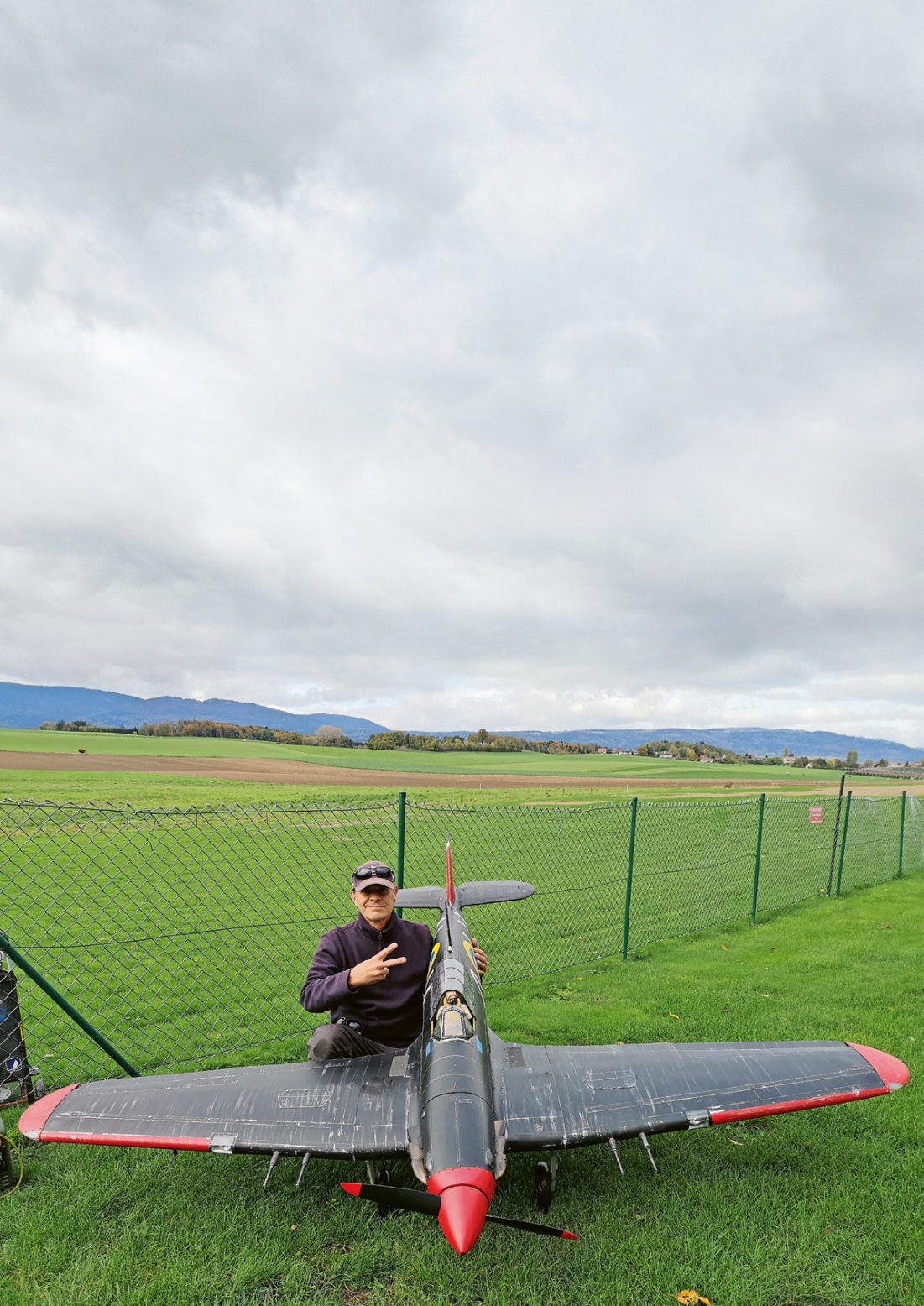
That said, while the builder has long been known for his highly detailed models of World War I biplanes and triplanes, today we’ll focus on another story—one that’s just as human—through the 1/4.5-scale Hawker Hurricane.
We will not revisit the history of this iconic Royal Air Force fighter, which perhaps symbolized—even more so than the Spitfire, which was far less numerous in the British skies at the time—the very spirit of British resistance during those dark hours of September 1940, except to point out just how much it marked a turning point—among several others—in the mid-1930s, with its design inherited from its biplane predecessors and all the transition and challenges that this new generation presented to pilots (and especially their superiors) the monoplane fighter with a cantilever wing and retractable landing gear. Since I assume everyone here has already thoroughly examined the photos of this remarkable model, we will therefore focus on what is less visible—namely, the few technical solutions chosen that made it possible, with this level of finish, to achieve a reasonable final weight for this scale, which makes
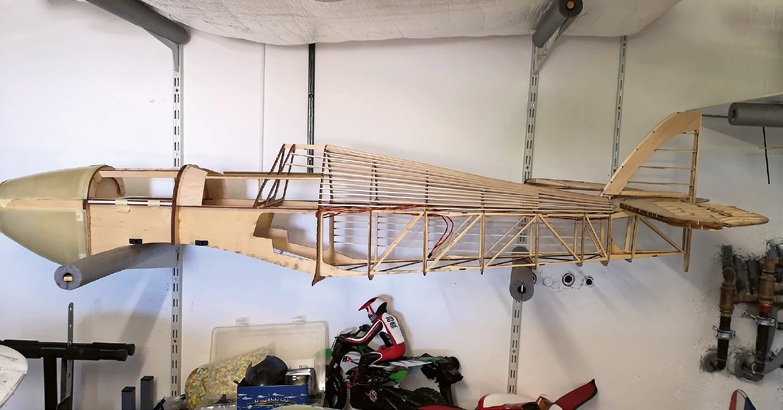
the real appeal of this model of personal development.
This story began somewhat by chance with the purchase of a fuselage that was only partially built from a Mick Reeves kit. For our younger readers, Mick Reeves, who was the 1978 F4C World Champion, remains a true institution in the model-making world across the Channel. Today, his son Jim still sells his kits; it’s worth noting that the technical solutions they offer include some typically British innovations—and even anachronisms—whose technical soundness, aside from the significant amount of preliminary work
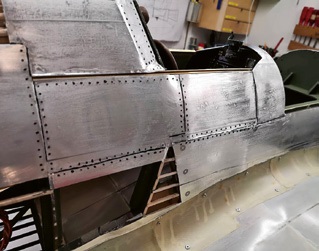
required, along with necessary adjustments that demand some experience, has never since been called into question. This Hurricane, with a wingspan of 2.77 m, is built entirely of wood. The fuselage, which consists of a square-section box frame surrounded by stringers and ribs arranged like the original Hurricane, is, of course, only boxed at the front and covered with Solartex. The forward section of the fuselage is covered with fiberglass and aluminum panels in some areas. Propulsion is provided by a ROTO 85cc FSi two-cylinder 4-stroke engine driving a 24x12 propeller at 5,300 rpm (which may seem low but is actually more than sufficient—Ed.). The sheet-metal exhausts are connected directly to the
locations of the original Merlin II’s exhaust pipes. Cooling—a critical issue for all scale models whose originals were powered by liquid-cooled engines—is achieved through the following measures: while the ROTO 85 is visible only through the rocker covers of the front cylinder—which has no direct cooling—cooling is provided by an electric fan installed in the ventral radiator scoop. This system draws in and propels the cool air collected toward the cylinders via a 180-degree elbow tucked into the wing. The whole system is complemented by side grilles that are made relatively inconspicuous by the model’s black color. While everything was lightened as much as possible along the entire length
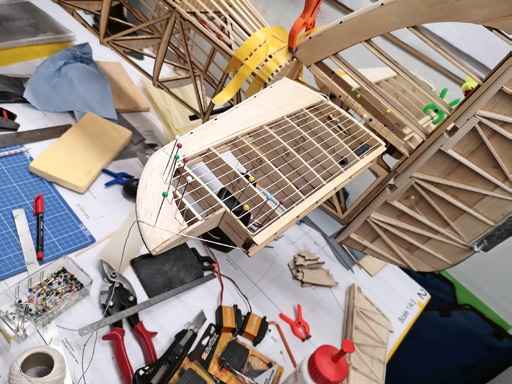
As for the rear lever arm, the tail section—for the same reasons of weight reduction—remains a single, integral unit. As a direct result of the previous point, only 340 grams of
lead were added to the front for trim, which, let’s be clear, is still reasonable compared to other “cases” observed on the same scale (which we will not comment on). →
The wings are perhaps the most distinctive feature of this design. From a modeler’s perspective, one of the Hurricane’s unique advantages is its thick wings.
This not only helps the model maintain stable flight characteristics even at low Reynolds numbers,
but also, precisely because of its relatively high thickness, theoretically requires less material to be added to the structure to counter, among other things, the bending stresses that can become significant during flight. After a thorough examination of the disassembled wing panels—whose thickness at the root is a respectable 19 percent of the relative thickness—
, it must be noted that, aside from two fir strips on the lower and upper surfaces, there is no box structure or strut between these two spars, including at the wing roots (which are tubular). Nor is there any wooden formwork or fabric covering. How is this possible? Here, the solution proposed by Mick—ProSkin—was tested, which consists
of a 0.3 mm sheet of raw epoxy bonded directly to the ribs using PU-type polyurethane adhesive. Although the writer was not initially very convinced by the process, he had to acknowledge the structure’s remarkable lightness combined with good resistance to bending and torsion. However, it is important to keep in mind the downside to this approach, which is well known to
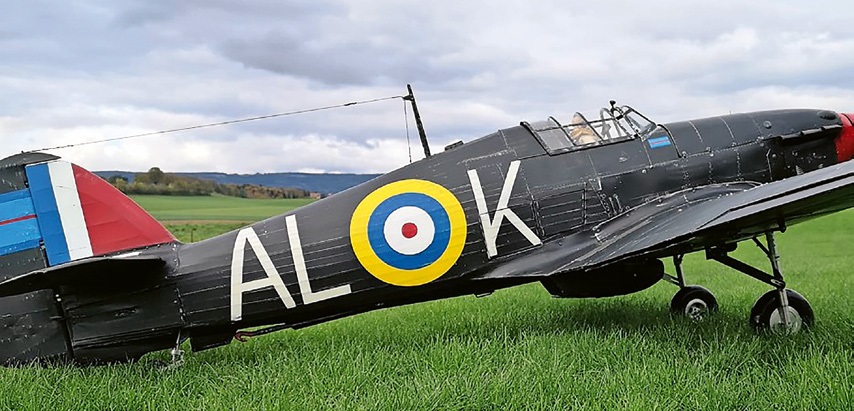
For enthusiasts of lightweight construction, the quality of each bond is crucial, piece by piece—and this is especially true for the attachment of the retractable landing gear, which obviously cannot tolerate any sloppiness.
As a finishing touch, Alain was able to use this as a basis to create a number of effects that really make it all come together
the charm of these personal touches, such as the retractable step, the remote-controlled landing gear, not to mention the rib reinforcement and the weathering effect achieved by applying aluminum tape before painting and then brushing it off, all these tricks, steeped in anecdotes and presumably familiar to many, still require that special touch unique to every passionate modeler.
All this preparatory work has thus ensured that, given the size and volume of this model, it weighs 16.3 kg, resulting in a wing loading of 115 g/dm², a very respectable figure for a warbird. The budget remains modest and is focused on the engine and onboard equipment—such as Savôx components, for example (free advertising)—which ultimately means that the value of this model, by its very uniqueness, remains immeasurably beyond the scope of mere monetary concerns.
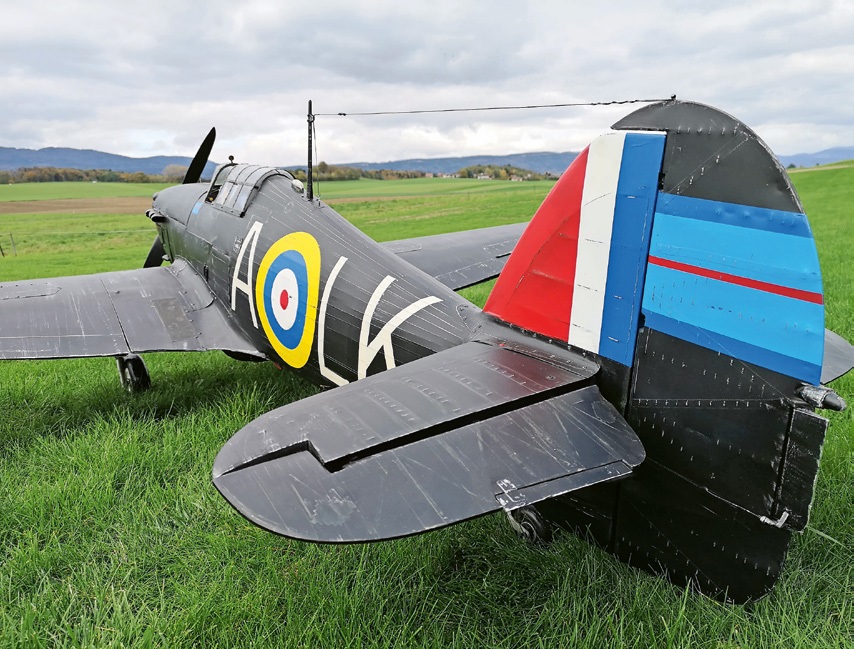
given the work that has been done (which is a good thing).
It was therefore with complete confidence that this Hurricane Mark II made its maiden flight over the Vaud countryside in late summer 2022, piloted by the young Benjamin Fontana (head of electronics and programming), requiring no adjustments other than compensating for the nose-up torque caused by the flaps being lowered during the approach. While we wait to further
the already highly realistic flight characteristics of this model, it’s time to savor this immense pleasure, which is a well-deserved reward for hundreds of hours of passion and devotion in the workshop. So, as enthusiasts of beautiful airplanes ourselves, we hope to see Alain’s magnificent creation—to whom we extend our congratulations—soaring through our skies again next spring for the upcoming season! Thank you.


News from HEBU

TEAM MANAGER "THIS" BOSSHARD
 Rodito Nussbaumer

YOU KNOW WHAT I MEAN? 125 YEARS OF THE SWISS AERO CLUB
 Emil Giezendanner

PRIDE AND GOOD IDEAS
 Markus Nussbaumer

ATOM, THE NEW DOUBLE-DECKER FROM CPLR
 Matthias Bosshard

SUMMER FUN 2026 AT MG USTER
Martin Wunderli
F3A EUROPEAN CHAMPIONSHIPS IN ST-MACAIRE, FRANCE
Matthias Bosshard
52. 2026 ALPS CUP
Emil Giezendanner
HORIZON HOBBY/LEMACO NEWS: MICRO OV-10 BRONCO 645 MM BY E-FLITE

TWIN TOWN PARTNERSHIP
Wolfgang Voeller
CORSAIR F4U – A WARBIRD WITH A MEMORABLE LOOK
Jürgen Rosenberger, Jürgen Prinz
TRY-OUT DAY AT MFV WETTINGEN
Urs Keller
EURO CONTEST GLIDER ACRO TOUR AUSTRIA 2026

BY YOUTH, FOR YOUTH
Lorena Betschen
INSIGHTS INTO THE HISTORY OF SEAPLANES

SMALL, MODEL-LIKE SAILBOATS
Res Dauwalder
What's New at Leomotion.com

COUPE DES ALPES – OBSERVE AND LEARN
Rodito Nussbaumer
34th HAHNENMOOS ALPINE MODEL AIRPLANE CAMP
Res Dauwalder
WELCOME, NEW MEMBER!
Andrea Bolliger
FREE FLIGHT IN THE MIDDLE OF SUMMER
Urs Muntwyler
THE PC-21 STORY
Emil Giezendanner
NEWS FROM HEBU
 Julia Bucher

FROM 0 TO 100
Markus Nussbaumer
MEMORIES
Wolfgang Völler
NOS REGION – A HUB FOR ELECTRIC AVIATION
Emil Giezendanner
Have you almost forgotten about aircraft that take off and land vertically?
Emil Giezendanner
DO YOU KNOW WHAT I MEAN IN THE LAND OF SMILES?
Emil Giezendanner