
A Look Back at the 6th Jet World Championship in Hungary
After the last two events were held in Asia and Africa, the Jet-Scale World Championship returned to Europe last year. And this time, the action took place behind the former Iron Curtain in Hungary, near the city of Kecskemét.
A beautiful country, largely flat, vast, and sparsely populated. A striking number of new industrial and commercial enterprises are clustered around the highways and their interchanges. Huge shopping malls are also located there. But alongside them, in the “countryside,” you can very clearly see the traces of decades of communist mismanagement. The infrastructure is old and prone to breakdowns. The rail service on the branch lines now has only one advantage over horse-drawn carriages. During the World Cup, everything mostly worked, and when it didn’t, the Hungarians rarely panicked. A prolonged power outage during an evening event, caused by a lightning strike, was taken in stride, and the many candles that were then used for lighting show that such outages are not uncommon and that those affected have come to terms with them.
The beautiful Jacabszallas airfield, with its new hotel buildings, hangars, and recreational facilities, is owned by three elderly gentlemen. We definitely don’t have a facility like this in Switzerland. Flying is simply more enjoyable and relaxing when you know there are no buildings or roads nearby. The runway measures 600×18 meters. We were able to store our model planes in a new hangar with a tiled floor. The buildings were guarded around the clock. Anyone who wanted to—or needed to—could tinker with or repair their models in the hangar without restrictions. A campground with excellent facilities had been set up right next to the hotel. The supporting program followed standard tourist practices and offered excursions to Budapest, the Puszta, and so on. The prices for these offerings did not always reflect Hungarian standards; in some cases, they were exorbitant. As a result, only a few interested participants were enthusiastic about them. The Hungarians are quick learners when it comes to business acumen.
After a long absence, our colleagues from the U.S. also made their way to Europe.
However, they still struggled with interpreting the current regulations. It became apparent that some participants, as well as judges, had not read the rulebooks thoroughly enough. Anyone who goes to all the trouble of building scale models, training for flights, competing in qualifiers, and participating in the World Championships should also take the time to spend a few hours studying the rules. With 70 registered pilots, the field of participants was one of the largest to date. The level of model construction and flying has once again noticeably improved.
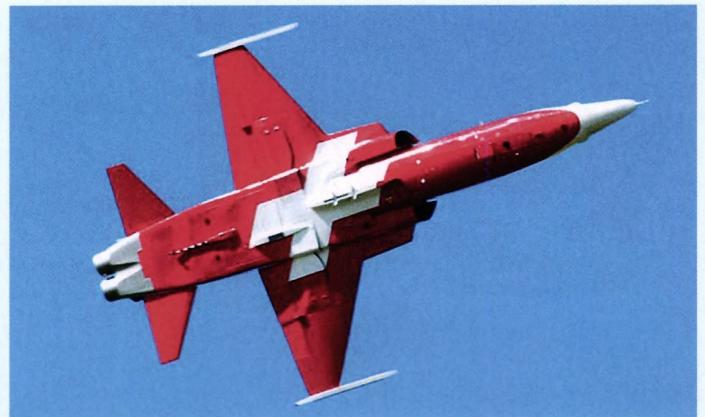
The Swiss team achieved top results for the sixth consecutive time, with Reto Senn winning the runner-up title at the World Championships and the team finishing third. Peter Rütimann placed fifth in the “Open Class.” Martin Forster placed seventh, Roger Thoma fifteenth, and Urs Mayländer eighteenth in the “Individual Class.” Unfortunately, Franz Walti suffered a total loss of his “Rafale.” Special thanks go to our team leaders, Evi and Edgar Bruhin, and to the helpers Manfred Rätz, Fritz Keller, and Roger Knobel. These friends devote a great deal of their free time and energy to our cause, and without them, the Swiss Jet Scale Team would not exist in its current form. In 2005, we were once again able to count on the support of our sponsors, some of whom have been with us for many years. Thank you very much! The group of supporters and patrons traveling with us has grown with every event. Among them are Vreni and Hans Bühr, who, to my knowledge, have never missed a World Championship. Many thanks also to the model flying clubs and the VBS, which allowed us to train at their fields.
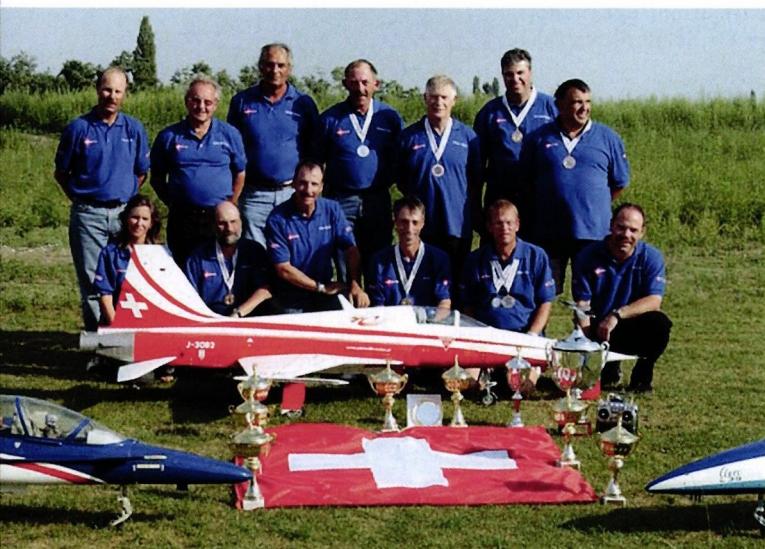
The seventh Jet World Championship will take place in Northern Ireland in July 2007. This will be a logistical challenge for the team, and it remains to be seen whether they will travel by land and sea or by air. Team tryouts are currently underway. Dates, information, and contact details can be found on our website at www.modellflug.ch/igjet/. Here is my take on the Jet Team’s prospects for continuing to achieve top rankings at future World Championships. When it comes to building and judging the competition models, the Swiss team has been at the forefront for years. In this area, the main focus is on refining techniques, learning from mistakes, and improving the construction documentation. Our long-standing competitors, Germany and England, are ahead of us in the flying category. All Swiss pilots were able to deliver good to very good flights in Hungary. However, there is a lack of consistency—even on the part of this writer. The Swiss train as a team at the well-known military airfields in Central Switzerland and Ticino. The biggest drawbacks here are the distances that must be traveled and the restrictions on airspace caused by structural obstacles or heavily trafficked roads. Only a few active pilots can train with their competition models at the airfield of the model flying club of which they are members, since either the field is too short or the runway itself is unpaved. However, individual training is important for putting together the flight program and incorporating new maneuvers. That’s why I find myself daydreaming when I visit model airfields in Austria, Italy, and Germany and notice the excellent infrastructure available in many places. Austria strikes me as exemplary in this regard, especially when I hear how actively model flying clubs in some federal states are supported by the government. Given the rampant austerity measures currently in Switzerland, we can’t expect funding right now, but every trend reverses at some point, and we model aviators are already happy if no one puts obstacles in our way…! Furthermore, model aviation is a more meaningful way to support youth than the legalization of cannabis; perhaps there are still politicians who recognize this. On behalf of the Jet Team, I would like to thank everyone who was there for us in any way and helped out.
Text by Peter Rütimann,
photos by Urs Mayländer

EURO CONTEST GLIDER ACRO TOUR AUSTRIA 2026

THE PC-21 STORY
 Emil Giezendanner

TWIN TOWN PARTNERSHIP
 Wolfgang Voeller

SUMMER FUN 2026 AT MG USTER
Martin Wunderli
CORSAIR F4U – A WARBIRD WITH A MEMORABLE LOOK
Jürgen Rosenberger, Jürgen Prinz
52. 2026 ALPS CUP
Emil Giezendanner
YOU KNOW WHAT I MEAN? 125 YEARS OF THE SWISS AERO CLUB
Emil Giezendanner
News from HEBU

TEAM MANAGER "THIS" BOSSHARD
Rodito Nussbaumer
ATOM, THE NEW DOUBLE-DECKER FROM CPLR
 Matthias Bosshard

F3A EUROPEAN CHAMPIONSHIPS IN ST-MACAIRE, FRANCE
Matthias Bosshard
INSIGHTS INTO THE HISTORY OF SEAPLANES

WELCOME, NEW MEMBER!
Andrea Bolliger
What's New at Leomotion.com

PRIDE AND GOOD IDEAS
 Markus Nussbaumer

SMALL, MODEL-LIKE SAILBOATS
Res Dauwalder
FREE FLIGHT IN THE MIDDLE OF SUMMER
Urs Muntwyler
BY YOUTH, FOR YOUTH
Lorena Betschen
HORIZON HOBBY/LEMACO NEWS: MICRO OV-10 BRONCO 645 MM BY E-FLITE

34th HAHNENMOOS ALPINE MODEL AIRPLANE CAMP
Res Dauwalder
COUPE DES ALPES – OBSERVE AND LEARN
Rodito Nussbaumer
TRY-OUT DAY AT MFV WETTINGEN
 Urs Keller

NEWS FROM HEBU
 Julia Bucher

NOS REGION – A HUB FOR ELECTRIC AVIATION
Emil Giezendanner
MEMORIES
 Wolfgang Völler

70 YEARS OF THE NIDWALDEN MODEL AIRPLANE CLUB
Martin Barmettler
A SPECTACULAR F3A WORLD CUP IN THE PRINCIPALITY OF LIECHTENSTEIN
Emil Giezendanner
FROM 0 TO 100
Markus Nussbaumer