
Who is familiar with the F5A electric aerobatics class?
Aerobatics with electric models (F5A) is often mistakenly regarded outside the electric model community as an F3A class using electric models. This stems from the early days of electric aerobatics. Back then, electric aerobatics competitions—including two European Championships—were held in the F3A style, but with less performance-oriented maneuver programs. However, over the past nearly ten years, electric aerobatics has evolved into a distinct, versatile, and interesting competition class.
While just five years ago, F3A models with electric propulsion systems were considered more or less successful pioneering achievements —especially when they were no louder than internal combustion engines, which was easily achieved with high-speed milling machines—electric powertrains are now widely accepted. The new generations of batteries, combined with electronically commutated gear motors or outrunner motors, as well as improved controller technology, have brought about a complete breakthrough. Much like with four-stroke engines in their day, electric models are no longer at a disadvantage in F3A championships—quite the opposite—and therefore no longer require a separate electric
F3A class (there used to be F3A four-stroke competitions as well). Thus, holding two F3A competitions—one with internal combustion engines and one with electric motors—makes no sense. Except in Germany, these F3A electric competitions have all but disappeared from the scene. Incidentally, our electric helicopters are also facing a similar problem.
The F5A electric aerobatics rules take a different approach than F3A. Competitors fly within a box not only from right to left—or vice versa—but also perpendicular to this axis. The elimination of turn maneuvers drastically changes the nature of the flight program. The fact that competitors can individually design their flight programs leaves plenty of room for imagination and creativity. Maneuvers such as loop-snap combinations or “torques” can be performed right in front of the opponent.
If you have complete control over your aircraft in all flight attitudes and don't want to be constrained by the precise flight paths of the F3A style, F5A is the perfect choice for you. However, this freedom may be viewed with suspicion, especially by competitors who are (still) too heavily influenced by F3A—

...are far from being fully exploited. A shift in mindset is needed. This is likely one of the reasons why F5A has not really caught on to this day. The judges, too, need to adjust their approach. On the other hand, carefree Fun Fly and 3D enthusiasts are practically made for this diverse aerobatics class.
The entire concept of F5A aerobatics is exceptionally well-suited for indoor aerobatics. The great freedom in program design, as well as the absence of turn maneuvers, make F5A the ideal indoor format. Anyone who takes a closer look at indoor aerobatics will soon recognize the major advantages of the F5A rules. If supplemented with a freestyle routine, it further enhances the
its appeal and a more relaxed airshow atmosphere.
- Any electric model may be used. Manual launch is permitted, but results in a reduced score for the “overall impression.”
- The flight area consists of a cube-shaped box with sides measuring 80 to 120 m. The maneuver program should be performable on standard sports fields.
- The flight distance ranges from 50 to a maximum of 120 m, so it is extremely short.
- Each participant puts together their own routine from a catalog: the overall coefficient is capped at a maximum.
- Competitors have the option of adjusting the difficulty level to their skill level and performing a larger number of simpler maneuvers, or
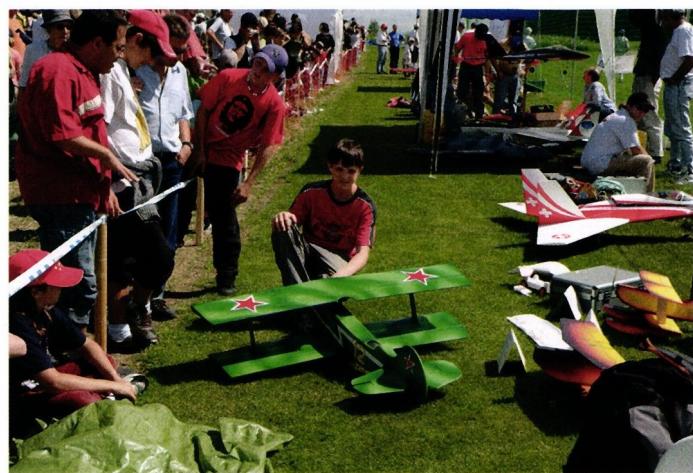
Choose fewer, but more difficult, figures.
- He can also tailor his routine to his model or its propulsion system.
- The maneuvers may also be flown perpendicular to the judges’ line (3D style). Exceptions: rolls and knife-edge flights.
- Turning maneuvers are not aerobatic maneuvers; they are not listed on the judges’ scorecard and are not evaluated as (individual) maneuvers, but are instead factored into the “overall impression.”
- In the final, the competitor’s routine is accompanied by music (recorded tracks are also permitted—but not smoke).
The CIAM meeting last March approved a provisional set of rules for indoor aerobatics (F3AI) proposed by the German Aero Club. The concept was likely developed under time pressure; it’s an almost 100 percent copy of F3A and doesn’t hold a candle to the F5A concept in any respect. “They want to lump everything together,” commented the German delegate to CIAM. I’m curious to see when the first models equipped with Yamadas will race through the halls and set off the smoke detectors.
GZ.
| No. | Basic Figure | K | Option 1 | K | Option 2 | K | Option 3 | K |
|---|---|---|---|---|---|---|---|---|
| 1. | Positive loop(s) (at least 2) | 2 | with roll(s) | 3 | with a snap | 4 | Rosette | 7 |
| 2. | Negative loop(s) (at least 2) | 3 | with roll(s) | 4 | with a snap | 5 | Rosette | 8 |
| 3. | Square Loop | 3 | with 2 half rolls | 4 | with 4 half rolls | 5 | with 4 full rolls | 6 |
| 4. | Cuban Eight | 3 | Horizontal Square Eight | 4 | Vertical square eight | 5 | Vertical square eight with two half rolls | 6 |
| 5. | Roll(s) | 2 | two | 3 | slow | 4 | 2 counter-rotating rollers | 5 |
| 6. | Dotted rolls (at least 2) | 3 | 4-point | 4 | 8-point | 5 | 4-Reverse-Point Roll | 6 |
| 7. | Knife Flight | 3 | Reversed with a half roll | 4 | Reversed with a full roll | 5 | Reverse with a snap | 6 |
| 8. | Roll circle with 4 half rolls | 4 | with 4 full rolls | 5 | with 4 full rolls in the opposite direction | 7 | with one roll | 8 |
| 9. | Twist | 1 | 3 turns | 2 | 2 counter-rotating turns each | 3 | 3 rotations on the back | 4 |
| 10. | Immelman | 2 | combined with half rolls | 3 | combined with full rolls | 4 | combined with a reel and a snap | 5 |
| 11. | Humpty Bump positive | 2 | Humpty Bump negative | 3 | Humpty Bump (negative or positive) combined with half rolls and dotted rolls | 4 | Humpty Bump (negative or positive) combined with a roll(s) and a snap | 5 |
| 12. | Torque roll(s) (at least 1) | 3 | two | 5 | three | 6 | More than three | 8 |
| 13. | Positive cylinder with 2 half-rolls | 3 | positive with full rolls | 4 | negative with half or dotted rolls | 5 | negative with a full roll and a snap | 6 |
| 14. | Turn | 2 | up and down with half rolls | 3 | Up and down with full rolls | 4 | Up with a roll and down with a snap | 5 |
All figure drawings can be found at www.silentwings.ch.
Scores 0 to 10
| Criteria | Qualification | Final | ||
|---|---|---|---|---|
| K max. | Max. Points | K max. | Max. Points | |
| Precision of each figure, perfection | 25 (max. 8 figures) | 250 | 50 (max. 12 figures) | 500 |
| Overall impression (including turn maneuvers, takeoff, and landing) Presentation of maneuvers, landing inside or outside the landing area | 25 (15 without landing gear) | 250 (150) | 25 (15 without landing gear) | 250 (150) |
| Harmony, rhythm, elegance (with music) | – | – | 25 | 250 |
| Total | 50 | 500 | 100 | 1,000 |
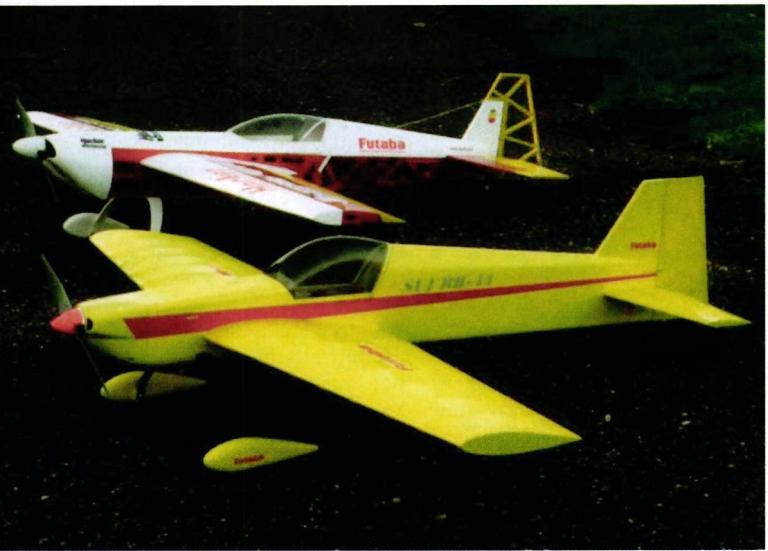
You can find the complete F5A rules in English on the CIAM website at:
http://www.fai.org/aeromodelling/documents/sc4.asp

EURO CONTEST GLIDER ACRO TOUR AUSTRIA 2026

THE PC-21 STORY
 Emil Giezendanner

TWIN TOWN PARTNERSHIP
 Wolfgang Voeller

SUMMER FUN 2026 AT MG USTER
Martin Wunderli
CORSAIR F4U – A WARBIRD WITH A MEMORABLE LOOK
Jürgen Rosenberger, Jürgen Prinz
52. 2026 ALPS CUP
Emil Giezendanner
YOU KNOW WHAT I MEAN? 125 YEARS OF THE SWISS AERO CLUB
Emil Giezendanner
News from HEBU

TEAM MANAGER "THIS" BOSSHARD
Rodito Nussbaumer
ATOM, THE NEW DOUBLE-DECKER FROM CPLR
 Matthias Bosshard

F3A EUROPEAN CHAMPIONSHIPS IN ST-MACAIRE, FRANCE
Matthias Bosshard
INSIGHTS INTO THE HISTORY OF SEAPLANES

WELCOME, NEW MEMBER!
Andrea Bolliger
What's New at Leomotion.com

PRIDE AND GOOD IDEAS
 Markus Nussbaumer

SMALL, MODEL-LIKE SAILBOATS
Res Dauwalder
FREE FLIGHT IN THE MIDDLE OF SUMMER
Urs Muntwyler
BY YOUTH, FOR YOUTH
Lorena Betschen
HORIZON HOBBY/LEMACO NEWS: MICRO OV-10 BRONCO 645 MM BY E-FLITE

COUPE DES ALPES – OBSERVE AND LEARN
Rodito Nussbaumer
34th HAHNENMOOS ALPINE MODEL AIRPLANE CAMP
Res Dauwalder
TRY-OUT DAY AT MFV WETTINGEN
 Urs Keller

NEWS FROM HEBU
 Julia Bucher

NOS REGION – A HUB FOR ELECTRIC AVIATION
Emil Giezendanner
MEMORIES
 Wolfgang Völler

70 YEARS OF THE NIDWALDEN MODEL AIRPLANE CLUB
Martin Barmettler
A SPECTACULAR F3A WORLD CUP IN THE PRINCIPALITY OF LIECHTENSTEIN
Emil Giezendanner
FROM 0 TO 100
Markus Nussbaumer