
Tiger Moth G-ACDC
Actually, at first I just wanted to build a slightly larger electric-powered biplane. But it ended up being a bit more than that. One day, while looking through a book about older aircraft, I saw a Tiger Moth with the registration G-ACDC. For some reason, I thought “ACDC” was particularly fitting for an electric model, so I decided to take a closer look at this Tiger Moth.
First, I got my hands on a whole bunch of books about Tiger Moths,
something I didn’t realize until much later. Through a good pilot friend, I managed to get in touch with a co-owner of a real Tiger Moth, which is based in Sitterdorf, TG.
One Saturday morning, armed with a camera, I drove to Sitterdorf and snapped away as much as I could, focusing especially on the details. Although I now actually had enough reference material to build the Tiger Moth from scratch, I decided to go with a kit from Flair, since it’s the ideal size and offers surprisingly high accuracy.
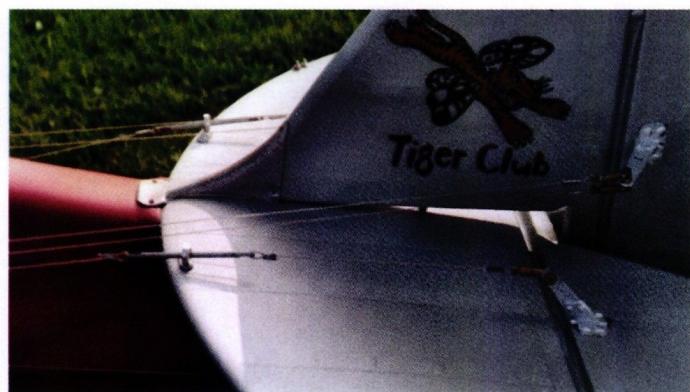
where I also found more pictures of the ACDC.
It also described this particular aircraft as the No. 3 Tiger Moth, noting that it was repainted in the 1980s and is now the oldest Tiger Moth still airworthy. I even managed to get my hands on a very good four-page technical diagram, which also included a lot of detailed drawings. By this point at the latest, it was clear that it would be a scale model; but what that would entail
Of course, a few changes had to be made during the airframe construction, but they were kept to a minimum.
To save weight, almost the entire kit was assembled using Flex-Zap instant adhesive. After about 150 hours, the airframe was basically complete. But that’s when the real work began.
I don’t want to go into every detail of building this scale model here, since it’s different for every aircraft anyway. Still, a few small
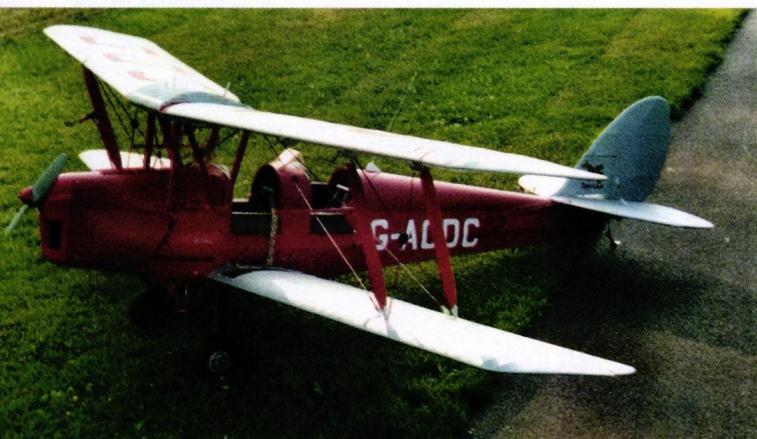
A little model. The tail landing gear was entirely cut to size, bent, and soldered by hand, as was most of the main landing gear; both, by the way, are spring-damped.
The fuel tank, located between the upper wings, was covered with corrugated cardboard and treated with laminating resin. The model was completely covered with Oratex and then painted in the correct color. While we’re on the subject of covering, it’s worth noting that among the 55 running meters of zigzag tape, there are about 800 imitation staples, each of which was cut to size by hand.
The model also features approximately 80 nuts and 160 screws.
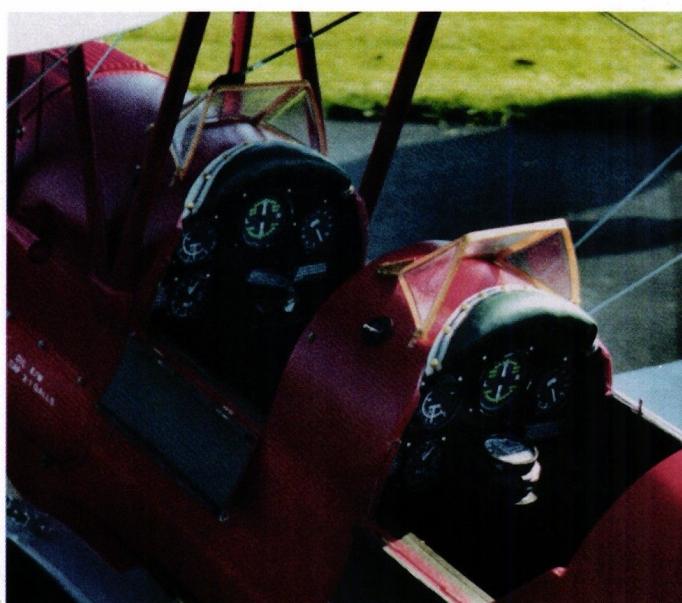
The two cockpits were also built entirely from scratch.
The most exciting part of the entire build was that, by the end, I knew just about every stationery store, hardware store, craft store, and fabric shop within a 30-kilometer radius.
Speaking of fabric stores, I was
in about ten of them before I finally found the green upholstery leather used for the seats and the headrests.
Well, eventually—much, much later—the time had finally come for me to focus on choosing the propulsion system. I opted for a Kontronik Tango 45/4 with a Kruse 2.5:1 timing belt transmission and a 20/10 wooden propeller. The whole thing was initially powered by 21 Sanyo 2400 cells.
I knew from the start that this would hardly be enough, but since comparative data for a model of this size is hard to come by, I first had to assess the situation. This took place one Saturday morning at our airfield in Fehraltorf. After about 45 minutes of setup time, it was ready to fly on the runway.
After going through the whole routine of taking photos, testing the range, checking that everything was working, and calming my nerves, I pushed the throttle forward, and the plane rolled out beautifully.
all the way to the end of the runway. Great—she just wasn’t quite used to flying yet. When I returned to the field a week later, the little bugger had been fitted with a 19x9 spar and 27 cells in its fuselage.
And now the time had come. She flew—and how! After the ACDC had reached a safe altitude, I made a few
trim adjustments and tried a few times to push it to the edge of a stall. Forget it!
It became clear very quickly: The Tiger Moth can only be flown with strong rudder input. That’s exactly what the co-owner of the Tiger Moth from Sitterdorf had already told me about the original; and anyone who’s seen
just how little aileron travel it has, knows exactly why.
After about 5 minutes of flight time, I began the landing approach, and with just a tiny bit of drag, the ACDC was back on solid ground. A great feeling.
My conclusion: Building a scale model is certainly one of the
challenging tasks in model building one can take on—in every respect. However, you have to be aware (or perhaps it’s better not to be) that, until the model takes to the air for the first time, a whole lot of evenings, nights, and especially weekends—when others are out flying—will be spent on it. But when the aircraft stands fully assembled in front of you and, even upon closer inspection, you can’t find anything that distinguishes the model from the original, then it was definitely worth it, wasn’t it?! A heartfelt thank you to everyone who contributed to this project, either directly or indirectly.
Technical Specifications:
Wingspan: 2270 mm
Length: 1860 mm
Weight: ~9700 g
Max. height: 660 mm
Motor: Kontronik Tango 45/4
ESC: Kontronik Beat 50-8-30
Receiver: 2x Webra DS 8
Construction time: approx. 12 months
or 1,800 hours
*M. Eusebio*

EURO CONTEST GLIDER ACRO TOUR AUSTRIA 2026

THE PC-21 STORY
 Emil Giezendanner

TWIN TOWN PARTNERSHIP
 Wolfgang Voeller

SUMMER FUN 2026 AT MG USTER
Martin Wunderli
CORSAIR F4U – A WARBIRD WITH A MEMORABLE LOOK
Jürgen Rosenberger, Jürgen Prinz
52. 2026 ALPS CUP
Emil Giezendanner
YOU KNOW WHAT I MEAN? 125 YEARS OF THE SWISS AERO CLUB
Emil Giezendanner
News from HEBU

TEAM MANAGER "THIS" BOSSHARD
Rodito Nussbaumer
ATOM, THE NEW DOUBLE-DECKER FROM CPLR
 Matthias Bosshard

F3A EUROPEAN CHAMPIONSHIPS IN ST-MACAIRE, FRANCE
Matthias Bosshard
INSIGHTS INTO THE HISTORY OF SEAPLANES

WELCOME, NEW MEMBER!
Andrea Bolliger
What's New at Leomotion.com

PRIDE AND GOOD IDEAS
 Markus Nussbaumer

SMALL, MODEL-LIKE SAILBOATS
Res Dauwalder
FREE FLIGHT IN THE MIDDLE OF SUMMER
Urs Muntwyler
BY YOUTH, FOR YOUTH
Lorena Betschen
HORIZON HOBBY/LEMACO NEWS: MICRO OV-10 BRONCO 645 MM BY E-FLITE

COUPE DES ALPES – OBSERVE AND LEARN
Rodito Nussbaumer
34th HAHNENMOOS ALPINE MODEL AIRPLANE CAMP
Res Dauwalder
TRY-OUT DAY AT MFV WETTINGEN
 Urs Keller

NEWS FROM HEBU
 Julia Bucher

NOS REGION – A HUB FOR ELECTRIC AVIATION
Emil Giezendanner
MEMORIES
 Wolfgang Völler

70 YEARS OF THE NIDWALDEN MODEL AIRPLANE CLUB
Martin Barmettler
A SPECTACULAR F3A WORLD CUP IN THE PRINCIPALITY OF LIECHTENSTEIN
Emil Giezendanner
FROM 0 TO 100
Markus Nussbaumer