
A unique manufacturing process for an original: the Dassault Dornier Alpha on a 1:4 scale
The purpose of this feedback is to highlight the opportunities that 3D printing offers in terms of design, modeling, and printing of molds, with a view to producing multiple models.
A PRUSA printer was used, with a build plate measuring 25 cm wide, 21 cm deep, and 21 cm high. A layer thickness of 0.15 mm was selected as the print setting, which represents an acceptable compromise between accurate surface reproduction and a print time that is “not too long.” The PRUSA Slicer software was then used to convert the 3D model file into a print file. The infill—that is, the grid around the edges of the shapes to ensure their rigidity and serve as a frame—was set to 20%.
The choice immediately fell on PLA, which is made of plastic and recycled plastic (1-kg rolls).
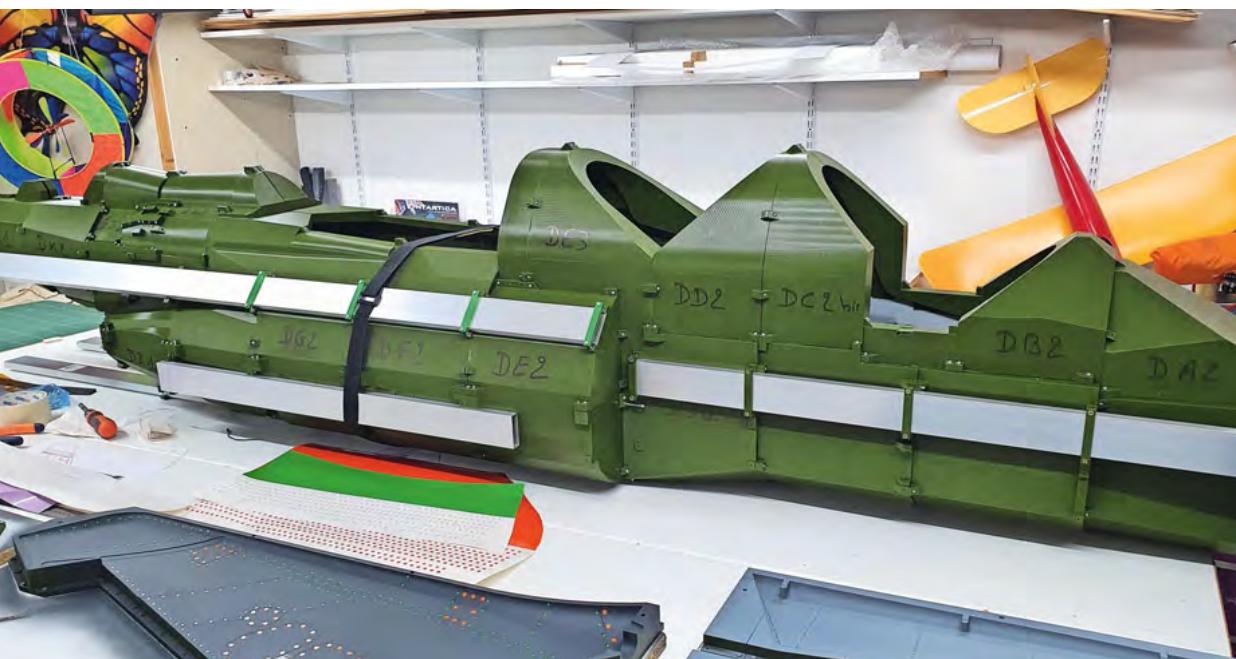
Printing and production required 27 rolls, each weighing 1 kg. Since the Alpha Jet’s fuselage unfortunately cannot be removed from the mold in one piece, the mold consists of four half-shells so that the lower part of the engine nacelles can be removed from the mold along with the rest of the fuselage.
Step 1: Three coats of painter’s primer were applied to the mold. Step 2: Fabrication and assembly of the screws and self-adhesive rivets (machine-cut), which was a time-consuming and laborious process. Step 3: For a perfect finish, an additional coat of primer was applied, followed by a topcoat of glossy black paint to ensure the parts could be removed from the mold.
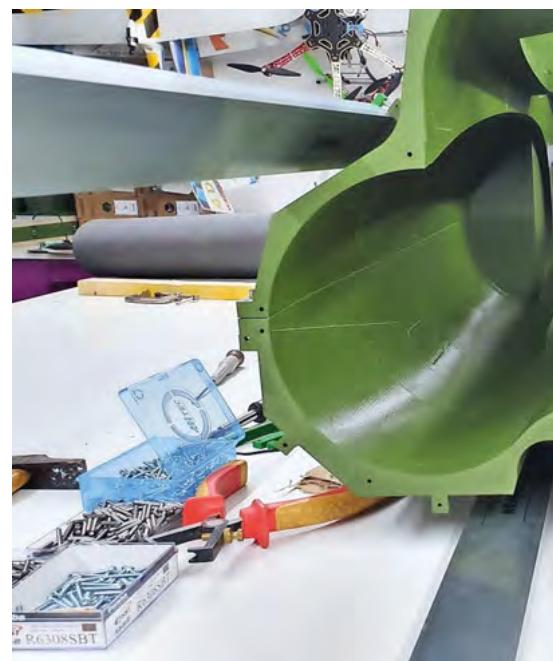
The fuselage layup consists of:
- from the forward tip to the air intakes: 80 g/m² glass fabric on the surface, followed by two layers of 160 g/m² glass fabric with 200 g/m² carbon fiber reinforcements in critical areas, as well as wooden joints for attaching the wing and the landing gear.
- from the air intakes to the rear of the fuselage: two layers of 160 g/m² carbon fiber with localized unidirectional carbon fiber reinforcements to ensure good mechanical strength of the stabilizers.
The first presentation in Switzerland took place in September 2023 during the Acro-Model Club meeting in Geneva, where many were able to appreciate the qualities of this model—with its unique silhouette—compared to conventional models. This allowed us to see the full speed range of the Alpha-Jet, including during a go-around at a critical angle of attack and at a critical altitude with the treetops in view. An impressive demonstration!
Read the full article and see more photos on Flickr or directly from Frank Ridoux: fraerodesign@gmail.com
| – Wingspan: | 2.35 m |
| – Length: | 2.95 m |
| – Fin height: | 1.05 m |
| – Takeoff weight (full load): | 23.9 kg |


News from HEBU

TEAM MANAGER "THIS" BOSSHARD
 Rodito Nussbaumer

YOU KNOW WHAT I MEAN? 125 YEARS OF THE SWISS AERO CLUB
 Emil Giezendanner

F3A EUROPEAN CHAMPIONSHIPS IN ST-MACAIRE, FRANCE
 Matthias Bosshard

SUMMER FUN 2026 AT MG USTER
Martin Wunderli
TRY-OUT DAY AT MFV WETTINGEN
Urs Keller
52. 2026 ALPS CUP
Emil Giezendanner
BY YOUTH, FOR YOUTH
Lorena Betschen
ATOM, THE NEW DOUBLE-DECKER FROM CPLR
Matthias Bosshard
CORSAIR F4U – A WARBIRD WITH A MEMORABLE LOOK
Jürgen Rosenberger, Jürgen Prinz
SMALL, MODEL-LIKE SAILBOATS
Res Dauwalder
What's New at Leomotion.com

TWIN TOWN PARTNERSHIP
Wolfgang Voeller
PRIDE AND GOOD IDEAS
 Markus Nussbaumer

EURO CONTEST GLIDER ACRO TOUR AUSTRIA 2026

INSIGHTS INTO THE HISTORY OF SEAPLANES

34th HAHNENMOOS ALPINE MODEL AIRPLANE CAMP
Res Dauwalder
WELCOME, NEW MEMBER!
Andrea Bolliger
HORIZON HOBBY/LEMACO NEWS: MICRO OV-10 BRONCO 645 MM BY E-FLITE

FREE FLIGHT IN THE MIDDLE OF SUMMER
Urs Muntwyler
COUPE DES ALPES – OBSERVE AND LEARN
Rodito Nussbaumer
THE PC-21 STORY
Emil Giezendanner
NEWS FROM HEBU
 Julia Bucher

FROM 0 TO 100
Markus Nussbaumer
MEMORIES
Wolfgang Völler
NOS REGION – A HUB FOR ELECTRIC AVIATION
Emil Giezendanner
Have you almost forgotten about aircraft that take off and land vertically?
Emil Giezendanner
DO YOU KNOW WHAT I MEAN IN THE LAND OF SMILES?
Emil Giezendanner