
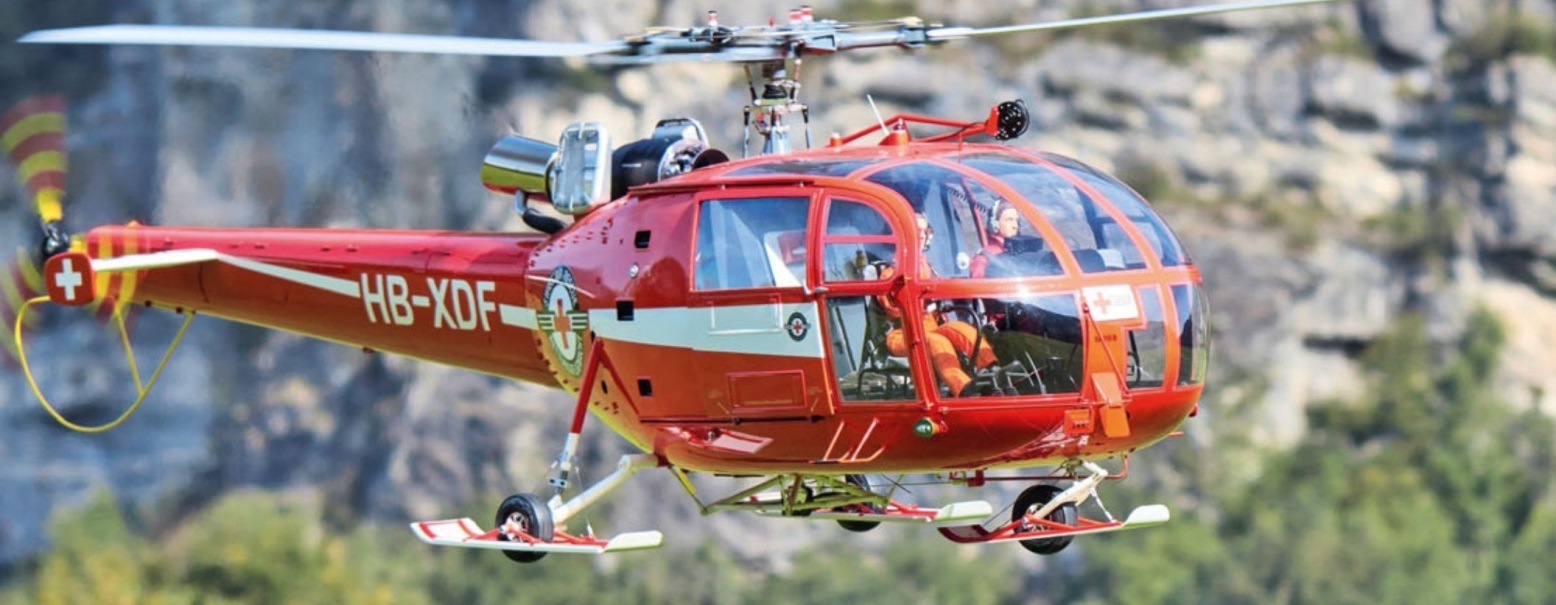
Alouette III SE 319
Alouette III SE 319
The Aérospatiale SA.319 Alouette III (French for "lark") was a light, single-engine, multi-purpose helicopter. It was built by the French manufacturer Sud Aviation (later Aérospatiale) starting in 1959, with over 1,400 units produced for both military and civilian use. It was also manufactured under license in India, Romania (as the IAR.316B), and Switzerland. Many of these simple and robust aircraft are still in service today.
Inspired by this history, Hardy Mosberger from Maienfeld, GR—a member of the MG Falknis—built a model that is truly one of a kind.
For many years, however, the Alouette III also served as the backbone of the Swiss Army. The first nine SE-3160 Alouette III helicopters, manufactured by Sud Aviation in Marignane, France, were delivered to the Swiss Army in 1964. The helicopter soon proved its worth thanks to its wide range of applications and its outstanding capabilities in mountainous terrain. In 1966, an additional 15 helicopters were procured. This was followed in 1972 by a batch of 60 helicopters—a very large number by today’s standards—which were manufactured under a partial license by Flugzeugwerke Emmen. In total, the Swiss Air Force subsequently operated 84 Alouette IIIs. After 46 years and well over 300,000 flight hours, Sud Aviation Alouette III helicopters were deployed for the last time by the Swiss Air Force on Friday, December 10, 2010.
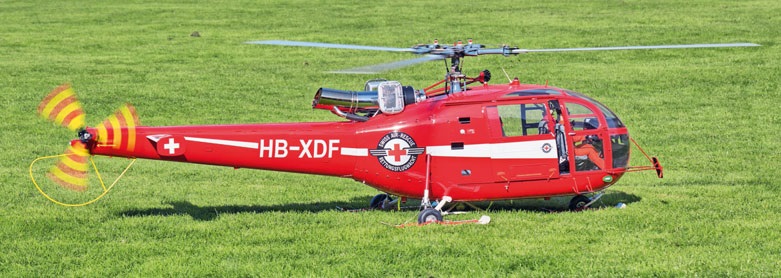
On June 4, 1971, the Swiss Air Rescue Service received its first helicopter financed exclusively by donations—an Alouette III SE 316B (SE 3160) with the registration number HB-XDF. The Alouette III, which formed the backbone of Rega’s helicopter fleet for many years, marked the true breakthrough for helicopter rescue in the high mountains.
The HB-XDF was retired in 1980 and is now on display at the Swiss Museum of Transport in Lucerne. The Alouette III was not only used by the Swiss Air Rescue Service; all major Swiss operators had this model in their fleets. As of today, two Alouette IIIs are still registered in the Swiss Aircraft Register.
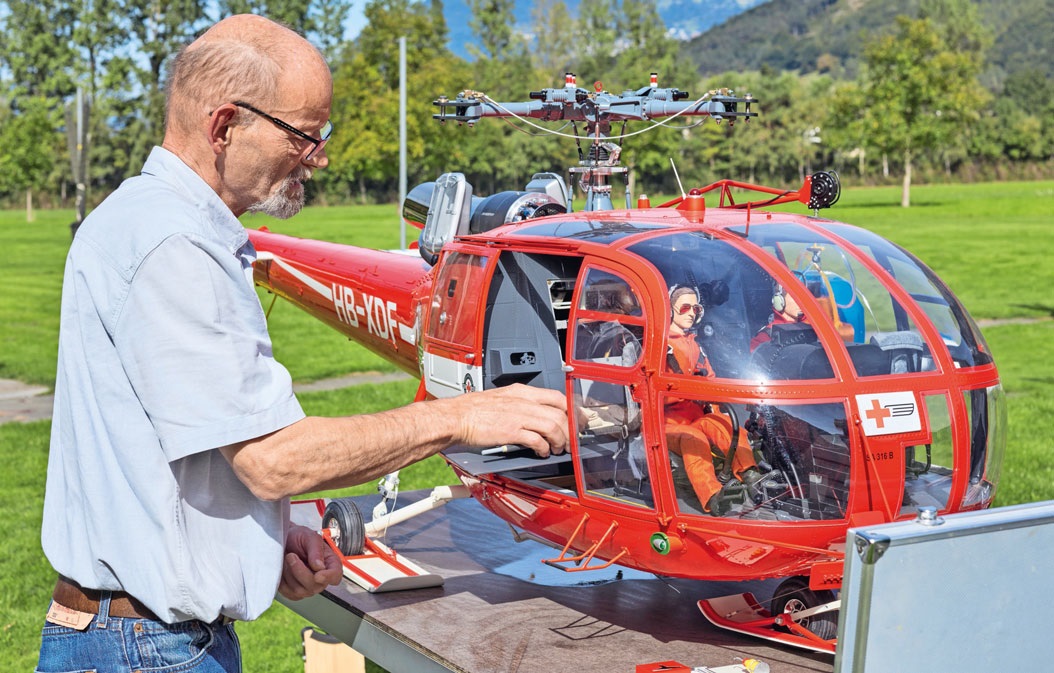
Unfortunately, however, the unmistakable sound of the Turbomeca is heard only very, very rarely—or almost never—these days.
In April 2019, Hardy Mosberger received the semi-scale kit from the German manufacturer Vario Helicopter Uli Streich GmbH & Co. KG. The package also included the mechanical components, the Jakadofsky PRO 5000 turbine, the fuel tank, the tail rotor, and the rotor head, including the matching blades.
The fuselage’s load-bearing structure does not consist of a set of plywood frames, but rather a stainless steel tubular frame. This eliminates the need for time-consuming epoxy bonding work, which can ultimately have a positive effect on the weight. The central screw connection for the tail is unusable. The rear section of the fuselage, where the tail is bolted on, is no longer accessible once the support structure and mechanical components have been installed. Vario provides for an extended central bolt with a knurled nut that extends all the way to the rear wall of the cockpit. Unfortunately, this system is likely intended for one-time assembly only. If the tail section is detached later, the coupling falls downward, which would result in a tedious recovery operation inside the fuselage—and is virtually impossible due to the fixed mechanical components. Once assembled, the Vario solution should never be disassembled again. So Hardy had to modify this, since he has to remove the tail section for transport each time. Using two plates with springs in between—similar to a car’s clutch pressure plate—he quickly modified this bolted connection. This way, when the central bolt connection is loosened, the coupling is pushed apart and remains seated on the carbon fiber tube leading to the tail section. How such a non-functional design from Vario can be sold as a tail section that can be repeatedly removed is a mystery.
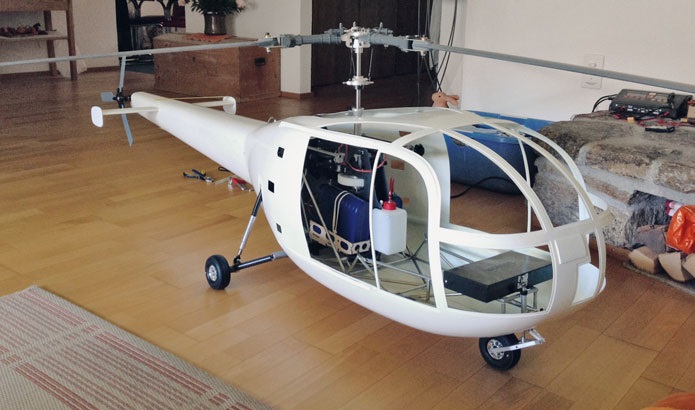
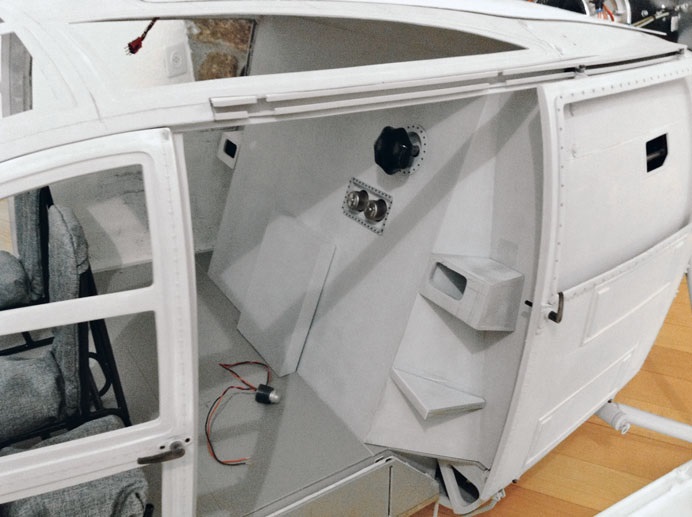
Upon closer inspection of the fuselage, however, I was in for another disappointment: it lacked all scale details.
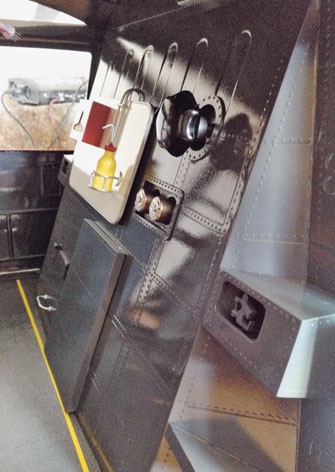
Well, Hardy isn’t the kind of modeler who gives up at this point. So he put his recently purchased 3D printer to work. Using the 3D printer, however, also requires creating 3D drawings to feed into the printer. He drew countless details in CAD, printed them out, and as a result, the fuselage slowly but surely began to take on features very similar to those of the real thing.
Of course, the rivets are a must on the fuselage. After marking the lines with a pencil, over 5,000 rivets were set using white glue.
| SE-3160 Data | Model Specifications | |
| Fuselage Length: | 10.11 m | 2.45 m |
| Rotor diameter: | 10.93 m | 2.50 m |
| Height: | 2.95 m | 0.68 m |
| Payload: | maximum 7 seats | – |
| Curb weight: | 1,042 kg | 28 kg |
| Takeoff weight: | 2,100 kg | 28 kg |
| Powerplant: | Turbomeca Artouste IIIIB gas turbine with 570 shaft PS | Jakadofsky PRO 5000, 6 kW |
| Maximum speed: | 200 km/h at sea level | – |
| Cruising speed: | 190 km/h at sea level | – |
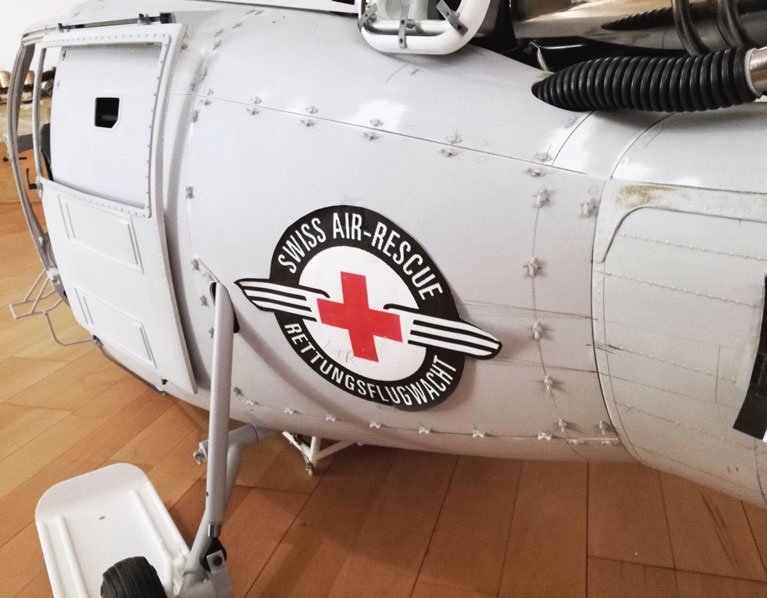
Hardy Mosberger also crafted the entryways, antennas, and other accessories on the fuselage from welding wire. The corresponding mounts were designed in CAD to fit these parts and sent to the 3D printer. But it’s precisely these kinds of details that make all the difference in the end. The hardware included with the kit for the sliding doors doesn’t allow for a door that functions reasonably well. To solve this, he crafted new door frames which, like the real thing, protrude slightly outward at first. After that, the sliding door can be pushed backward. The hinges on the front doors simply won’t work. “If we’re going to do this, let’s do it right,” Hardy thought, and crafted the hinges to match the original. Using brass, a Dremel, and a file, he created the special hinges so that the door’s pivot point would be correct. The entry point for the rear left sliding door is also slightly different to prevent the rescue winch cable from rubbing against the fuselage. In the past, the winches could not be folded out because they were rigidly attached to the fuselage. In keeping with the prototype, this detail was also meticulously recreated, including a functioning floor hatch. Also produced using Hardy Mosberger’s 3D printer and workshop are the load harness with load hooks, the skis, the numerous antennas, and the pitot tube. It is these many details that make each model a truly unique piece.
To keep the paint job to a professional painter and keep costs down, only the spray painting was done by a professional auto painter. The builder handled the sanding, masking, and applying the decals on his own. The result was simply perfect when the model came back from the paint shop.
After reinstalling all mechanical components and completing the electronic setup, it was soon time to focus on programming and test flights.
The following electronics were installed in the Alouette III: MKS servos, PowerBox evo battery switch, Bavarian AXON flybarless system, 2x Futaba R7008SB receivers (1x RC, 1x lights, winch, load hook), 2x PowerPak 2.5X2 PRO batteries, 1x 3S Konion battery for the turbine, 1x 2S LiPo battery for the lights.
After programming and inspecting all the remaining parts in and on the helicopter, the maiden flight was scheduled for May 2020. Everything went off without a hitch; the model handled very well in the air, and its flight performance more than made up for all the hard work Hardy put into building it.
Unfortunately, however, after only 20 minutes of flight time, he noticed that white plastic debris was accumulating in the fuselage fin. Upon closer inspection, this debris was traced to the main gear. The main gear is simply too weak for a takeoff weight of 27 kg. After much deliberation, Hardy Mosberger decided to replace Vario’s fixed gear system with a Helifactory suspension system. However, this change also meant that the rotor head had to be replaced. The Vario model features a 12-mm rotor shaft—which is at the lower limit for a takeoff weight of 27 kg—while Helifactory’s model has a 15-mm shaft. The Vario Scale rotor head also features heavy damping. This makes it nearly impossible to fly in even light winds when using an FBL.
With this new setup—featuring the Helifactory Scale rotor head and mechanical components—Hardy Mosberger has now logged nearly 20 flight hours on the Alouette III. “Now the helicopter is a joy to fly and does exactly what the pilot commands,” the builder and pilot concluded.
Photos: Hardy Mosberger, Alois Müller, Anton Laube
These are the photos that make all the hard work seem worthwhile.


News from HEBU

TEAM MANAGER "THIS" BOSSHARD
 Rodito Nussbaumer

YOU KNOW WHAT I MEAN? 125 YEARS OF THE SWISS AERO CLUB
 Emil Giezendanner

HORIZON HOBBY/LEMACO NEWS: MICRO OV-10 BRONCO 645 MM BY E-FLITE

PRIDE AND GOOD IDEAS
 Markus Nussbaumer

TRY-OUT DAY AT MFV WETTINGEN
Urs Keller
F3A EUROPEAN CHAMPIONSHIPS IN ST-MACAIRE, FRANCE
 Matthias Bosshard

52. 2026 ALPS CUP
Emil Giezendanner
ATOM, THE NEW DOUBLE-DECKER FROM CPLR
Matthias Bosshard
SUMMER FUN 2026 AT MG USTER
Martin Wunderli
What's New at Leomotion.com

COUPE DES ALPES – OBSERVE AND LEARN
Rodito Nussbaumer
TWIN TOWN PARTNERSHIP
Wolfgang Voeller
BY YOUTH, FOR YOUTH
Lorena Betschen
34th HAHNENMOOS ALPINE MODEL AIRPLANE CAMP
Res Dauwalder
CORSAIR F4U – A WARBIRD WITH A MEMORABLE LOOK
Jürgen Rosenberger, Jürgen Prinz
SMALL, MODEL-LIKE SAILBOATS
Res Dauwalder
WELCOME, NEW MEMBER!
Andrea Bolliger
FREE FLIGHT IN THE MIDDLE OF SUMMER
Urs Muntwyler
EURO CONTEST GLIDER ACRO TOUR AUSTRIA 2026

INSIGHTS INTO THE HISTORY OF SEAPLANES

THE PC-21 STORY
Emil Giezendanner
NEWS FROM HEBU
 Julia Bucher

FROM 0 TO 100
Markus Nussbaumer
MEMORIES
Wolfgang Völler
NOS REGION – A HUB FOR ELECTRIC AVIATION
Emil Giezendanner
DO YOU KNOW WHAT I MEAN IN THE LAND OF SMILES?
Emil Giezendanner
A SPECTACULAR F3A WORLD CUP IN THE PRINCIPALITY OF LIECHTENSTEIN
Emil Giezendanner