
Glider Aerobatics—Things Are Happening!
A lot has happened since the last report on the glider aerobatics scene in Switzerland (mfs 6/2000). Back then, I wrote with great awe about our first steps on the international aerobatics stage. In the 2001 season, we wanted to get to the bottom of things. So, on the one hand, we trained diligently, and on the other, we participated in international competitions in Germany and Austria, as well as, of course, in Swiss events. The insights gained from these experiences have also led to some significant changes for 2002.
The Swiss Akro Connection (SAC) has established itself and become a fixture in the Swiss sailplane aerobatics scene. Communication takes place primarily via email. The SAC website—www.modellflug.ch/sac—serves as its home base, so to speak. All important dates, schedules, and announcements can be found there. This year, for the first time, the SAC also organized regular training sessions. Intensive flying took place every Thursday starting at 5:30 p.m. from April through the end of September 2001. The model aircraft clubs in Wehntal, Zurich, and Stetten generously made their fields available, and about seven tow pilots—including, of course, the Powerschlepp team—ensured smooth and reliable operations. The event was a complete success both in terms of flying and socializing and will therefore be held again in 2002. The training sessions are also intended as a platform for beginners and those interested in the sport. Anyone with a suitable aircraft is welcome to participate.
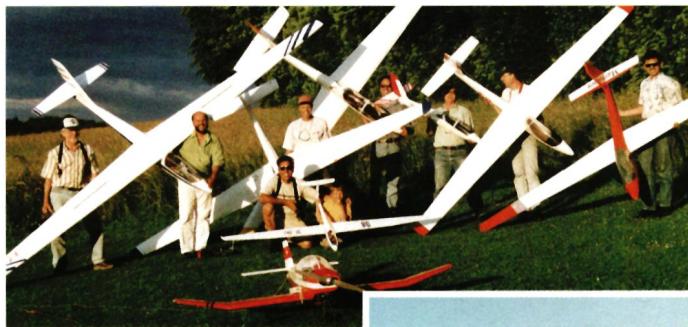
From July 27 to 29, 2001, the 4th German Championship was held in Simmern (Hunsrück) under glorious summer weather. Despite it being the summer vacation season, 34 pilots from Germany, Austria, and Switzerland competed. Christian Ebert and Stefan Völker battled it out for the victory. The Völker–Ebert duel was also a clash of different flying styles. While Stefan sticks to his familiar jet-like flying style with very high speeds, Christian showcased a new style with low speeds—especially in the upper sections of the maneuvers. In my opinion, that’s the future.
The second international event we attended was the glider aerobatics meeting in Feistritz an der Gail (Austria), initiated by Hans Wallner, which took place from August 17 to 19, 2001. Hans is one of the pioneers of the glider aerobatics scene, and so his competition is also considered the unofficial Austrian Championship.
Twenty-seven pilots, including three Swiss participants, and numerous accompanying guests agreed after the event: This was the best glider aerobatics event of 2001.
To wrap up the season, the international scene will meet once again in October alongside the power pilots for the Acro Cup in Langenselbold (near Frankfurt, Germany). The event will take place at a glider airfield closed off specifically for this purpose, providing first-class infrastructure. Overall, the event was a great success. Saturday evening at the Fliegerbeiz, in particular, will remain unforgettable. We’re already considering whether we should start practicing our singing as well.
| 1. | Stefan Völker | D |
| 2. | Christian Ebert | D |
| 3. | Randolph Brömer | D |
| 4. | Hans Wallner | A |
| 5. | Gerhard Tuma | A |
| 6. | Thomas Gleissner | D |
| 7. | Reinhard Melz | D |
| 8. | Böhm, Acro Team Velbert | D |
| 9. | Ulf Reichmann | D |
| 10. | Enno Scheer | D |
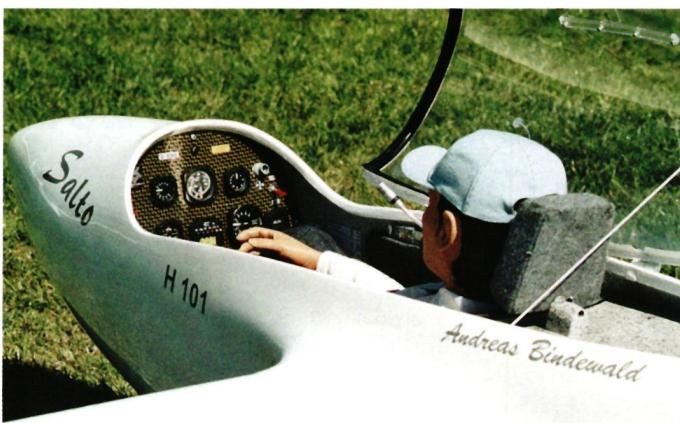
| 11. | Andreas Bindewald | D |
| 12. | Andi Schaerer | CH |
| 13. | Gerhard Bruckmann | A |
| 14. | Joachim Kastl | D |
| 15. | Marcel Kremer | D |
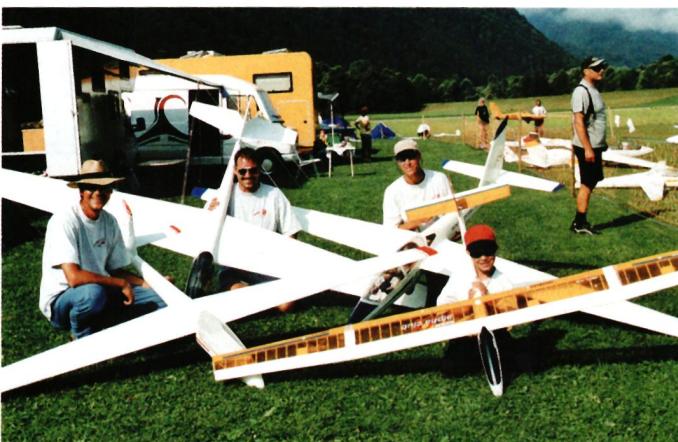
After the Mük was canceled in May due to bad weather, the glider aerobatics competition in Hinwil on September 15, 2001, was the only Swiss competition and was therefore also intended to serve as the regional championships for Regions 3 and 5. Eighteen pilots, including participants from Germany and Austria for the first time, enjoyed a wonderful day filled with fun among like-minded people. The pilots’ skill level had clearly risen once again. Every participant completed the program without major difficulties, and the differences could only be discerned by the trained judges. There were five such judges present, who, under the expert guidance of Barbara Gafner, evaluated the competition very skillfully and fairly. With the exception of Beat Heusser’s ASW 24, only full-fledged aerobatic aircraft were in use. Fox, Swift, B4, Lunak, and, of course, Thomas Hoffmann’s Mü28 dominated the scene. Already during the lunch break, the first interim results showed that Frank Oeste—who had traveled all the way from Germany with his family specifically for this event—would be a strong contender for the overall victory. Frank left no room for doubt in the afternoon either, confidently securing the victory by achieving the highest score in every round.
| 1. | Markus Böhm | D |
| 2. | Gerhard Tuma | A |
| 3. | Hans Wallner | A |
| 4. | Markus Loböck | A |
| 5. | Andreas Bindewald | D |
| 9. | Andi Schaerer | CH |
| 1. | Hans Wallner | A |
| 2. | Stefan Krämer | D |
| 3. | Ulf Reichmann | D |
| 4. | Markus Böhm | A |
| 5. | Reinhard Melz | D |
| 10. | Andi Schaerer | CH |
| 1. | Frank Oeste | D |
| 2. | Peter Gafner | CH |
| 3. | Andi Schaerer | CH |
| 4. | Gerd Vollenweider | CH |
| 5. | Fabian Gafner | CH |
| 6. | Adi Eggenberger | CH |
| 7. | Thomas Ritzmann | CH |
| 8. | Thomas Hoffmann | CH |
| 9. | Peter Schuppisser | CH |
| 10. | Gerald Caser | A |
| 11. | Beat Heusser | CH |
| 12. | Walter Wuhrmann | CH |
| 13. | Hans Baumann | CH |
| 14. | René Bürgi | CH |
| 15. | Martin Krüger | CH |
This intense and very enjoyable season has shown that Swiss pilots have managed to keep pace with the international field. With a little training and a properly tuned model, finishes in the top 15 are possible. To move even further up the rankings, the focus must be on achieving greater consistency across individual runs. It’s always a shame when two good runs are ruined by a single “mishap.” This can be achieved through systematic training, which should also involve bringing in more trained judges. That way, good placements will follow naturally.
For me, the best part of the 2001 season was the many new friendships that developed. Of course, everyone brings a healthy dose of ambition and wants to win, but camaraderie and mutual support take precedence. I’m always happy to see familiar faces and sit down together in the evening for a relaxing beer (or two).
At the winter meeting in November 2001, the Swiss aerobatics community decided to take the next step—both in terms of flight programs and the structure of the competitions. As a result, the regional competitions for Regions 3 and 5 will be merged and held jointly in September going forward. These will be held alternately at Ruckfeld by the MG Wettlingen and at the MG Hinwil’s grounds. The regional competitions are generally open to everyone, but additional regions are also welcome to join and crown their own regional champions. Flights will be conducted from a maximum tow altitude of 400 meters, following the same program as in 2001 but with an additional maneuver at the beginning. The detailed rules can be found on the SAC website.
As a completely new initiative, the Swiss Acro Cup will be the first open international competition of its kind. From June 7 to 9, 2002, glider aerobatics pilots will gather for a two-day competition. Pilots from abroad are, of course, also warmly welcome. Friday is set aside for training and familiarization with the airfield, while the competition takes place on Saturday and Sunday. In addition to the flying activities, an attractive supporting program will be offered. Camping and meals are available on site.
The competition will feature the 2002 Swiss Regional Program. In addition, there will be the well-known compulsory routine, as flown at international competitions in Germany and Austria. This routine is changed every two years and will therefore be the same for 2002 as it was last season. The third round consists of a freestyle routine—a program of the pilot’s own choosing, flown from a maximum altitude of 500 meters. Additional effects such as music and smoke are permitted. The program as a whole is evaluated, rather than individual maneuvers. Many pilots fly the freestyle routine without much preparation, just going with the flow and flying freely from the heart. The competitions in Austria and Langenselbold have shown that the freestyle routine is a lot of fun for all pilots and very appealing to spectators.
To enable even aerobatics novices to participate, an “Espoir” category is also being created. More information, as well as details about the venue, can be found on the Swiss Akro Connection website.
- I. Regio Program 2002
- II. Well-Known Compulsory Routes (CH / D / Ö)
- 1. Pushed loop, ¼ roll, negative exit
- 2. ¼-rotation spin, positive exit
- 3. Humpty Bump (pulled)
- 4. ¼ Cuban Eight, ¼ negative snap roll 45 degrees down
- 5. Cover Leaf: approx. 70 degrees up, ¼ roll, inverted flight 90 degrees down, ¼ roll, exit positive
- 6. Turn
- 7. Cuban Eight with a ¼ roll at the first apex, exit negative
- 8. Negative 90-degree circle segment with a ½ controlled inside roll, positive exit
- 9. Approach / Landing
III. Freestyle
To get accustomed to the routines and to practice, the well-known Acro Training Day will be held on May 11, 2002, in
Stetten. Every pilot will have the opportunity to fly the new programs and be evaluated by the judges in attendance.
As you can see, there’s a lot going on in the glider aerobatics scene. Preparations behind the scenes are already in full swing. I can highly recommend this exciting branch of model flying to everyone. Don’t let complicated maneuvers scare you off. Anyone who has already flown a loop or a roll with their model is capable of participating. There are now plenty of suitable models on the market in every price range. And even if you happen to mess up a maneuver, it’s not the end of the world. This community is one of the friendliest I’ve ever experienced, so you’re guaranteed to have plenty of fun off the field as well. And that’s what it’s all about, after all.
Adi Eggenberger and I are happy to answer any questions you may have about glider aerobatics. See you soon.
Andi Schaerer
sac_info@modellflug.ch
www.modellflug.ch/sac
Cell: 079 282 08 24
- 1. 45-degree descent with a full controlled roll (center figure)
- 2. ¾ loop with negative exit (turn maneuver)
- 3. ¾-point roll (center figure)
- 4. Turn (turning maneuver)
- 5. Pulled loop (center figure)
- 6. Half uninverted Cuban eight (turn maneuver)
- 7. Controlled roll (center figure)
- 8. Approach / Landing

EURO CONTEST GLIDER ACRO TOUR AUSTRIA 2026

THE PC-21 STORY
 Emil Giezendanner

TWIN TOWN PARTNERSHIP
 Wolfgang Voeller

SUMMER FUN 2026 AT MG USTER
Martin Wunderli
CORSAIR F4U – A WARBIRD WITH A MEMORABLE LOOK
Jürgen Rosenberger, Jürgen Prinz
52. 2026 ALPS CUP
Emil Giezendanner
YOU KNOW WHAT I MEAN? 125 YEARS OF THE SWISS AERO CLUB
Emil Giezendanner
News from HEBU

TEAM MANAGER "THIS" BOSSHARD
Rodito Nussbaumer
ATOM, THE NEW DOUBLE-DECKER FROM CPLR
 Matthias Bosshard

F3A EUROPEAN CHAMPIONSHIPS IN ST-MACAIRE, FRANCE
Matthias Bosshard
INSIGHTS INTO THE HISTORY OF SEAPLANES

WELCOME, NEW MEMBER!
Andrea Bolliger
What's New at Leomotion.com

PRIDE AND GOOD IDEAS
 Markus Nussbaumer

SMALL, MODEL-LIKE SAILBOATS
Res Dauwalder
FREE FLIGHT IN THE MIDDLE OF SUMMER
Urs Muntwyler
BY YOUTH, FOR YOUTH
Lorena Betschen
HORIZON HOBBY/LEMACO NEWS: MICRO OV-10 BRONCO 645 MM BY E-FLITE

34th HAHNENMOOS ALPINE MODEL AIRPLANE CAMP
Res Dauwalder
COUPE DES ALPES – OBSERVE AND LEARN
Rodito Nussbaumer
TRY-OUT DAY AT MFV WETTINGEN
 Urs Keller

NEWS FROM HEBU
 Julia Bucher

NOS REGION – A HUB FOR ELECTRIC AVIATION
Emil Giezendanner
MEMORIES
 Wolfgang Völler

70 YEARS OF THE NIDWALDEN MODEL AIRPLANE CLUB
Martin Barmettler
A SPECTACULAR F3A WORLD CUP IN THE PRINCIPALITY OF LIECHTENSTEIN
Emil Giezendanner
FROM 0 TO 100
Markus Nussbaumer