
RC Aerobatics Today—and Tomorrow?
A Look Back at the 2001 F3A World Championships
"mfs" interview subject
Bernhard Schaden.
"mfs" interview partner
Wolfgang Matt.

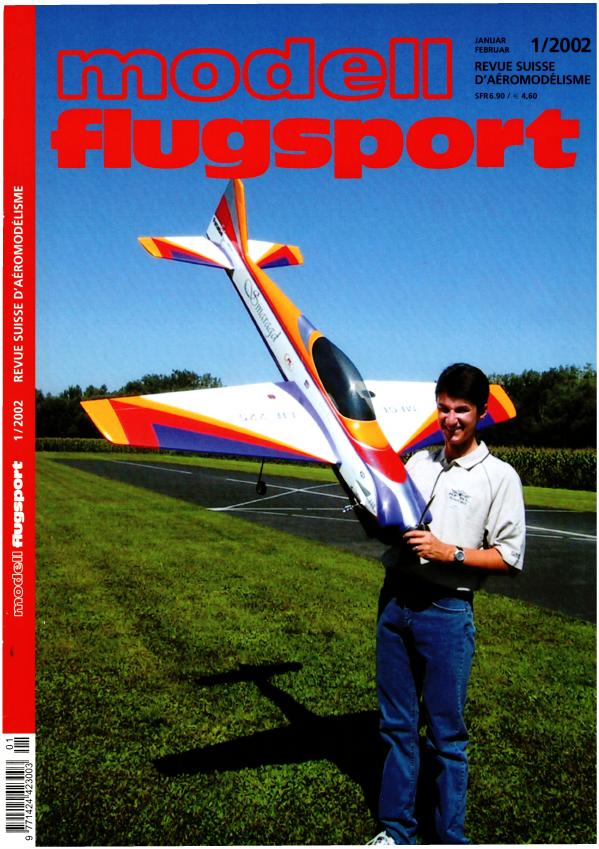
The Swiss team, including Armada, from left: Patrick Drack, Bernhard Schaden, and Daniel Koch.
Text (10 questions): Emil Giezendanner
Photos: Liechtenstein F3A Team
and B. Schaden
Question 1
The 2001 F3A World Championships were held in Cork, Republic of Ireland. What were the participation numbers like? How many participants can an F3A World Championship accommodate?
A: The 2001 World Championships set a new record with 103 competitors.
B: The maximum number of participants depends on the weather.
W: Sure, due to fog, we were only able to start around 10 a.m. a few times, but we still managed to complete the program. With larger numbers of participants, we’d just have to fly even in the rain.
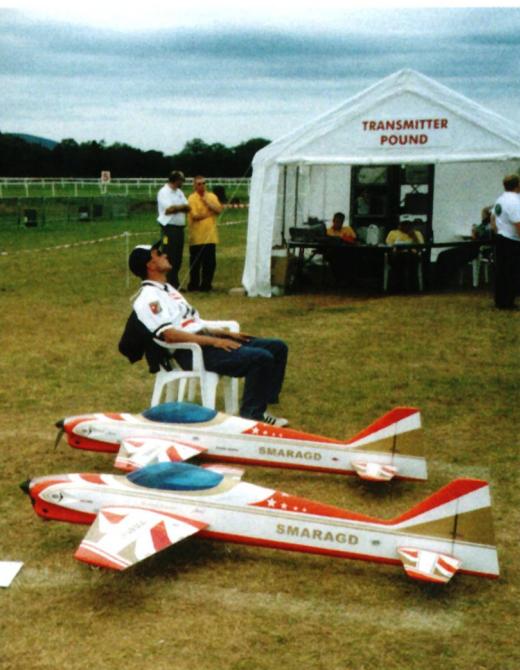
Bernhard Schaden is waiting for his turn.
Question 2
The organization in Cork, Ireland, was praised by experts. The only exception was reportedly the somewhat difficult access for spectators, and at the last CIAM executive meeting (FAI) in Lausanne, the chairman of the F3A Commission, Bob Skinner, criticized the very delayed announcement of the results (the most important aspect of a competition). Did you feel the same way? What do you think caused this? Do you have any further observations regarding the organization, or the 2001 World Championships in general?
B: What bothered me the most was that, once again, the World Championships in Cork took place behind closed doors. Not even the intersections around the World Championships venue were marked.
W: Exactly—they weren’t prepared for spectators. There was no scoreboard showing the point totals—the rankings can’t be calculated until after all four rounds anyway. But even during the final flights, it wasn’t possible to determine the order of finish. The Tarasov-Bauer-Lang method (TBL) works well, but it’s unsuitable for providing information to spectators. The organizers really need to do a lot more in this area.
B: The goal of introducing RC aerobatics to a wider audience at such events can only be achieved through advertising.
Question 3
I’ve noticed that, compared to just a few years ago, there are now whole armies of judges showing up. Do you see any pros and cons?
W: The judges were rotated every 25 competitors—which is about every three hours. It would also be possible to focus on scoring for half a day. The advantage of having so many judges (20 people) is certainly that regional biases or disadvantages are better balanced out.B: One disadvantage is the massive increase in entry fees that comes with it. However, this factor alone hardly contributes to the cost explosion in RC aerobatics.
W: The training of judges still needs to be greatly improved. There were judges who had hardly ever seen the final program. The CIAM plans to take significant steps to address this in the coming years.
Question 4
Is it even possible today, as an outside observer, to get a reasonable overview of what’s happening—if we set aside the finals for a moment?
W: The lack of spectators was a major shortcoming of these World Championships. However, this wasn’t due to the competitions or the category itself, but rather a problem with the organization.B: It was a World Championship for insiders—that’s what bothered me the most!
What are the most important requirements for a modern F3A model? What was the ratio of two-stroke to four-stroke engines in the final group?
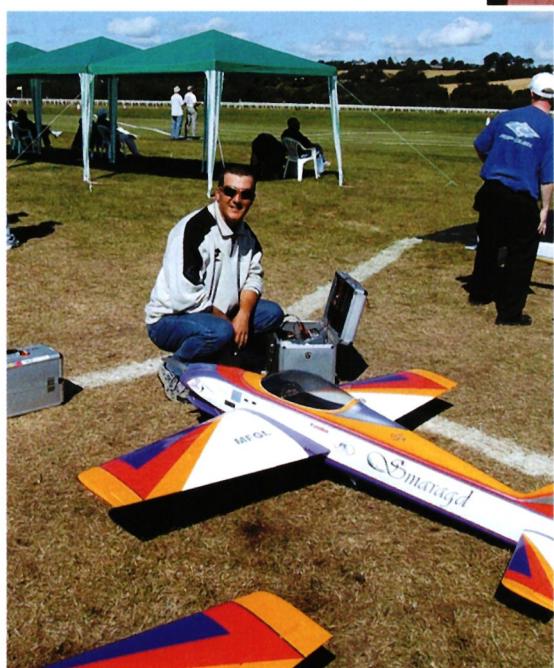
W: Everyone should buy the “Smaragd” (laughs). What’s important is the overall design concept. The specific shapes built around that concept are a matter of taste. The decisive factors are weight, lever arms, and airfoil profile. The static stress on the models during snap maneuvers is enormous these days.
B: Engine performance is becoming increasingly important. Torque is particularly crucial for having sufficient pull-out capability when recovering from slow, critical flight conditions. In terms of flight characteristics, the “snapped” maneuvers are playing an increasingly important role.
W: Exactly; many believe that the thinnest possible airfoil profiles are advantageous here. But compromises are necessary here as well. Tuning an F3A model typically requires at least 20 to 30 flights.
B: I can confirm that. It’s important to take a structured approach.
W: Right—you should never change two things at once—unless you’re 100 percent sure
. W: In the final, the ratio of two-stroke to four-stroke engines was exactly 5:5, and in the semifinals, 18 four-stroke and 12 two-stroke engines were used.
B: I get the impression that the two-stroke is easier for some pilots to handle. Although, once you’re familiar with the four-stroke, it’s also very straightforward. But either way, you need a deep understanding of both propulsion systems to ensure everything works optimally.
What does it take to be a top F3A pilot today? What’s the most important thing? What kind of environment is necessary?
B: The most important thing is definitely a suitable training area and club members who are understanding and let you train.W: We have set training times for F3A pilots. No other models fly during these times. There are also training times for our F3B group.
B: Young F3A pilots need supportive people behind the scenes. Without a pilot, you can’t do anything in this category. You also need talent, hard work, and healthy ambition.
W: It’s also important to accept the subjectivity of the judging. You’re judged by people who, under certain circumstances, might not even be able to fly themselves. I’d like to expand on your question: What does F3A offer me?
B: You learn quite a lot technically in F3A: materials science, electronics, aerodynamics.
W: You learn how to optimize.
B: F3A also benefits me professionally; you learn to overcome setbacks.
W: Right, the rewards can also be seen in other ways—for example, successfully completing a competition can bring you a high degree of personal satisfaction.
What would you think of an aerobatics school?
B: A dedicated competition school would certainly be interesting, but I simply don’t think such a project would be financially viable.W: There are a lot of people who learn model flying at flight schools. I could also imagine a competition school.
I’ve noticed that, unlike most other sports, the Swiss Model Aircraft Association places relatively little emphasis on coaching teams. Other associations train their team coaches. Do you see it that way, too? How important do you consider the role of the team leader to be?
W: F3A pilots are individualists. I’ve repeatedly observed teams where there’s tension—sometimes even within the same team, with representatives of one brand pitted against another, and so on. For us, things are a bit simpler because we usually train together and know each other. In countries where distances are great, team-oriented training immediately becomes a problem.B: In my opinion, recruiting team leaders is largely a financial issue. As long as these people have to foot a large portion of the costs for a World Championship trip themselves—not to mention the vacation time they have to sacrifice—it will remain very difficult to recruit coaches for multiple events.
W: A team leader needs to be technically skilled and have a good understanding of human nature. However, the actual F3A expertise could also be taught by a separate coach. There are already teams structured that way.
B: Still, a coach who doesn’t come from the F3A scene would have to be very enthusiastic about the sport, and—as our recent past shows—without much experience, silly mistakes happen.
W: When I hear that your team leaders aren’t fully funded by the association, I’m naturally very happy about our situation in Liechtenstein. We recognize three pillars of sports funding: professional sports, elite sports, and grassroots development. Our participation in the World and European Championships is practically fully covered through elite sports funding and donations—and that naturally includes the team coach and the support staff as well.
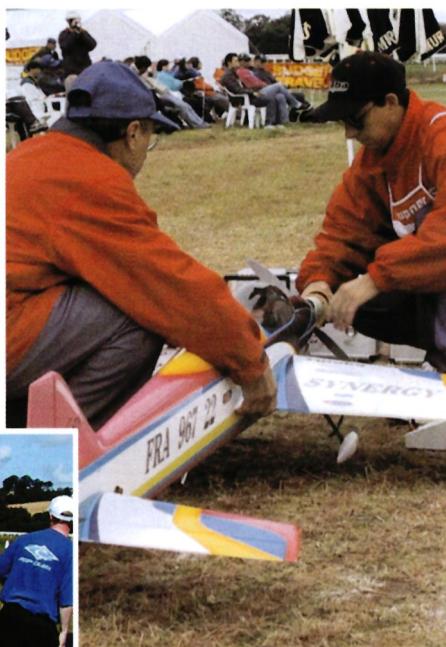
Model aerobatics has gained immense popularity worldwide. The German Model Aviation Association is strongly promoting aerobatics with large glider models and launching competitions featuring gigantic motorized models. Las Vegas hosts the well-known TOC, which has always played a very special role in terms of model size, the prominence of the participants, and the amount of prize money; and finally, in Japan, the world’s best F3A pilots are invited to a freestyle-only competition where substantial prize money is also awarded. Or let’s consider the jet scene!
Sales figures are enormously high—but I don’t believe these will establish themselves as an FAI category. There aren’t enough training sites available either. I think the FAI’s 2 x 2-meter limit is an ideal restriction to keep the whole thing from getting out of hand.
B: I can confirm that. With large aerobatic models (3 meters), many people would be excluded from RC aerobatics. Even today’s FAI models aren’t very easy to transport.
W: I also don’t believe that pure freestyle flying (AA Artistic Aerobatic) will replace F3A. The effort required to design and train for a freestyle routine set to music is enormous. At the moment, the best freestyle competition pilots are also the best F3A specialists.
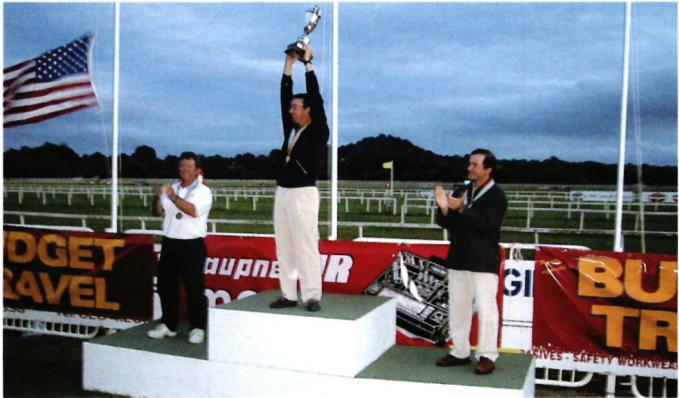
What are the biggest threats to the future of F3A? What are the biggest opportunities? Do you see an urgent need for rule changes?
What role can F3A still play in the future with its—relatively modest models compared to the events mentioned?
W: Although the large 3-meter models are all the rage today—sales figures are sky-high—I don’t believe they’ll establish themselves as an FAI category. There also aren’t enough training fields available. I think the FAI limit of 2 x 2 meters is an ideal restriction to keep the whole thing from getting out of hand.B: I can confirm that. With large aerobatic models (3 meters), many people would be excluded from RC aerobatics. Even today’s FAI models aren’t very easy to transport.
W: I also don’t believe that pure freestyle flying (AA Artistic Aerobatic) will replace F3A. The effort required to design and train for a freestyle routine set to music is enormous. Right now, the best freestyle competition pilots are also the best F3A specialists.
W: As long as I’ve been observing the scene, there have always been certain ups and downs. I have to laugh when I think about how often F3A has already been called a “dying category.” Today, F3A is in very good shape.
B: F3A is very popular and—unlike almost any other RC category—is flown in a great many countries.
W: As we all know, the rules are always the same for everyone—whoever executes them best wins.
B: The effort required in F3A has become very significant.
W: That’s true. There are categories where the same programs are flown for years on end. Every two years, we have to learn two new programs (Preliminary and Final) and, on top of that, go through the difficult process of preparing for unfamiliar programs.
In other categories, fine-tuning is even more crucial. In F3A today, everything the top pilots fly—right down to the fuel—can be bought in stores. There are practically no equipment advantages anymore, as was often the case in the past.
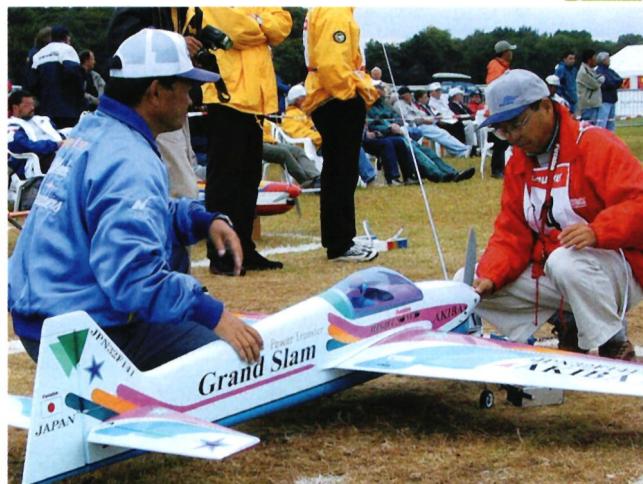
B: That's true. But I also think it's a bit of a shame.
W: In F3A, there has clearly been a shift in recent years from technical craftsmanship to the demands of flying. Systematic training is of the utmost importance.
This interview took place on December 29, 2001.

EURO CONTEST GLIDER ACRO TOUR AUSTRIA 2026

THE PC-21 STORY
 Emil Giezendanner

TWIN TOWN PARTNERSHIP
 Wolfgang Voeller

SUMMER FUN 2026 AT MG USTER
Martin Wunderli
CORSAIR F4U – A WARBIRD WITH A MEMORABLE LOOK
Jürgen Rosenberger, Jürgen Prinz
52. 2026 ALPS CUP
Emil Giezendanner
YOU KNOW WHAT I MEAN? 125 YEARS OF THE SWISS AERO CLUB
Emil Giezendanner
News from HEBU

TEAM MANAGER "THIS" BOSSHARD
Rodito Nussbaumer
ATOM, THE NEW DOUBLE-DECKER FROM CPLR
 Matthias Bosshard

F3A EUROPEAN CHAMPIONSHIPS IN ST-MACAIRE, FRANCE
Matthias Bosshard
INSIGHTS INTO THE HISTORY OF SEAPLANES

WELCOME, NEW MEMBER!
Andrea Bolliger
What's New at Leomotion.com

PRIDE AND GOOD IDEAS
 Markus Nussbaumer

SMALL, MODEL-LIKE SAILBOATS
Res Dauwalder
FREE FLIGHT IN THE MIDDLE OF SUMMER
Urs Muntwyler
BY YOUTH, FOR YOUTH
Lorena Betschen
HORIZON HOBBY/LEMACO NEWS: MICRO OV-10 BRONCO 645 MM BY E-FLITE

COUPE DES ALPES – OBSERVE AND LEARN
Rodito Nussbaumer
34th HAHNENMOOS ALPINE MODEL AIRPLANE CAMP
Res Dauwalder
TRY-OUT DAY AT MFV WETTINGEN
 Urs Keller

NEWS FROM HEBU
 Julia Bucher

NOS REGION – A HUB FOR ELECTRIC AVIATION
Emil Giezendanner
MEMORIES
 Wolfgang Völler

70 YEARS OF THE NIDWALDEN MODEL AIRPLANE CLUB
Martin Barmettler
A SPECTACULAR F3A WORLD CUP IN THE PRINCIPALITY OF LIECHTENSTEIN
Emil Giezendanner
FROM 0 TO 100
Markus Nussbaumer