
A hydroplane on foils: the HydraFoil
The most common seaplanes are either equipped with two floats or feature a floating hull. In both cases, the float or hull has a step that allows the aircraft to lift out of the water, enabling it to accelerate to its cruising speed.
Another, less common design is the foil-equipped seaplane. As speed increases, the foils lift the hull, thereby reducing drag from the water, which allows the aircraft to reach takeoff speed. The advantage of foils is that they reduce drag during flight:
- For a twin-float seaplane, this results directly in the elimination of drag
- For a hull-type seaplane, it’s the reduction in yaw moment, and thus drag.
I was inspired by the famous Jupiter Duck, of which I initially built a version with a wingspan reduced to 42 cm and a step. This version works very well, by the way. I then redesigned the airframe to equip it with foils. They are positioned forward of the center of gravity, and given their angle of attack, they will lift the nose of the aircraft as speed increases.
The two foils are inverted V-shaped: This provides roll stability as soon as they break the surface of the water. If the aircraft tilts to one side, the submerged surface area of the foil increases, thereby restoring balance.
They are angled backward to ensure yaw stability.
Among the modifications to the Jupiter Duck:
- the centerboard dips into the water to improve taxiing performance
- removal of the hull step
- a tapered bow and a reduction in the main beam
- And, of course, the addition of two foils at the front
The boat is constructed primarily from 3 mm Depron, with a few components made of 6 mm Depron.
A few carbon rods, along with parts made of carbon fiber, balsa, and CTP, complete the construction.
We use UHU POR adhesive for bonding Depron to Depron and EPP cyanoacrylate for bonding carbon fiber to Depron or balsa.
Wingspan: 42 cm
Wing area: 6 dm²
Mass: 65 g
Wing loading: approximately 11 grs/dm²
5 g brushless motor, 1105 kV, 6000
ESC: 6 A
Propeller: 3x2
Airfoil: concave
Servos: 2 x 4 g (elevator, rudder)
Receiver: 4-channel micro receiver
6 A speed controller; maximum current draw is 5 A
Receiver batteries: 2S-150 to 250 mAh
Control travel: Rudder +/-25 dg, elevator +/-20 dg
It can be made fairly quickly in two evenings.
In what follows, only the key points are detailed.
The wings: Start by cutting out the ribs that will give the wing its camber. Before gluing them, use a hair dryer to round off the edges of the two wing halves.
Next, attach the spar with the specified 8-degree dihedral. Install the motor mount on the wing. Initially, a salvaged brushless inrunner motor was used (see the video), then I later replaced it with a lighter outrunner motor.
The fuselage: Glue the CTP reinforcements to the sides; these will hold the aileron shafts. At this stage, mark and drill the holes for the aileron shafts. Glue the spar to one of the sides, then glue the front plate and the rear fairing. Glue on the other side, and finish gluing the various panels and the nose.
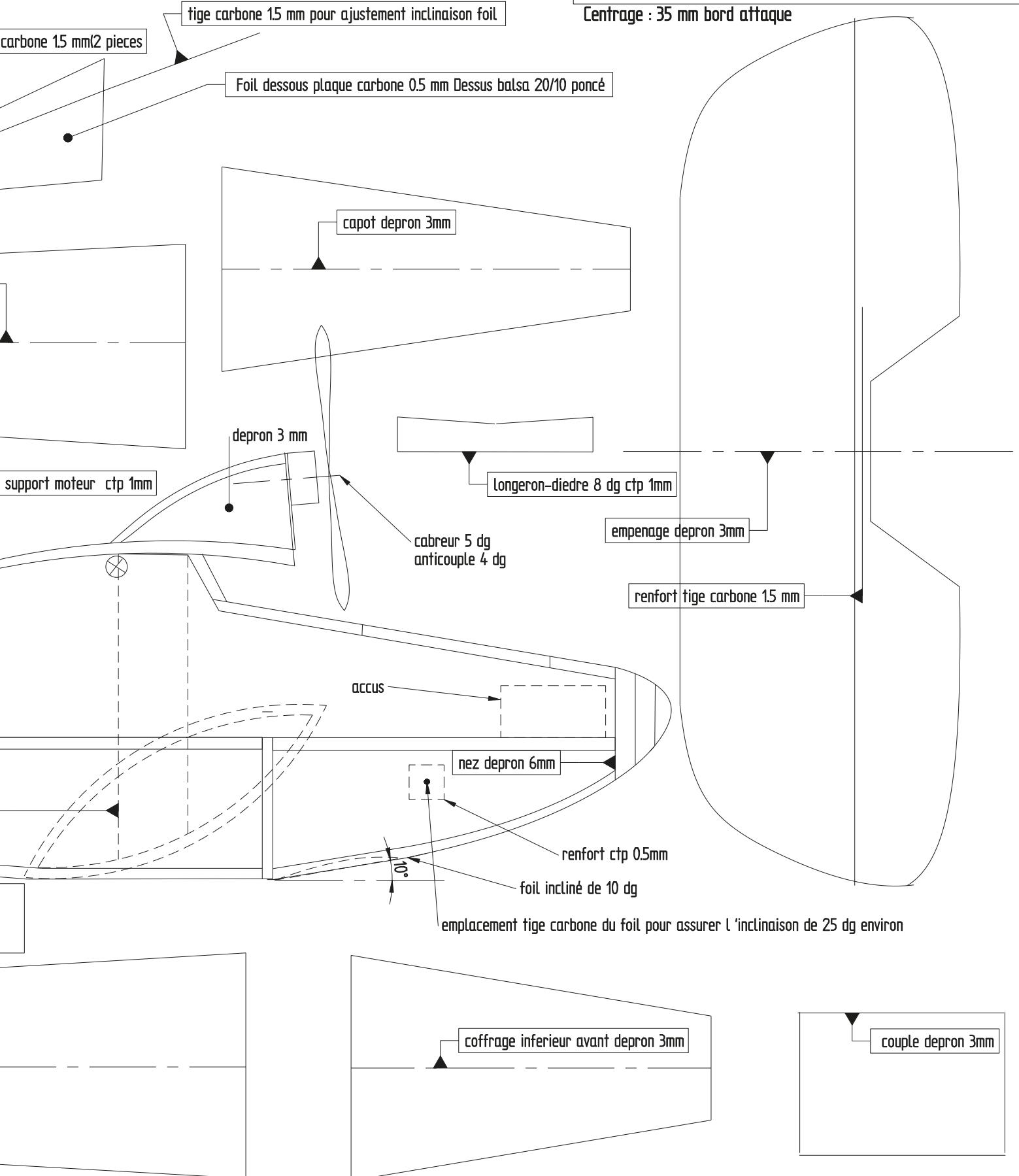
Install the two servos and the tail surfaces: The control surface hinges are made of laminating film, but you can also use heat-shrink tubing or tape. The control rods are carbon rods, with heat-shrink tubing serving as the hinge. The foils have a flat profile. The base is a carbon plate onto which 20/10 balsa is glued; this will be sanded to shape the profile. A carbon rod is inserted to define the inverted V angle. The foils are varnished and covered with heat-shrink tubing.
The foils are mounted on the fuselage and glued in place at the 10-degree angle of attack indicated on the plan. At this stage, the wing can be glued to the fuselage. The floats have an arm that will be attached to the wing; there is a flat carbon fiber reinforcement on its rear face. Once everything is in place, glue the struts that will pass through the float arms.
For the initial tests, a “standard” flight over the fields was conducted.
Make sure the center of gravity is correct; to do this, adjust the position of the receiver battery.
The motor power is very comfortable—you can fly at just 1/4 throttle. The aircraft responds quite well to inputs without being too aggressive. It’s a pleasure to fly, with no tendency to stall even during tight turns. You can try to
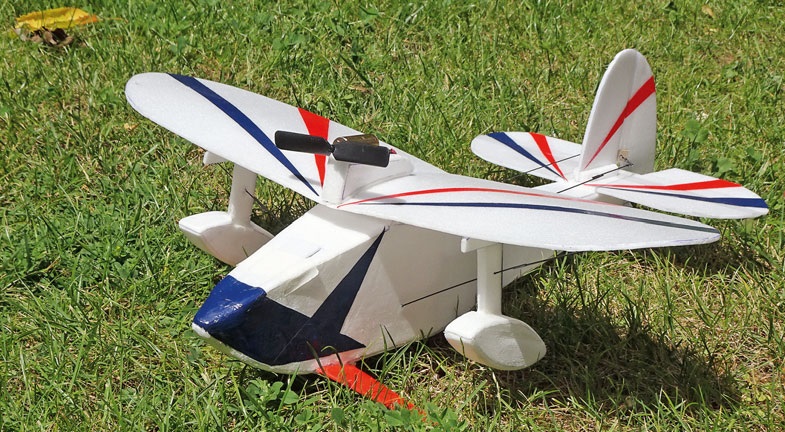
| Wingspan | 42 cm |
| Weight | 60 grs |
| Wing Loading | Approx. 10 g/dm² |
| Motor | GoFly 1105 brushless, 5 g, Kv 6000 - 3x2 propeller |
| ESC | 6 A |
| Servos | 2 x 3.7 g |
| Batteries | 2S LiPo 150–250 mAh |
| Control Travel (Aileron) | ± 25 dg |
| Elevator | +/- 20 dg |
| Center of Gravity | 35 mm leading edge |
Basic aerobatics, such as loops or inversions. Compared to the Jupiter Duck, which has the same wingspan, it is slightly slimmer, which is to be expected since the nose is more streamlined. The first flight took place in gusty winds, which isn’t ideal. Landing on grass with the foils isn’t a problem; the aircraft is sturdy.
The first tests were conducted in fairly strong winds (10–15 km/h).
Taxiing test: Thanks to the submerged fin, it’s easy to steer.
Then, we gradually increased throttle to check its behavior. The fairly strong wind caused it to lean, but the floats did their job—no tendency to tip over was observed.
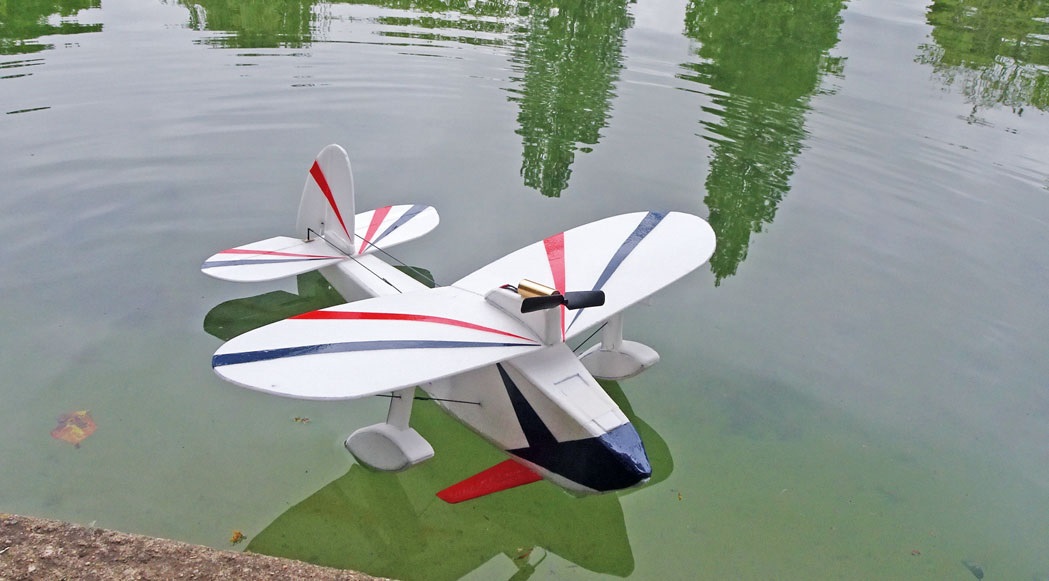
At half throttle, it can be seen rising onto the foils, and it remains controllable via the rudder. The wings remain level, demonstrating the good roll stability of the inverted V design. At full throttle, it takes off in just a few meters; power must be reduced once out of the water. Despite the strong wind, it reached its takeoff line without difficulty.
The small lake, with its trees, causes turbulence, but the situation is easily controlled. The first landing was unintentional on dry land; there was no damage, so we put it back in the water. The second attempt went better, with an immediate takeoff and a smoother flight.
A few laps drew the curiosity of onlookers, so we reduced power; the plane touched down gently on the water and slowed down very quickly. A short taxi to the lakeshore, and the session was over.
A video is available:
https://youtu.be/er7lsZDP3q8



News from HEBU

TEAM MANAGER "THIS" BOSSHARD
 Rodito Nussbaumer

YOU KNOW WHAT I MEAN? 125 YEARS OF THE SWISS AERO CLUB
 Emil Giezendanner

HORIZON HOBBY/LEMACO NEWS: MICRO OV-10 BRONCO 645 MM BY E-FLITE

PRIDE AND GOOD IDEAS
 Markus Nussbaumer

TRY-OUT DAY AT MFV WETTINGEN
Urs Keller
F3A EUROPEAN CHAMPIONSHIPS IN ST-MACAIRE, FRANCE
 Matthias Bosshard

52. 2026 ALPS CUP
Emil Giezendanner
ATOM, THE NEW DOUBLE-DECKER FROM CPLR
Matthias Bosshard
SUMMER FUN 2026 AT MG USTER
Martin Wunderli
What's New at Leomotion.com

COUPE DES ALPES – OBSERVE AND LEARN
Rodito Nussbaumer
TWIN TOWN PARTNERSHIP
Wolfgang Voeller
34th HAHNENMOOS ALPINE MODEL AIRPLANE CAMP
Res Dauwalder
CORSAIR F4U – A WARBIRD WITH A MEMORABLE LOOK
Jürgen Rosenberger, Jürgen Prinz
SMALL, MODEL-LIKE SAILBOATS
Res Dauwalder
WELCOME, NEW MEMBER!
Andrea Bolliger
FREE FLIGHT IN THE MIDDLE OF SUMMER
Urs Muntwyler
EURO CONTEST GLIDER ACRO TOUR AUSTRIA 2026

BY YOUTH, FOR YOUTH
Lorena Betschen
INSIGHTS INTO THE HISTORY OF SEAPLANES

THE PC-21 STORY
Emil Giezendanner
NEWS FROM HEBU
 Julia Bucher

FROM 0 TO 100
Markus Nussbaumer
MEMORIES
Wolfgang Völler
NOS REGION – A HUB FOR ELECTRIC AVIATION
Emil Giezendanner
DO YOU KNOW WHAT I MEAN IN THE LAND OF SMILES?
Emil Giezendanner
A SPECTACULAR F3A WORLD CUP IN THE PRINCIPALITY OF LIECHTENSTEIN
Emil Giezendanner