
Rated X: Valenta's RAY-X F3J
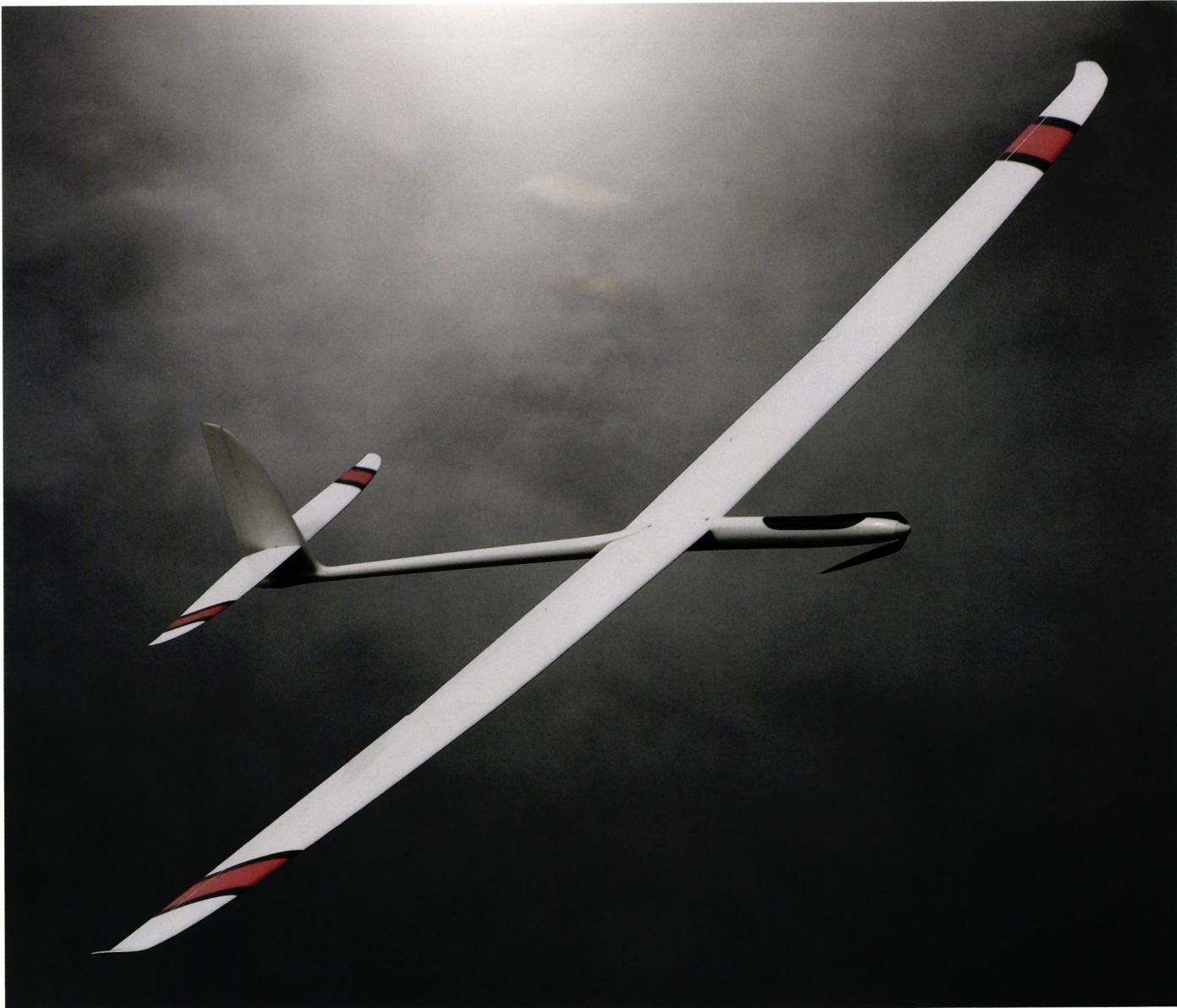
On November 1, 2011, I received a brief email from my friend Pascal Ducret, owner of the “Aéro Model Shop” in Mont-sur-Lausanne: ““Hey Marco, check this out,” along with a photo of the prototype of Valenta’s RAY-X, a new F3J glider with a 3.82-meter wingspan. That was all the information provided. No mention of weight, airfoil, or price either...
Never mind—I liked it, so I decided to put my trust in Pascal and Valenta, whom I already know well. I placed my order on November 2 and got a call on December 16: it had arrived! Hats off to my friend for his efficiency. It took just one month to deliver a glider that isn’t even in production yet in the Czech Republic—and in a custom color, no less.
So much for the history—let’s move on to the contents of the shipment. I like the build quality of this F3J model because the fuselage is reinforced with four longitudinal carbon strips and seems relatively rigid at the tail boom. The horizontal stabilizer is lightweight yet sturdy. These features seem important to me because I also hope to use this little gem for slope flying. The wings consist of three sections: a 160-cm center section and two wing tips, each 111 cm long. A small detail: the control linkages for the ailerons and the fiberglass dihedral flaps are already installed. Two rectangular wing splices measuring 17×14 cm are used to assemble the wing tips. There is no predefined system for connecting the aileron servos; however, two recesses are molded into the fuselage and the central wing section, ready to accommodate two 6-pin MPX connectors—enough for the four wing servos. For the wingtips, I simply chose servo extension leads with safety clips that I found at Flashobby. The elevator and rudder linkages are pre-installed, as is the elevator control linkage. As for the vertical stabilizer, all that’s left to do is glue on the fiberglass rudder (included), and you’re all set. The weight of the unpainted model before assembly is 1,965 g.
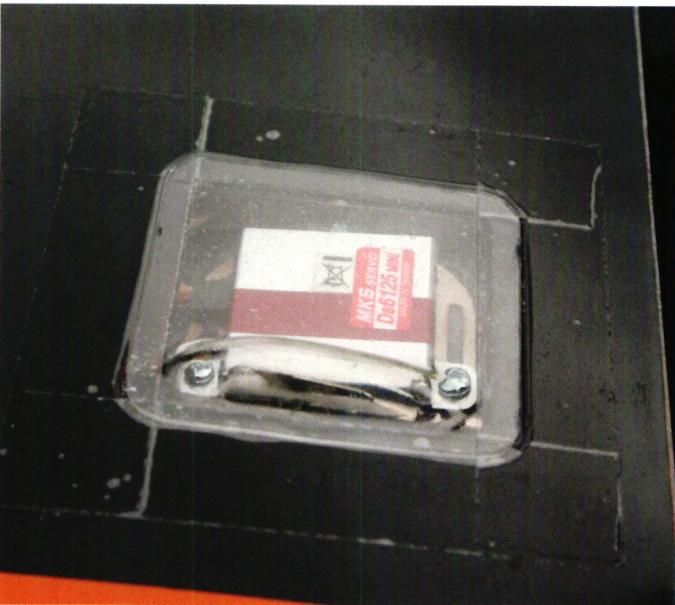
I chose two MKS servos that I bought from Flashobby.com at very attractive prices. For the wing, I selected the DS 6125-Mini model with a torque of 4.8 kg*cm @ 4.8 V. I used these servos in the wings because of their mounting system with horizontal mounting tabs, as well as their precision in operation and center return. The fuselage is equipped with two DS 6125-E servos rated at 2.5 kg*cm @ 4.8 V. The DS 6125-E version features standard mounting tabs and excellent precision. However, due to the thickness of the wing tips, the servo covers included with the model are not suitable. They are not contoured, and even when using the shortest possible servo arm, it touches the cover. So I made two covers myself using 0.3 mm PVC. The four wing servos were mounted on RC Solutions ball-bearing mounts, also available at Flashobby.com.
Powerplant: I chose to convert this model to an electric version for practical reasons. I used a Robbe ROXXY BL In-runner 2835/12 motor, which I paired with a Kontronik 5.2:1 gearhead to increase torque, along with a 17×9 Aero Naut propeller. The motor is powered by a 3S (11.1 V) 2200 mAh LiPo battery connected to a 45 A Castle Creation ESC. As a result, I draw only 16 A, which gives me a comfortable flight time of about 8 minutes at full throttle (calculation: 60 min./(16 A/2.2 Ah) = flight time in minutes). Climb performance is smooth without being excessive, and most importantly, the weight of this setup is very reasonable: 2,650 g, balanced and ready to fly.
On the first flight, I used a 15×8 propeller. I was very optimistic that day because the model was drawing only 10 A, but the climb was very, very, very sloooow... But that didn’t put the model in any danger at all. The settings from the first flight immediately revealed that the model was responding too sharply to the controls. At the time, I was using a 50% flap mix with the ailerons, which I immediately disabled, since the ailerons are so effective. Otherwise, nothing out of the ordinary—it responds well to all controls. The flight speed is that of an F3J, though it accelerates relatively well in a dive. As for its pure performance, I haven’t yet had the chance to fly it on a slope or in suitable weather, but the first flights were quite promising. With the flaps set 1–2 mm positive, the model performs very well. The quadroflops are effective during landing. The elevator trim is relatively significant.
Here’s an F3J model priced at CHF 1,100 that’s sure to appeal to many modelers. It’s sturdier than its competitors and will therefore be better suited for slope flying than others. And at 2.65 kg for 3.82 m, the weight-to-length ratio is still very impressive. One downside—because we have to find a downside, right? I’d say I would have preferred a 15-pin D-Sub connector instead of those two MPX connectors side by side. But honestly, for now, I can’t find anything else to criticize.
Marco Baraldini, CLAM (Club Lémanique d’AéroModélisme)


News from HEBU

TEAM MANAGER "THIS" BOSSHARD
 Rodito Nussbaumer

YOU KNOW WHAT I MEAN? 125 YEARS OF THE SWISS AERO CLUB
 Emil Giezendanner

HORIZON HOBBY/LEMACO NEWS: MICRO OV-10 BRONCO 645 MM BY E-FLITE

PRIDE AND GOOD IDEAS
 Markus Nussbaumer

34th HAHNENMOOS ALPINE MODEL AIRPLANE CAMP
Res Dauwalder
TRY-OUT DAY AT MFV WETTINGEN
Urs Keller
F3A EUROPEAN CHAMPIONSHIPS IN ST-MACAIRE, FRANCE
 Matthias Bosshard

52. 2026 ALPS CUP
Emil Giezendanner
ATOM, THE NEW DOUBLE-DECKER FROM CPLR
Matthias Bosshard
SUMMER FUN 2026 AT MG USTER
Martin Wunderli
What's New at Leomotion.com

COUPE DES ALPES – OBSERVE AND LEARN
Rodito Nussbaumer
TWIN TOWN PARTNERSHIP
Wolfgang Voeller
BY YOUTH, FOR YOUTH
Lorena Betschen
CORSAIR F4U – A WARBIRD WITH A MEMORABLE LOOK
Jürgen Rosenberger, Jürgen Prinz
SMALL, MODEL-LIKE SAILBOATS
Res Dauwalder
WELCOME, NEW MEMBER!
Andrea Bolliger
FREE FLIGHT IN THE MIDDLE OF SUMMER
Urs Muntwyler
EURO CONTEST GLIDER ACRO TOUR AUSTRIA 2026

INSIGHTS INTO THE HISTORY OF SEAPLANES

THE PC-21 STORY
Emil Giezendanner
NEWS FROM HEBU
 Julia Bucher

FROM 0 TO 100
Markus Nussbaumer
MEMORIES
Wolfgang Völler
NOS REGION – A HUB FOR ELECTRIC AVIATION
Emil Giezendanner
DO YOU KNOW WHAT I MEAN IN THE LAND OF SMILES?
Emil Giezendanner
A SPECTACULAR F3A WORLD CUP IN THE PRINCIPALITY OF LIECHTENSTEIN
Emil Giezendanner