
The Rubber Motor—A New Lease on Life for an Old Drive System
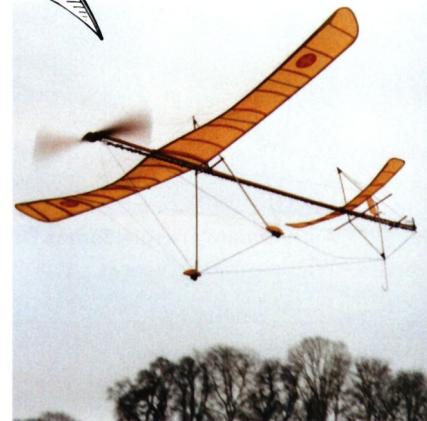
The long history of model aviation began with the Planophore, a rubber-powered model aircraft designed by the Frenchman Alphonse Pénaud, whose public demonstration dates back to 1871. Before the advent of internal combustion engines, the rubber motor was the standard source of propulsion.
The Wakefield Cup competitions began in 1911. This class lives on today in the form of the F1A and F1B classes: initially with bamboo rods, then with plywood and balsa wood, and today with carbon-fiber composite. It’s been a long evolution. In the early days, up to 200 g of rubber provided a lot of power. Today, F1B models—with just 30 g of rubber but perfected aerodynamics and advanced technology—deliver better performance. In addition to F1B, indoor flying (F1D) must also be mentioned. These fragile, lightweight models literally fly in slow motion for over half an hour. Throughout the various eras, there have been a wide variety of types and classes of rubber-powered models. Attractive, scale-accurate models in various sizes, as well as large numbers of beginner, utility, and performance models. There has been—and continues to be—a wide selection of plans and kit sets, particularly from the U.S. and the U.K. Thanks to modern laser technology, these classic rubber-powered models are once again available on the market.
As a complement to—or in contrast with—today’s model aircraft, the familiar rubber-powered models hold a special fascination. Rubber bands can be a powerful driving force. The idea of making the most of very little also has its own appeal. Harnessing this primal force is fascinating. From simple models to the major challenges of a modern competition model, there are many possibilities. When it comes to the rubber bands, there’s plenty of room for experimentation with cross-section and length, as well as propeller optimization.
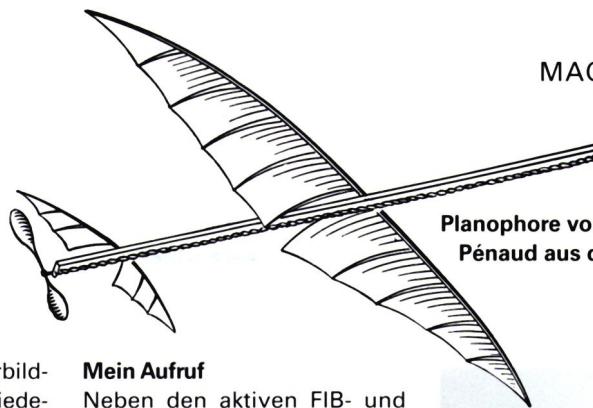
In addition to the active F1B and F1D competition model pilots, there are also a number of members who build rubber-powered models of all kinds. The IG Albatros, which focuses on vintage gliders, also engages in vintage model aircraft flying. It’s a fascinating treasure trove. This report aims to provide a brief insight, attract new enthusiasts to rubber-powered model aviation, and serve as a call to action for those interested. The goal is to foster a lively exchange of experiences and organize further gatherings centered on rubber-powered model aircraft.
An interesting topic with historical significance.
Alfred Genther
Gumpisbüelstrasse 35
8600 Dübendorf
Tel. 044 821 04 34
More photos on the next spread ... →


News from HEBU

EURO CONTEST GLIDER ACRO TOUR AUSTRIA 2026

TEAM MANAGER "THIS" BOSSHARD
 Rodito Nussbaumer

YOU KNOW WHAT I MEAN? 125 YEARS OF THE SWISS AERO CLUB
 Emil Giezendanner

F3A EUROPEAN CHAMPIONSHIPS IN ST-MACAIRE, FRANCE
 Matthias Bosshard

HORIZON HOBBY/LEMACO NEWS: MICRO OV-10 BRONCO 645 MM BY E-FLITE

PRIDE AND GOOD IDEAS
 Markus Nussbaumer

BY YOUTH, FOR YOUTH
Lorena Betschen
34th HAHNENMOOS ALPINE MODEL AIRPLANE CAMP
Res Dauwalder
TRY-OUT DAY AT MFV WETTINGEN
Urs Keller
52. 2026 ALPS CUP
Emil Giezendanner
TWIN TOWN PARTNERSHIP
Wolfgang Voeller
ATOM, THE NEW DOUBLE-DECKER FROM CPLR
Matthias Bosshard
CORSAIR F4U – A WARBIRD WITH A MEMORABLE LOOK
Jürgen Rosenberger, Jürgen Prinz
SUMMER FUN 2026 AT MG USTER
Martin Wunderli
What's New at Leomotion.com

THE PC-21 STORY
Emil Giezendanner
COUPE DES ALPES – OBSERVE AND LEARN
Rodito Nussbaumer
SMALL, MODEL-LIKE SAILBOATS
Res Dauwalder
WELCOME, NEW MEMBER!
Andrea Bolliger
FREE FLIGHT IN THE MIDDLE OF SUMMER
Urs Muntwyler
INSIGHTS INTO THE HISTORY OF SEAPLANES

NEWS FROM HEBU
 Julia Bucher

FROM 0 TO 100
Markus Nussbaumer
MEMORIES
Wolfgang Völler
NOS REGION – A HUB FOR ELECTRIC AVIATION
Emil Giezendanner
DO YOU KNOW WHAT I MEAN IN THE LAND OF SMILES?
Emil Giezendanner
A SPECTACULAR F3A WORLD CUP IN THE PRINCIPALITY OF LIECHTENSTEIN
Emil Giezendanner