
Save the classic cars!
In the field of model airplanes, the term “vintage” can refer both to aviation enthusiasts born before 1900 and to models of pioneering aircraft such as the Blériot, Blackburn, Etrich, and Fokker, or even replicas of model airplanes designed in the 1930s, 1940s, and 1950s. The following discussion will focus on the latter category.
In the 1960s and 1970s, particularly in the U.S. and the United Kingdom, model airplane enthusiasts with a specific interest (especially those who flew the increasingly popular radio-controlled “flying bricks”)—
(Pönten) joined forces in a joint effort to bring back to life a piece of a bygone era that had come to an end with the invention of Styrofoam. For them, the electric starter was a “new-fangled gimmick”—spending days cranking a spark-plug engine or struggling with a “flooded” diesel engine, on the other hand, was the very essence of model aviation. They regarded the clumsy maneuvers of radio-controlled models as the opposite of a casual free-flight model or a gently gliding tethered aerobatic aircraft. Clubs emerged and merged in America to form the Society of Antique Modelers (S.A.M.), and in Great Britain, the Society of Antique Modellers of England (S.A.M.E.). Today, these societies have thousands of members, and on nice weekends, they can be found scattered in groups across the entire country. In Switzerland, however, these “old-timers” are still virtually unknown.
In Switzerland, interest in old engines was rekindled, largely thanks to Siegfried Schmid. But where have all the Brown Juniors, Dynos, Microns, and Mills gone that were sold in Switzerland after World War II? Some have likely been saved by a handful of active collectors in Switzerland, but hundreds more still lie forgotten and rusting away in basements and workshops. This also applies to half-finished models, kits, blueprints, hobby magazines, and trade journals, as well as long-forgotten wheels and accessories: Go find them!
The following is a typical example: The author of this article placed an ad in the *Neue Zürcher Zeitung*. One of the few responses offered an American spark-plug engine. A visit to the 84-year-old seller in Bottmingen (BL) revealed that, considering the fact that the engine
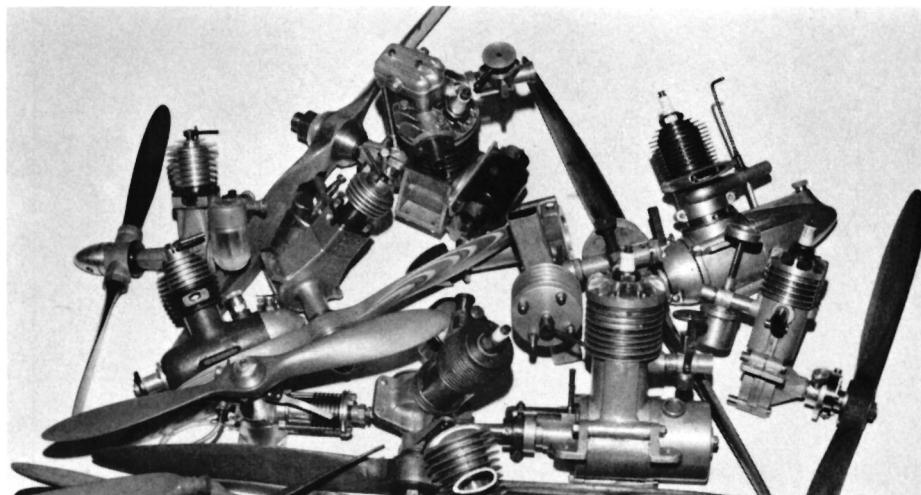
It had been purchased in New York forty years ago, used for only a short time, and then set aside, and was in excellent condition. But even the model built for this engine was still completely intact. Air-filled tires, a few tears in the silk covering, and a layer of dust—these are just minor details. And yet, the seller wondered if anyone might be interested in it. The answer to that question can only be a resounding “yes.”
So the next time you’re cleaning out your workshop, don’t throw away rubber wheels or wooden propellers like these, because there’s always someone who can give such items a good home. And one last request: Don’t try to “restore” these items—leave them just as they are. Who would still be interested in an antique chair that’s been coated with a thick layer of plastic resin...?
Peter N. Scott


News from HEBU

HORIZON HOBBY/LEMACO NEWS: MICRO OV-10 BRONCO 645 MM BY E-FLITE

PRIDE AND GOOD IDEAS
 Markus Nussbaumer

TEAM MANAGER "THIS" BOSSHARD
 Rodito Nussbaumer

YOU KNOW WHAT I MEAN? 125 YEARS OF THE SWISS AERO CLUB
 Emil Giezendanner

F3A EUROPEAN CHAMPIONSHIPS IN ST-MACAIRE, FRANCE
 Matthias Bosshard

ATOM, THE NEW DOUBLE-DECKER FROM CPLR
Matthias Bosshard
SUMMER FUN 2026 AT MG USTER
Martin Wunderli
TRY-OUT DAY AT MFV WETTINGEN
Urs Keller
What's New at Leomotion.com

52. 2026 ALPS CUP
Emil Giezendanner
TWIN TOWN PARTNERSHIP
Wolfgang Voeller
34th HAHNENMOOS ALPINE MODEL AIRPLANE CAMP
Res Dauwalder
CORSAIR F4U – A WARBIRD WITH A MEMORABLE LOOK
Jürgen Rosenberger, Jürgen Prinz
SMALL, MODEL-LIKE SAILBOATS
Res Dauwalder
WELCOME, NEW MEMBER!
Andrea Bolliger
FREE FLIGHT IN THE MIDDLE OF SUMMER
Urs Muntwyler
COUPE DES ALPES – OBSERVE AND LEARN
Rodito Nussbaumer
EURO CONTEST GLIDER ACRO TOUR AUSTRIA 2026

BY YOUTH, FOR YOUTH
Lorena Betschen
INSIGHTS INTO THE HISTORY OF SEAPLANES

THE PC-21 STORY
Emil Giezendanner
NEWS FROM HEBU
 Julia Bucher

FROM 0 TO 100
Markus Nussbaumer
MEMORIES
Wolfgang Völler
NOS REGION – A HUB FOR ELECTRIC AVIATION
Emil Giezendanner
DO YOU KNOW WHAT I MEAN IN THE LAND OF SMILES?
Emil Giezendanner
Have you almost forgotten about aircraft that take off and land vertically?
Emil Giezendanner